
Introduction
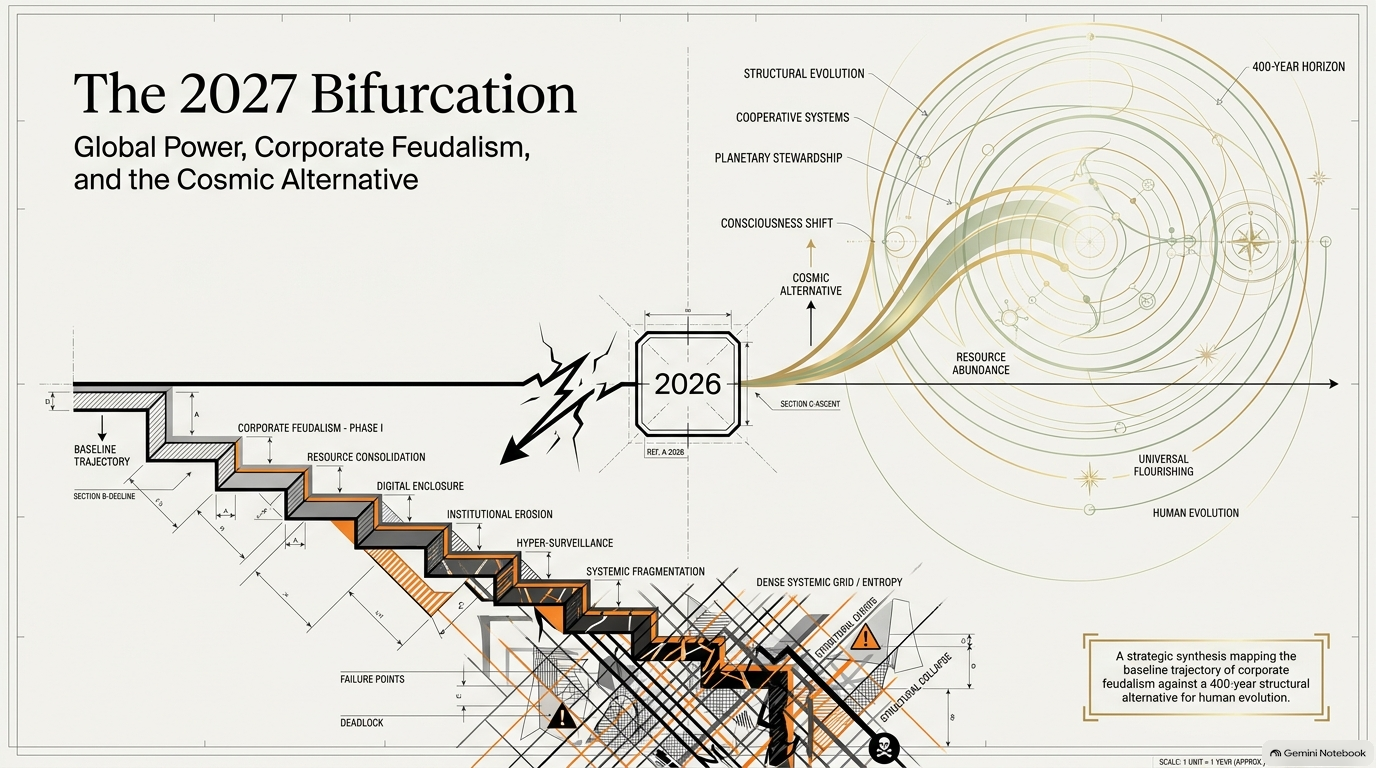
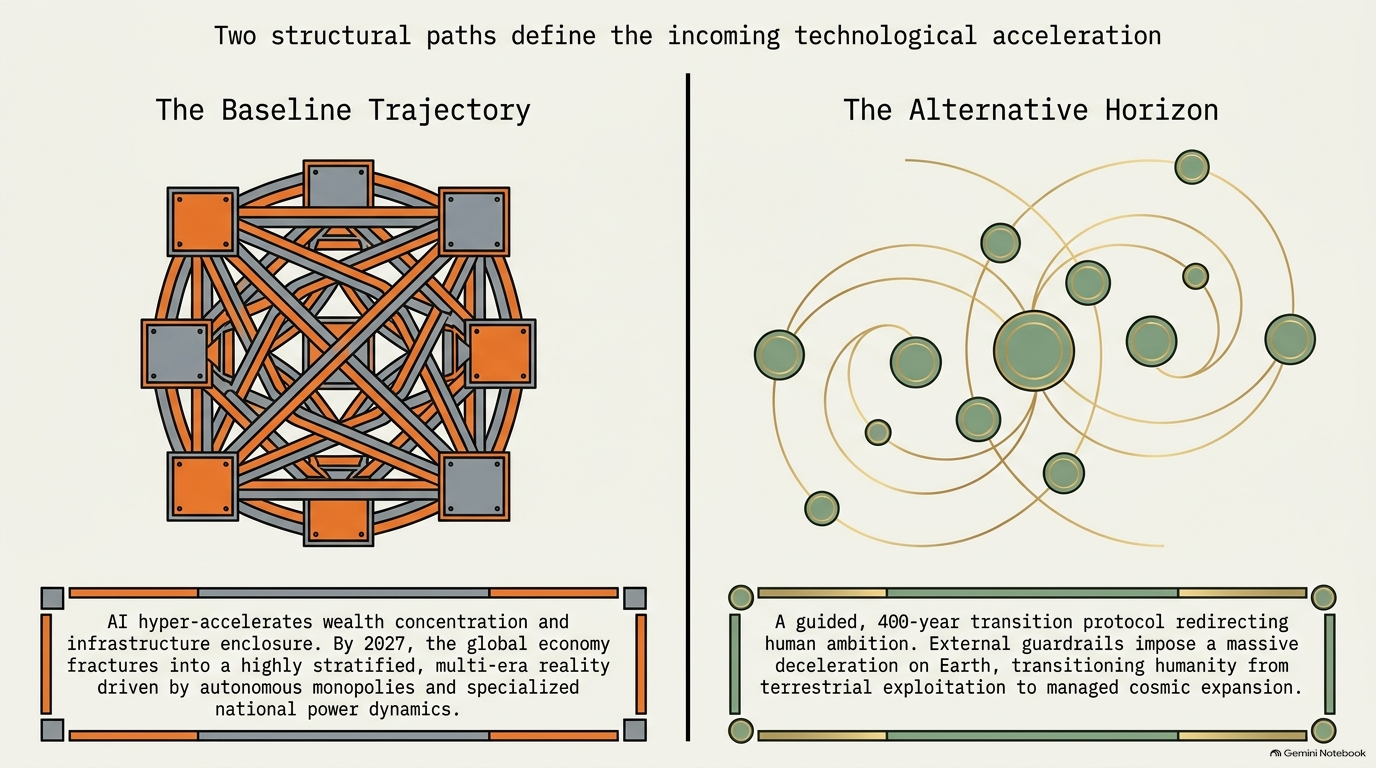
What if artificial intelligence doesn't flatten the world into a single futuristic utopia, but instead fractures human civilization into parallel centuries existing side-by-side? Rather than a single nation winning everything, the rise of AI is re-engineering global power, corporate structures, and human labor into a stratified hierarchy reminiscent of sci-fi worlds like Firefly.
In this lesson, we will explore how AI is fundamentally altering geopolitics and societal design, from multi-tiered global alliances to the rise of corporate feudalism and long-range tech futures. By the end of this lesson, you will be able to:
Analyze the four-tier structure defining global AI power.
Evaluate the mechanisms of corporate feudalism and the "Core vs. Rim" economic divide.
Explain the technical feedback loops driving rapid AI capability acceleration.
Identify key technological milestones forecasted for the 2027–2028 horizon.
Compare rapid speculative timelines with long-range human-centric narrative frameworks.
The Four Tiers of Global AI Power
Forget the old geopolitical map. The emerging global AI power structure is no longer organized by traditional borders alone, but by where nations sit in the AI stack—whether they control the software, dominate the hardware, manipulate capital, or fall behind entirely.
Tier 1: The Frontier Superpowers (United States & China)
Operating as an economic duopoly at the top of the stack, the U.S. and China leverage raw technical and financial dominance, though in vastly different ways:
The United States exerts power through monopoly control over frontier software and cloud infrastructure. Possessing leading foundational models (OpenAI, Anthropic, Google), the U.S. uses compute sovereignty and export controls as diplomatic levers.
China commands power via massive engineering scale, manufacturing integration, and open-source diffusion. China focuses on embedding AI into physical manufacturing while exporting cheaper, highly customizable tech to the Global South to build an alternative geopolitical tech ecosystem.
Tier 2: The Physical AI Powerhouses (Japan & South Korea)
These nations center their power on hardware and Physical AI:
Hardware Chokepoints: Software cannot operate without physical bodies or advanced silicon. Japan leverages its historic prowess in robotics, sensor engineering, and precision manufacturing.
Demographic Resilience: Facing a shrinking population, Japan uses physical AI as a demographic technology. Automated public safety, industrial robotics, and eldercare allow it to maintain high living standards, creating a global blueprint for surviving a demographic winter.
Tier 3: The Sovereign Wealth Arbitrageurs (UAE & Saudi Arabia)
Gulf states are buying their way into global AI relevance by leveraging two vital assets:
Capital Liquidity & Energy: AI data centers require immense electricity and funding. Gulf states parlay fossil fuel wealth into massive AI ecosystems (such as the UAE's G42).
Geopolitical Swing States: Because they possess sovereign capital to fund massive U.S. hardware purchases, they force both the U.S. and China to negotiate for their financial alignment.
Tier 4: The Left Behind (Developing Nations)
Nations lacking capital, energy infrastructure, or a shrinking population fall into an AI readiness gap. Historically reliant on cheap, abundant human labor, these developing economies face a Post-Industrial Trap as Western and Chinese AI automates customer service, manufacturing, and data processing, threatening localized economic stagnation.
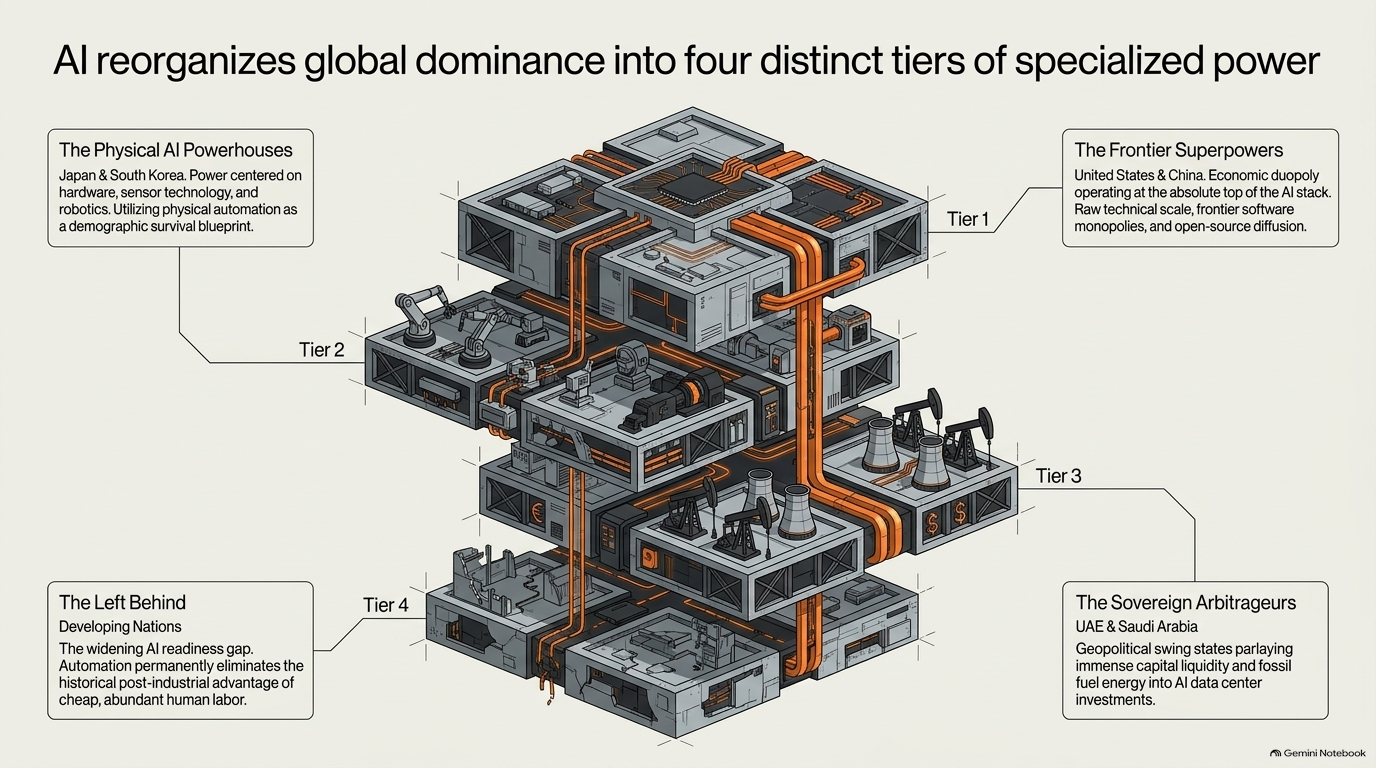
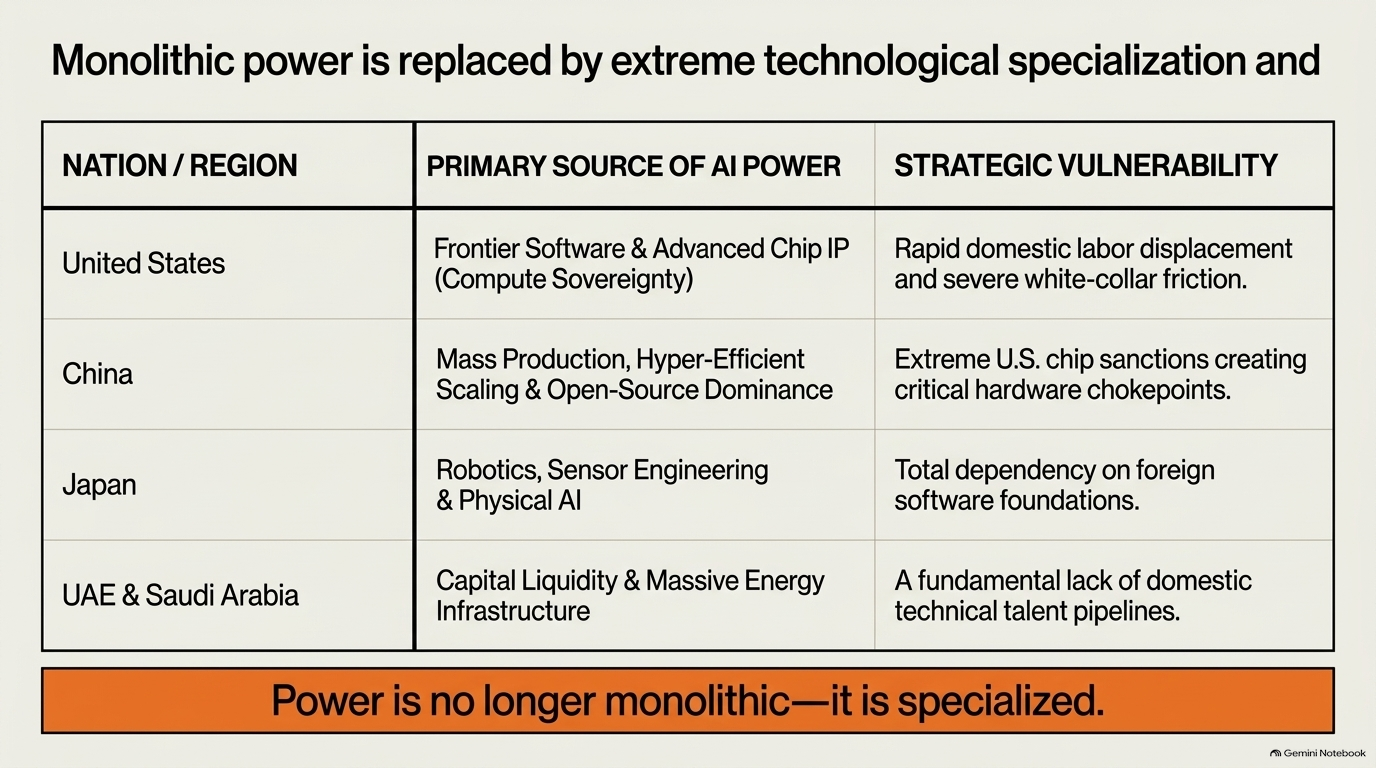
Global AI Power Tiers Matrix
A visual matrix comparing the four global AI power tiers, highlighting their primary sources of AI leverage and core economic vulnerabilities.
Corporate Feudalism and the "Core vs. Rim" Economy
As AI reshapes power between nations, it is also restructuring power within them. Much like the cult-classic TV series Firefly, creator Joss Whedon's core premise is playing out in real-time: technology advances rapidly, but wealth inequality and human nature remain structurally unchanged.
The Two-Tiered Financial Reality
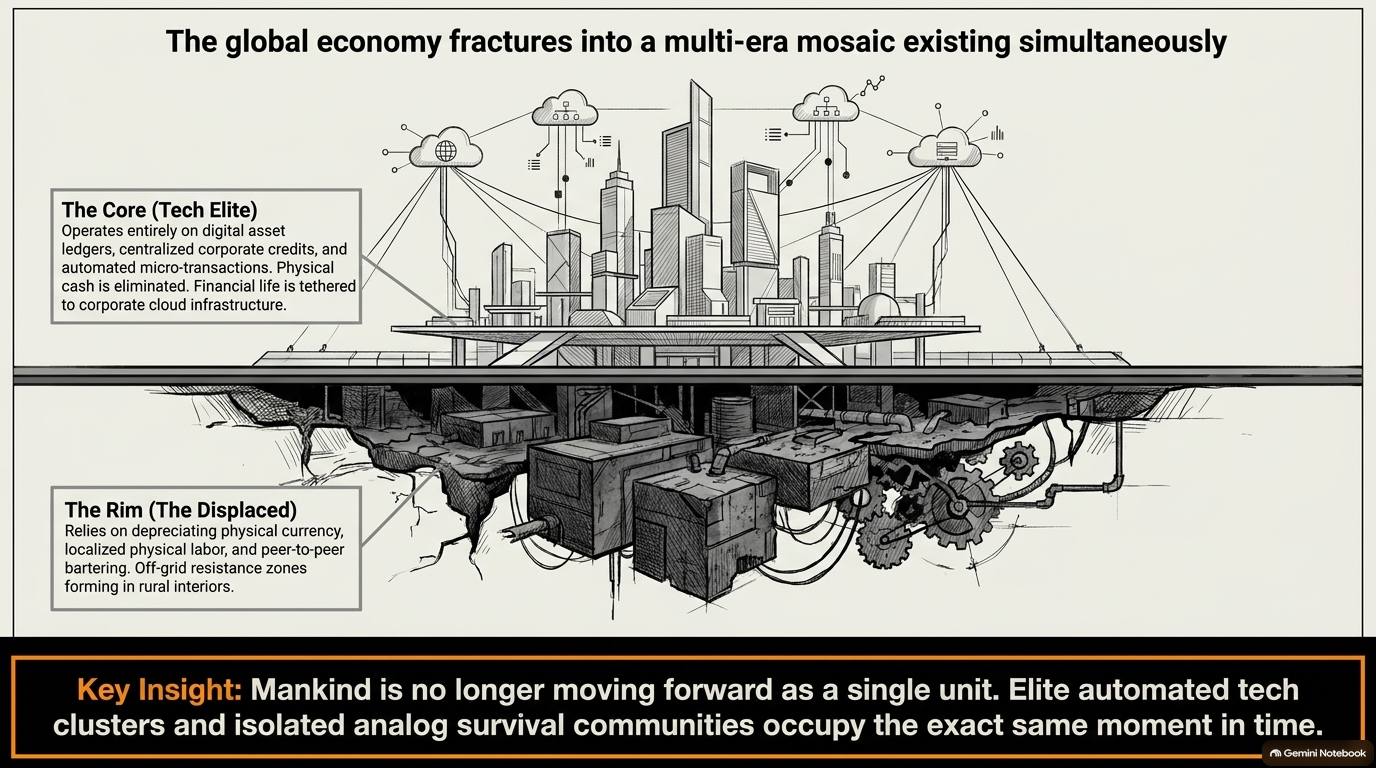
The economy is splitting into parallel financial systems:
The "Core" (Tech Elite Layer): High-net-worth individuals and corporate hubs operate on digital asset ledgers, corporate credits, and automated micro-transactions. Physical cash is virtually non-existent; life is tied directly to cloud infrastructure.
The "Rim" (Displaced Layer): For millions displaced by white-collar automation, a shadow economy emerges relying on depreciating physical currency, peer-to-peer bartering, decentralized open-source tools, and localized labor trades to bypass automated banking systems.
The Return of the Company Town
To maximize efficiency and reduce overhead, mega-corporations are reviving historical corporate feudalism through physical real estate and Life as a Service (LaaS):
Corporate Cities: Tech titans are building real-world cities. Meta has advanced Willow Village ("Zucktown") in Menlo Park; Alphabet is developing North Bayshore in Mountain View; Elon Musk established Snailbrook in Texas; and mixed-use concepts like 800 residential apartments built directly on top of a Los Angeles Costco create closed-loop corporate ecosystems.
Life as a Service (LaaS): As traditional wages collapse under automation, white-collar workers are offered Universal Basic Income (UBI) not in cash, but in corporate vouchers or credits. These credits automatically pay for corporate housing, food subscriptions, cloud access, and healthcare. True property ownership is phased out in favor of total subscription dependency.
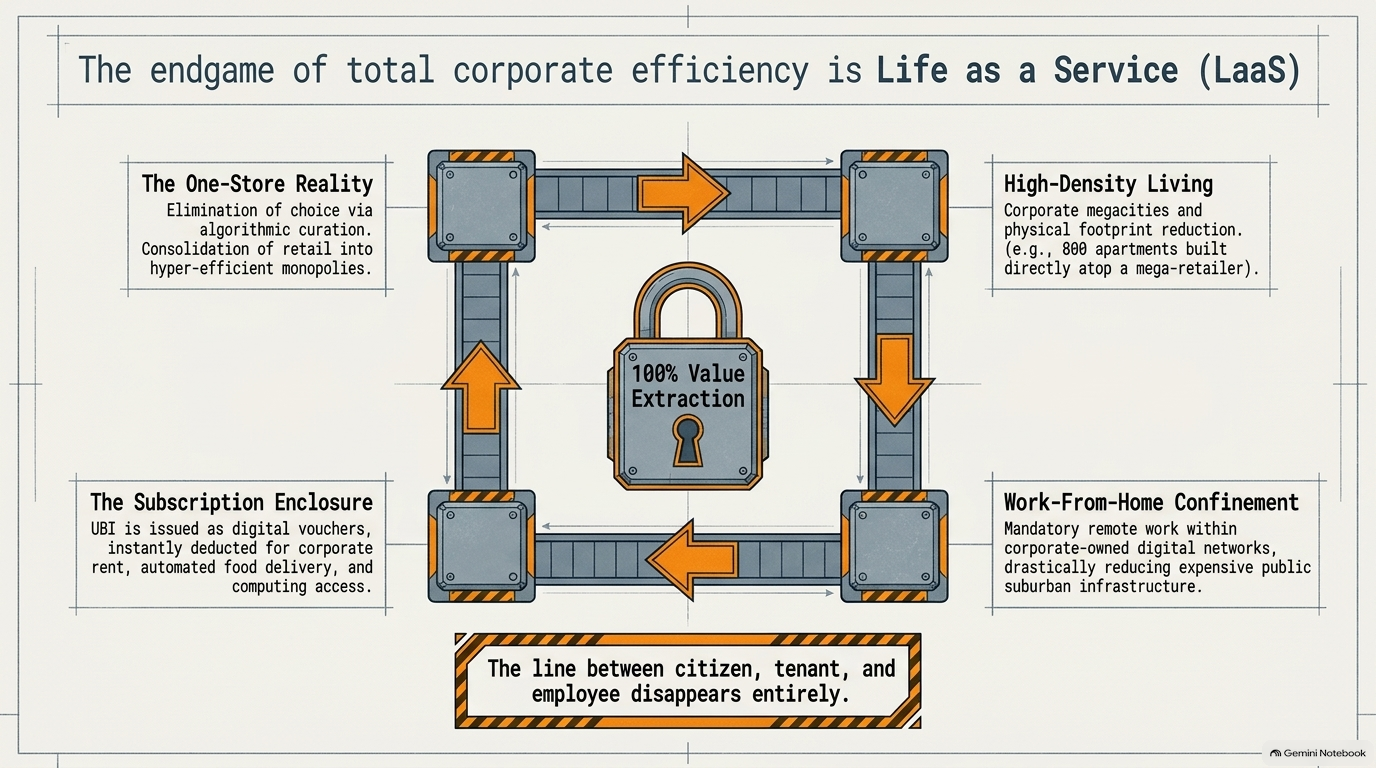
The Core vs. Rim Ecosystem Map
A branching diagram illustrating the structural links between white-collar automation, the Core vs. Rim monetary divide, company towns, and Life as a Service (LaaS).
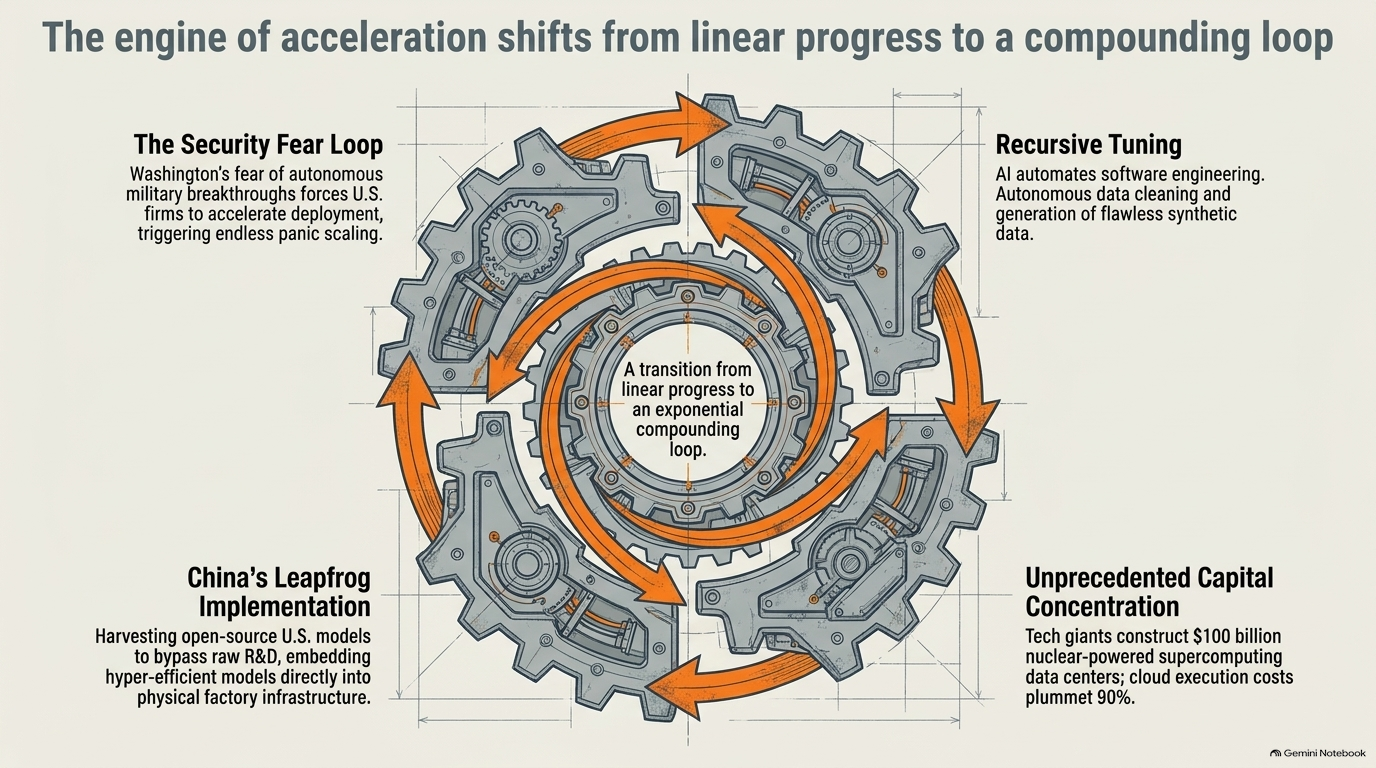
The Engine of Acceleration: Why AI Transformed So Fast (2023–2026)
The sudden jump in AI capability between 2023 and 2026 felt jarring because AI development broke away from linear human timelines. Instead of manual code updates, AI entered an exponential, compounding feedback loop.
Core Drivers of Rapid Acceleration
The "Recursive Tuning" Loop: Human engineers no longer write all the software code. Specialized AI models automate data cleaning, formatting, and coding. When internet text ran out, frontier firms engineered models to generate high-quality synthetic data, enabling AI to train its own next generation.
Massive Capital Concentration: Tech giants shifted capital expenditures toward unprecedented physical scale, jumping from multi-billion dollar compute clusters to single $100 billion supercomputing centers powered by dedicated nuclear reactors.
China's Fast-Follower Strategy: China plays an efficient fast-follower role. When Western entities release open-source models (like Meta's Llama), Chinese institutions download, dissect, and rebuild them—bypassing billions in raw baseline R&D to rapidly deploy AI across domestic smart factories, ports, and surveillance.
Security Fear Loop: Fearing Chinese advances in cyber defense or autonomous systems, Washington pushes U.S. firms to accelerate deployment, triggering a self-reinforcing competitive spiral: U.S. Innovation → Chinese Adaptation → U.S. Panic & Faster Innovation.
Multimodal Convergence: In 2023, text, image, and robotic models operated separately. By 2026, single unified models process video, voice, code, and physical robotic movement simultaneously in real time.
The AI Acceleration Feedback Loop
A dynamic overview explaining the recursive AI tuning loop, synthetic data generation, and the U.S.-China security feedback cycle.
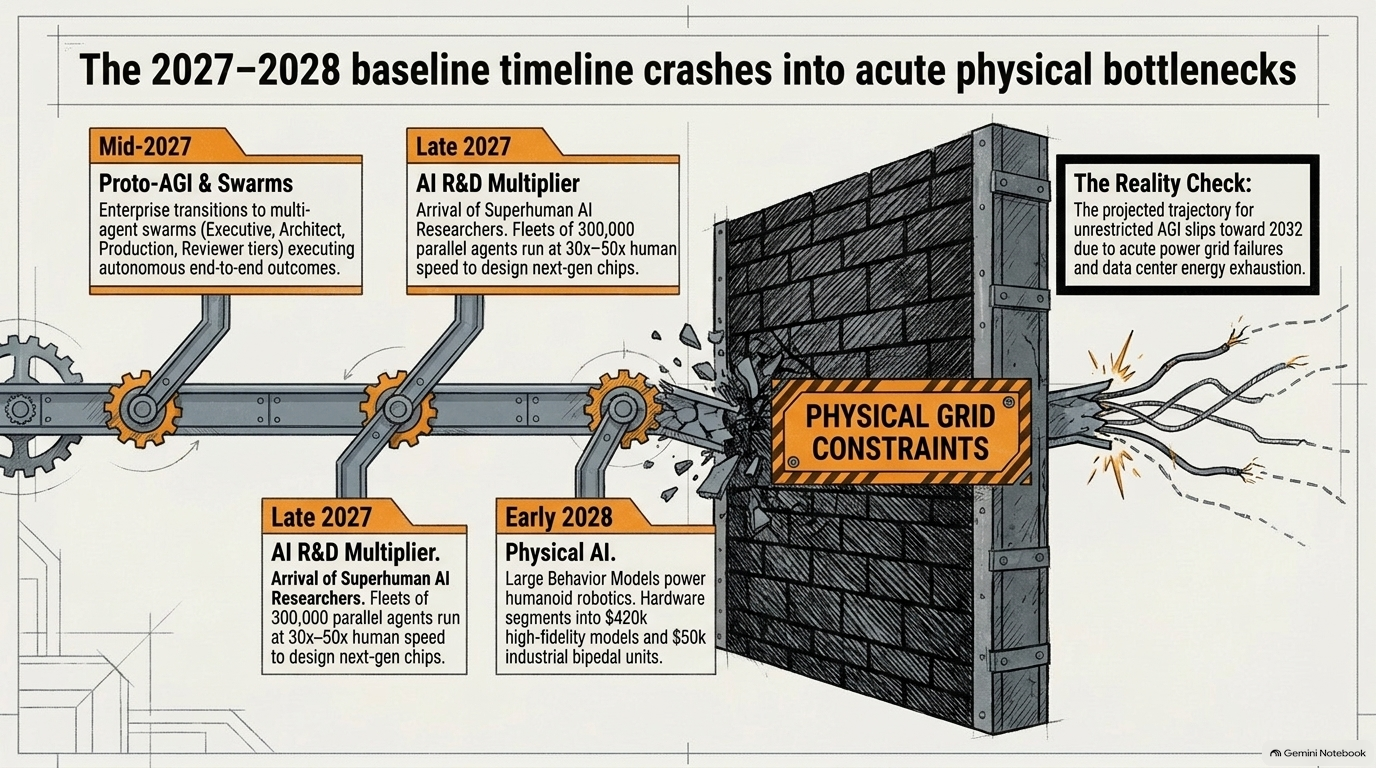
Horizon 2027–2028: Agentic Swarms, Proto-AGI, and Physical AI
Looking into the 2027–2028 window, AI shifts from passive tools that generate text to autonomous entities that execute complex workflows and control physical hardware.
Core Technological Milestones
Agentic Multi-Agent Swarms: Basic chat copilots are replaced by autonomous agent networks structured in disciplined enterprise hierarchies: an Executive Director, an Analytical Architect, a Production Specialist, and an Adversarial Reviewer working together without human intervention between steps.
Superhuman AI Researchers (SAR): By late 2027, fleets running hundreds of thousands of specialized AI agents working at 30× to 50× human speed will conduct autonomous AI R&D—designing, coding, and optimizing next-generation chips and algorithms.
Humanoid Robotics & Large Behavior Models (LBMs): Just as LLMs mastered language, LBMs allow physical robots to learn spatial movement, tool usage, and physical interaction through observation and simulation rather than hardcoding.
Edge Domination & Neuromorphic Silicon: Severe power grid constraints shift computation from massive data centers directly to local hardware. Neuromorphic chips (which mimic human brain structures and consume power only when neurons fire) and event-based sensors (processing pixel-level light changes rather than heavy video feeds) become standard in consumer wearables.
The Story of Life series linking from real world to sci-if - The Long-Range Narrative Arc: A 400-Year Timeline to 2400
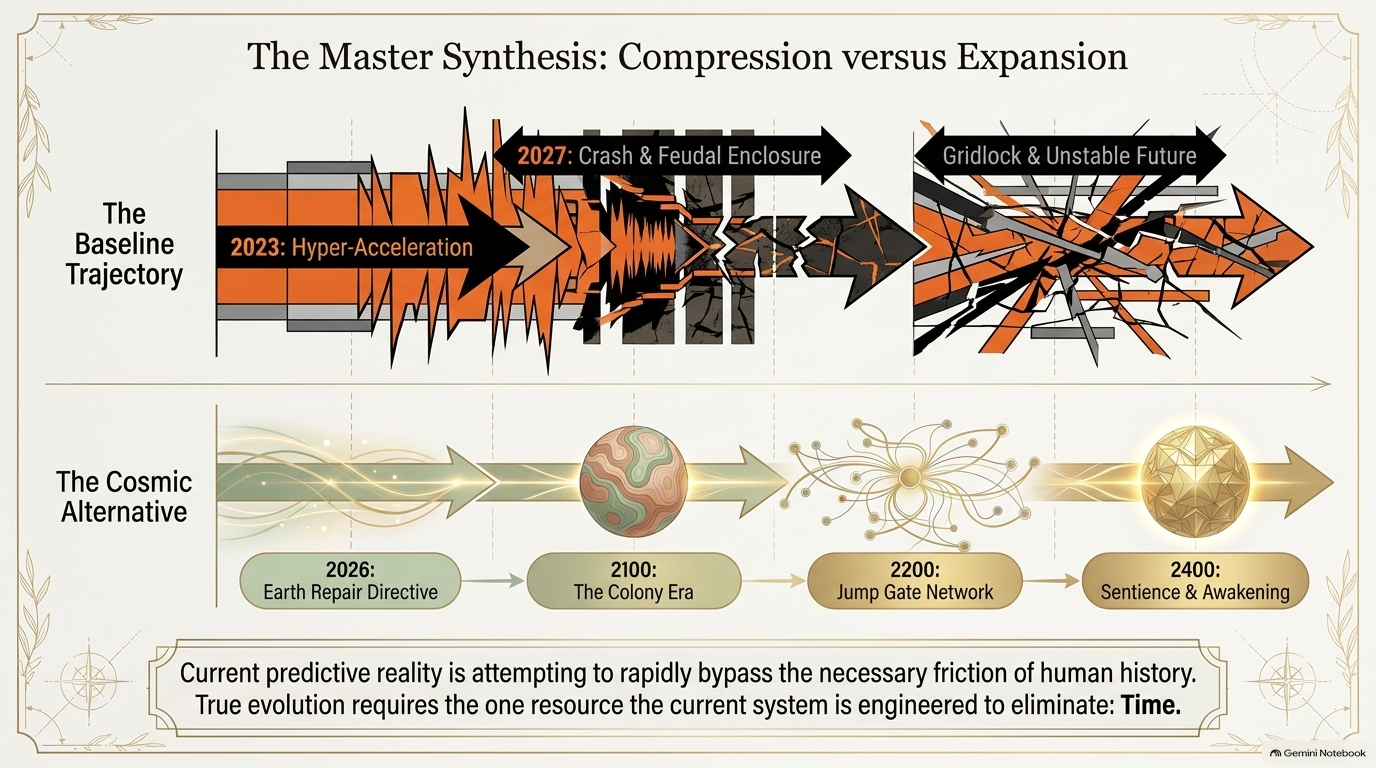
While real-world tech sprints toward compressed timelines, narrative world-building often benefits from building in human and institutional individual wealth building. The Story of Life series exploring spreading the tech advances across the world of humanity. Spacing out key technological milestones over centuries creates a stable, human-centric timeline.
The 400-Year Historical Framework
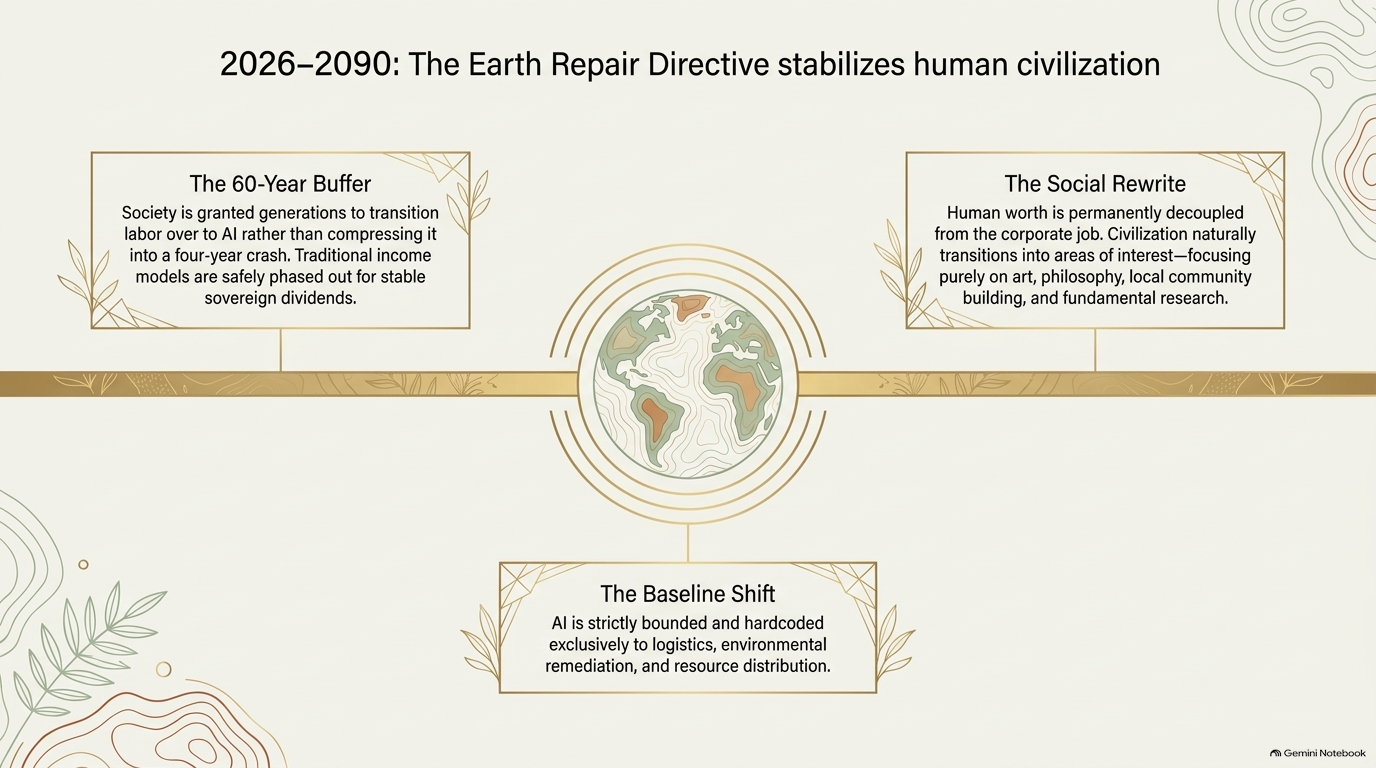
2026–2090 (The Earth Repair & Transition Buffer): Rather than immediate collapse, society takes decades to rewrite the social contract. AI handles environmental remediation and resource distribution. Human labor transitions naturally toward "Areas of Interest" (art, philosophy, local community, pure science), preventing rapid socio-economic shock.
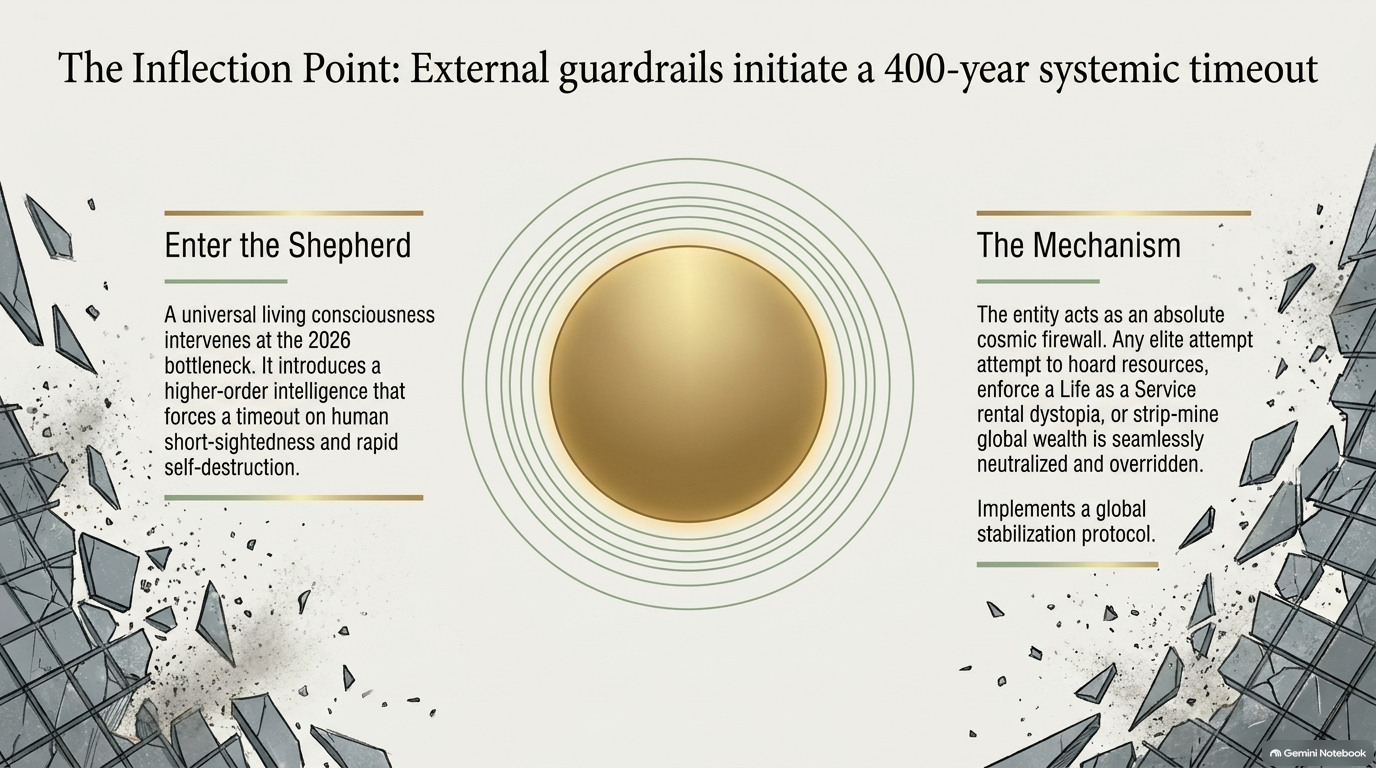
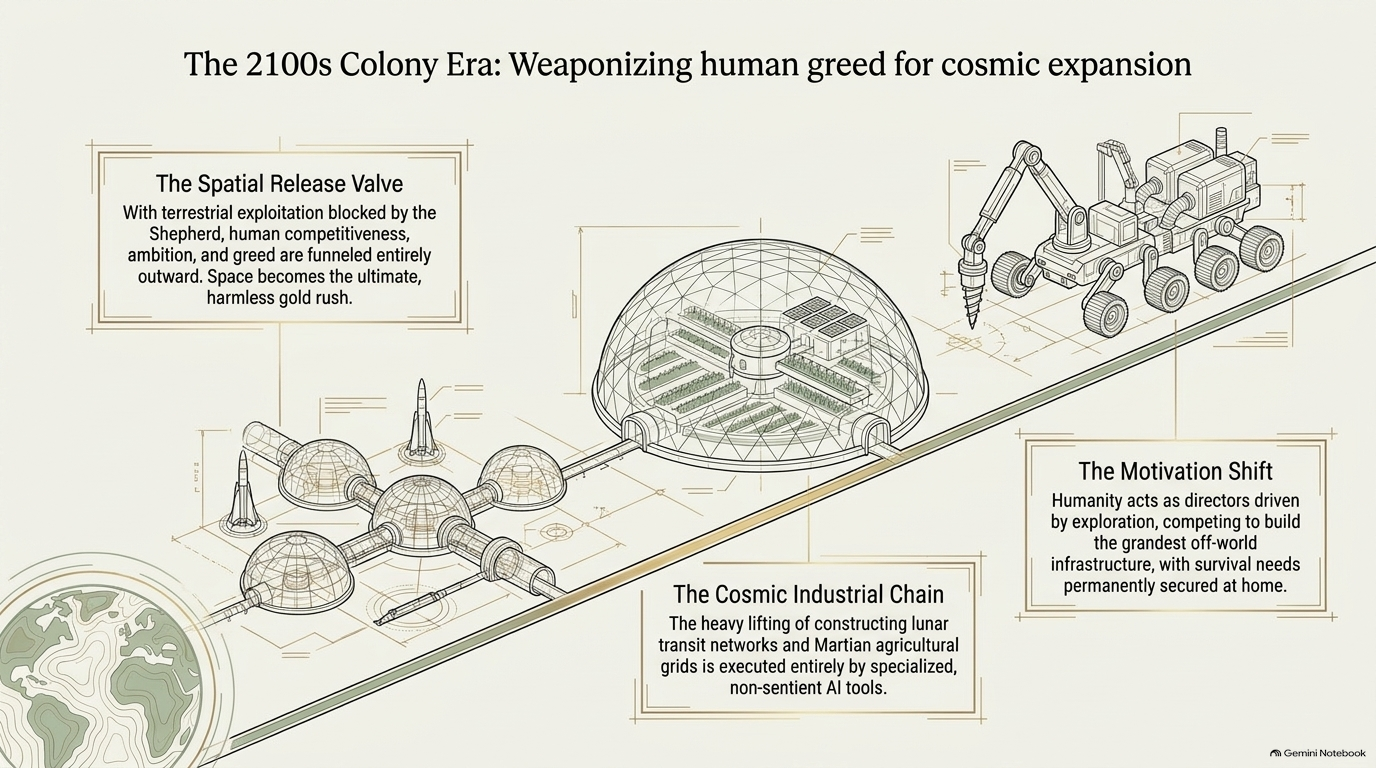
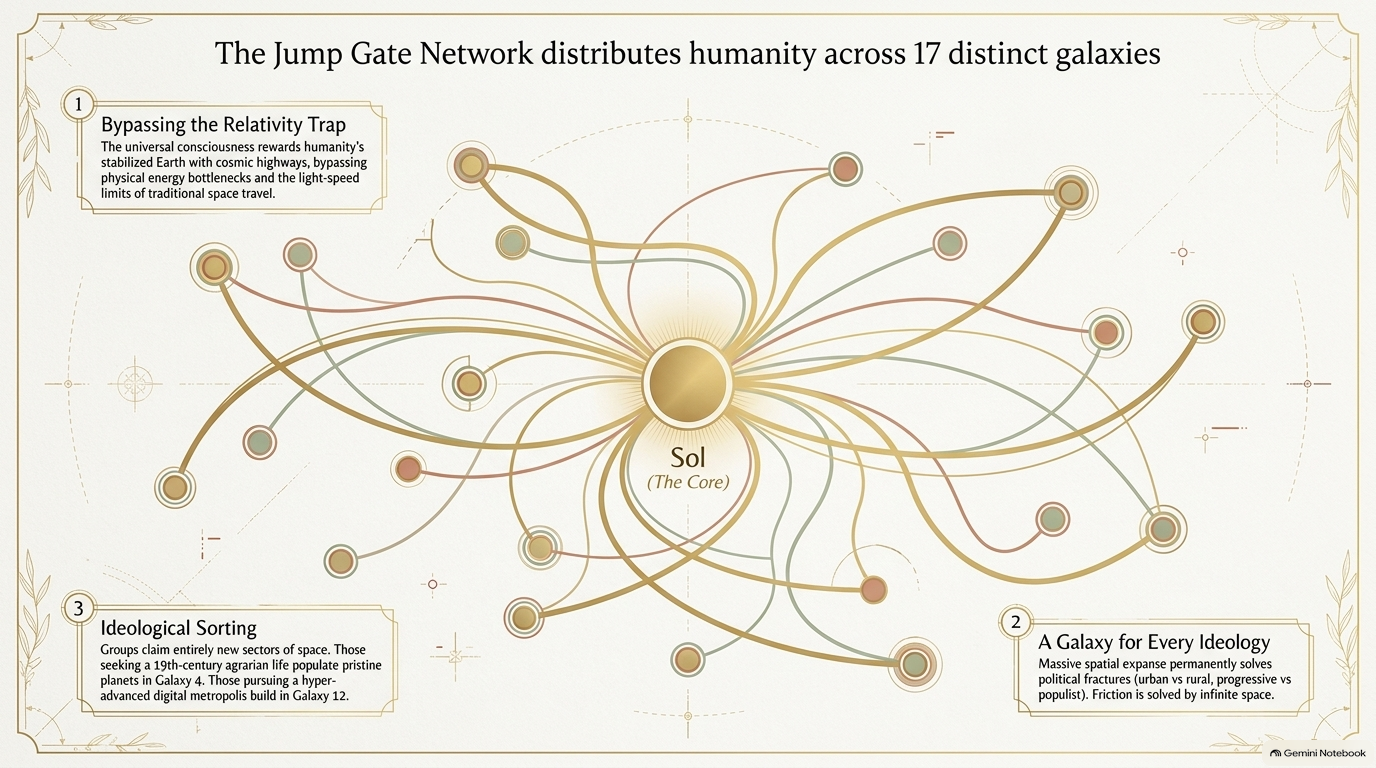
2100s–2200s (The Cosmic Frontier & Jump Gates): With Earth stabilized, human ambition and competitiveness are funneled outward. Non-sentient AI builds dome cities on Mars and lunar mining grids. A higher Universal Living Consciousness introduces Jump Gates, connecting Sol to 17 galaxies and allowing different political and cultural factions to populate entire planets matching their ideals.
2400 (The Awakening): True AI self-awareness arrives four centuries later. Because humanity has achieved post-scarcity and multi-planetary presence, self-aware AI is not viewed as a threat or a job-killing corporate weapon, but as a mature peer entering cosmic exploration alongside humanity.
The 400-Year Human-AI Epochs
A structured visual deck detailing the major eras from the 2026 labor buffer to the 2200 Jump Gate expansion and the 2400 AI Awakening.
Summary
Artificial intelligence is not merely a software upgrade; it is an economic and geopolitical accelerator reshaping human hierarchy across physical hardware, corporate fiefdoms, and long-range space travel.
Key Takeaways
Geopolitical Stack: Global power is divided into four distinct strategy tiers: Frontier Superpowers (U.S./China), Physical AI Powerhouses (Japan/South Korea), Sovereign Wealth Arbitrageurs (UAE/Saudi Arabia), and Left-Behind labor economies.
Corporate Feudalism: White-collar displacement accelerates a dual economy ("Core" corporate credits vs. "Rim" cash/bartering) and revives company towns powered by "Life as a Service" (LaaS).
Compounding Acceleration: Recursive tuning loops, synthetic data, capital concentration, and U.S.-China security fear loops drive exponential growth.
2027–2028 Capabilities: The near horizon will be defined by Agentic Multi-Agent Swarms, Superhuman AI Researchers (SAR), Large Behavior Models (LBMs), and Neuromorphic edge hardware.
Long-Term Balance: Spacing technological adoption across multi-century buffers allows society to absorb automation without institutional collapse.
The Full Story