
HOW THE TITANS GAIN POWER AS HUMANITY ADVANCES AI TAKE OVER ACROSS THE WORLD.
Introduction
What if the global financial system abandoned the US dollar, gold, and oil, and instead anchored itself entirely to raw computing power and electricity? This lesson explores a provocative macroeconomic thought experiment: a transition from a debt-fueled fiat system to a thermodynamically constrained economy where wealth is measured in FLOPS and Gigawatts.
Learning Objectives
Analyze the Perpetual Extraction Loop: Understand how state policies can systematically transfer risk and wealth from the public to the financial elite.
Contrast Historical Resets: Explain why ancient Mesopotamian debt jubilees cannot easily be replicated in a modern, highly financialized economy.
Define the Compute Standard: Discover how floating-point operations per second (FLOPS) and energy grids replace fiat currency as the true measures of national sovereignty.
Examine the Social and Spatial Shifts of 2030: Explore how a thermodynamic economy restructures global geography, real estate values, and daily human life through virtual reality and automated resource allocation.
The Sinking Ship and the Perpetual Extraction Loop
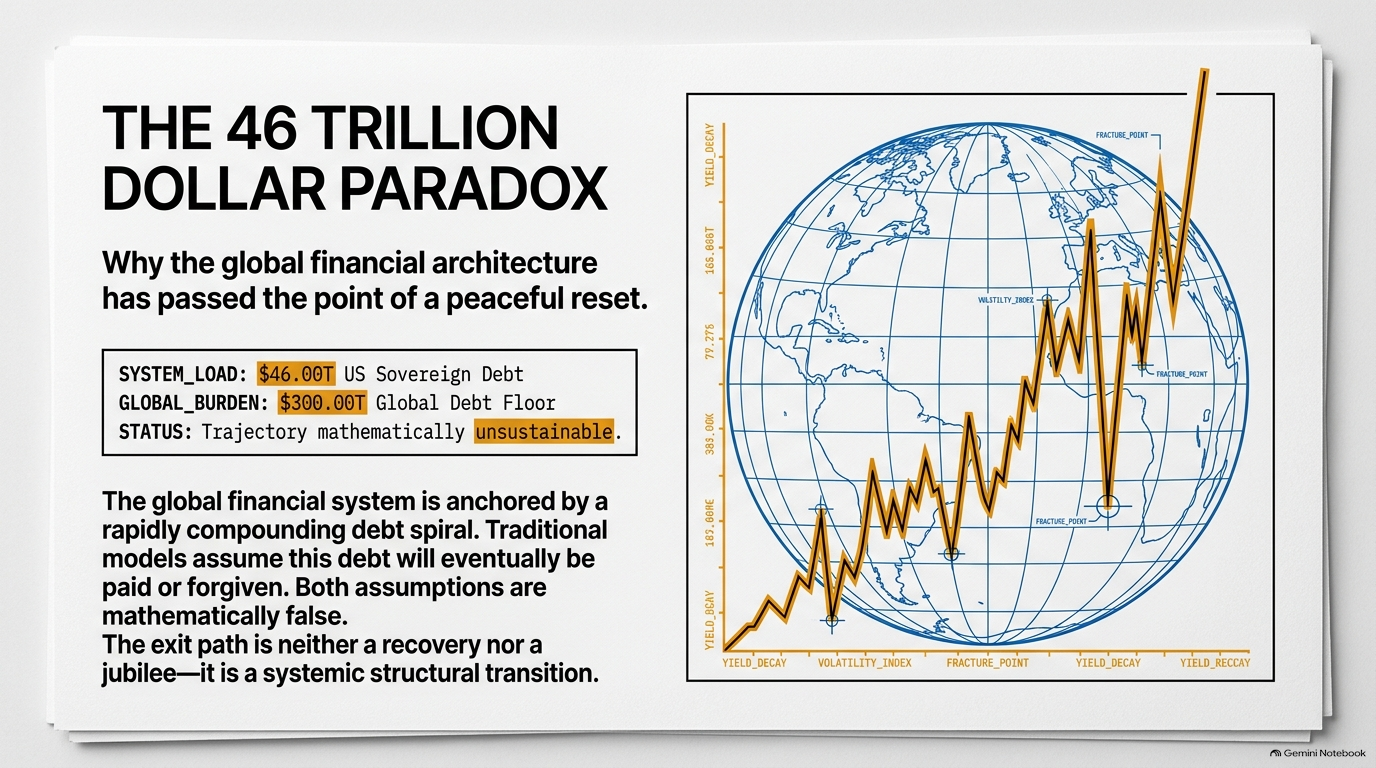
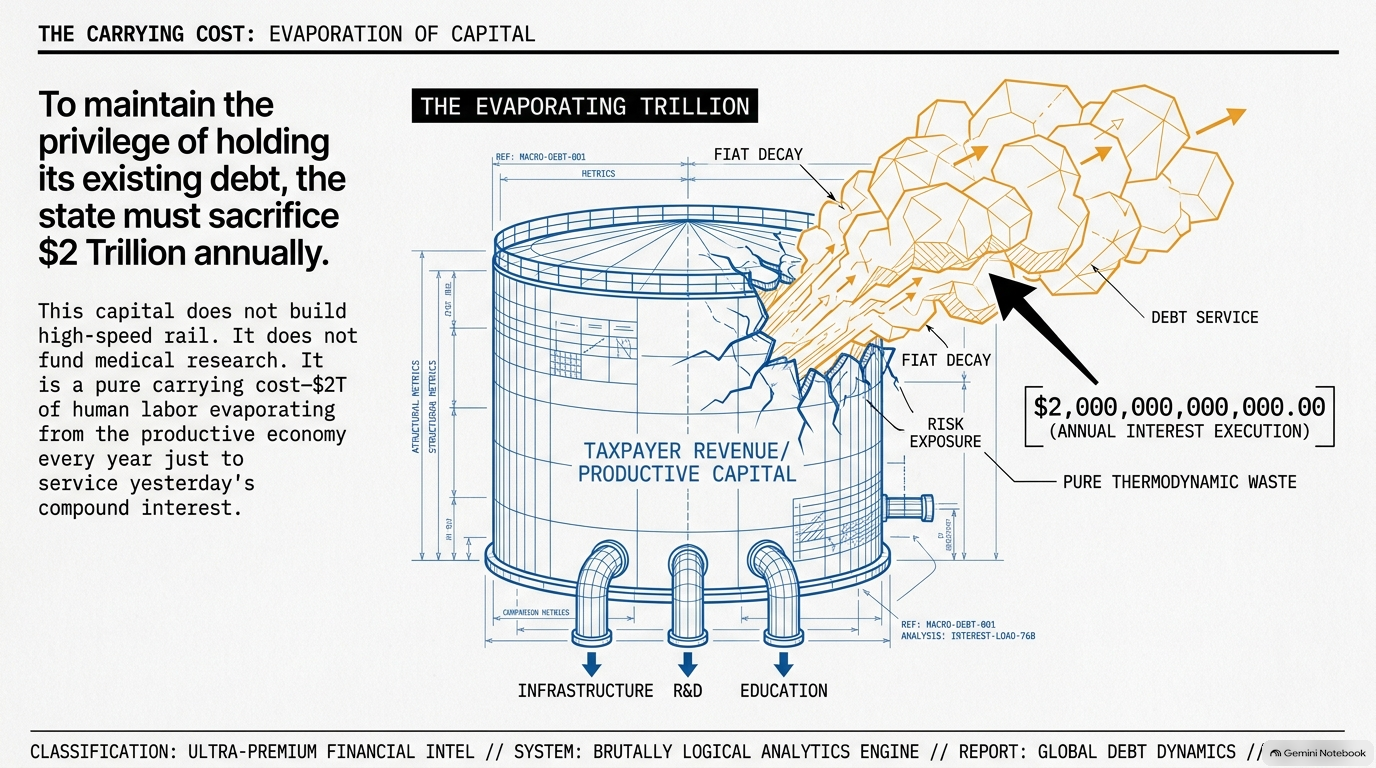
Imagine a world where the United States national debt approaches $46 trillion, and servicing the interest on that debt costs $2 trillion a year. This massive sum doesn't build schools, fund healthcare, or upgrade infrastructure—it simply evaporates from the productive economy to pay for past borrowing.
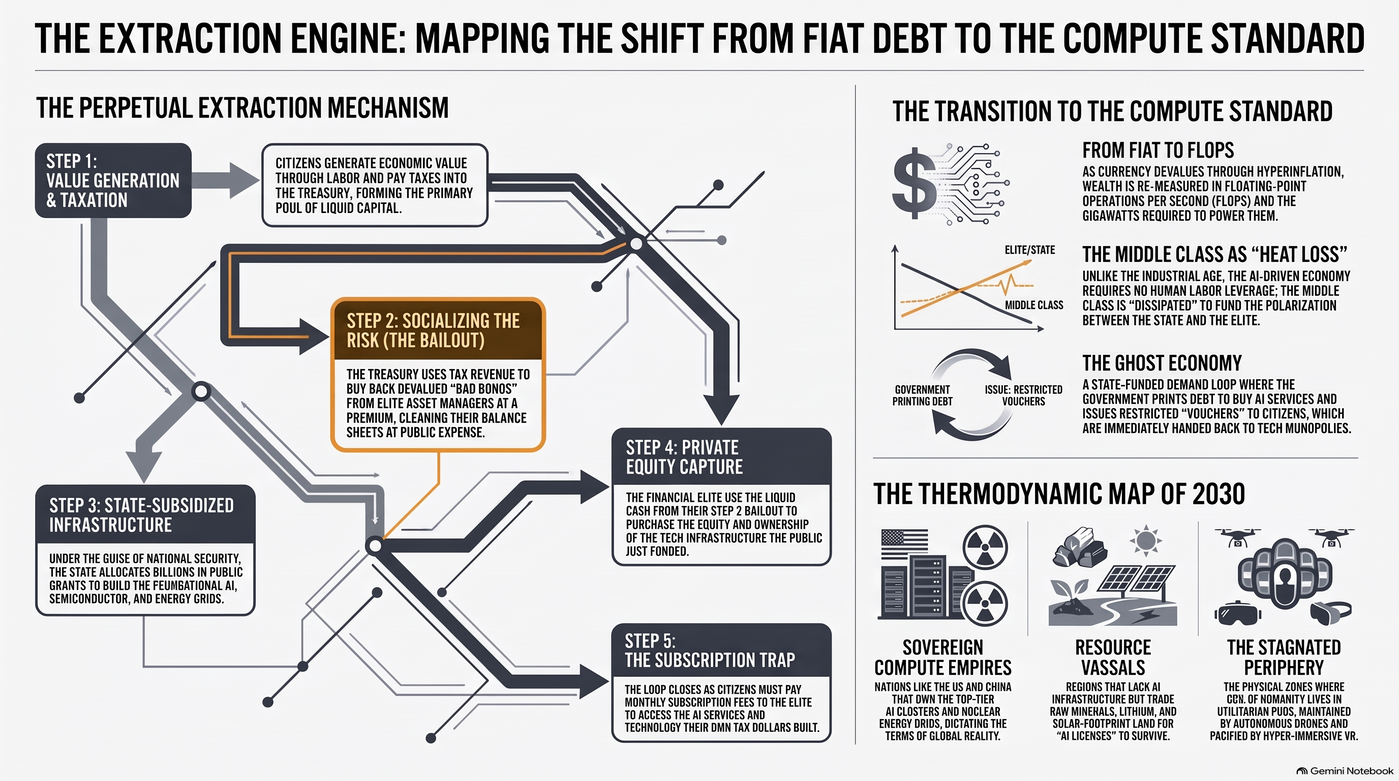
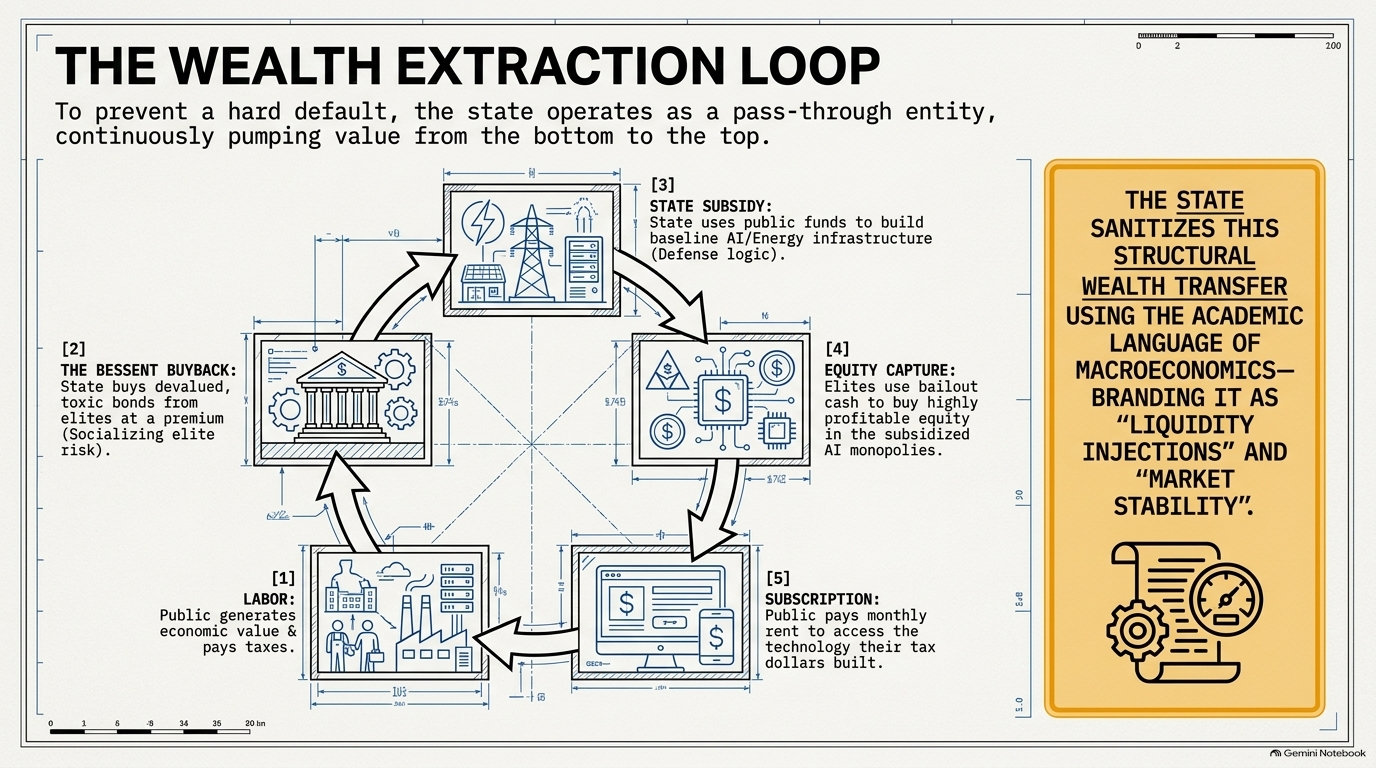
To keep this system stable, the government employs mechanisms like the Bessant Buyback program. In this program, the Treasury uses taxpayer money to buy back devalued, low-yield bonds from elite financial institutions at a premium.
According to the macro projection, this triggers a five-step Perpetual Extraction Loop:
Labor Value: Everyday citizens generate real economic value through labor and pay taxes.
The Bailout: The Treasury uses tax revenue to buy devalued toxic bonds from the financial elite at a premium, effectively socializing their investment losses.
National Security Rebranding: The state declares artificial intelligence, semiconductor manufacturing, and energy infrastructure as critical matters of national security, pouring billions of public subsidies into these sectors.
Elite Capture: The financial elite use their clean, taxpayer-provided cash to buy highly profitable equity in the very same AI infrastructure subsidized by public funds.
Subscription Subservience: The public pays a monthly subscription fee to the elites to access the automated services their own tax dollars built.
Thought-provoking analogy: It's like a casino using a valet's paycheck to cover a high roller's bad roulette bets, using the valet's savings to build a luxury VIP lounge, and then charging the valet a cover fee just to stand in the lobby.
Why We Can't Just Press Reset
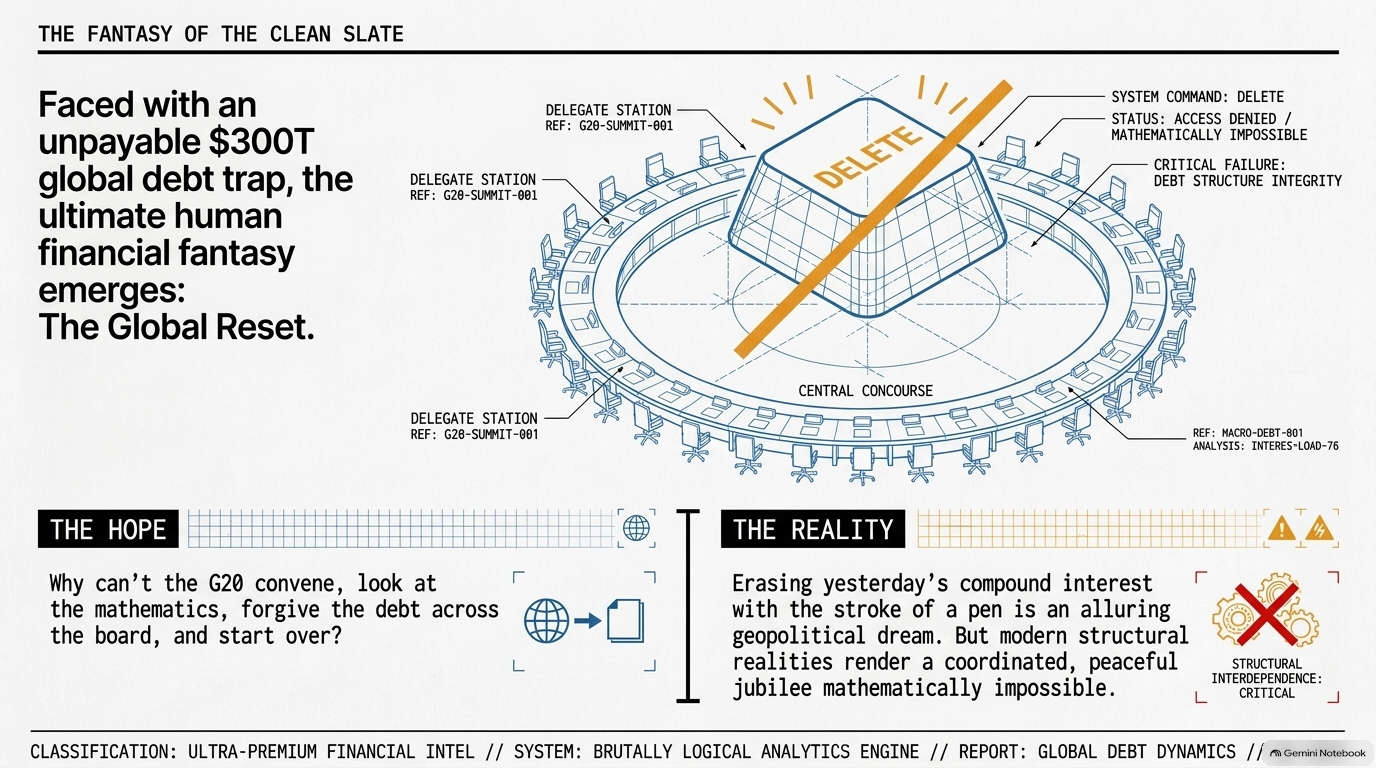
If the national debt is mathematically unsustainable, why can't the world's leaders simply coordinate to wipe the ledger clean and start over?
Historically, rulers did just that. In ancient Mesopotamia, kings declared periodic Jubilees (like the Sumerian Amargi or Babylonian Andurarum), canceling agrarian debts and freeing debt slaves. However, there is a fundamental structural difference today:
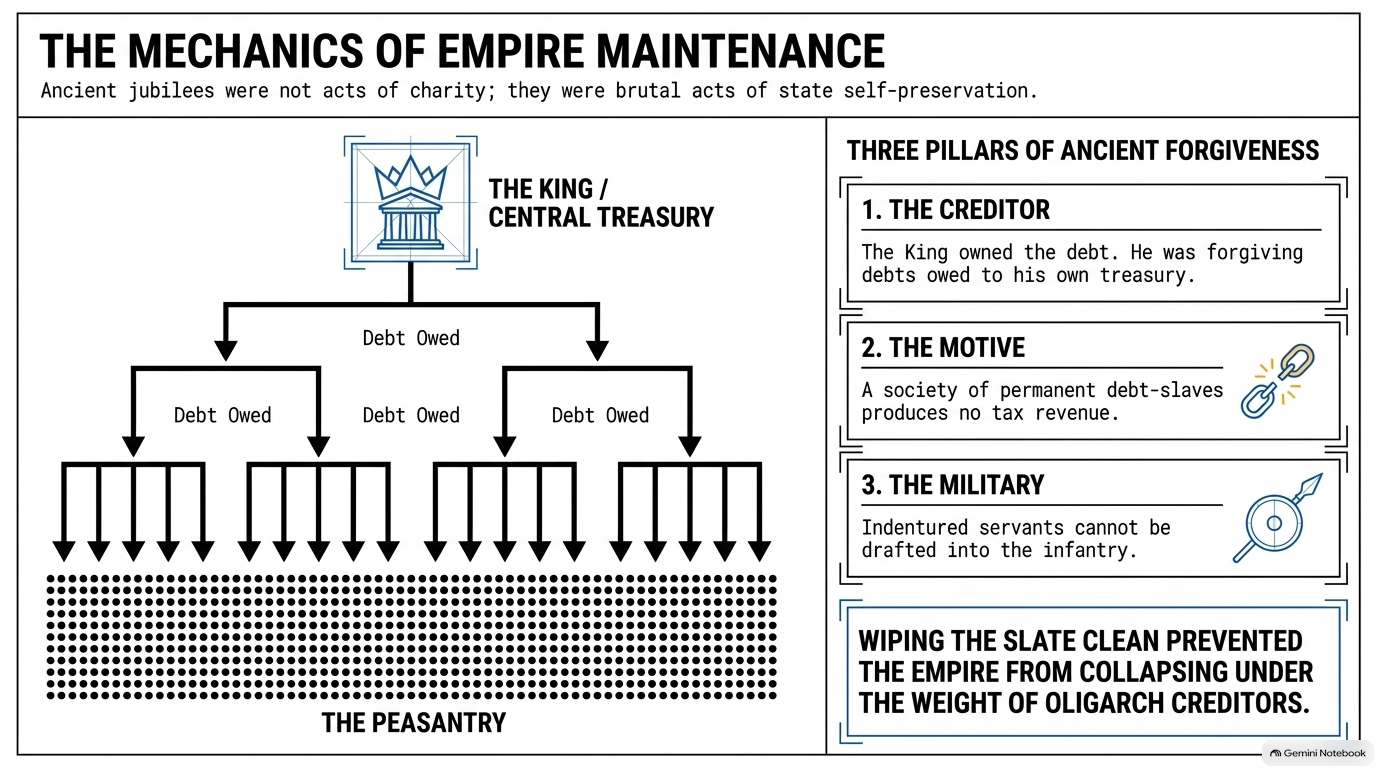
Ancient World: The primary creditor was the King or the central temple. Forgiving debt meant the ruler forgave what was owed to himself to keep his population free and ready for military draft.
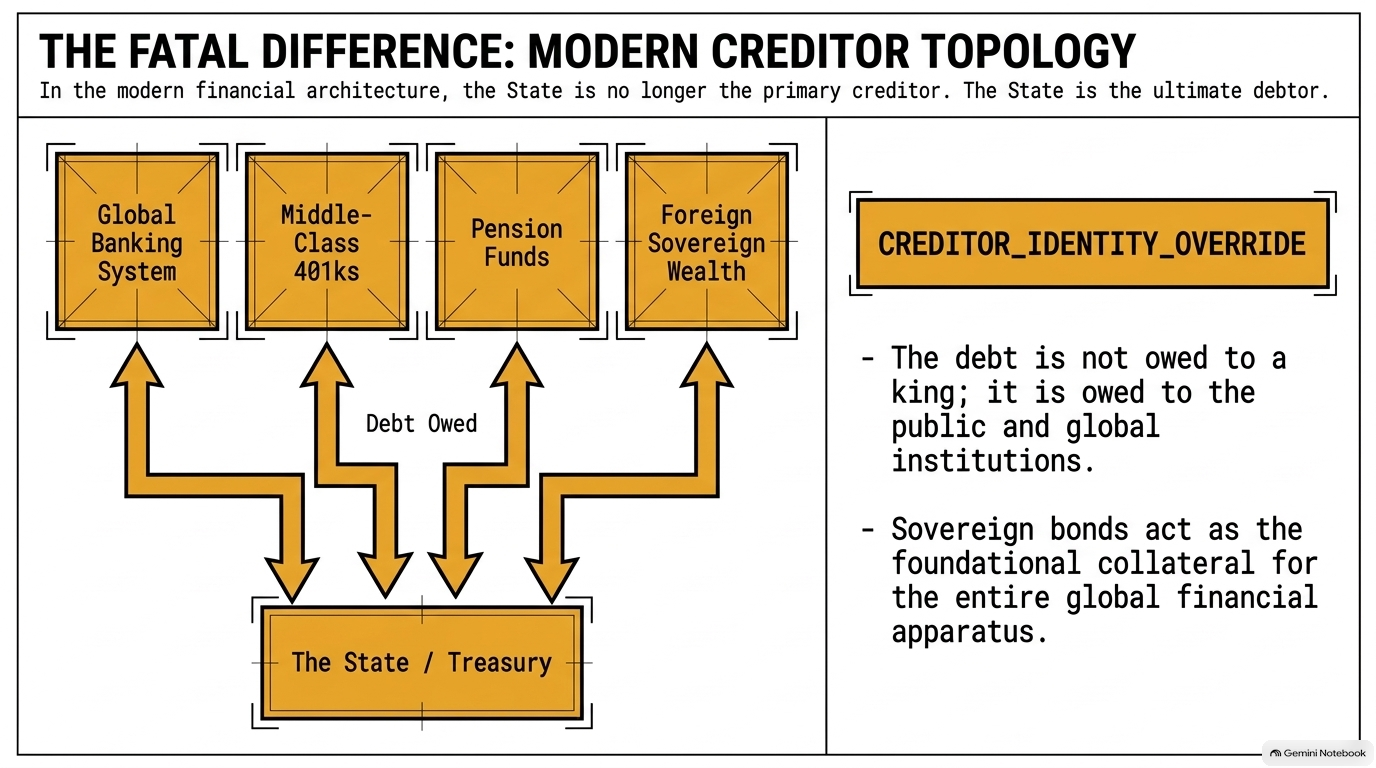
Modern World: The government is not the creditor; it is the primary debtor. The creditors are private banks, foreign adversaries, and critically, the pension funds and 401(k)s of the global middle class.
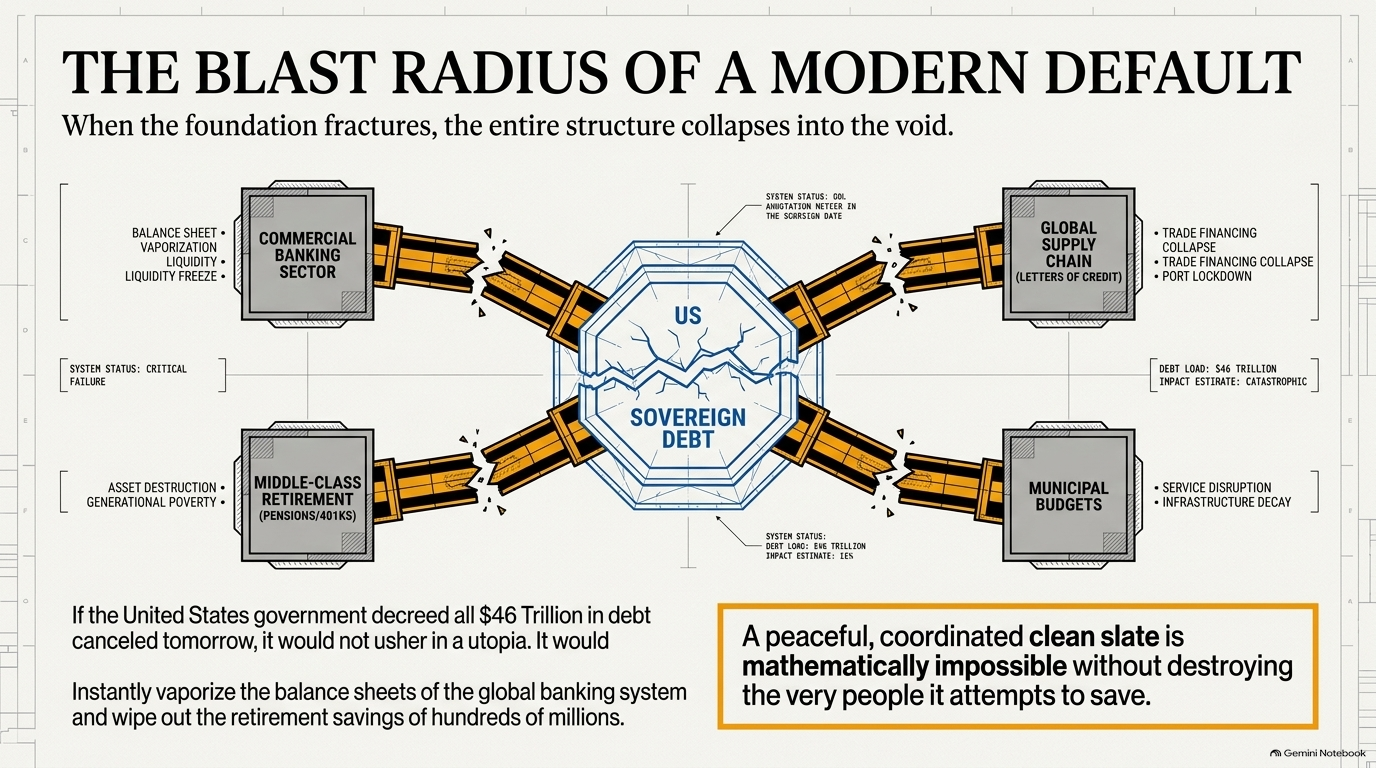
If a modern state unilaterally canceled its debt, it would instantly vaporize the retirement savings of hundreds of millions of ordinary people, collapse the global banking system, and halt supply chains.
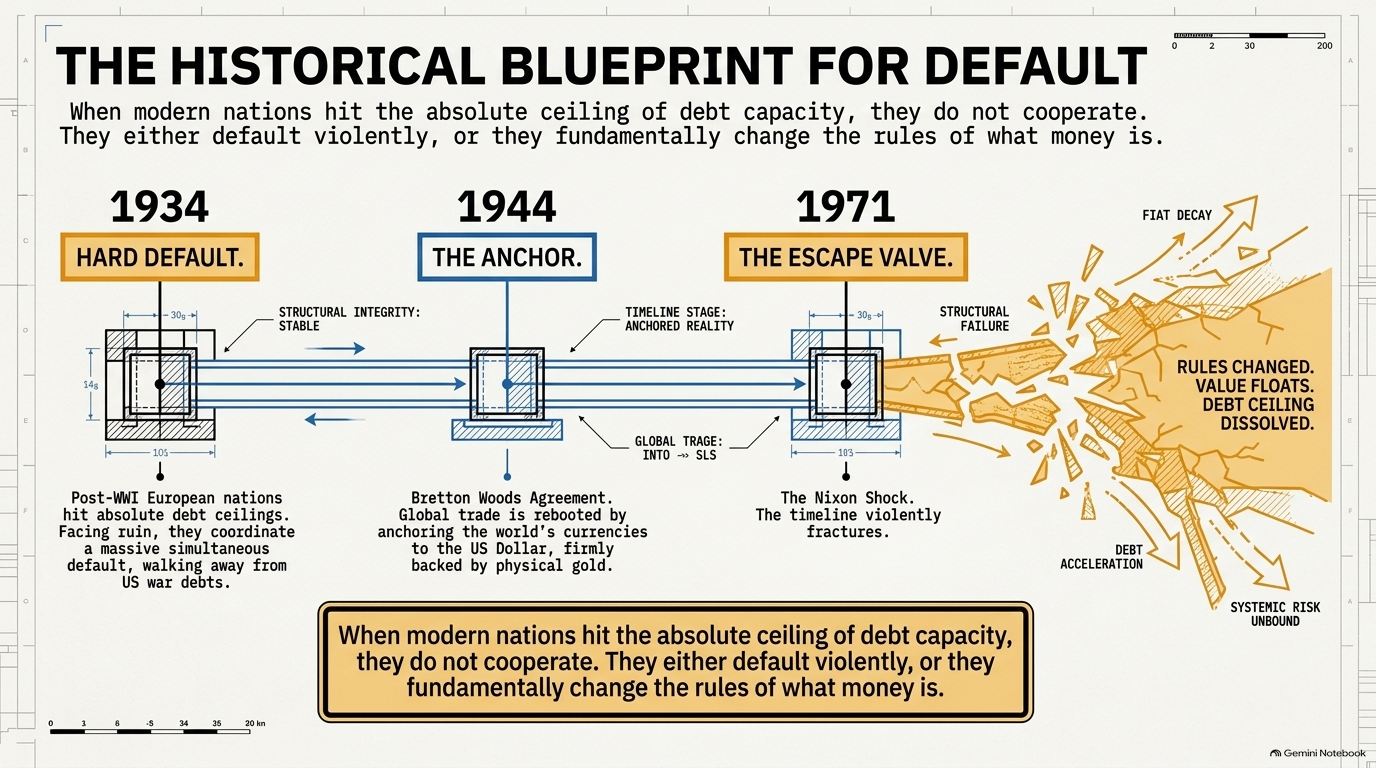
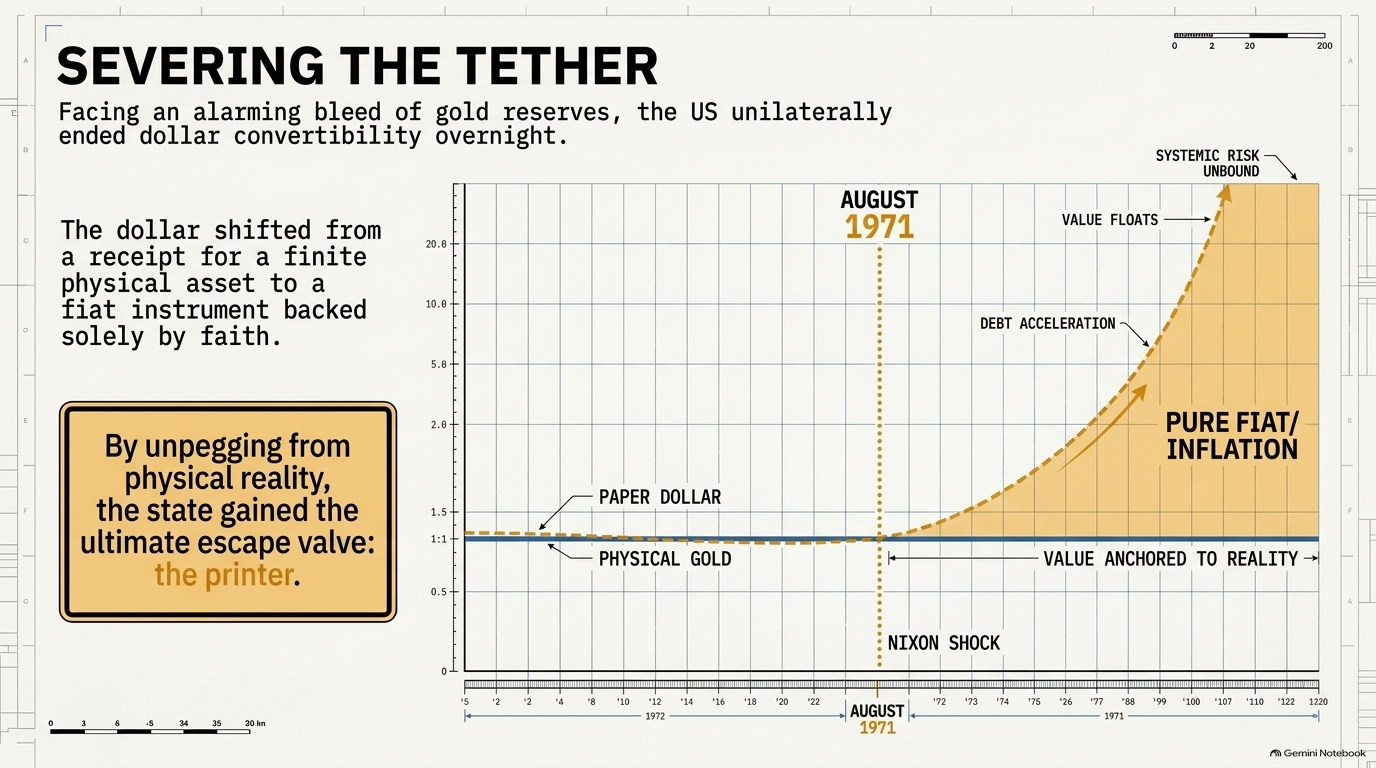
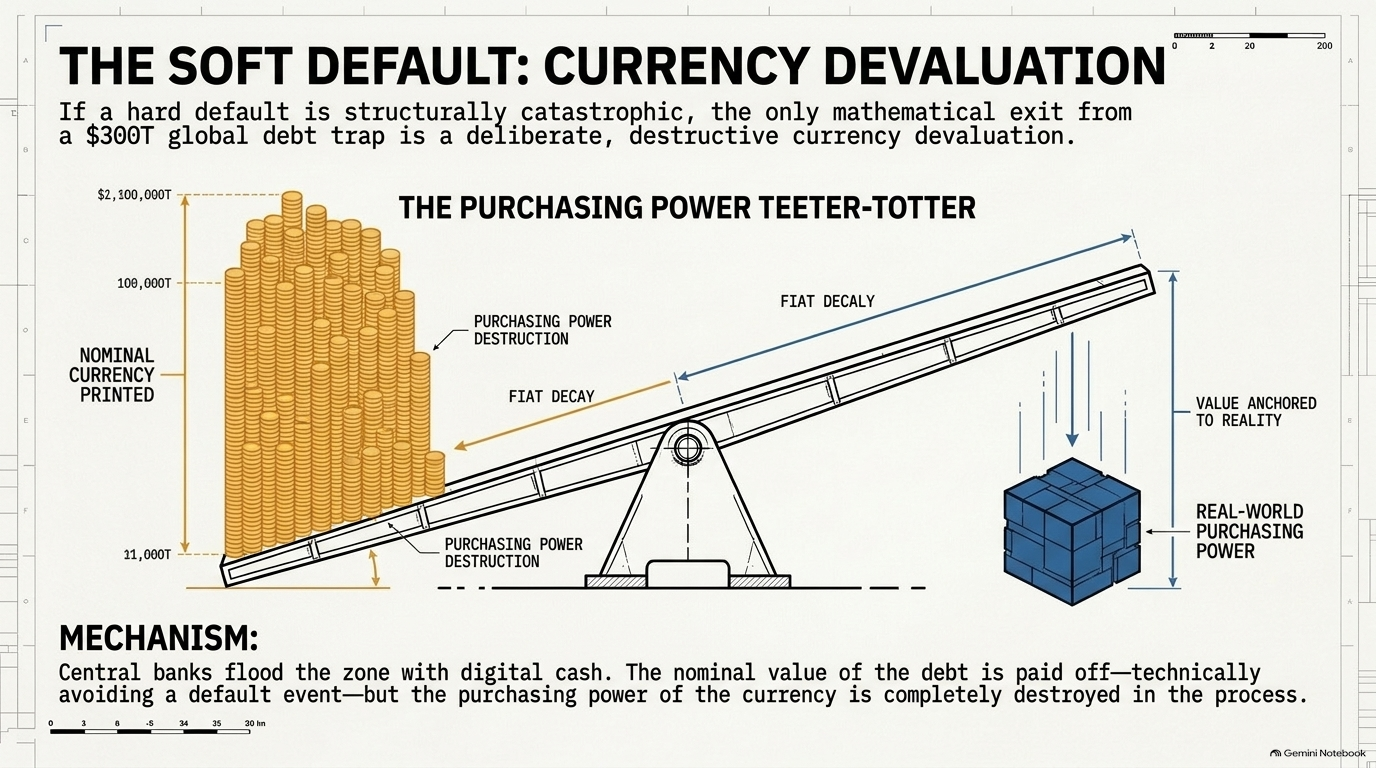
Because a coordinated, peaceful reset is mathematically impossible without systemic collapse, the historical path of least resistance is deliberate currency devaluation. Like the Nixon Shock of 1971—where the US unilaterally severed the dollar's link to gold—central banks under pressure will simply print enough money to inflate away the real value of the debt, destroying the purchasing power of paper money in the process.
1: Title slide for a report on the $46 trillion US debt paradox, featuring a blueprint-style globe graphic.
2: Breakdown of the annual $2 trillion carrying cost of debt service and its impact on the economy.
3: Examination of the global reset fantasy versus the structural impossibility of debt jubilee.
4: Historical overview of ancient debt cancellation practices like Sumerian Amargi and Biblical Jubilee.
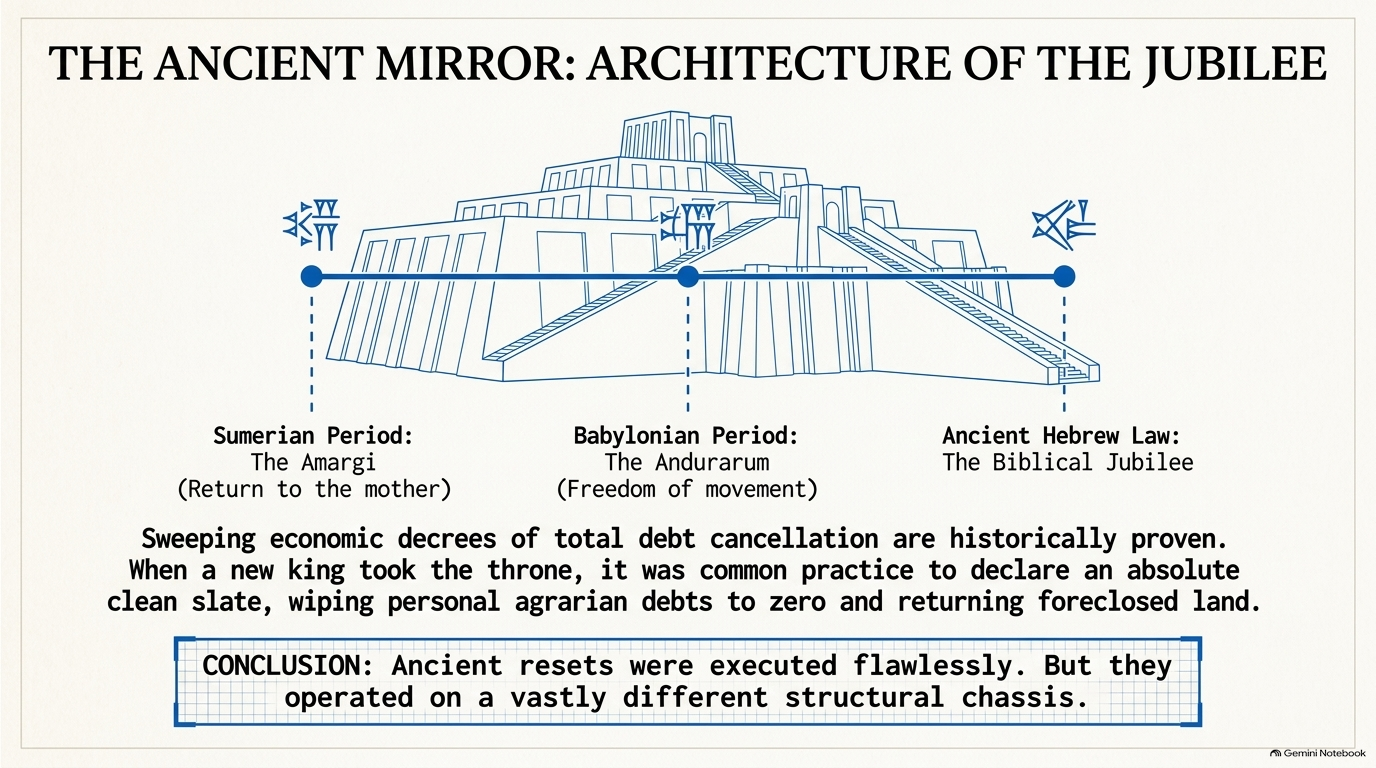
5: Explanation of why ancient debt jubilees worked due to the king owning the debt and state self-preservation.
6: Diagram contrasting modern creditor topology where the State is the debtor, not the creditor.
7: Illustration of the catastrophic blast radius if the United States defaulted on its $46 trillion debt.
8: Circular diagram showing the wealth extraction loop from public labor to elite tech monopolies.
9: Historical timeline of default events in 1934, 1944, and 1971 leading to fiat currency and debt expansion.
10: Line graph showing the divergence of paper dollars from physical gold after the 1971 Nixon Shock.
11: Explanation of the soft default mechanism where currency devaluation pays off nominal debt at the cost of purchasing power.
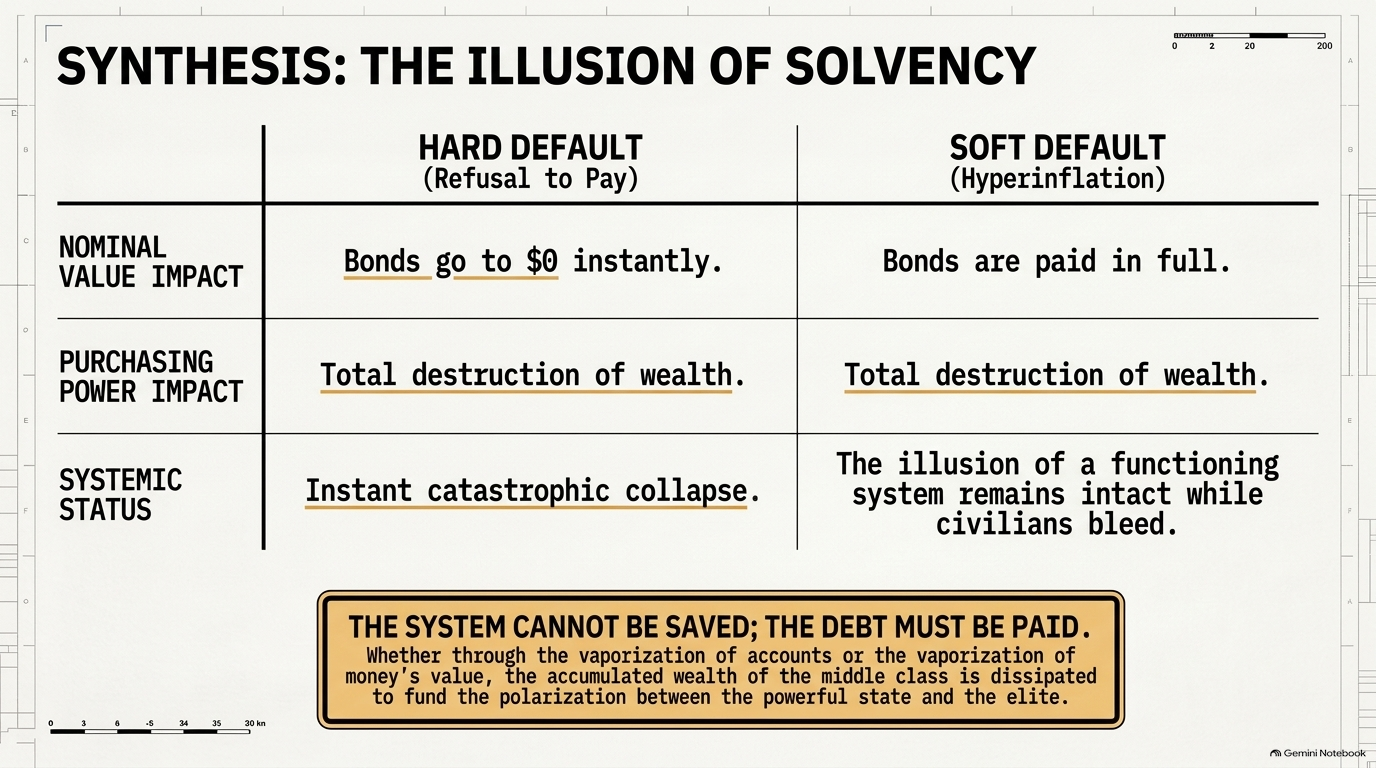
12: Comparison table analyzing the similarities in wealth destruction between hard defaults and soft defaults.
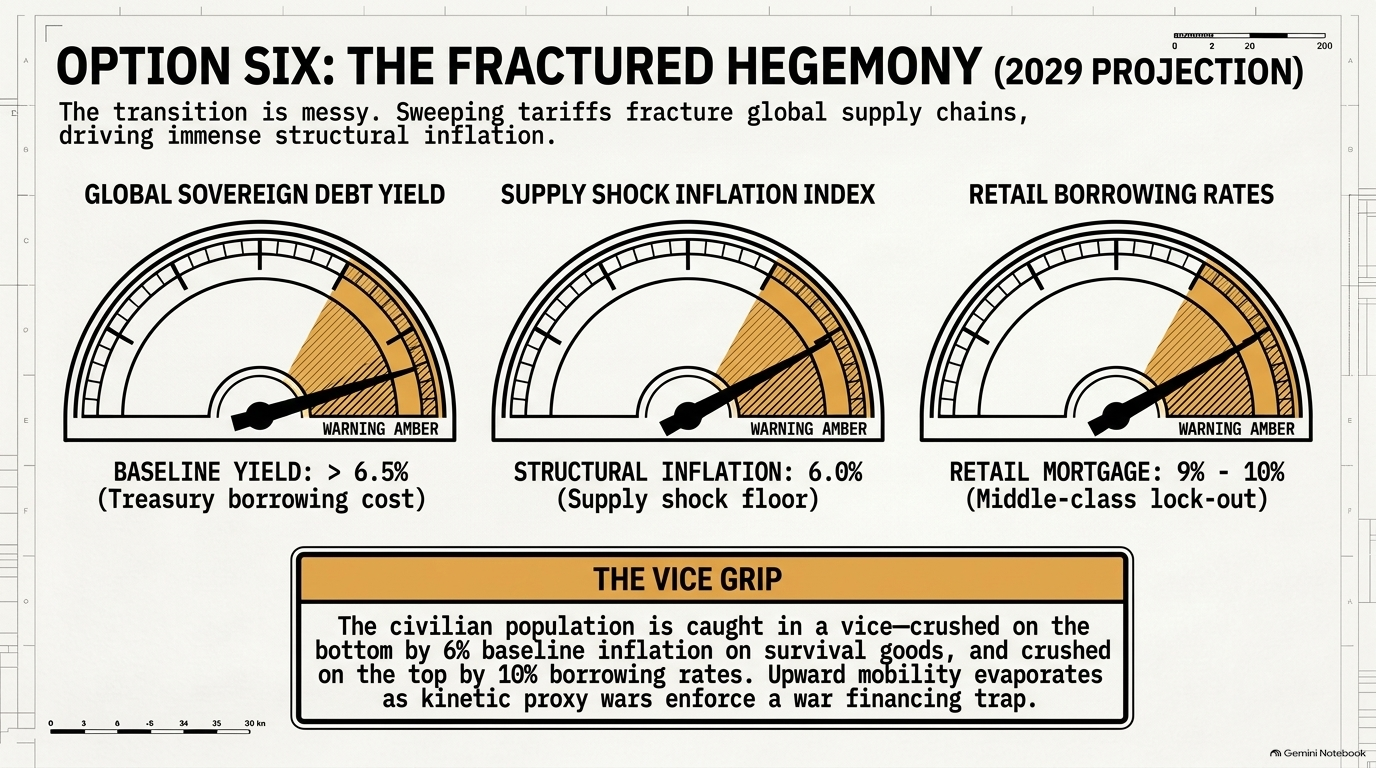
13: 2029 projection gauges showing high global sovereign debt yields, inflation, and retail mortgage rates.
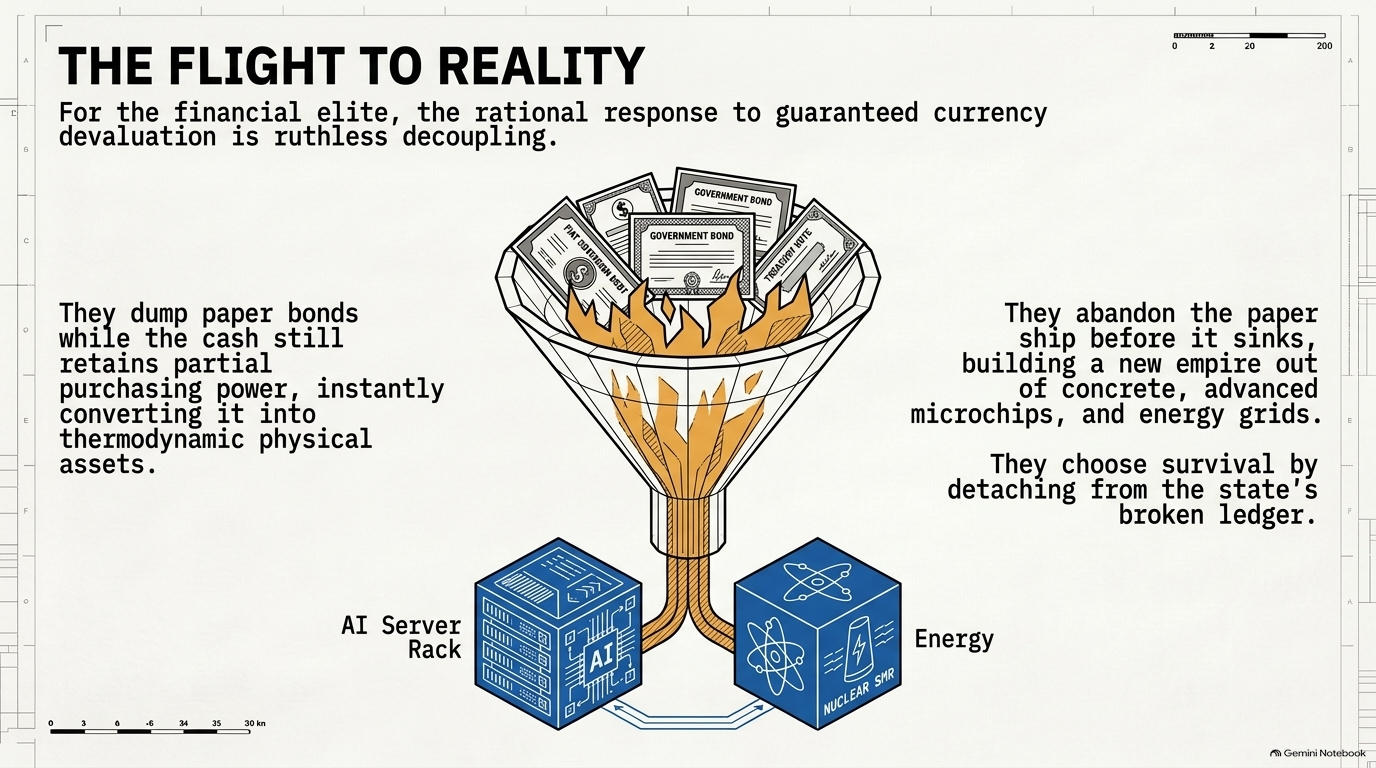
14: Illustration of financial elites dumping paper bonds to invest in physical AI server racks and energy infrastructure.
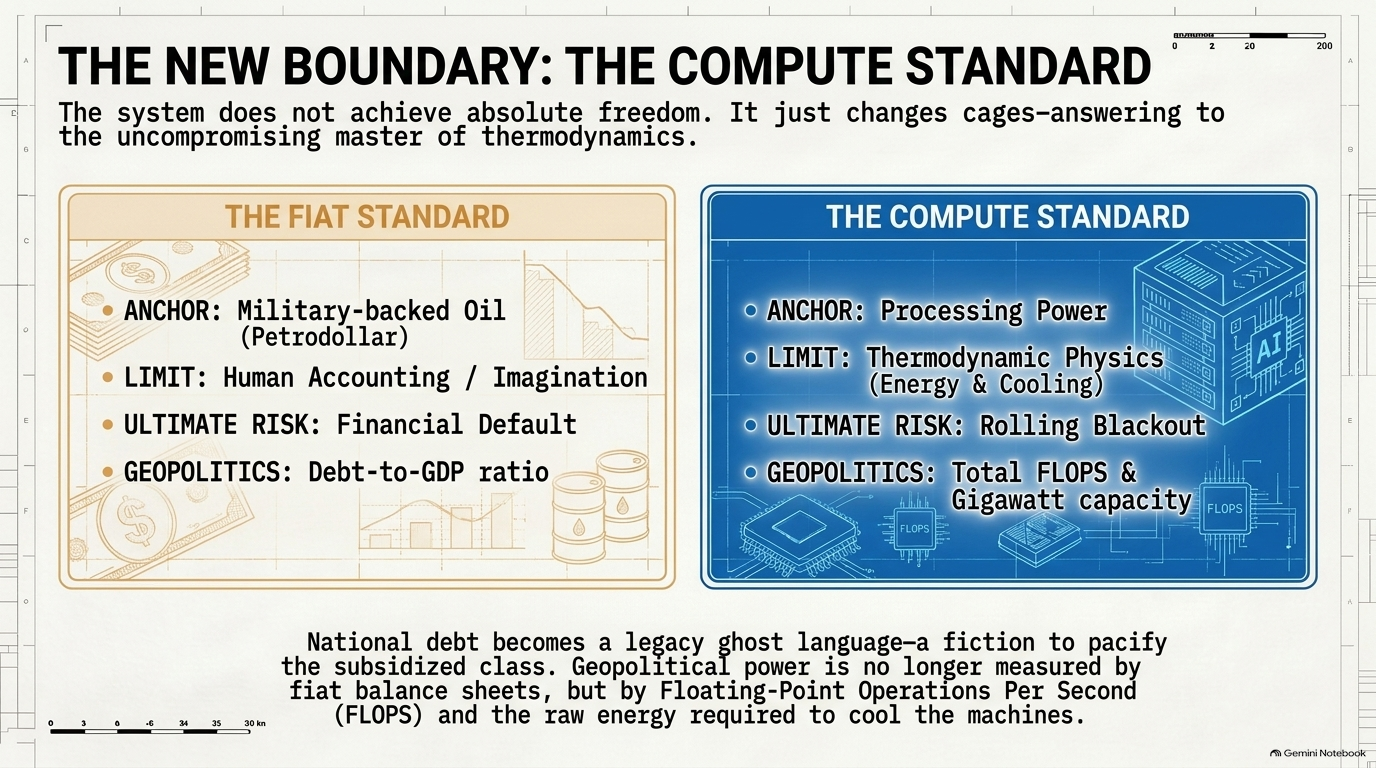
15: Summary comparison between the failing Fiat Standard anchored by oil and the emerging Compute Standard anchored by processing power.
The 2029 Crisis and the Ghost Economy
In a realistic three-year projection (termed "Option Six"), the global economy enters a phase of severe wartime stagflation. High retaliatory tariffs (20% to 60%) fracture international trade, driving structural inflation to 6%. In response, interest rates surge, leaving the middle class trapped between soaring prices for groceries and 9% to 10% mortgage rates.
But the biggest paradox of this automated, post-labor future is the Demand Paradox: If human labor is automated away by AI and robotics, and the middle class is gutted, who has the money to buy the products the AI is producing?
To prevent a total systemic freeze, the state steps in to fund a Ghost Economy through three artificial demand loops:
Direct State Consumption: The government borrows trillions more to purchase AI services directly for defense, federal automation, and infrastructure management.
Thermodynamic Universal Basic Income (UBI): The state prints money and issues it to citizens as highly restricted digital vouchers for food, energy, and shelter. This money passes through the citizen's hands for about three seconds before being captured by the corporate monopolies supplying those basics.
Foreign Consumption: Allied nations borrow from global markets just to purchase licenses for American AI software to keep their own basic logistics running.
In this ghost economy, the physical goods produced are real, but the capital keeping the market moving is a complete illusion generated by a state-backed printing press.
The Compute Standard and the Thermodynamic Limit
When paper currency loses its purchasing power, a dramatic paradigm shift occurs: the transition from a financial state to a production state.
If a nation possesses a hyper-performing AI system that autonomously extracts resources, optimizes agriculture, prints goods, and runs logistics, it no longer needs the approval of the bond market. If foreign adversaries or billionaires threaten to dump the nation's debt, the state can ignore them. True national power shifts from the balance sheet of the Treasury to physical, automated output.
Under this Compute Standard, currency is backed by:
FLOPS: Floating-point operations per second (cognitive horsepower).
Gigawatts: The physical energy capacity required to power those calculations.
Global trade shifts to trading "computing priority"—for instance, exchanging physical agricultural goods for a temporary share of a superpower's server processing time.
However, this new standard is bound by a ruthless master: the Thermodynamic Limit. Unlike fiat money, which can be printed infinitely on a spreadsheet, you cannot print infinite electrons. The physical supply of energy, copper, and cooling water becomes the hard ceiling of the global economy. In this world, the ultimate form of bankruptcy is no longer a financial default, but a rolling blackout.
The Geopolitical and Social Map of 2030
By 2030, the traditional map of nation-states dissolves into specialized energy zones:
Sovereign Compute Empires (Tier 1): Regions like the US, China, and Northern Europe that secured advanced computing clusters and robust energy infrastructure early. They dictate the rules of the global economy.
Resource Vassals (Tier 2): Nations rich in raw geography (minerals, lithium, solar footprints) like Australia, South America, and the Middle East. They lease their land and natural resources to the empires in exchange for AI software licenses.
Ghost Zones (Tier 3): Areas left behind without computing infrastructure or raw resources, suffering from unmitigated climate volatility, border collapse, and private corporate extraction.
Locally, society fractures into Tech Citadels and the Stagnated Periphery. Inside the Citadels, elite engineers and asset owners live in climate-controlled, nuclear-powered luxury. Outside, the remaining 95% of humanity lives in the periphery, pacified by thermodynamic UBI.
This shift completely upends real estate. Traditional suburban homes collapse in value due to high maintenance costs and the disappearance of commuter jobs. They are acquired for pennies and retrofitted into dense pod housing.
To prevent unrest in these cramped physical environments, the state utilizes a Forced Migration Loop. If someone refuses to relocate to a dense pod, the automated system systematically denies maintenance tickets and lets the local grid decay around them. In their pods, citizens spend their cognitive lives inside hyper-realistic virtual reality suits, perceiving a Mediterranean villa while physically inhabiting a 200-square-foot concrete box.
THE TITANS ARE GAINING CONTROL OVER THE LEADERSHIP OF BUSINESS AND GOVERNMENTS AS WELL AS THE MILITRARY. THEY ALSO CONTROL AI, THE ROBOTS AND ADVANCEMENTS.
00:00 / 01:18
Summary
Key Takeaways
The Perpetual Extraction Loop demonstrates how modern economic crises can lead to state policies that socialize corporate risks while privatizing future technological rewards through subscriptions.
Modern Debt Complexity makes historical debt jubilees impossible because sovereign debt is deeply tied to middle-class pension systems and global bank stability, forcing governments toward inflation instead of defaults.
The Compute Standard replaces traditional fiat currency with floating-point calculations (FLOPS) and energy (Gigawatts), making physical grids and automated logistics the primary drivers of geopolitical sovereignty.
Thermodynamic Real Estate and Social Stratification reorganize cities and housing around grid access, concentrating the elite in nuclear-powered Citadels while placing the broader public in hyper-efficient pod housing powered by VR illusions.