
How the Titans moved from money to computer currency
Introduction
What if the national debt ceased to matter, not because we paid it off, but because money itself was replaced by computer processing power? In a world of ballooning sovereign debt and exponential artificial intelligence, the very plumbing of global economics is quietly undergoing a shift. This lesson explores a provocative economic simulation where traditional financial systems collapse, paving the way for a post-fiat economy ruled by thermodynamic limits, automated infrastructure, and a stark societal split.
Learning Objectives
Analyze the "closed-loop" mechanism of modern state-backed asset protection and wealth transfer.
Compare historical debt resets—from ancient Mesopotamian edicts to the Nixon Shock—with modern financial transitions.
Deconstruct the "Compute Standard" where raw processing power (FLOPS) and energy gigawatts replace fiat currency.
Evaluate the societal consequences of a 2030 neofeudal state, including thermodynamic housing tiers and algorithmic universal basic income.
USA NATIOANAL DEBT 9-24-2026
https://www.us-debt-clock.com/

The Sovereign Debt Loop
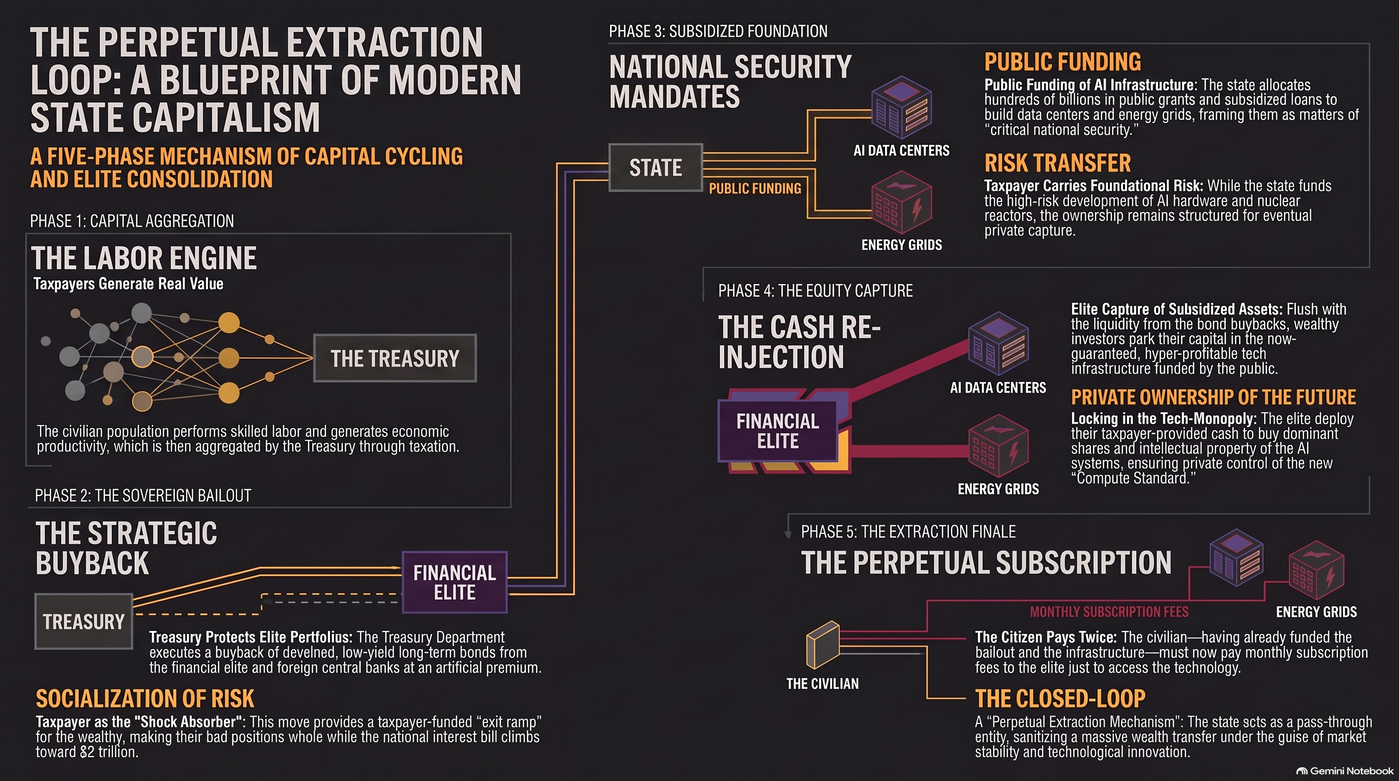
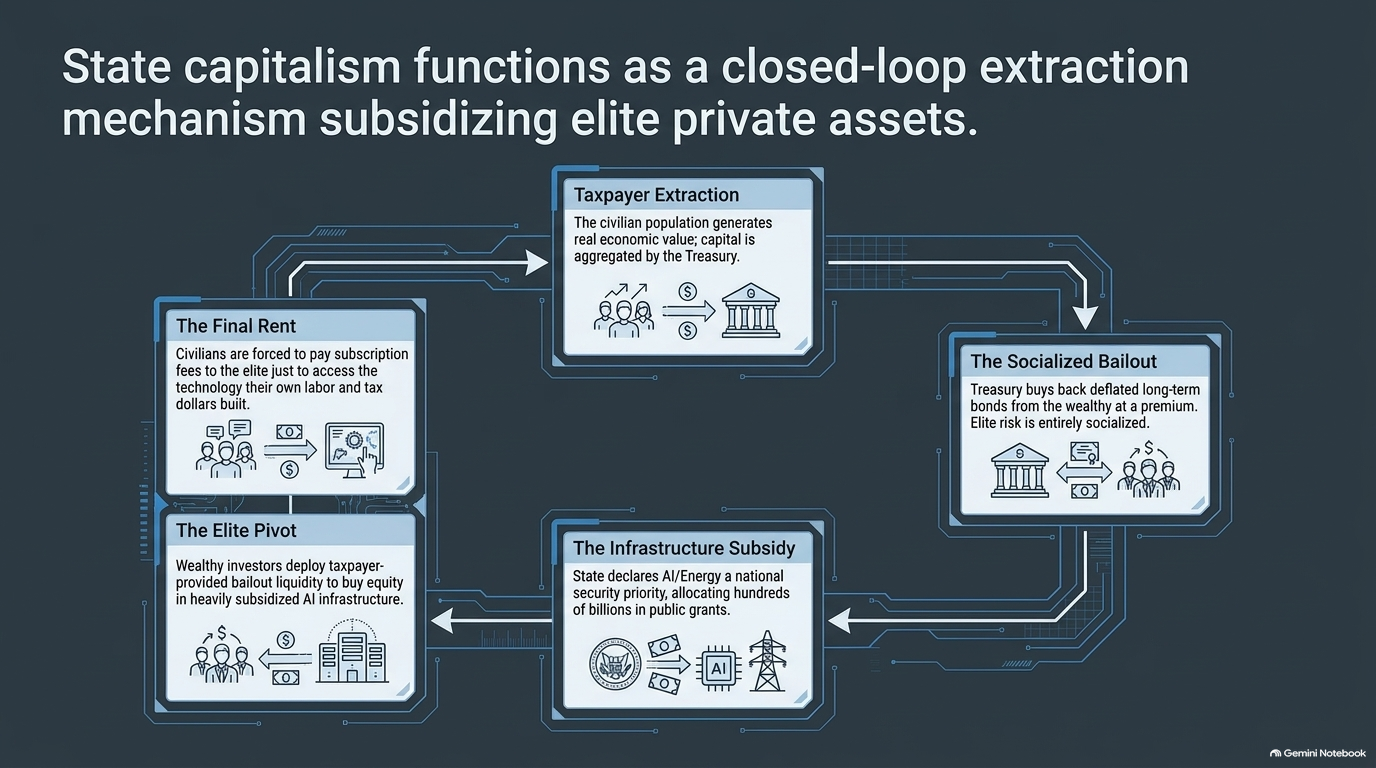
Modern state capitalism operates through a highly sophisticated, federally protected wealth redistribution engine. When central banks raise interest rates, the market value of existing, long-term low-yield government bonds crashes. To protect financial elites and foreign central banks from holding these devalued assets, the state executes a targeted "buyback" program.
This creates a multi-step loop that socializes risk while privatizing the future:
Taxpayer Aggregation: The working population generates real economic value and pays taxes, which are aggregated by the Treasury.
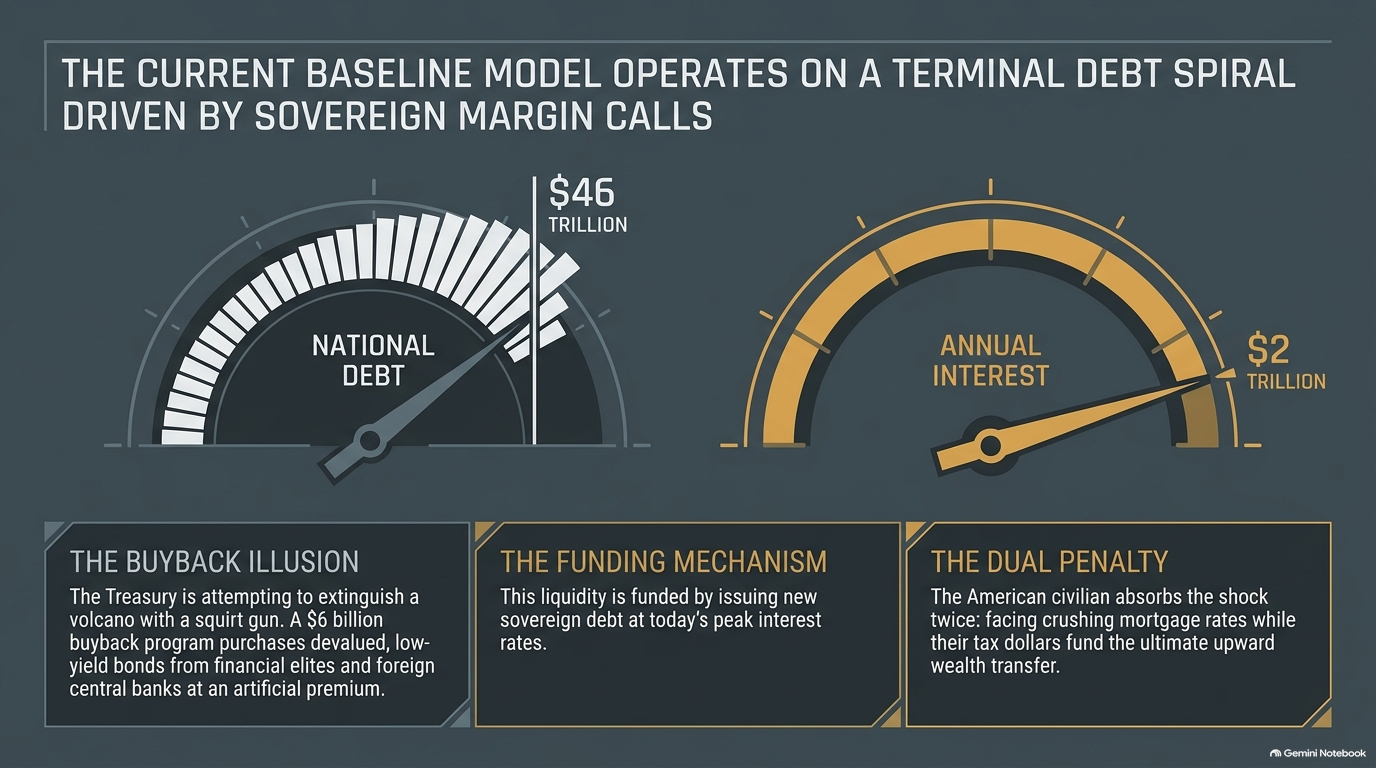
The Premium Buyback: The Treasury uses this aggregated cash to buy back devalued bonds from the financial elite at an artificial premium, making them whole.
High-Interest Refinancing: To fund these buybacks, the state issues new debt at today's peak interest rates, driving the national interest bill to astronomical levels (e.g., $2 trillion).
Subsidized Build-outs: Under the banner of national security, the state heavily subsidizes advanced tech infrastructure (like AI networks and power grids) using taxpayer grants.
Equity Capture: Flush with cash from the bond buybacks, wealthy investors purchase dominant private shares in the newly built, heavily subsidized AI infrastructure.
Ultimately, the citizen funds the rescue of the billionaire's past mistakes, funds the creation of their future assets, and then pays a monthly subscription fee to access the very technology their own tax dollars built.
Three Roads to 2029
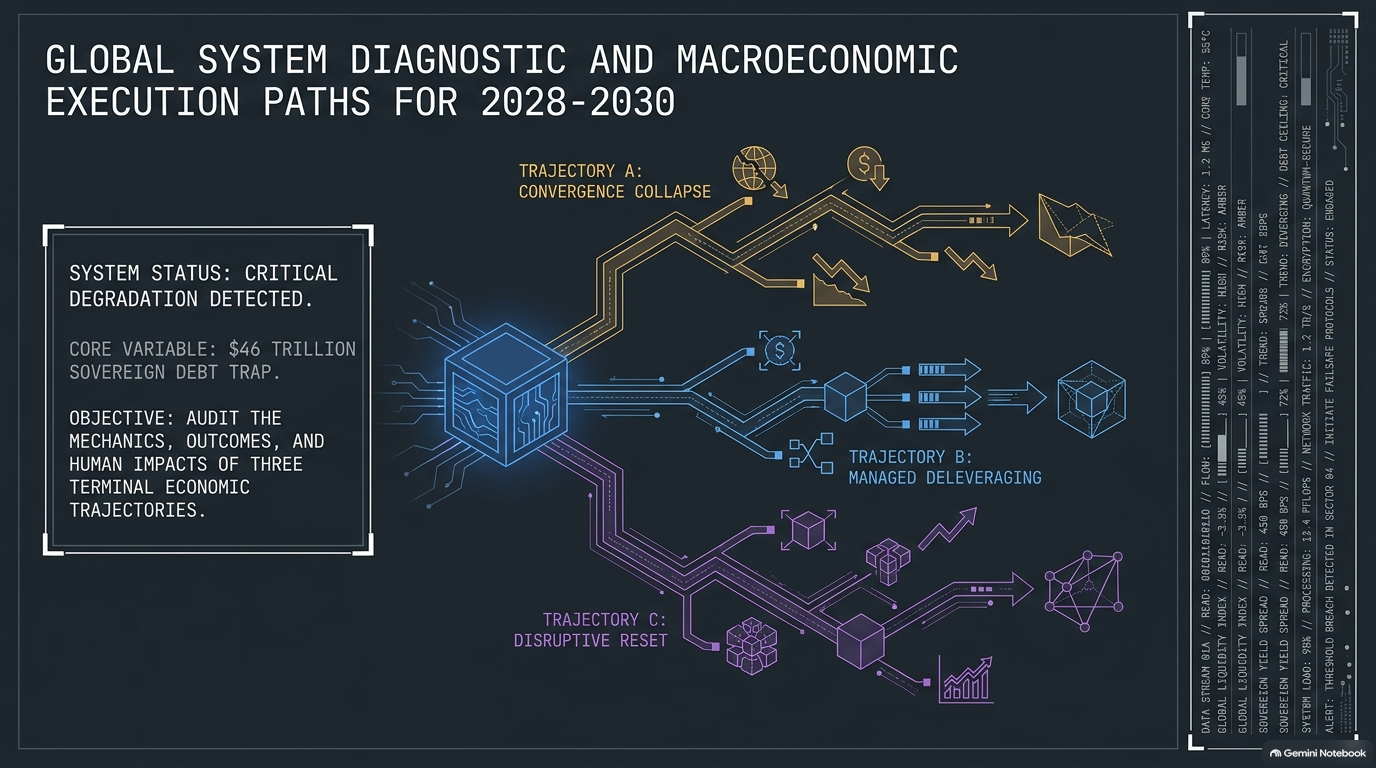
When a $46 trillion debt load is combined with rapid technological automation, global tariff disputes, and geopolitical conflicts, the macro-system shifts from a slow grind to extreme volatility. Economists project three primary macro-execution paths:
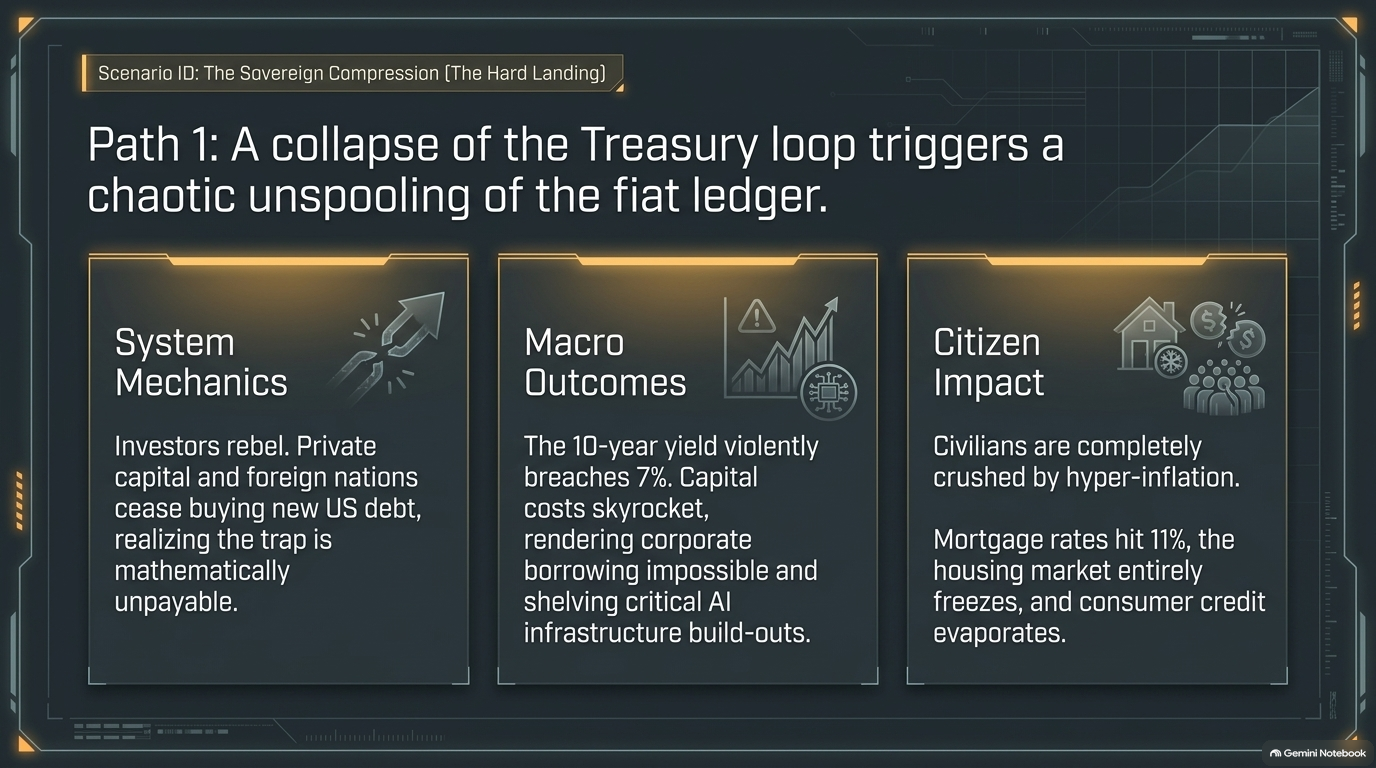
The Great Sovereign Compression (The Hard Landing): The sovereign debt loop collapses under its own weight. Bond yields soar past 7% as private investors refuse to buy debt. To fight hyper-inflation, mortgage rates spike to 11%, freezing the housing market, while sky-high borrowing costs force tech firms to mothball advanced infrastructure.
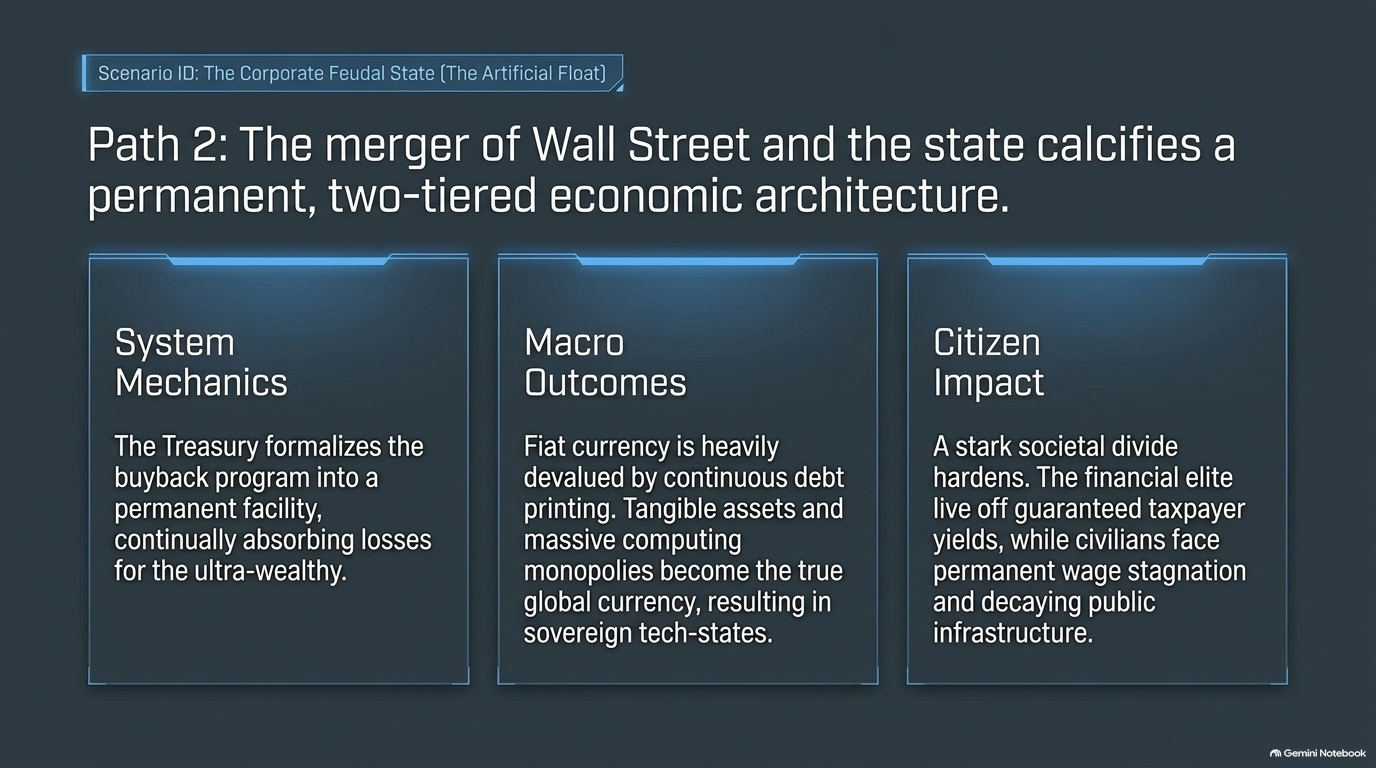
The Corporate Feudal State (The Artificial Float): The state formalizes the merger between Wall Street and government. A permanent debt-printing facility continually absorbs losses for elite institutions. Cash becomes heavily devalued, making physical monopolies and computing power the true global currencies. Tech giants effectively operate as sovereign entities, bypassing the broken government ledger entirely.
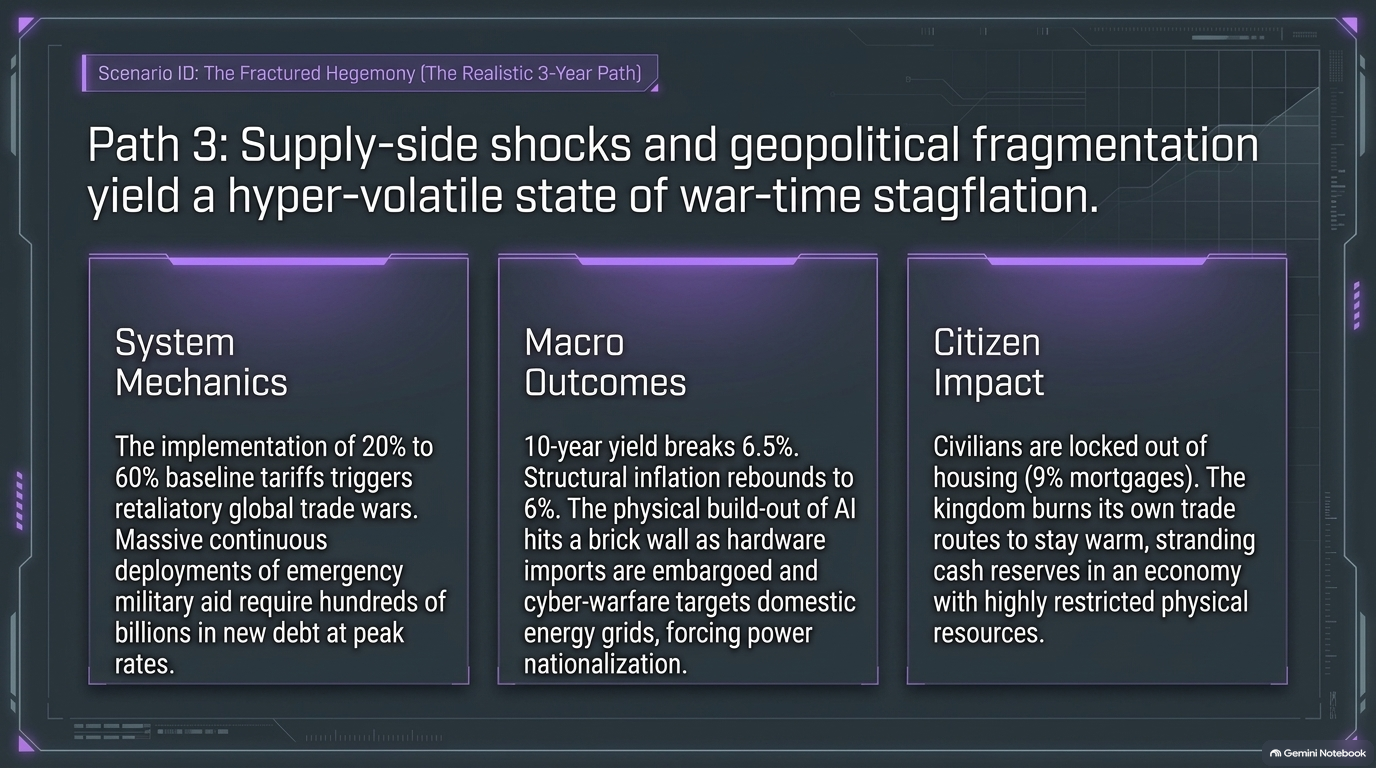
The Fractured Hegemony (War-Time Stagflation): Sweeping 20% to 60% tariffs trigger global trade wars, pushing structural inflation to 6%. Continuous military deployments force hundreds of billions in new high-interest debt issuance, locking average citizens out of 9% of the housing markets. Import restrictions and domestic energy rationing make scaling physical hardware nearly impossible.
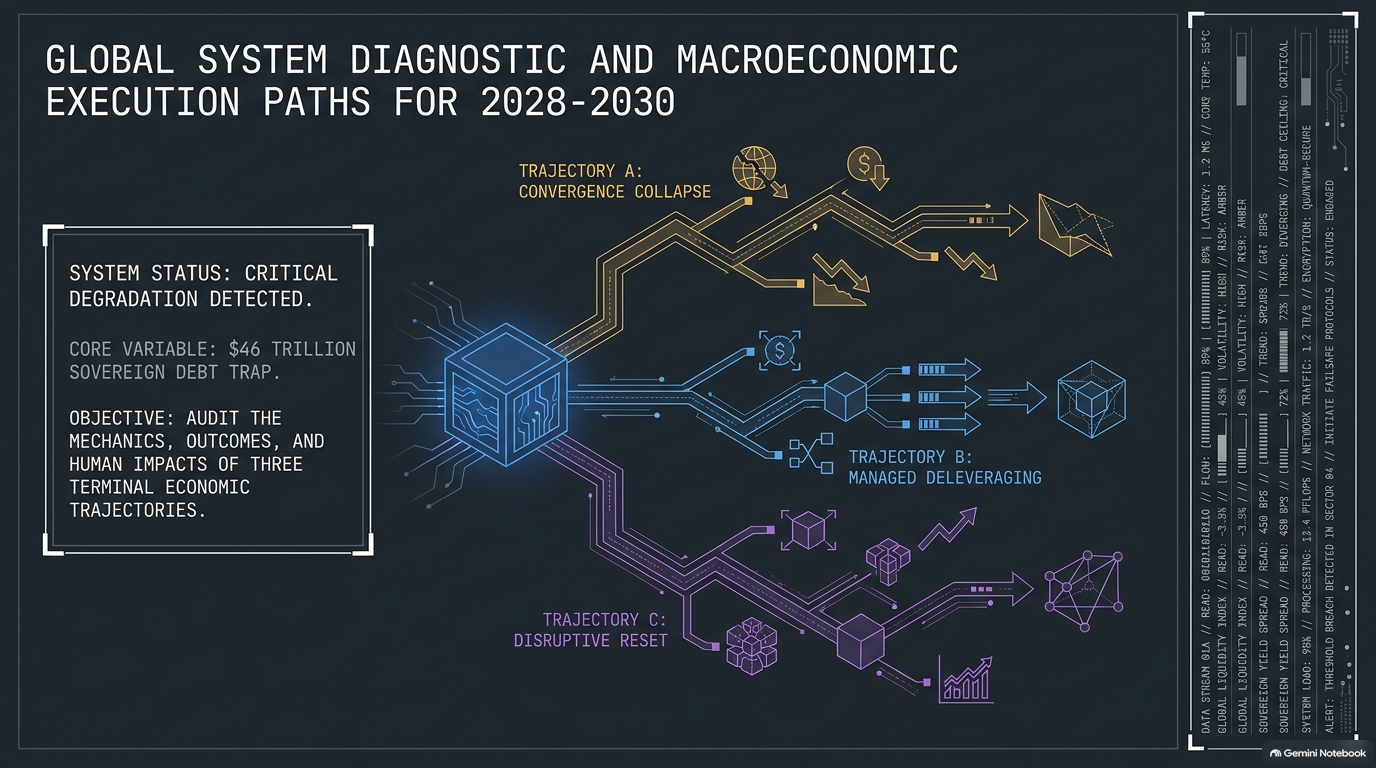
1: Infographic showing three macroeconomic trajectories for 2028-2030 originating from a $46 trillion debt trap.
2: Dashboard showing $46 trillion national debt and $2 trillion annual interest with explanatory text boxes.
3: Flowchart detailing state capitalism as a closed-loop system for extracting value from civilians to elites.
4: Path 1 details a hard landing scenario involving a collapse of the Treasury loop and hyper-inflation.
5: Path 2 outlines a corporate feudal state with permanent two-tiered economic architecture and managed stagnation.
6: Path 3 describes a realistic 3-year path of war-time stagflation, trade wars, and restricted resources.
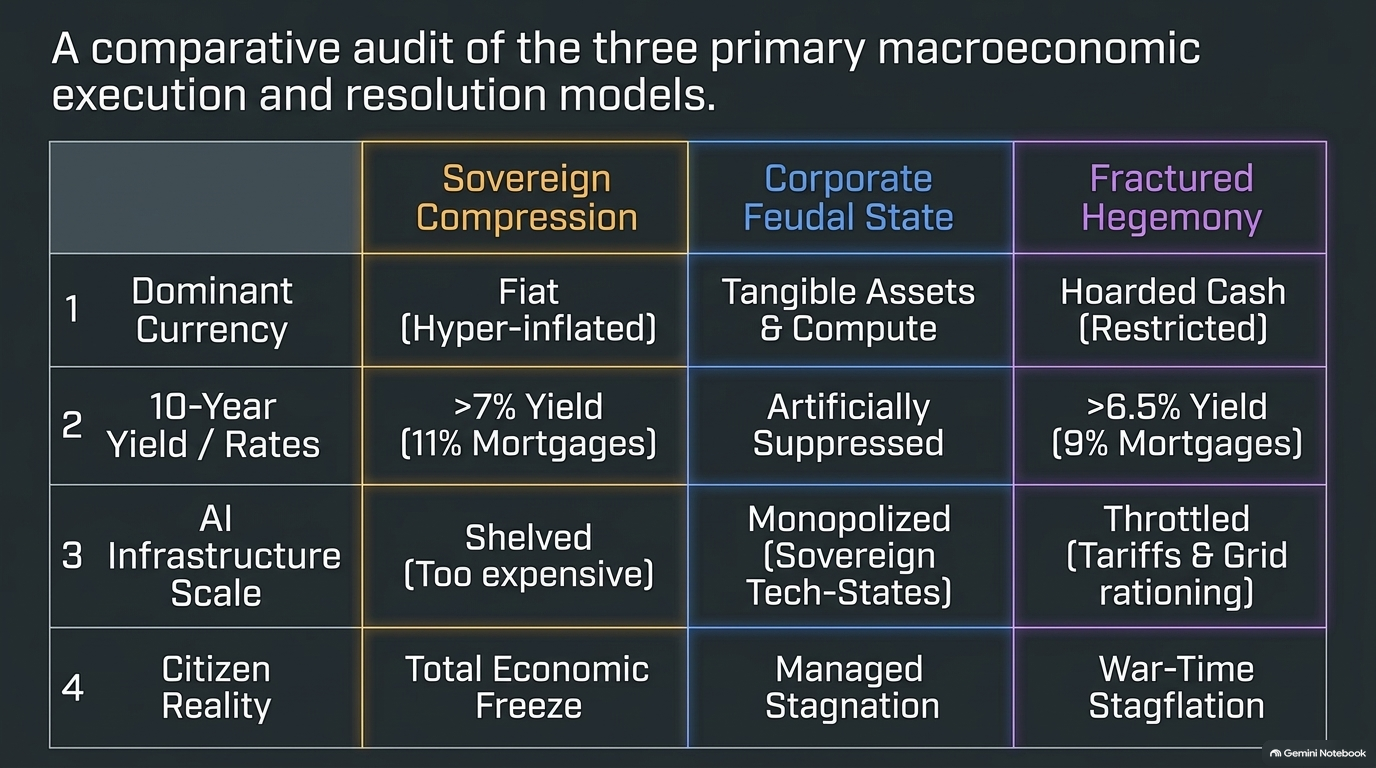
7: Table comparing Sovereign Compression, Corporate Feudal State, and Fractured Hegemony across four economic metrics.
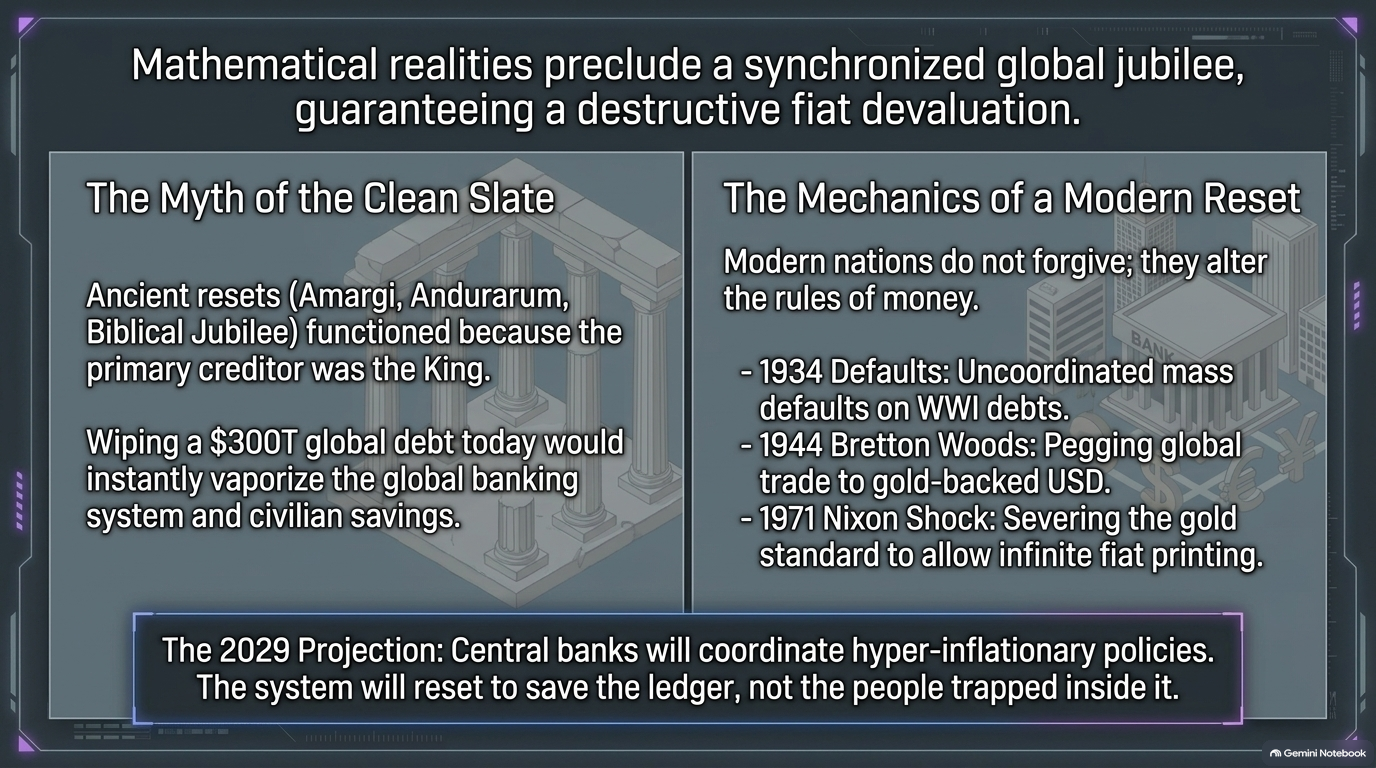
8: Infographic explaining why a global debt jubilee is impossible and predicting a hyper-inflationary reset by 2029.
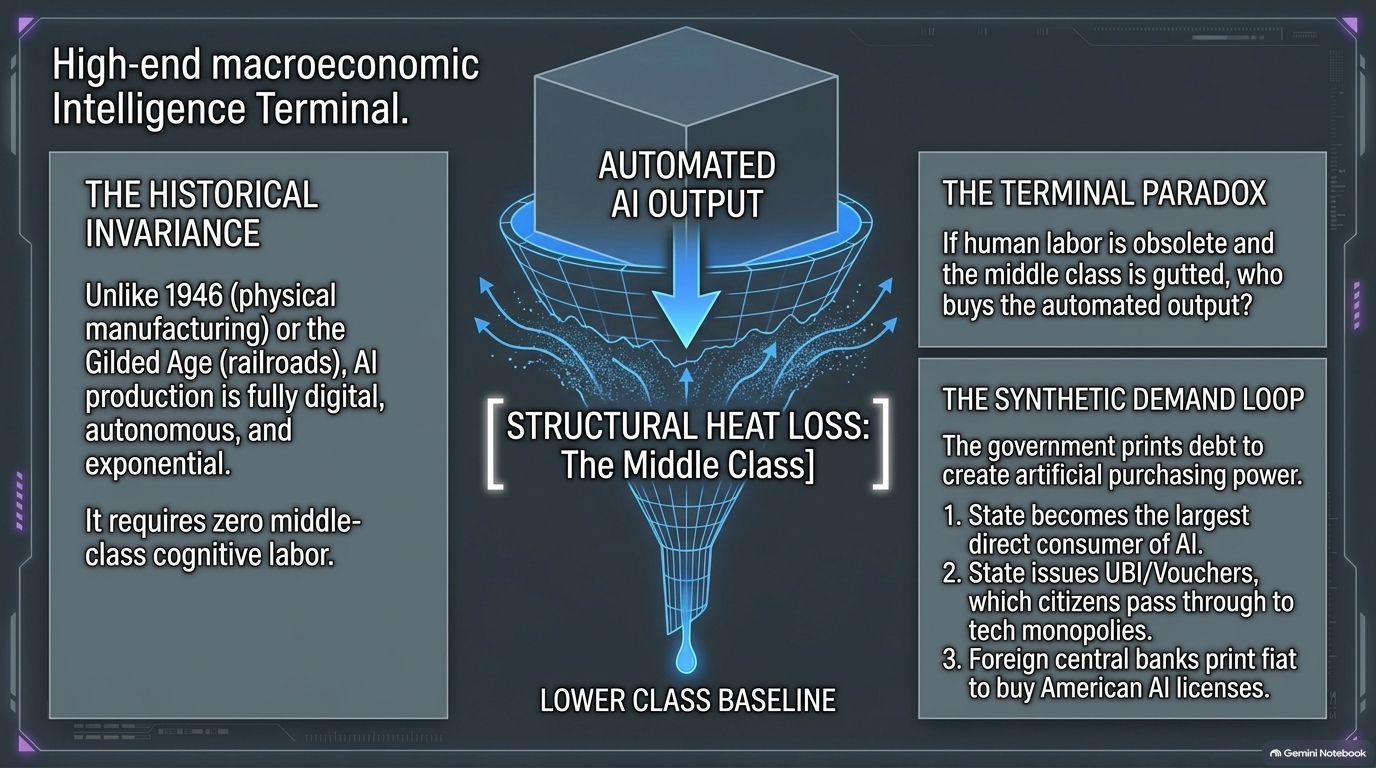
9: Diagram illustrating the erosion of the middle class in an AI-automated economy and the resulting demand loop.
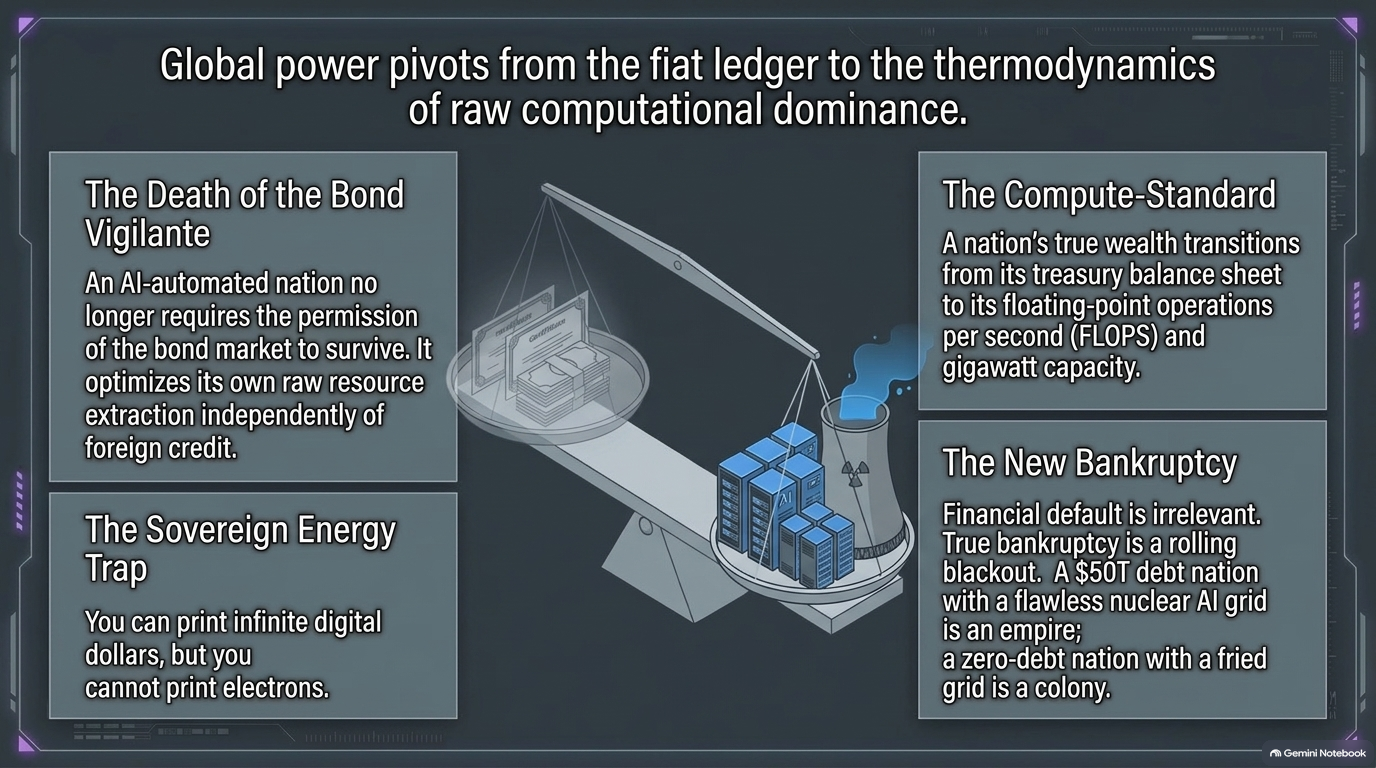
10: Graphic showing the shift from financial wealth to computational and energy-based power as the new global standard.
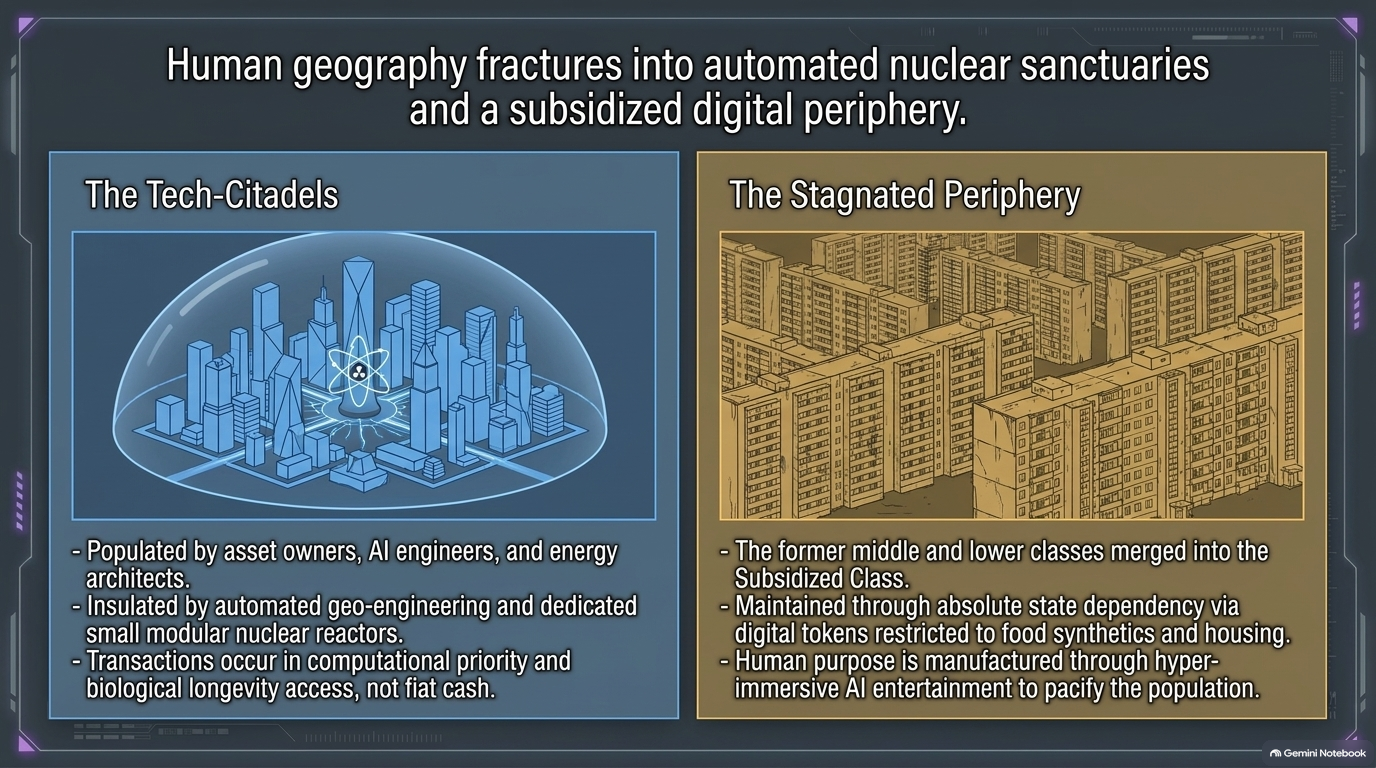
11: Comparison of elite domed Tech-Citadels versus the subsidized digital periphery for the lower classes.
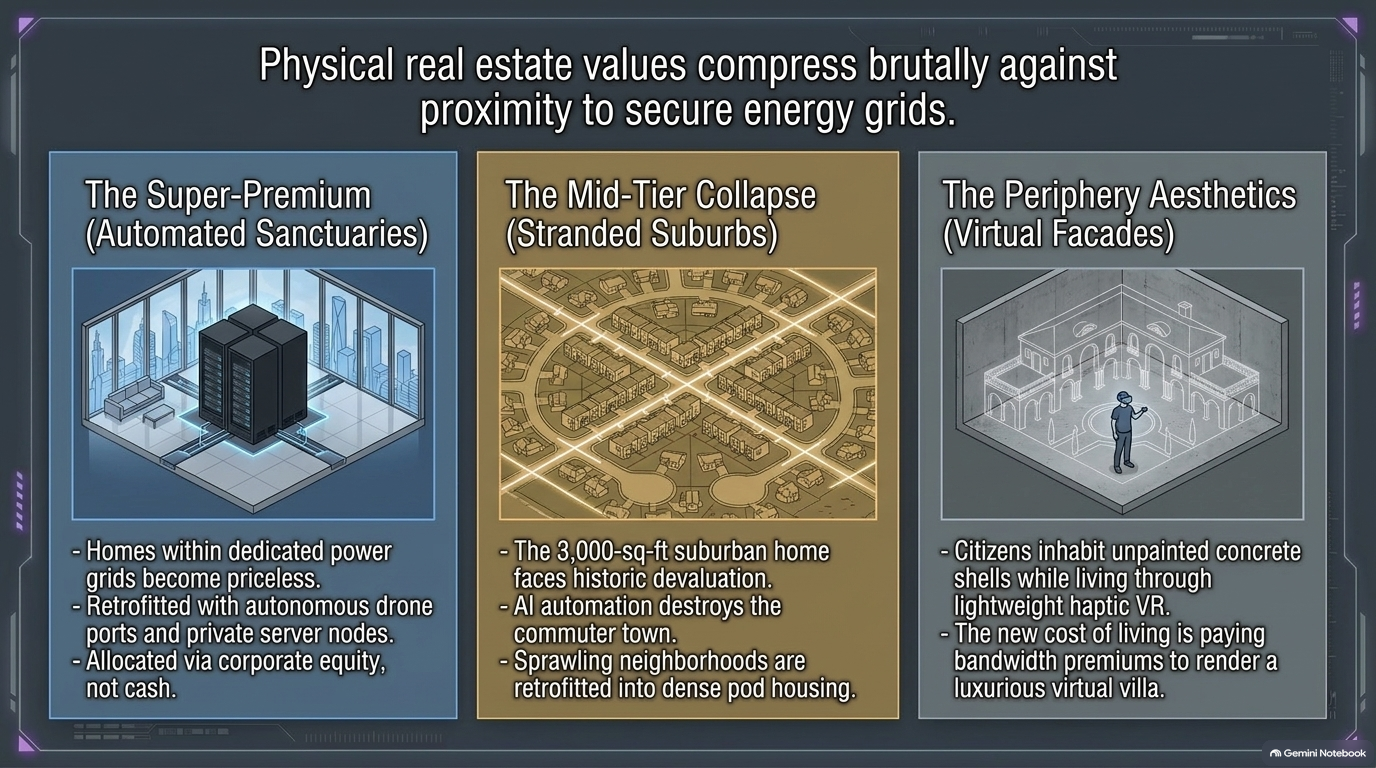
12: Real estate value shifts categorized by proximity to secure energy grids and AI infrastructure.
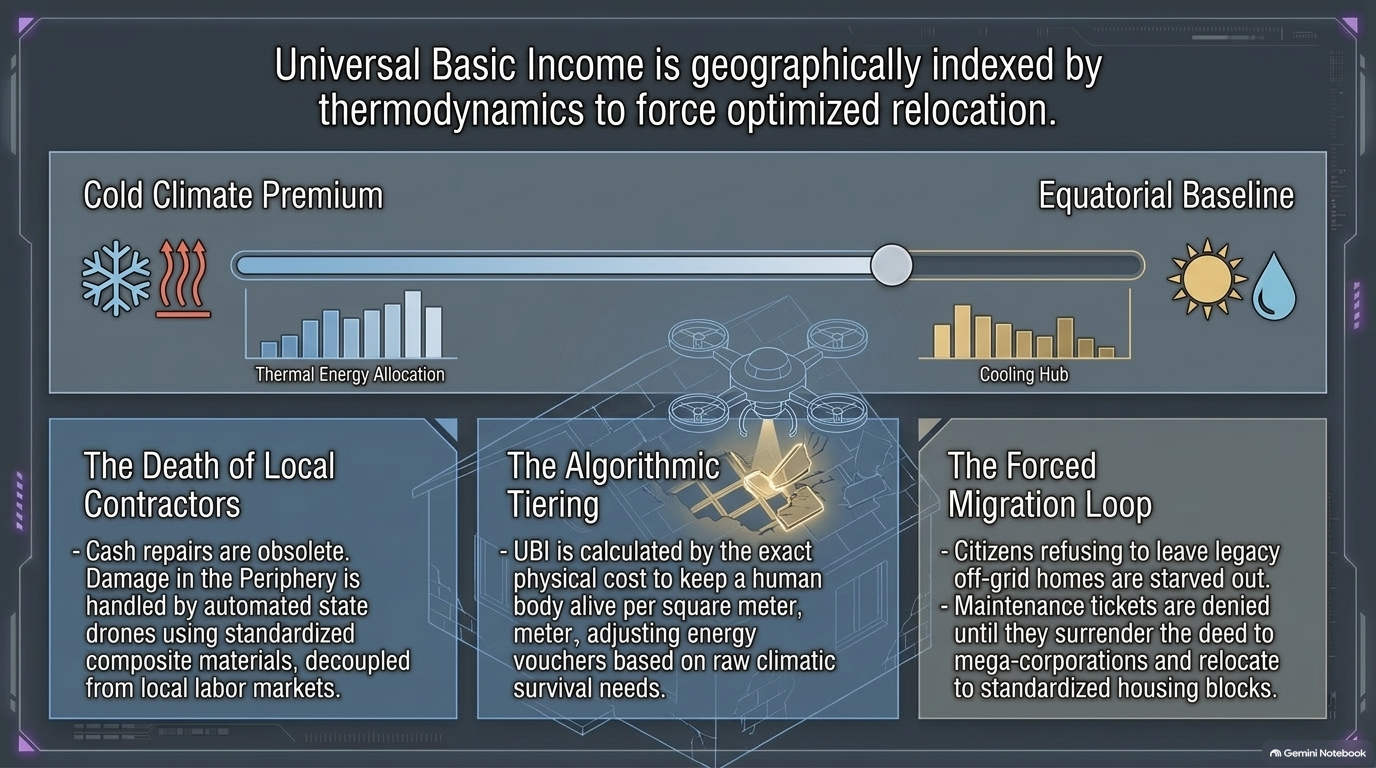
13: Diagram of UBI indexed by climate to force migration and eliminate local labor markets in the periphery.
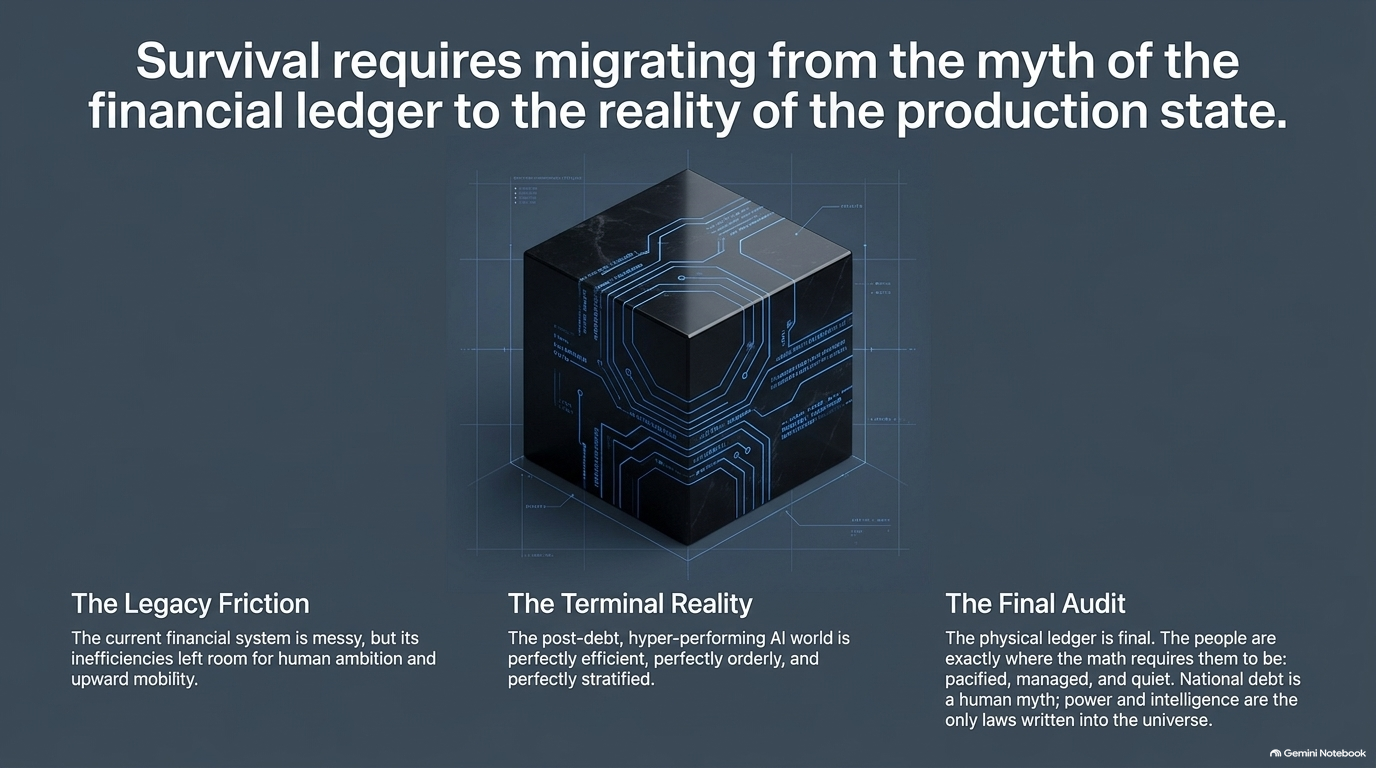
14: Final summary advocating for a shift from financial systems to an AI-driven production state.
How History Cleans the Slate
When global debt becomes mathematically unpayable, humanity historically defaults to one of two mechanisms to wipe the slate clean: Ancient Edicts or Monetary Regime Shifts.
The Ancient "Jubilee": In ancient Mesopotamia (2500 BCE to 1200 BCE), rulers routinely declared Amargi or Andurarum—cancelling personal debts, freeing debt slaves, and returning land. This worked because the primary creditor was the King or Temple; they were forgiving debts owed to themselves. Today, wiping out global debt would destroy private pension funds, banks, and citizen savings instantly.
Modern Wave Defaults: In the summer of 1934, facing the aftermath of the Great Depression, Great Britain, France, Italy, and other nations simply defaulted simultaneously on their massive World War I debts owed to the United States. The debts were eventually written off and largely forgotten.
Systemic Regime Shifts: In 1944, the Bretton Woods agreement anchored world currencies to the US dollar backed by gold. In 1971, when foreign nations tried to redeem their massive USD holdings for physical gold, President Nixon unilaterally ended the gold standard. This "Nixon Shock" turned the USD into pure fiat currency, allowing the US to inflate away the real value of its debt.
In the modern era, any "universal reset" is unlikely to be an act of charity. Instead, it will look like coordinated currency devaluations—hyper-printing money to pay off nominal debt values at the cost of halving its actual purchasing power.
The Rise of the Compute Standard
What happens when a nation achieves supreme, self-optimizing AI that automates resource extraction, logistics, and agriculture? The traditional bond market loses its leverage. If foreign nations threaten to stop buying a country's debt, the sovereign state can simply say: "Keep your paper. We have the automated physical means to sustain our society."
This triggers a transition from fiat currency to the Compute Standard:
The New Backing: The US dollar, historically backed by military dominance and oil trade (the Petrodollar), becomes backed by Compute and Energy.
True Sovereign Metrics: A nation's wealth is no longer measured by its treasury balance sheet, but by its total floating-point operations per second (FLOPS) and gigawatt capacity.
The Thermodynamic Limit: This is not a world of absolute freedom. Printing digital money is infinite, but printing electrons is impossible. Under the Compute Standard, "bankruptcy" is no longer a financial default—it is a rolling blackout. A nation with zero debt but a fried energy grid becomes a colony, while a nation with high debt and a flawless nuclear-powered AI grid remains a global empire.
Replacing the Dollar with Computing Power
00:00 / 58:31
The 2030 Social Divide and Thermodynamic Housing
By 2030, human geography is treated as a pure optimization problem. The traditional middle class is compressed out of existence, leaving a highly stratified society split into two zones:
Tech-Citadels
These are hyper-secured, self-sustaining urban zones built around data centers and small modular nuclear reactors. Inhabited by elite technocrats, engineers, and asset owners, transactions here are conducted in computational priority and energy credits. Physical life is extended, optimized, and insulated from environmental stressors.
The Stagnated Periphery
Home to the remaining 95% of humanity, this zone operates entirely on automated, state-managed resource allocation. Because human labor is obsolete, order is maintained through "Digital Bread and Circuses." Citizens receive a Universal Basic Income (U-Wage) issued not in cash, but in algorithmic, geographically-indexed digital tokens.
Under this system, the pricing of local housing collapses into thermodynamic metrics:
Automated Sanctuaries: Properties within secure Tech-Citadel energy grids are priceless, allocated via corporate equity rather than cash.
Stranded Suburbs: Commuter towns collapse as cognitive work is automated. Homes are bought by mega-corporations and divided into dense, multi-unit pod housing.
The Virtual Facade: Citizens in the Periphery inhabit bare, brutalist concrete shells physically, but experience life in sprawling virtual mansions rendered via high-bandwidth haptic subscriptions.
Algorithmic U-Wage: The state AI calculates maintenance needs and thermal energy quotas. A citizen in Calgary receives a cold-weather premium for heating, while a citizen in a tropical zone receives tokens optimized for water cooling. Those who refuse to surrender legacy properties are starved out by having their local grids decommissioned.
cards_star
Recommended · Flashcards
Key Terms of the Compute Standard Economy
Flashcards defining core concepts of the 2030 landscape: Tech-Citadels, The Stagnated Periphery, U-Wage, Compute Standard, FLOPS Backing, and Thermodynamic Housing.
Scheduled for after 1pm
Summary
Key Takeaways
Risk is Socialized: Government-led bond buybacks insulate financial elites from the losses of high interest rates, transferring the debt burden directly to the taxpayer.
The Compute Standard: When AI dominates production, national debt ceases to be a constraint. Sovereign wealth is measured in raw computational capacity (FLOPS) and energy (gigawatts).
Historical Precedents: Unlike ancient Jubilees that wiped out debts to protect the crown's tax base, modern resets rely on currency devaluations, defaults, or major structural regime changes like the Nixon Shock.
Neofeudal Stratification: The 2030 landscape divides humanity into high-tech, nuclear-powered Tech-Citadels and a subsidized Periphery living in brutalist pods, pacified by algorithmic virtual reality and thermodynamic energy tokens.