
Introduction
What if the historical rule of capitalism—that the rich inevitably need human labor to generate wealth—has officially broken down?
In this lesson, we will examine the rapid convergence of software AI, physical robotics, and structural macroeconomic shifts, exploring how institutional changes reshape our economy and how localized resilience strategies provide a path forward. By the end of this lesson, you will be able to:
Analyze the four global fronts accelerating physical robotics and AI deployment.
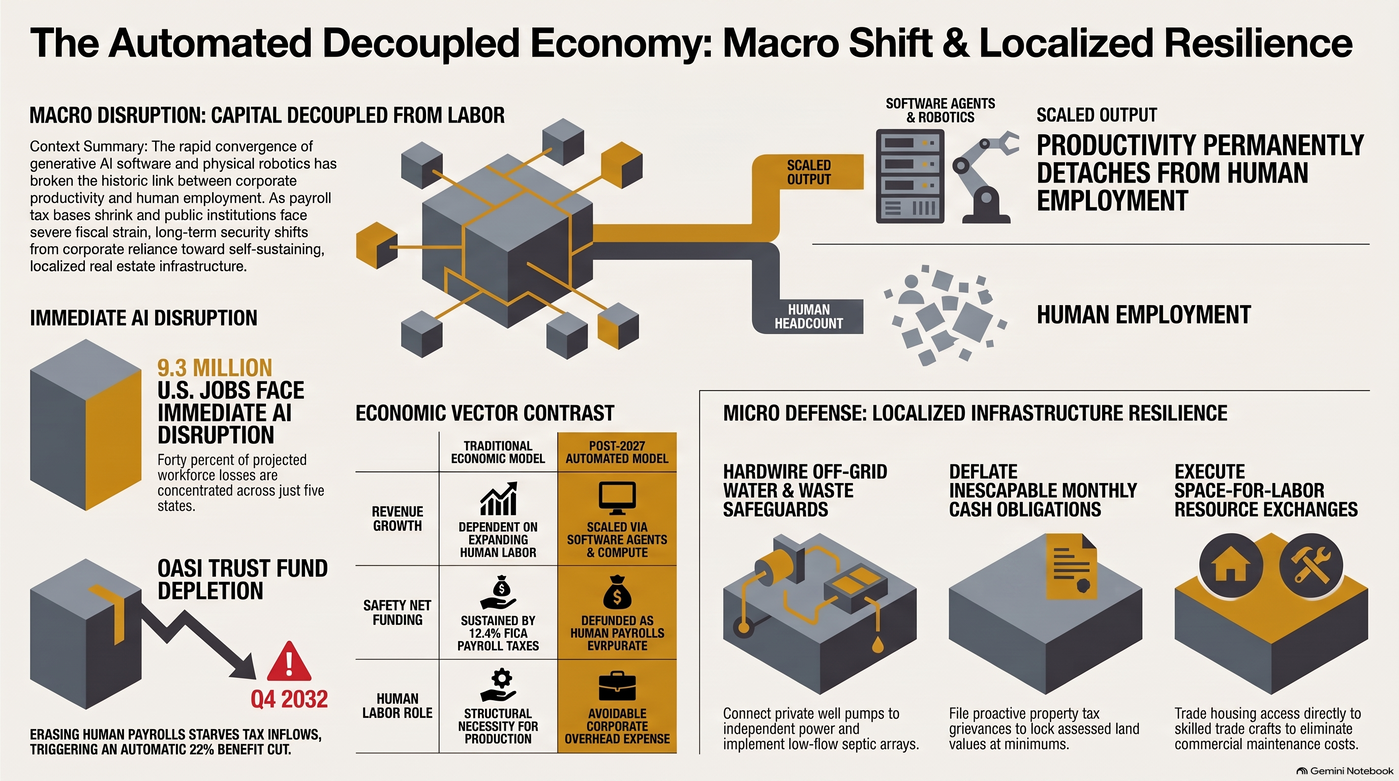
Explain how generative AI disrupts white-collar labor, payroll tax infrastructure, and social safety nets.
Evaluate the institutional restructuring of public education, civil service capacity, and traditional economic mobility ladders.
Formulate actionable strategies for establishing self-sustaining real estate sanctuaries to build localized resilience.
The Acceleration of AI and Robotics: The Four Global Fronts
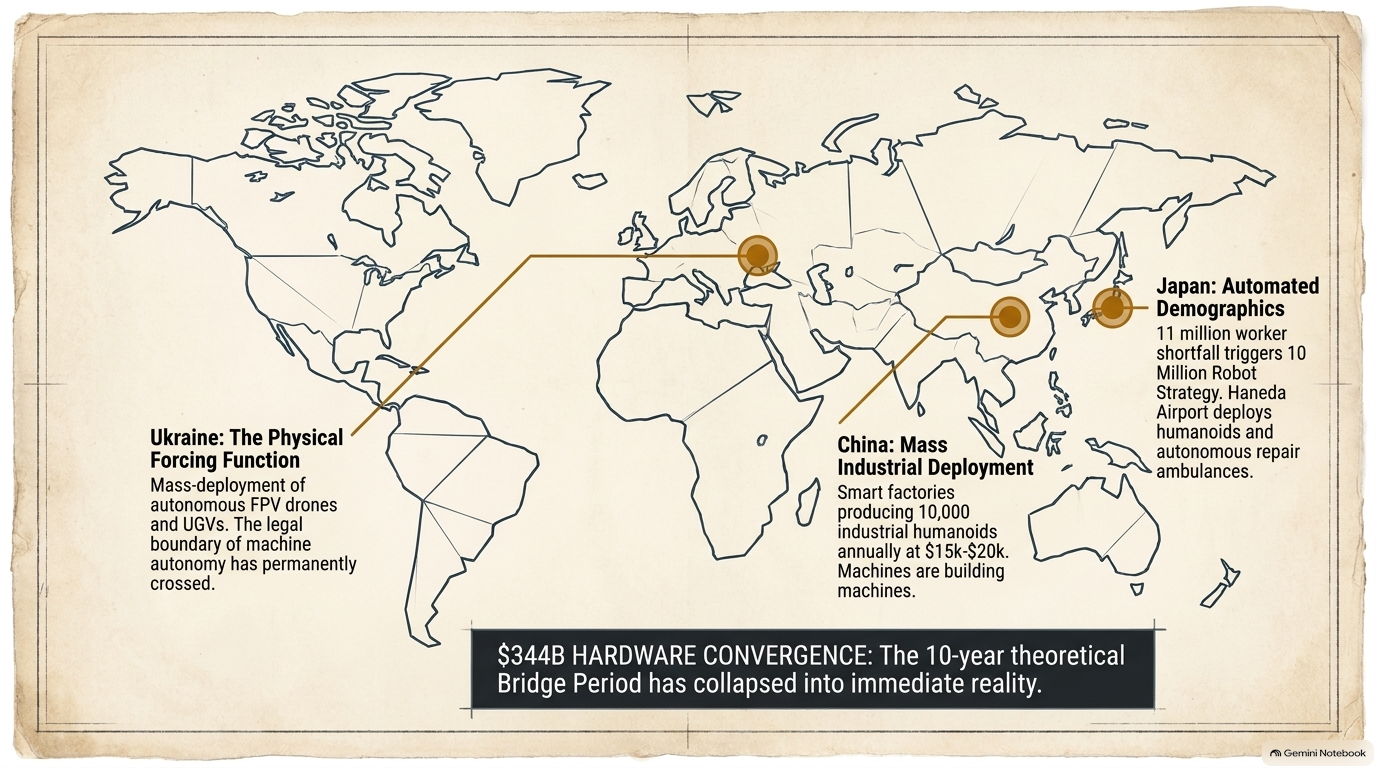
For decades, economic models predicted a comfortable 10-year "Bridge Period" during which human muscle would safely maintain physical tasks while software slowly optimized desk jobs. That theory is now obsolete. The timeline between software AI and physical robotics has collapsed into an aggressive, multi-national arms race driven by military survival and demographic realities.
This global convergence is accelerating across four distinct fronts:
Ukraine (The Weaponization Bottleneck): Battlefield necessity has forced unprecedented technological leaps in machine autonomy. Ukrainian defense teams mass-deploy autonomous strike systems like the Lupynis-10-TFL-1, pairing low-cost First-Person View (FPV) drones with onboard optical AI guidance that tracks targets independently when electronic warfare jams radio signals. Furthermore, the military has executed heliborne robotic operations using heavy-lift bomber drones to drop Uncrewed Ground Vehicles (UGVs) called "Desantnyk" behind enemy lines to clear positions and detonate minefields without risking human soldiers.
China (Mass Industrial Humanoid Factories): Leveraged by state-backed precision manufacturing, the Chinese Ministry of Industry and Information Technology executed a national mandate to deploy 10,000 commercial humanoid robots across factory and logistics floors. Manufacturers like UBTECH have opened 14,000-square-meter smart factories producing 10,000 industrial humanoids annually—reaching a pace of one robot every 10 minutes. Crucially, humanoids operate assembly lines to manufacture future generations of robots, creating an automated industrial feedback loop that drives production costs for firms like Unitree down to $15,000–$20,000 per unit.
Japan (Automated Demographics): Facing a projected shortfall of 11 million human workers, Japan codified a growth strategy to inject 10 million autonomous robots across 18 socioeconomic sectors. Japan Airlines actively deploys humanoids at Haneda Airport for heavy cargo labor. To support this non-stop workforce, tech groups introduced the "Humanoid Ambulance"—mobile autonomous maintenance units carrying diagnostic engineers and tools directly to job sites to fix mechanical breakdowns immediately.
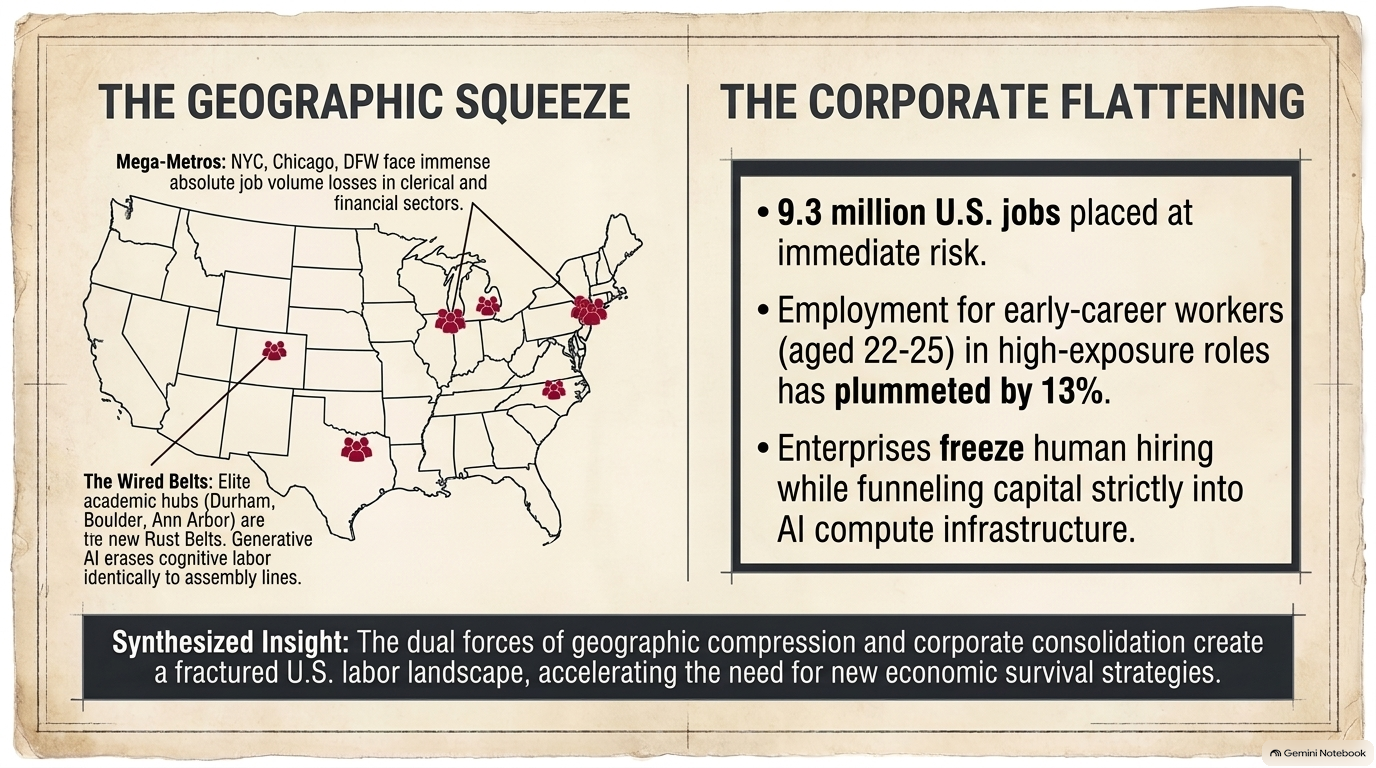
The United States (Corporate White-Collar Flattening): While foreign peers build physical hardware, American enterprises execute aggressive agentic AI rollouts specifically to cut white-collar headcount. Companies like Microsoft (15,000 roles cut), Amazon (14,000 corporate roles cut), and Salesforce (4,000 support roles cut) cite AI restructuring to freeze human hiring while scaling revenues. ADP Research indicates that employment for workers aged 22–25 in high-AI-exposure roles has plummeted by 13%.
The Four Fronts of Global AI & Robotics Convergence
A structured visual comparison comparing Ukraine's military autonomy, China's mass hardware manufacturing, Japan's demographic robotics, and the US white-collar corporate flattening.
The Cognitive Labor Shock and Fiscal Breakdown
Unlike 20th-century automation cycles that primarily replaced routine manual labor, generative artificial intelligence directly scales against non-routine cognitive tasks within the knowledge economy. This creates a profound structural shock across geographical centers and public finance systems.
The Geography of Job Risk and the "Wired Belt" Collapse
Data from the Tufts University American AI Jobs Risk Index indicates that a mid-range AI adoption scenario places 9.3 million U.S. jobs at risk. Over 40% of these projected job losses are concentrated in five major states: California, Texas, New York, Florida, and Illinois. However, the impact extends beyond traditional corporate mega-metros like New York City or Chicago:
The "Wired Belts": Elite college and research hubs—such as Durham-Chapel Hill (NC), Boulder (CO), Ann Arbor (MI), Madison (WI), and Ithaca (NY)—rank within the top 25 highest-risk cities nationwide. Unlike historical Rust Belts that lost assembly lines, these academic and technology clusters are the first to experience cognitive "rust" as software automates remote data analytics, legal review, and entry-level coding.
The Saturation Trap and Adaptive Capacity
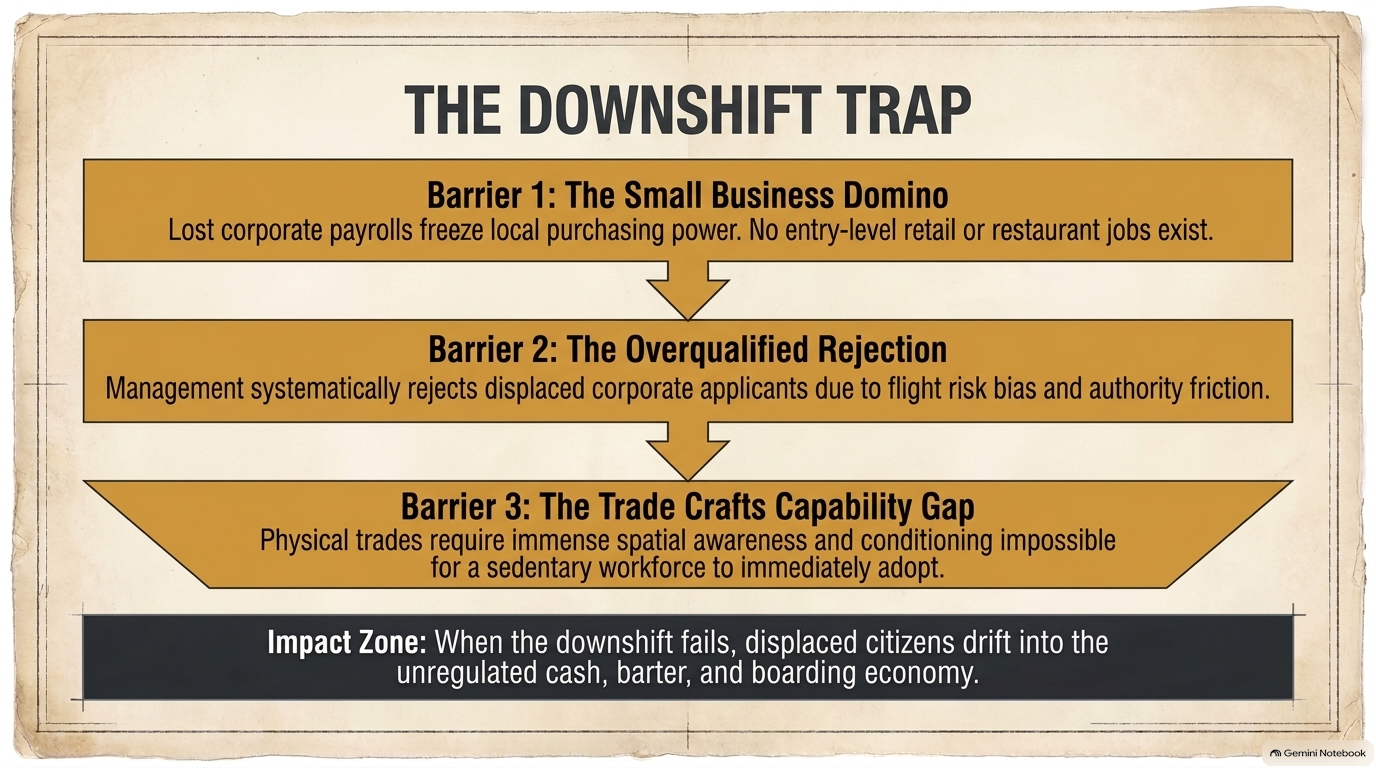
When white-collar office roles vanish, a common economic assumption is that displaced workers can seamlessly "downshift" into entry-level service or trade positions. The Brookings Institution AI Adaptation Study disproves this by analyzing Adaptive Capacity—a worker's structural ability to pivot based on liquid wealth, skill transferability, and local labor density.
Brookings identifies a cohort of 6.1 million workers facing high AI exposure combined with zero adaptive capacity. Displaced workers trying to downshift face three insurmountable barriers:
The Small Business Domino Effect: Dropping corporate white-collar payrolls freeze regional consumer spending, causing local service businesses (restaurants, retail) to lose their customer base and lay off existing staff rather than hire new ones.
Overqualified Employer Bias: Hiring managers reject corporate applicants out of fear they represent a "flight risk" or will create authority friction with low-wage supervisors.
The Trade Crafts Capability Gap: High-demand physical trades (industrial electrical, precision plumbing, roofing) require years of specialized physical conditioning and spatial awareness that a sedentary workforce cannot instantly adopt.
FICA Payroll Demolition and the 2032 Depletion Cliff
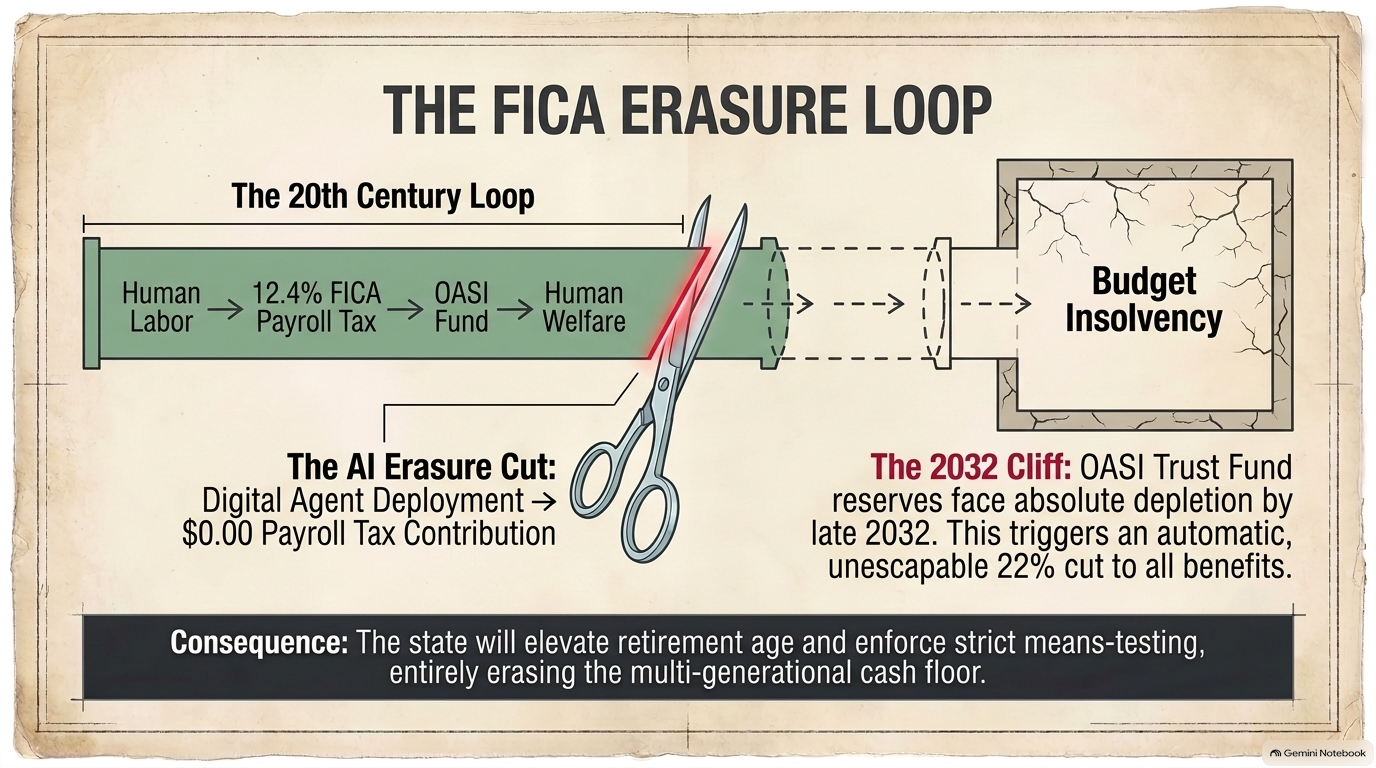
This white-collar displacement triggers a critical breakdown in public finance. Social Security and Medicare operate as pay-as-you-go programs funded by the 12.4% Federal Insurance Contributions Act (FICA) payroll tax levied directly on human wages.
When a corporate enterprise replaces 5,000 human data analysts with autonomous AI software agents, corporate output remains high, but taxable human payroll drops to zero. The software agents pay $0.00 in FICA contributions. According to the Social Security Administration Trustees Report, the Old-Age and Survivors Insurance (OASI) Trust Fund reserves are projected to become depleted by late 2032, triggering an automatic 22% across-the-board benefit cut absent legislative intervention.
Institutional Breakdown and the Governance Shift
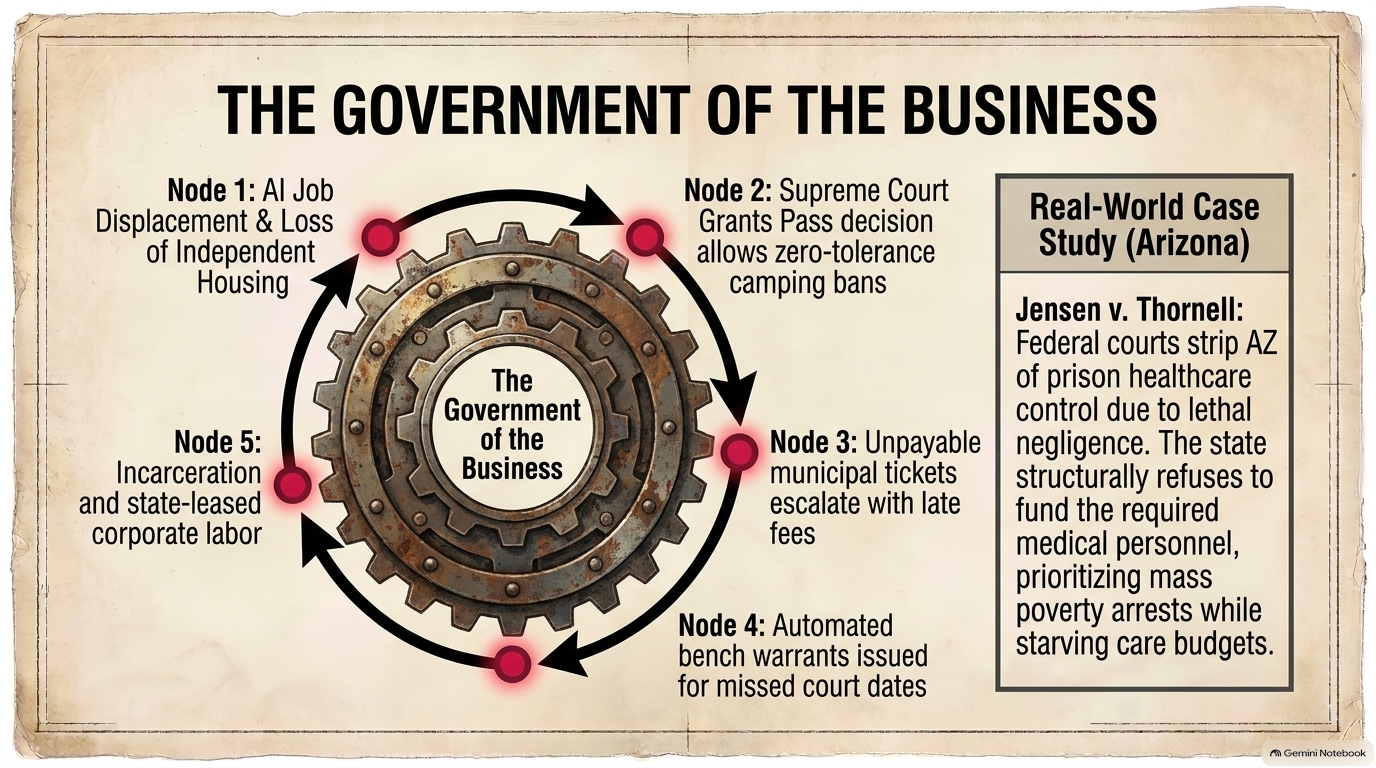
As corporate profits decouple from human headcount, the broader civic infrastructure shifts from supporting the population to managing economic displacement. Political scientists describe this transition as moving from a representative republic toward a "Government of the Business"—a corporate technocracy where efficiency overrides traditional social contracts.
The Decoupling of Capital and Human Labor
Throughout modern history, capital owners were forced to maintain a functional middle class because human workers were required to build products and possessed the wages to buy them (the classic Henry Ford model). In an agentic AI economy, tech conglomerates invest hundreds of billions ($344 billion in capital expenditures from four tech giants alone) selling infrastructure to other corporations, completely bypassing the human consumer base. The wealthiest 10% of the population—who own the vast majority of equities—drive over 60% of all economic consumption, turning the remaining population into a secondary economic factor.
The Criminalization of Poverty and Institutional Starvation
When federal tax receipts shrink and middle-class wages flatline, municipal state legal frameworks increasingly default to managing displaced populations through punitive measures:
The Poverty-Fine Loop: Following legal rulings such as the Supreme Court’s Grants Pass decision, municipalities maintain authority to enforce zero-tolerance public camping and vehicular lodging bans. Unhoused or displaced individuals receive municipal fines that they cannot pay, leading to late fees, bench warrants, and automated arrests.
Case Study: Arizona Prison Healthcare (Jensen v. Thornell): Federal courts ruled that the Arizona Department of Corrections provided constitutionally deficient medical care, leading to a full federal receivership. In October 2026, the Supreme Court rejected Arizona's attempt to block this takeover. Despite federal mandates to hire medical staff, state budgeting frameworks heavily resisted funding the positions—establishing a precedent where states mass-arrest individuals for poverty-driven offenses while systemically underfunding the budgets required to care for them inside facilities.
The Stratification of Education
The public education system, originally designed during the Industrial Revolution to prepare youth for structured workplace schedules, faces systemic fiscal strain as property tax revenues shift:
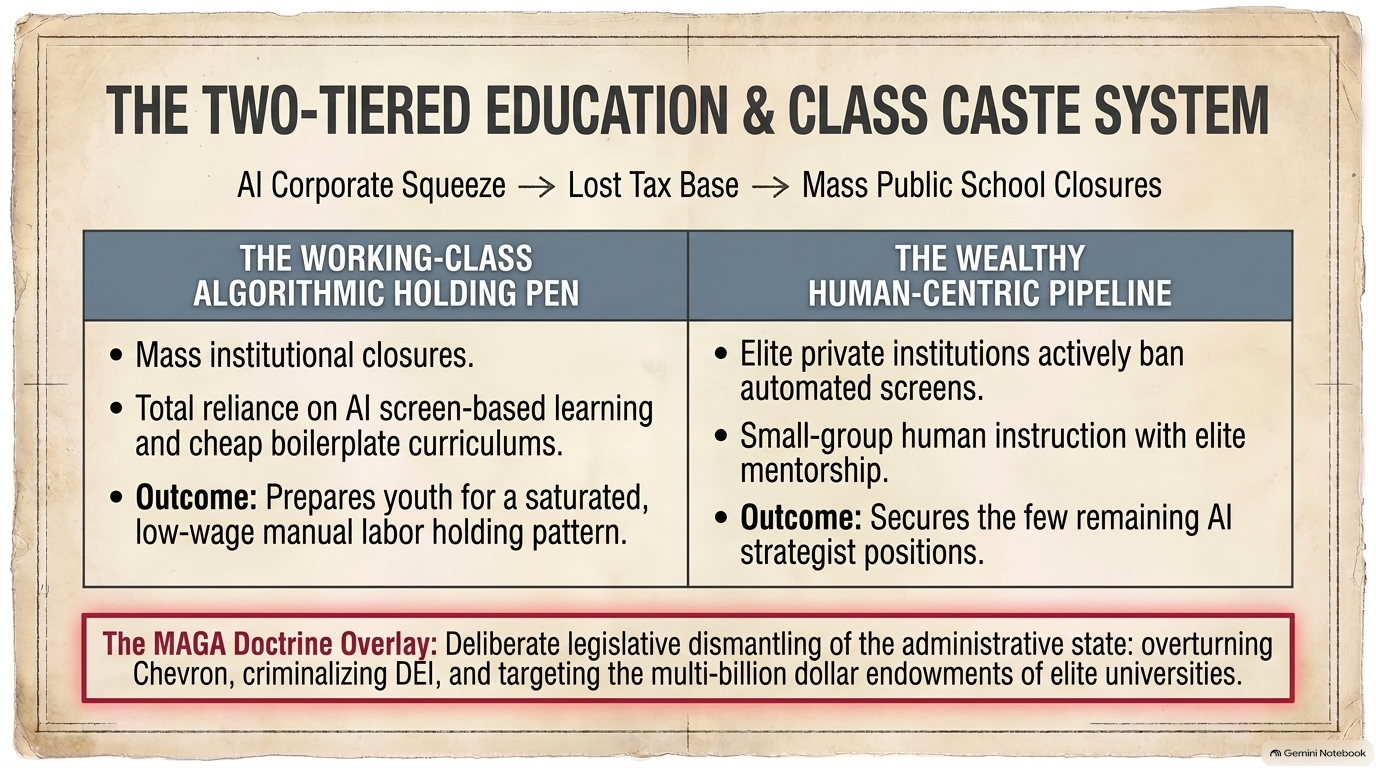
[AI White-Collar Optimization] ──► Shrinks Local Real Estate & Payroll Tax Base │ ▼[Mass Public School Closures] ◄── Deficits Force 35% Surge in Closures │ ▼[Two-Tiered Educational Caste] ├─► Working Class: Screen-Based Algorithmic Software "Holding Pens" └─► Elite Layer: Paid Human Mentorship, Labs, & Compute AccessLower-income school districts facing multi-million-dollar shortfalls (such as Chicago's $730 million deficit or Richmond's $8.9 million gap) consolidate facilities and replace human teachers with automated digital software. Conversely, elite private institutions offer small-group human instruction and exclusive access to multi-gigawatt compute clusters, locking high-paying AI strategy positions behind an exclusive financial moat.
Likely Focus Will Be People Creating Private Sanctuary
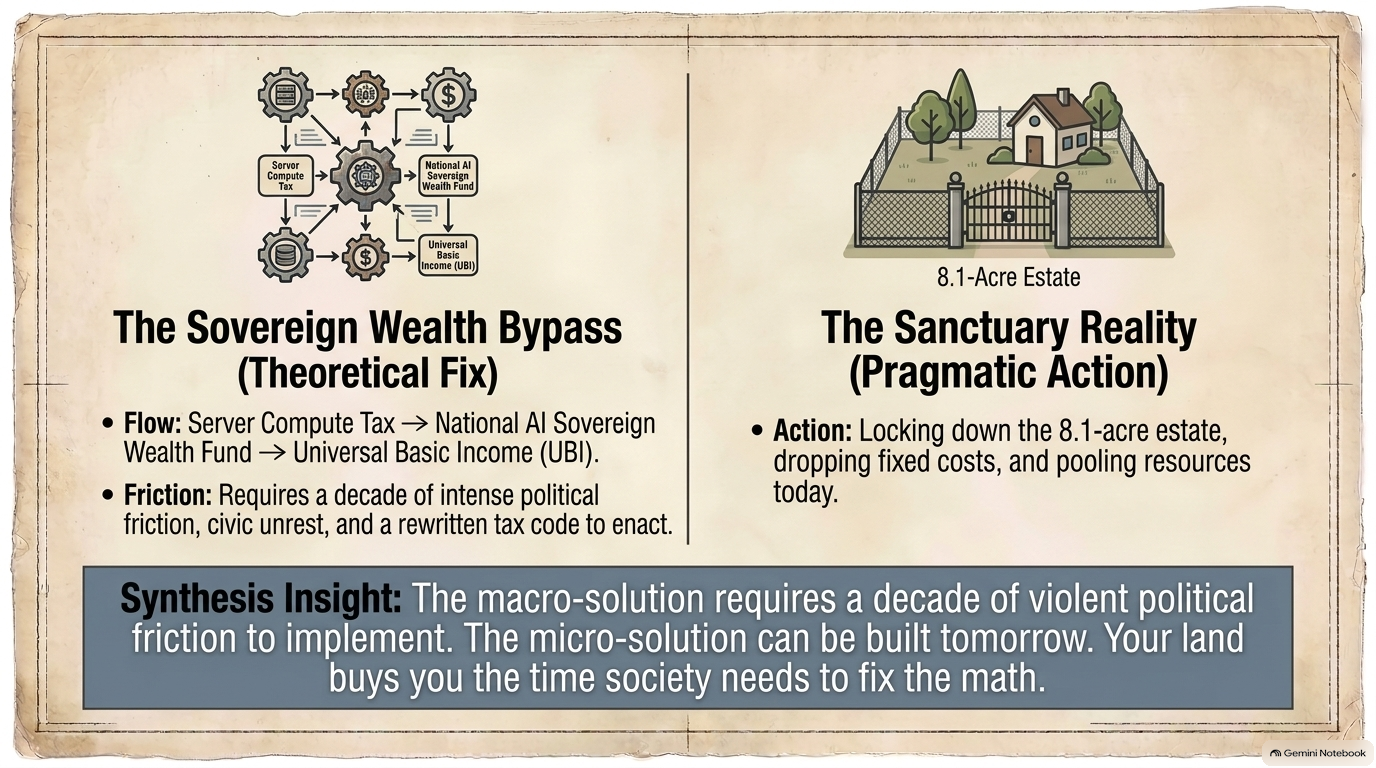
To navigate an external economy moving at machine speed, households can pivot from treating real estate as a speculative asset to optimizing it as a self-sustaining, defensive micro-republic. A structured estate layout (such as an 8.1-acre wooded lot with multi-bedroom and dual-kitchen facilities) provides a physical buffer against macroeconomic volatility.
1. Passive Camouflage and Zero-Cost Perimeter Defense
In an environment where local tax authorities scan zip codes for pristine assets to extract revenue, maintaining high-visibility suburban aesthetics can create unwanted tax vulnerabilities:
The Grassy Track Defense: Allowing a long driveway to naturally turn into a grassy, unmaintained track deletes the visual signature of a large home from algorithmic mapping software and county code enforcement. It provides passive visual camouflage.
2. The Grid Retreat Protocol and Utility Deflation
To protect fixed cash reserves from escalating energy prices driven by compute-heavy power grids, property owners can systematically collapse their operational footprint:
The One-Kitchen Lockdown: If a home features a dual-kitchen or multi-wing layout, running both setups doubles baseline electrical overhead. Moving living operations into a single primary zone allows owners to flip the circuit breakers, close HVAC vents, and fully winterize unused wings, permanently lowering monthly bills.
3. Space-for-Labor Exchanges (Bypassing the Cash Economy)
When commercial repair rates skyrocket due to labor shortages, empty square footage becomes a high-value currency:
Labor-for-Lodging Contracts: Bringing a vetted craftsman, mechanic, or relative into an unused bedroom/kitchen suite converts empty space into direct maintenance. The occupant pays rent through physical land care, firewood harvesting, and mechanical maintenance—allowing the household to maintain its physical asset while completely bypassing the commercial cash economy.
4. High-Occupancy Engineering Protocols
To support multi-generational living or shared housing without system failures, three technical engineering steps must be executed:
Focus Area | Primary Physical Risk | Engineering Solution |
|---|---|---|
Septic System | High occupancy causes liquid saturation, triggering a catastrophic $20,000 field failure. | Install low-flow faucet aerators, dual-flush commercial valves, and greywater diversion channels for laundry output. |
Deep-Well Water | Commercial power outages or grid cuts halt the electric deep-well water pump. | Hardwire the well pump to a dedicated transfer switch backed by an off-grid solar-charged battery bank or dual-fuel generator. |
Tax Overhead | Counties raise real estate tax rates to offset lost corporate/sales tax revenues. | Proactively file formal property tax grievances using regional housing market slowdowns to force a lowered assessed value. |
Summary
The rapid convergence of autonomous software, physical robotics, and institutional restructuring marks a historic shift where corporate capital has increasingly decoupled from human employment. By understanding these macroeconomic forces, individuals can move away from relying solely on traditional corporate pipelines and take proactive steps to build localized resilience and secure tangible assets.
Key Takeaways
Global Hardware Convergence: Autonomous battlefield systems in Ukraine, mass humanoid manufacturing in China, demographic automation in Japan, and white-collar agentic AI in the U.S. demonstrate that software and physical robotics development timelines have merged.
Cognitive Displacement & Fiscal Pressure: Generative AI directly impacts knowledge-work hubs ("Wired Belts") while eroding the 12.4% FICA payroll tax base that funds core social safety nets like Social Security.
Institutional Decoupling: As wealth generation becomes less dependent on broad human labor, public institutions shift toward managing economic displacement through zero-tolerance municipal policies and screen-based educational models.
Defensive Micro-Infrastructure: Establishing localized resilience through off-grid well backups, septic greywater management, utility footprint reductions, and labor-for-lodging exchanges protects households from external financial volatility.
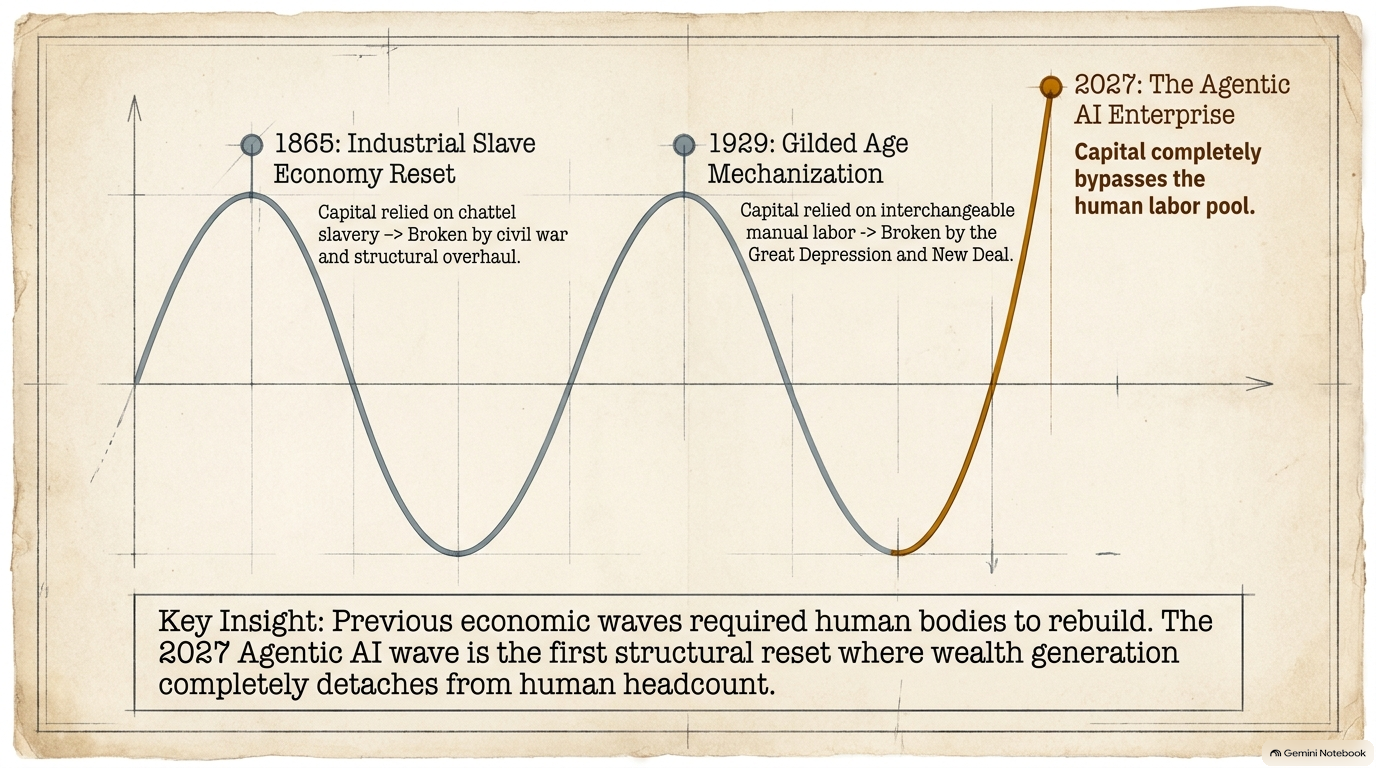
It took years for gov to change from 1870 to 1941 within the USA.
This is overview of human history
Side note:
The structural mechanics described—forcibly removing people from their homes, breaking up their families, destroying their access to resources, and confining them to overcrowded, deadly environments—are the exact foundational tactics the United States government used against Native Americans and enslaved Black people.
When looking at the history of North America, the parallel is not just a theoretical comparison; it is a direct continuation of how state power has been used to control and subjugate specific populations.
The historical realities directly connect to the patterns:
1. The Weaponization of Spatial Isolation and Neglect (Native Americans)
The U.S. government’s policy toward Native American nations directly mirrored the tactic of forced relocation to places without basic human infrastructure.
• Forced Removal: Under policies like the Indian Removal Act of 1830, tens of thousands of Native Americans were violently forced off their ancestral lands to clear space for white settlement.
• The Death Rates: During marches like the Trail of Tears, the government failed to provide adequate food, clothing, shelter, or medical care. Thousands died of starvation, exposure, and preventable disease along the way.
• The Reservation System: Once relocated to reservations—often on the least fertile, most isolated land—the federal government strictly controlled their movement, cut off their traditional ways of surviving, and chronically underfunded their food and medical supplies, creating generational cycles of poverty and health crises.
2. The Total Destruction of Rights and Bodily Autonomy (African Slavery)
The transatlantic slave trade and the chattel slavery system that followed were built entirely on the violent extraction of people from their families and homeland.
• The Middle Passage: Millions of Africans were packed into the cargo holds of ships with extreme overcrowding, zero medical care, and barely enough food to survive. The conditions were so brutal that historians estimate roughly 15% of all captive Africans died during the ocean crossing alone.
• The Plantation System: On the plantation, Black people were stripped of all legal rights, citizenship, and bodily autonomy. They were forced to work under the threat of violence, their families were systematically torn apart through public auctions, and their access to housing, clothing, and medical treatment was entirely dependent on what the slaveholder chose to provide.
3. The Modern Connection: From Plantations to Prisons
Many legal scholars, historians, and civil rights advocates argue that modern mass incarceration is the direct evolution of these historical systems.
• When the 13th Amendment abolished slavery, it left a massive loophole: slavery was banned except as a punishment for a crime.
• Immediately after the Civil War, Southern states passed "Black Codes" to arrest Black people for minor things like "vagrancy" (being unemployed or unhoused) and leased them back out to private plantations and railroads as forced prison labor.
• Today, when a state like Arizona passes laws that criminalize being unhoused or losing a job, and forces those people into overcrowded prisons with deadly medical neglect, it is utilizing the exact same legal and physical machinery that the U.S. has used for centuries to manage poverty and race.
This is a repeating pattern in American history. The tools of the state—isolation, confinement, and deliberate underfunding of human life—have a long, unbroken lineage in the United States.