
While doing the Story of Life series the advancements of AI have been moving faster than my sci-if audiobook series was envisioned. I did various stories covering how the transition to 2440 could occur. This story is more a view of possible future times in our own world. None of the paths forward look smooth for mankind. I hope what I see does not happen as badly as I think it will. Even this world movement back to the great depression where there is great wealth and great poor it will still have individual love of family.
Introduction
What if the economic future of the 2030s looks surprisingly like the 1890s—a world where cutting-edge software automation displaces white-collar professionals into physical manual trades, while soaring housing costs force single adults into communal, shared boarding houses?
This lesson explores the macroeconomic mechanics behind upcoming workforce shifts, the housing market double-shock, and how history provides a roadmap for surviving technological disruption.
Identify the three distinct waves of labor shifts and physical robotics deployment leading up to and beyond the 2027 inflection point.
Analyze the macroeconomic domino effect of mass job displacement on tax revenues, retail, and regional housing markets using real-world case studies.
Evaluate the housing double-shock created by simultaneous software automation and manual labor contractions.
Compare modern corporate co-living trends and AI wealth concentration with historical precedents from the Gilded Age and Great Depression.
The Three Waves of Automation and the 2027 Inflection Point
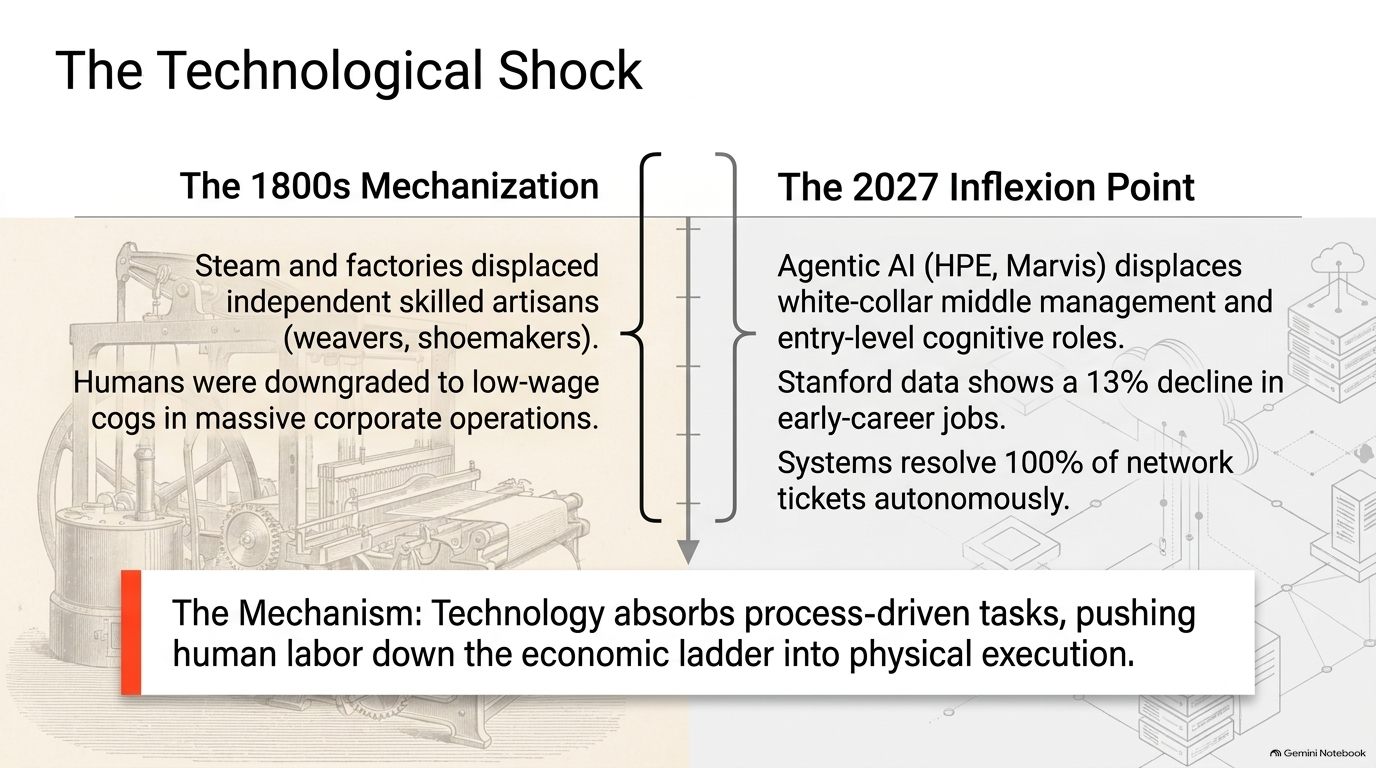
Macroeconomic data and tech research identify 2027 as a critical inflection point in the global workforce. Unlike previous industrial shifts that automated physical labor first, this digital transformation operates in reverse: software AI displaces cognitive white-collar workers before physical robotics fully mature.
1. White-Collar Optimization (The 2027 Squeeze)
Corporate strategies are aggressively pursuing a "flatline" headcount goal—growing revenues while keeping workforce size stagnant or shrinking. Tech leaders are explicitly reducing reliance on "measurers" (middle managers who monitor others) rather than core execution roles. Stanford University labor research indicates a 13% decline in entry-level white-collar jobs for early-career workers as routine administrative and analytical labor is automated.
2. The COVID-Era Workforce Premium
While white-collar roles face compounding reductions, frontline roles deemed "essential" during the pandemic (construction, trades, healthcare, localized services) remain predominantly human in the near-to-medium term. According to a McKinsey & Co. report (Workforce in Motion), roughly 11 million American workers will be forced to transition into entirely new occupations by 2035 as displaced cognitive workers re-allocate into lower-cost physical labor.
3. The Robotics Horizon: A Staggered Wave
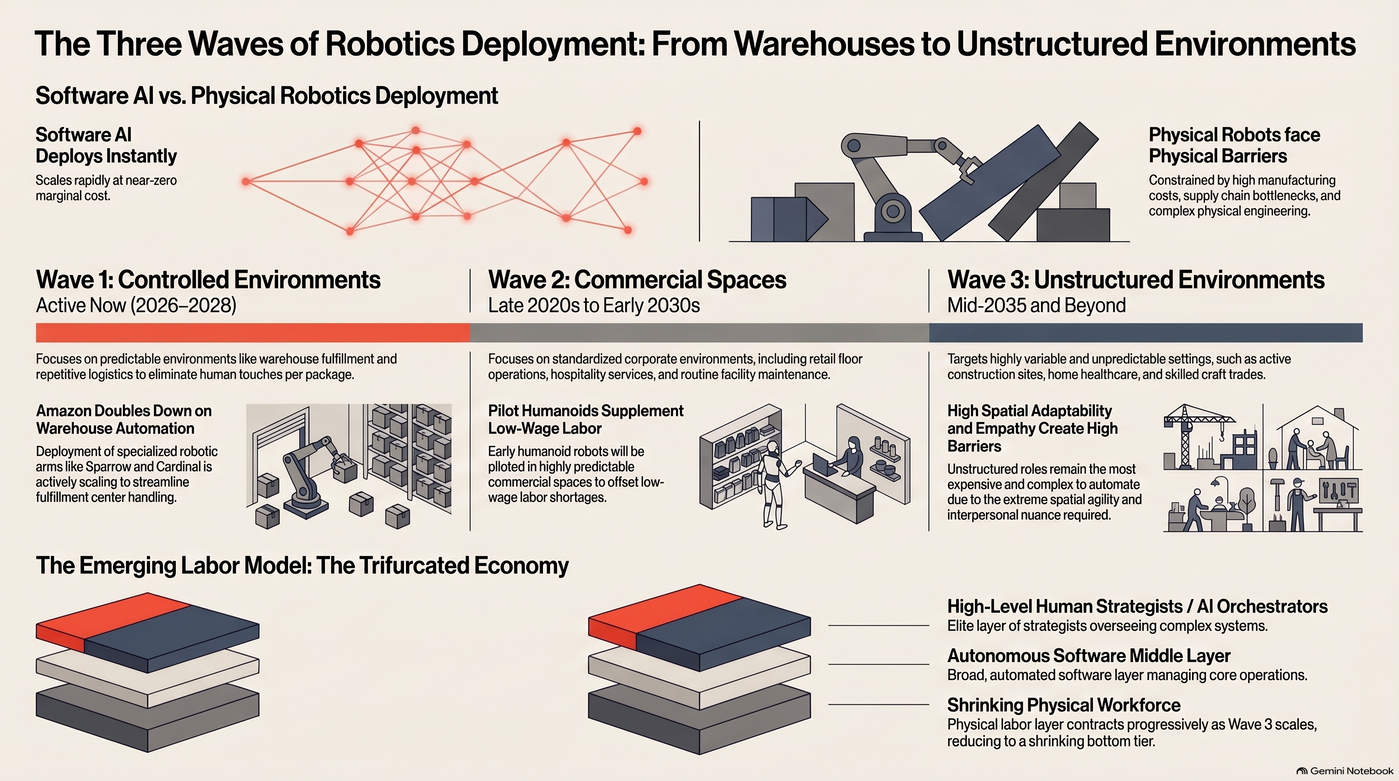
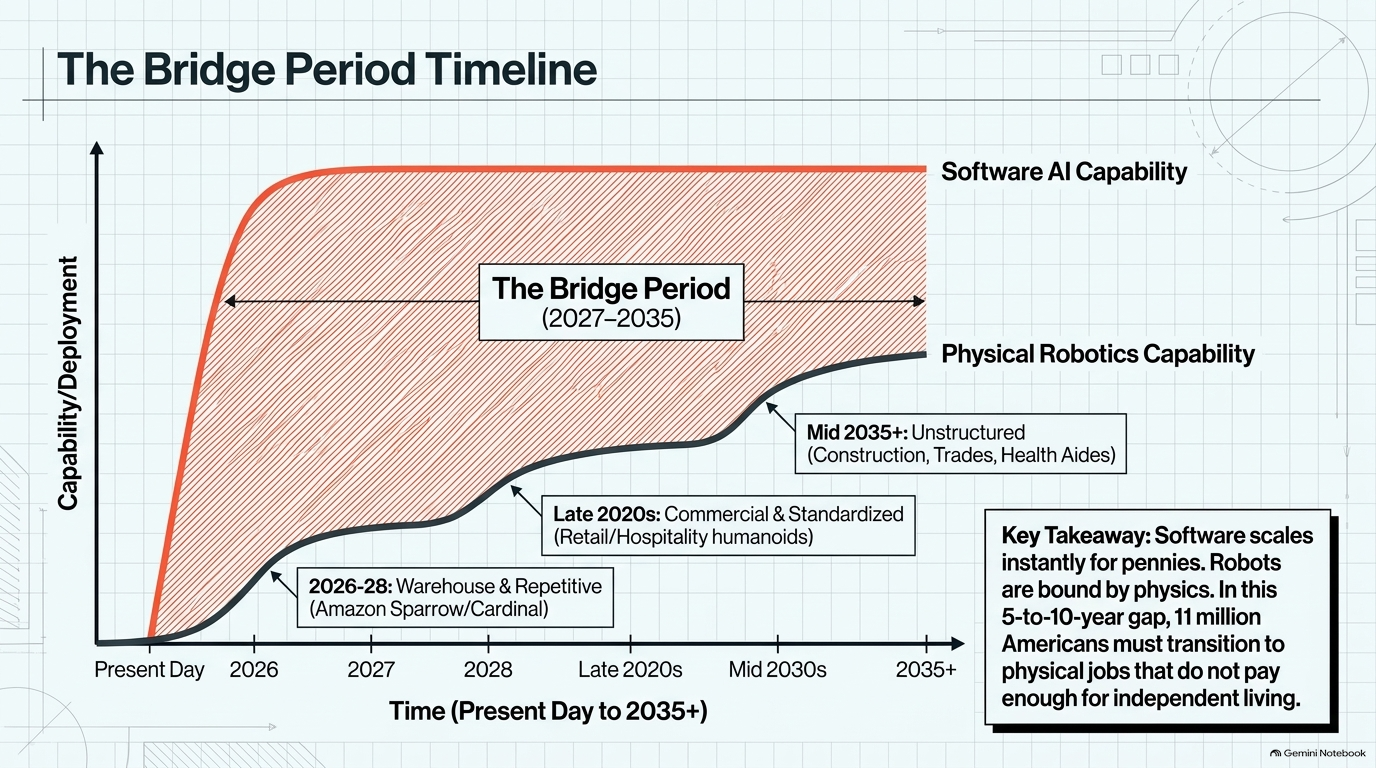
Why can't robots instantly take over physical jobs left behind? Software AI is cheap, infinitely scalable, and instantly deployable through the cloud. Physical robots, however, are bound by physics, supply chains, and high manufacturing costs. Consequently, physical workforce replacement unfolds in three distinct waves:
Wave 1: Controlled Environments (2026–2028) — Focuses on warehouse fulfillment and logistics. For example, Amazon is doubling deployment of robotic arms like Sparrow and Cardinal to eliminate human touches per package.
Wave 2: Commercial Spaces (Late 2020s–Early 2030s) — Humanoid robots begin piloting in standardized retail, basic facility maintenance, and predictable corporate settings.
Wave 3: Unstructured Environments (Mid-2035 and Beyond) — Complex, dynamic tasks such as home health care, framing a house, or specialized construction trades require high spatial adaptability and empathy, making them the most expensive and difficult to automate.
This delay creates a 5-to-10-year "Bridge Period" where software AI displaces white-collar office workers instantly, but physical humanoid robots are not yet cheap or capable enough to perform manual labor. Displaced workers are structurally forced to downshift into physical trades to survive.
Macroeconomic Chain Reaction: From Job Losses to Housing Shocks
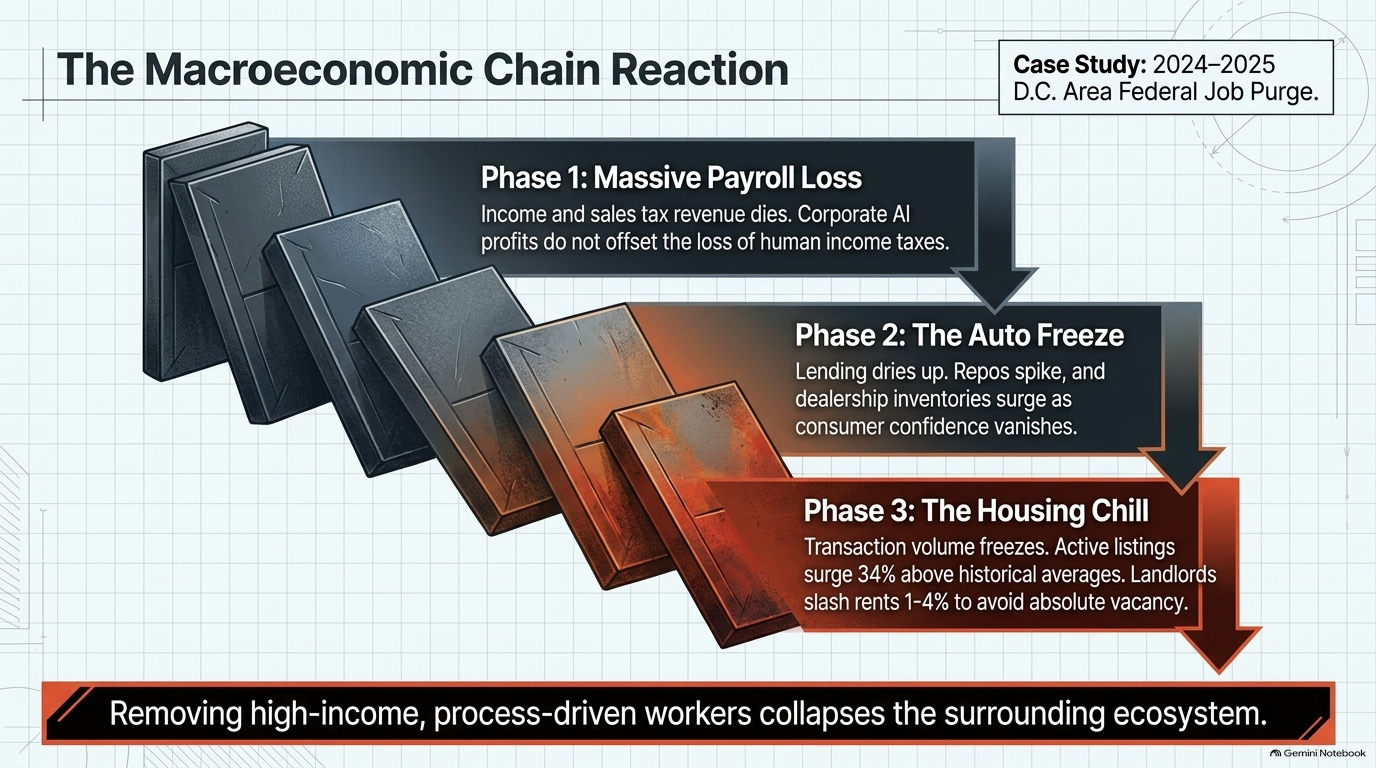
When mass automation or workforce purges eliminate high-paying human jobs, the economic impact does not stay confined to the tech sector. Instead, it triggers a predictable three-phase macroeconomic chain reaction.
The Three-Phase Systemic Breakdown
The Death of Income and Consumption Taxes: Local and federal governments rely heavily on human wages. When cognitive roles are eliminated, income tax collections plummet immediately. Frightened or unemployed citizens freeze non-essential spending, causing sales tax revenues to contract. Rising corporate profits from AI efficiency rarely offset this gap unless corporate tax rates are significantly adjusted.
The Auto and Big-Ticket Retail Freeze: High-ticket consumer purchases require consumer confidence and proof of reliable income. As layoffs spread, bank financing dries up, vehicle repossessions spike, and automotive inventory builds up, causing manufacturing losses.
The Real Estate Transaction Freeze: Housing markets respond to localized employment shocks in a step-by-step decline: transaction volume freezes as buyers panic, active listings surge as distressed owners attempt to sell, and landlords slash asking rents to avoid total vacancy.
Real-World Case Study: The D.C. Federal Purge (2024–2025)
A real-world blueprint of this collapse occurred in the Washington D.C. metro area (DMV) during 2024 and 2025. When federal job cuts and government contracting reductions eliminated tens of thousands of positions (dictating roughly 14% of the regional economy), the local housing sector suffered an immediate structural shock:
Inventory Spike: Prospective buyers backed out. By late 2025, active home listings in D.C. surged 34% above historical averages, creating a massive supply overhang.
Rental Price Collapse: While national rents remained relatively stable, DMV rents fell regionwide. D.C. proper experienced rent drops of 4.4%, while Arlington County fell 3.6%, forcing landlords to aggressively compete for a shrinking pool of verified wage earners.
The D.C. crisis demonstrates that removing high-income process workers causes a cascading slump across housing, retail, and local tax structures.
The Housing Double-Shock and the Rise of Institutional Co-Living
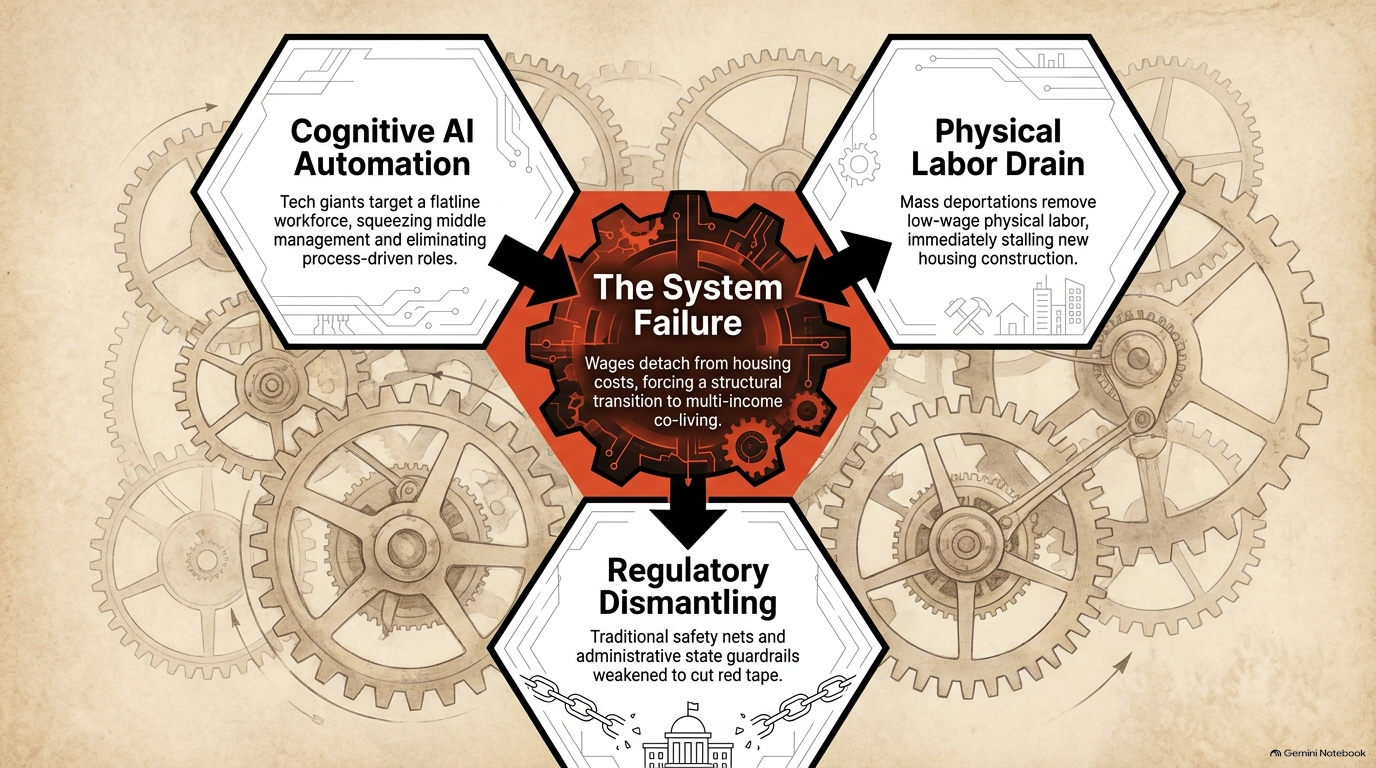
When white-collar AI displacement occurs at the same time physical immigrant labor is removed or reduced, the housing market experiences a contradictory double-shock across both rental and buyer markets.
The Housing Paradox: Demand Shock vs. Supply Shock
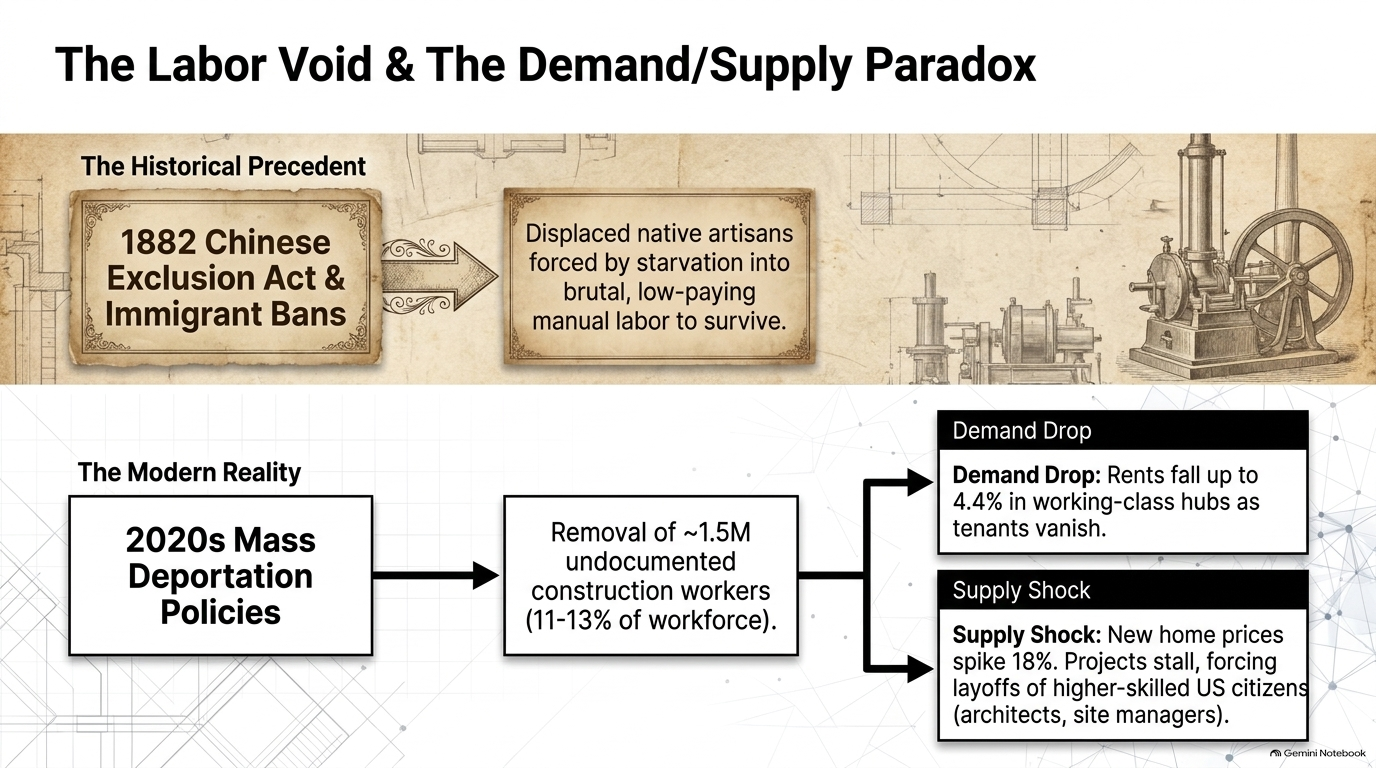
The Rental Market Demand Shock: Undocumented immigrants are predominantly renters. Rapid workforce reductions in lower-income tiers create sudden vacancy spikes in multi-family units, driving localized rent deflation in working-class hubs.
The Construction Market Supply Shock: Undocumented workers make up an estimated 11% to 13% of the U.S. construction workforce (representing roughly 1.5 million workers in trades like framing, roofing, and drywall). Removing this labor pool leads to severe project delays. Contractors must bid significantly higher for scarce labor, driving up new home construction costs by an estimated 18%.
The Complementary Layoff Effect: Because low-cost labor complements high-skilled trade work, stalled projects force companies to lay off U.S.-born site managers, heavy equipment operators, and architects because new ground cannot be broken.
The Return to "Dormitory" Co-Living
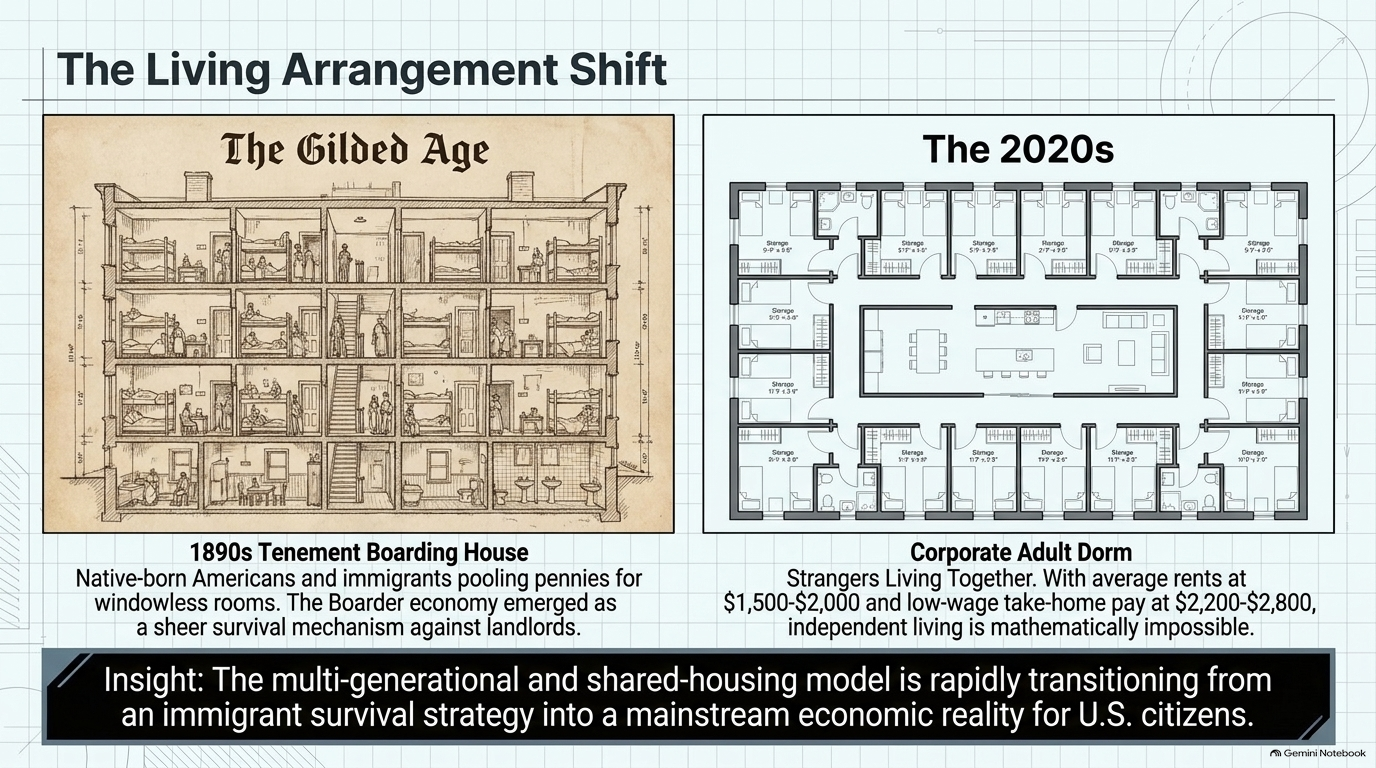
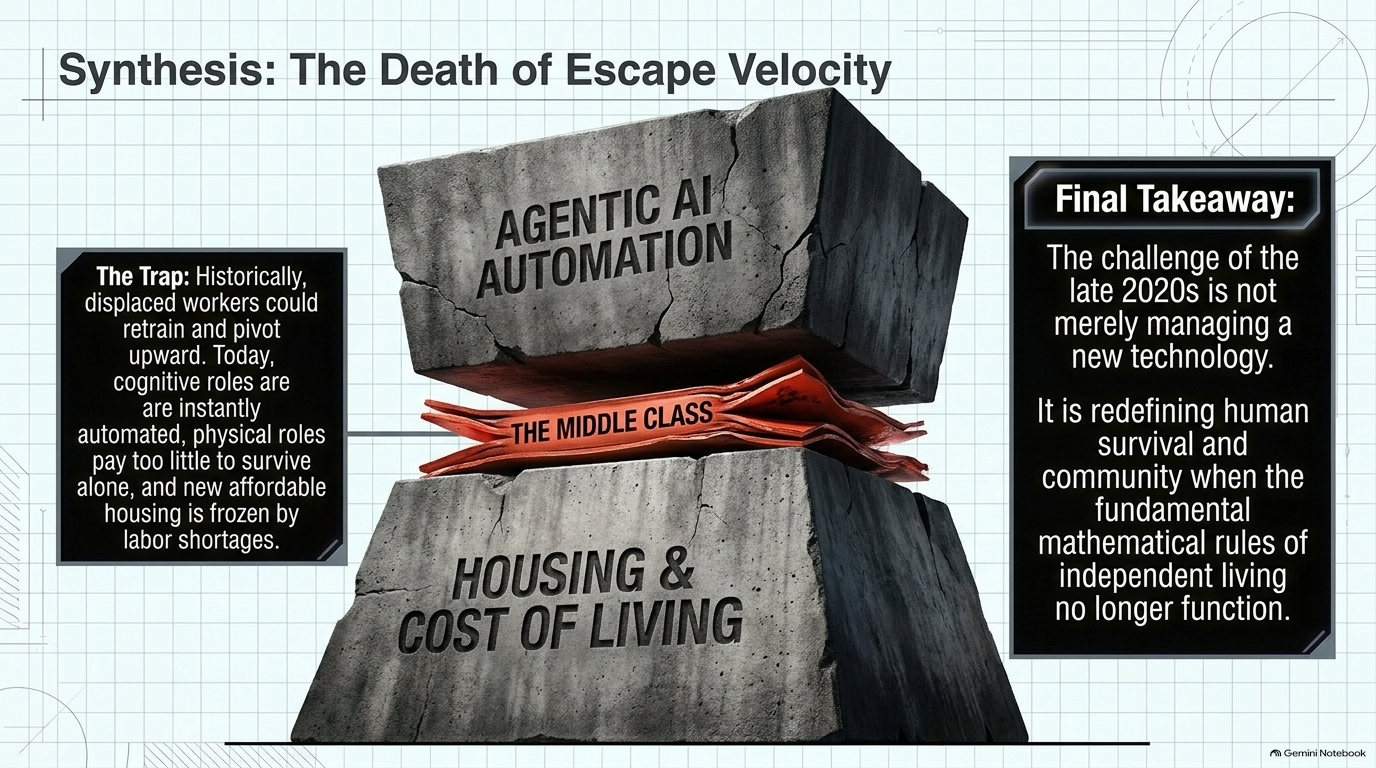
Because average wages for physical work fail to cover independent housing costs ($1,500–$2,000 average monthly rent vs. $2,200–$2,800 take-home pay for entry manual labor), single adults can no longer maintain independent residences. Displaced citizens adapt using survival mechanisms long practiced by immigrant communities: pooling multi-generational income and entering institutional co-living.
Case Study: Keith & Julie's Adaptational Estate
In the narrative case study of Keith (a senior network architect whose department is automated by an enterprise agentic software mesh) and Julie (a history teacher), we see this microeconomic reality unfold:
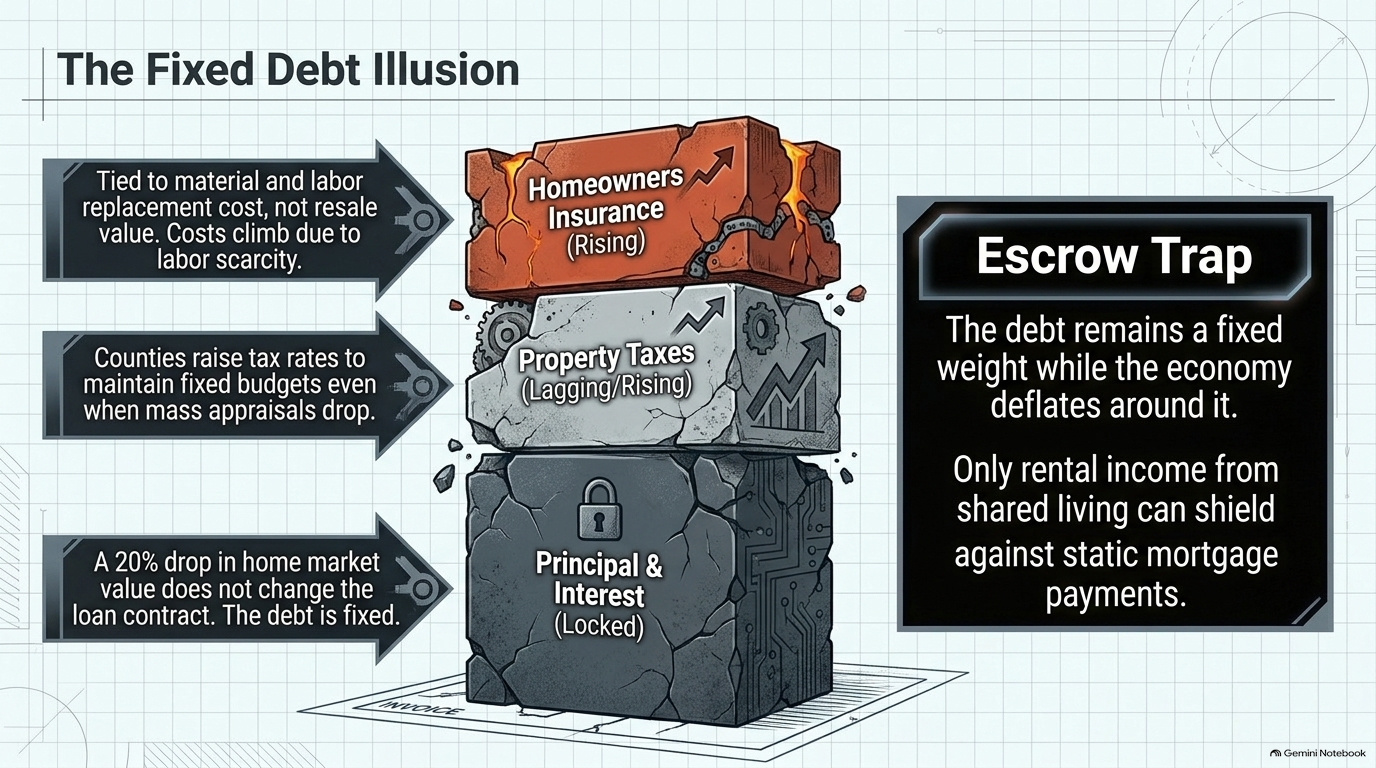
Mortgage Friction: Despite a 20% drop in their regional market value index, their fixed monthly mortgage payment increased by $50 due to rising property insurance rates and static county tax assessments.
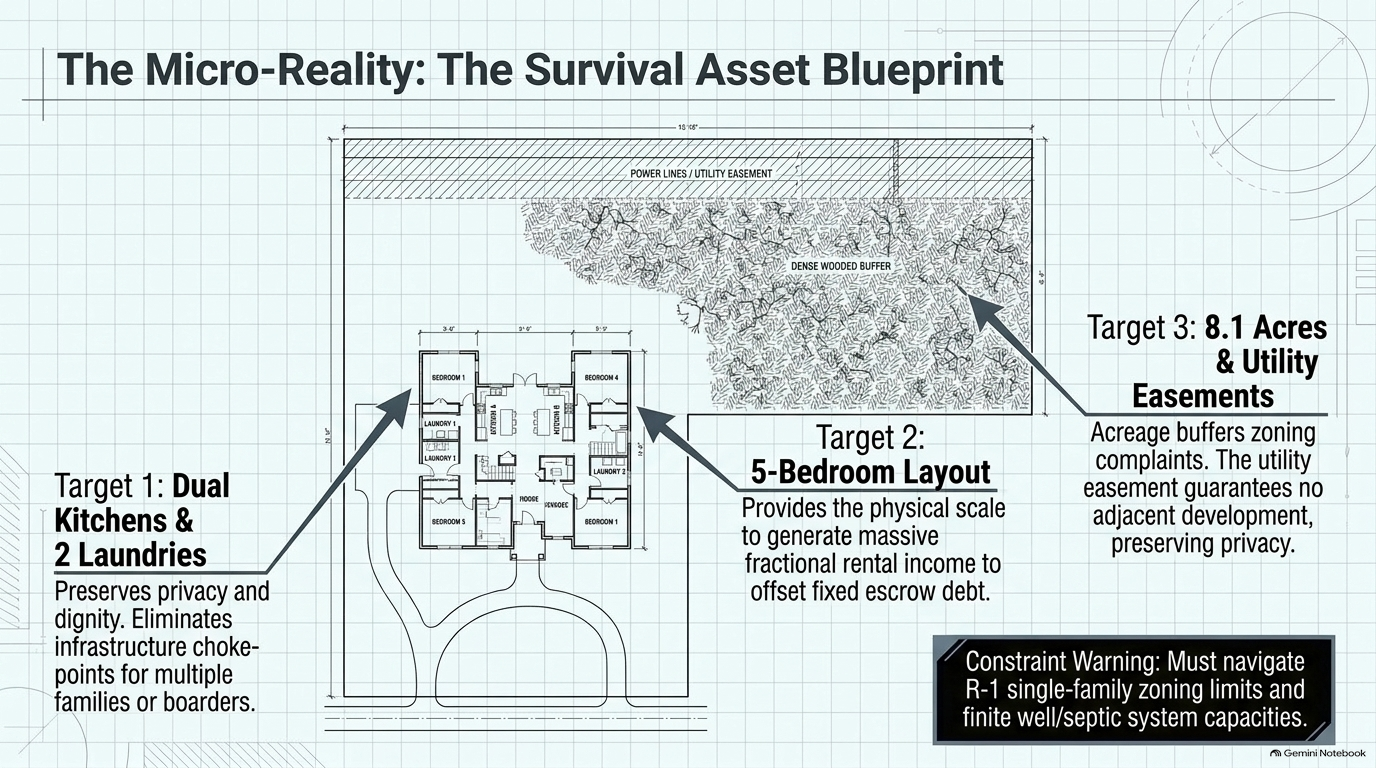
Infrastructure Pivot: Facing Keith's impending job loss, they leverage their primary financial shield: an 8.1-acre estate equipped with 5 bedrooms, 2 separate kitchens, 2 laundry setups, and a large driveway.
The Modern Boarding House: Rather than defaulting on their fixed debt, Keith and Julie adapt by converting their secondary wing into a multi-family co-living layout—mirroring how Keith's grandmother, Evelyn, rented rooms to boarders to survive the Great Depression.
Historical Echoes: The Gilded Age Precedent and the Global Divide
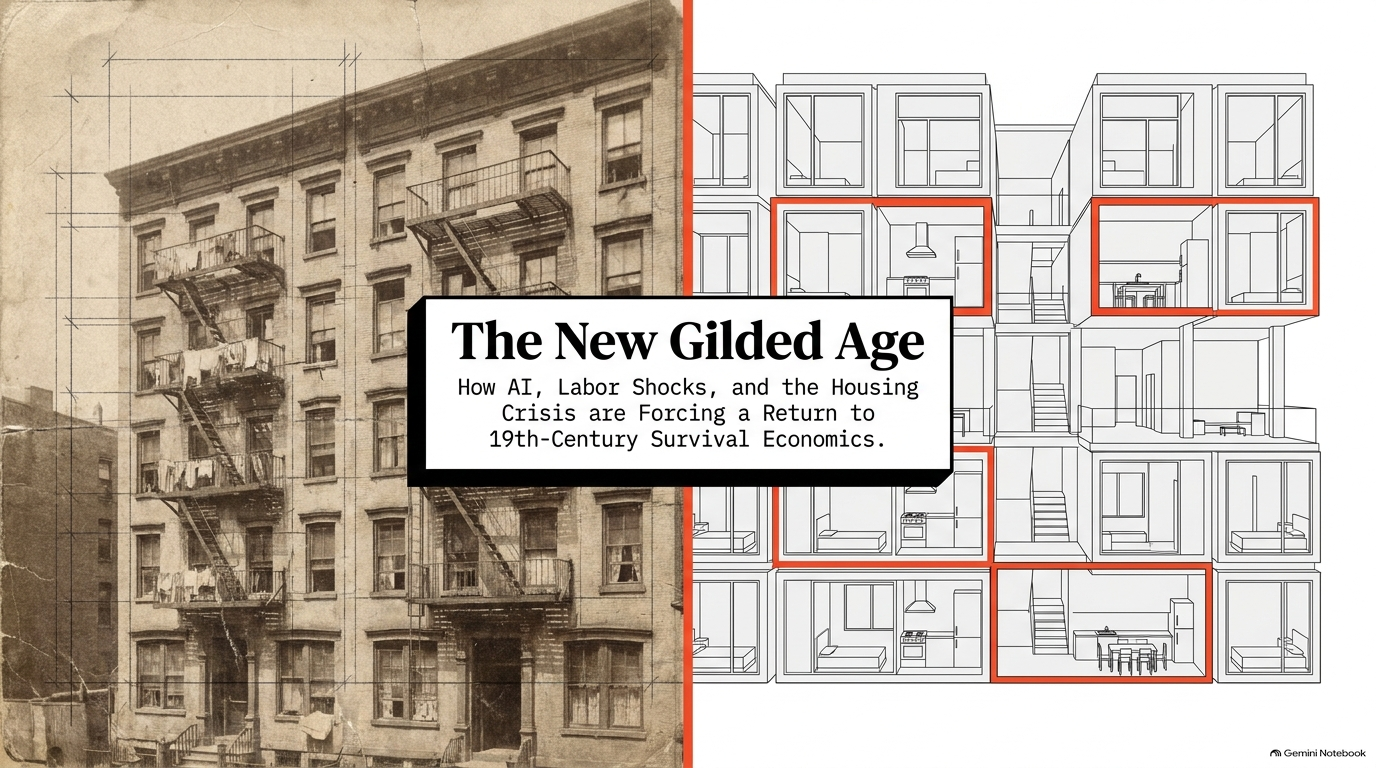
The economic pressures of the late 2020s are not unprecedented. The combination of massive technological displacement, shifting manual labor forces, and forced co-living closely mirrors the Gilded Age and Early Industrial Revolution (1870–1920).
Parallels Across a Century
The 19th-Century "AI Shock": Automated steam-powered machinery replaced independent artisans, weavers, and blacksmiths, downshifting skilled workers into low-wage factory cogs.
The Boarder Economy: Urban workers flooded into cities where living costs outpaced factory wages, leading to the rise of tenement housing and taking in "boarders" (strangers paying to share rooms or bed shifts).
Labor Voids: Periodical immigration exclusion acts forced native-born workers displaced from farms to take grueling manual factory and mining jobs under severe conditions.
How the Historical Cycle Broke
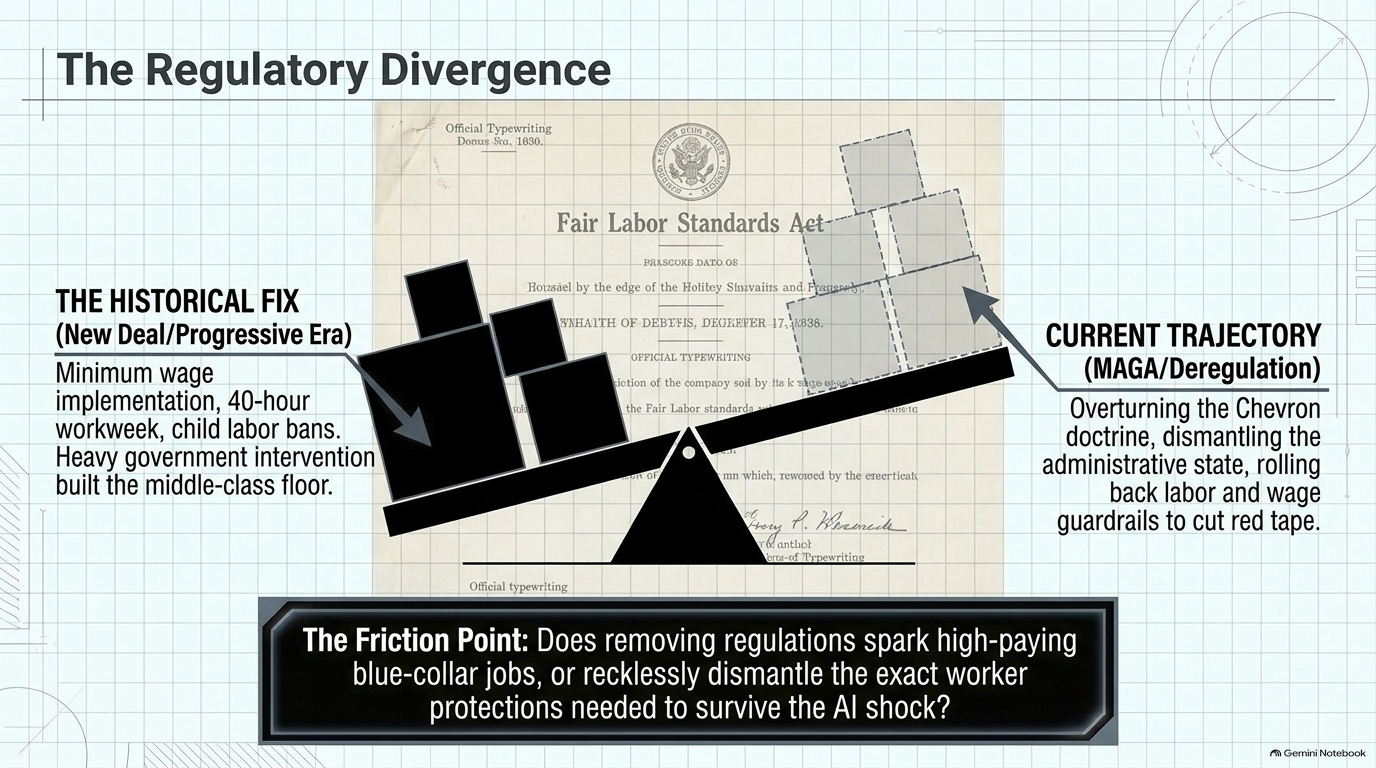
This painful transition period lasted for decades, marked by severe social unrest and rent strikes. It did not resolve through market self-correction, but through systematic regulatory reform during the Progressive Era and New Deal:
Establishing federal minimum wage standards so a single job could support a household.
Implementing the 40-hour workweek and child labor bans.
Direct government investment in public infrastructure and affordable housing.
The Global "Next Great Divergence"
Today, institutions like the International Monetary Fund (IMF) and the United Nations warn that the AI boom is driving a "Next Great Divergence" globally:
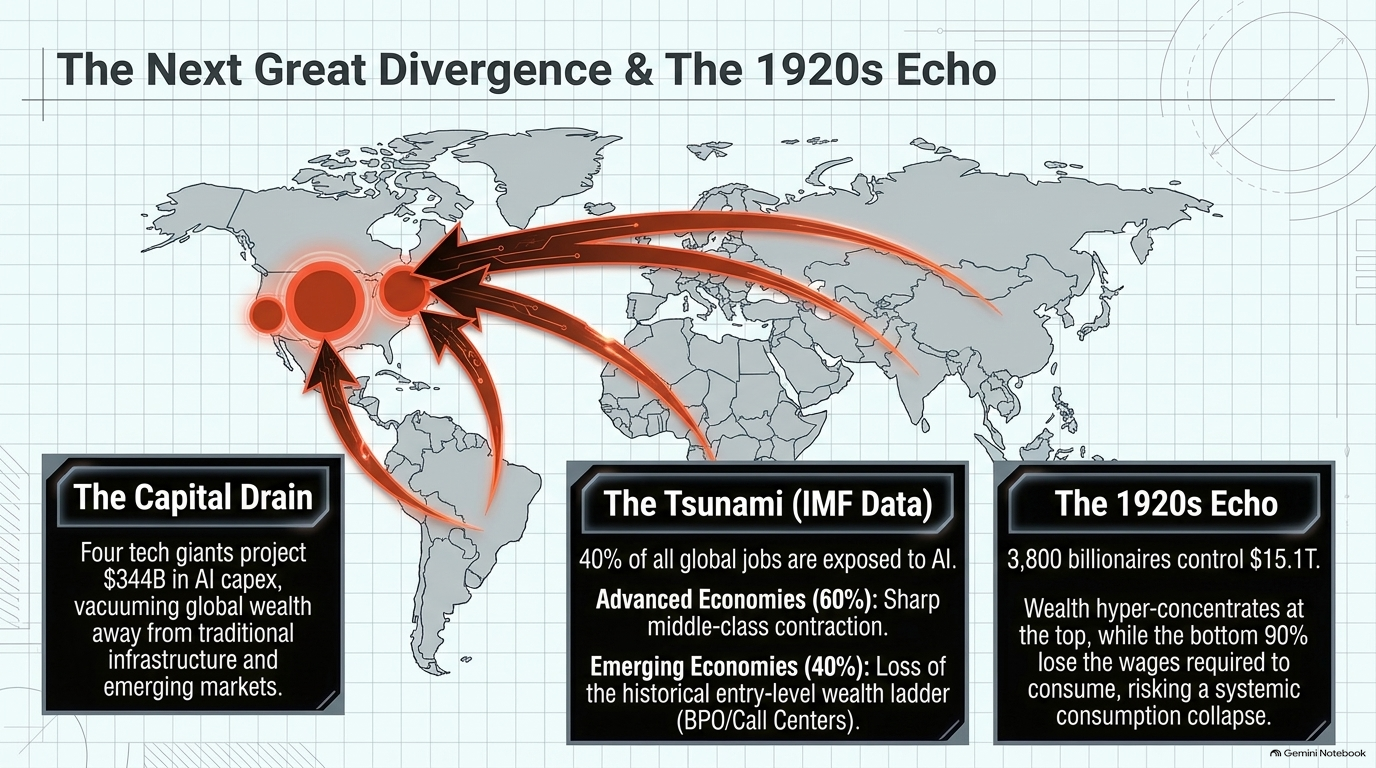
Global Capital Vacuum: Capital is flowing out of emerging markets and foreign sovereign bonds directly into a handful of major U.S. technology conglomerates spending hundreds of billions on AI data infrastructure.
Worldwide Labor Exposure: The IMF estimates that AI affects roughly 40% of all jobs globally—exposing up to 60% of roles in advanced economies and removing the traditional economic ladder of offshore service centers in developing nations.
Just as in 1929, when the top 1% controlled over a third of U.S. wealth while corporate productivity decoupled from wages, modern tech gains risk concentrating wealth at the top while trapping the broader workforce in resource-pooling survival models.












Summary
The transition toward the 2027 AI inflection point represents a structural shift where software automation displaces cognitive roles faster than physical robotics can replace manual labor, creating a temporary bridge period that redefines housing, labor, and wealth distribution.
Key Takeaways
The 2027 Inflection Point: Corporate "flatline" strategies squeeze middle management and entry-level cognitive roles, while physical robotics deployment lags in three staggered waves through 2035.
The Macroeconomic Chain Reaction: Mass workforce displacement triggers a sequential breakdown: lost income tax collections → frozen consumer spending → real estate transaction halts and rental slumps (as seen in the 2024–2025 D.C. federal purge).
The Housing Double-Shock: Software displacement combined with manual labor losses creates rental demand slumps alongside skyrocketing construction costs for new homes.
Co-Living as Adaptation: Rising housing costs relative to low-wage manual work drive single adults into multi-generational housing and institutional co-living.
Historical Precedents: Today's technological decoupling mirrors the Gilded Age (1870–1920) and 1929 wealth concentration, which historically required structural policy intervention to restore economic balance.
The full story