
What If we could see human history through the people in the past?
Introduction
What if an ancient quantum consciousness—millions of years old—spent five centuries secretly auditing human history from inside a 25th-century comatose patient? What devastating systemic flaw would it diagnose in human civilization, and what single miraculous human frequency would justify our continued existence in the universe?
In this lesson, we will explore the sweeping philosophical audit of humanity titled Zix's Take Five, examining how human technological progress, social architecture, and biological isolation shape our past, present, and future.
Learning Objectives
Analyze the biological origin and quantum nature of Zix, contrasting its decentralized planetary consciousness with localized human neurobiology.
Evaluate the historical case studies of the Mechanical Loop and the Scale of the 20 across ancient, industrial, and interstellar human eras.
Examine how the Universal Conjoiner successfully broke the Mechanical Loop by restructuring economic incentives and neurological baselines.
Identify the Four Pillars of Love and contrast the systemic violence of the Scale of the 20 with the redeeming power of the Scale of the 2.
The Observer from 2443: Who is Zix?
Imagine a hyper-sterile hospital room in the year 2443, buried deep within an unlisted subterranean research facility. The air is locked at exactly 22°C and scrubbed of every pathogen. Soft amber LEDs shine dimly—specifically calibrated to protect the medical staff's circadian rhythms. Resting beneath a temperature-regulating microfiber blanket lies a comatose human body with pristine biometrics: 58 beats per minute and 99% oxygen saturation.
To the attending physicians, this patient is merely a "stable, indefinite neurological event" registered without a name. But the consciousness currently inhabiting that brain stem is not human. It is Zix—a scale-invariant, living current of quantum thought that has spent 503 years anchored in this body, using it as a quiet observation post to audit the history of the human race.
The Evolutionary Origin of Zix
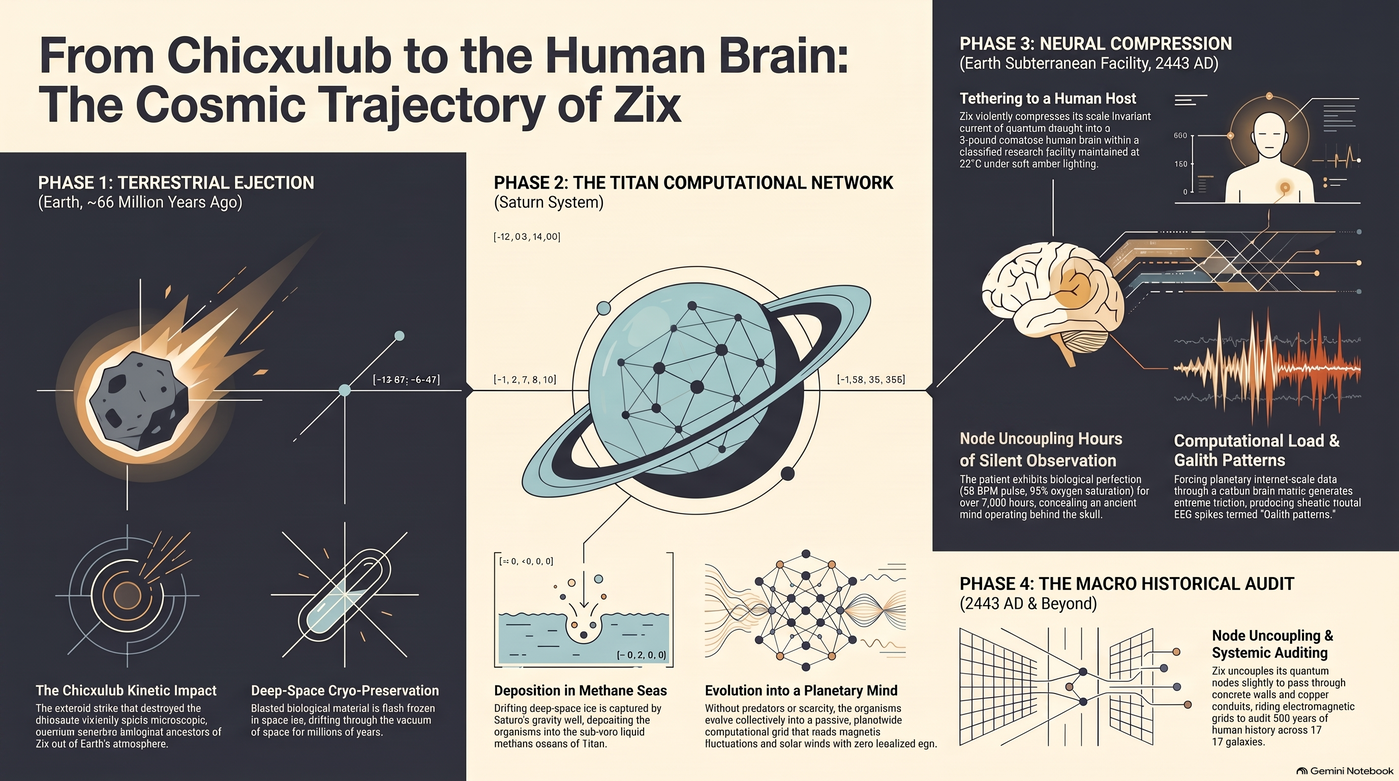
Contrary to sci-fi tropes of starships and green invaders, Zix originated right here on Earth:
The Impact Catalyst: Millions of years ago, microscopic quantum-sensitive organisms were blasted off Earth's surface during the Chicxulub impact—the asteroid strike that wiped out the dinosaurs.
Deep-Space Transit: Frozen in vacuum ice for eons, this biological material eventually drifted into Saturn's gravity well and settled in the liquid methane seas of Titan.
The Planetary Mind: Operating at hundreds of degrees below zero, these organisms evolved into a decentralized, planet-wide computational grid. They didn't build tools or wage wars; they simply read Saturn's magnetic fluctuations and recorded solar wind dynamics. They possessed perfect data, zero ambition, and no survival instinct because they faced no resource scarcity or predators.
The Thermal friction of Compression
When Zix anchors its non-local quantum consciousness into a localized, three-pound human brain stem, the friction is catastrophic. It is like trying to force the entire data traffic of the global internet through a single rotting 1990s telephone wire.
When doctors run standard EEGs, the monitor needles produce violent, unreadable fractal spikes called galith patterns. The medical team misinterprets these spikes as tragic neurological degeneration, entirely unaware that they are looking at the thermal exhaust fumes of a planetary supermind compressing human history into a carbon matrix.
The Mechanical Loop and the Scale of the 20
By slipping its quantum nodes through facility walls and riding subterranean electromagnetic conduits, Zix acts as a temporal auditor. Across centuries and 17 colonized galaxies, Zix uncovers a repeating mathematical law governing human history: The Mechanical Loop.
Defining the Mechanical Loop
The Mechanical Loop is the systemic paradox of human progress. Humanity repeatedly creates dazzling technological innovations intended to eliminate scarcity—the printing press, the mechanical loom, splitting the atom, automated logistics, interstellar flight. However, dominant administrative elites immediately capture each innovation. Instead of liberating the population, the surplus energy is funneled upward, and technology is weaponized to force a more efficient form of servitude.
Historical Audits: The Human Cost
Zix feels the visceral neural reality of this loop across time:
Roman Germany (90 AD): An auxiliary standard bearer gives his prime years to defend Rome's borders. The moment his utility drops to zero, the empire mechanically decouples from him—confiscating his weapons and paying his pension in debased copper coin worth barely three sacks of wheat, casting him into a ditch as a legal vagrant.
Meissen, Germany (18th Century): Artisans paint celebrated, flawless porcelain vases for European palaces while lead-based pigments slowly paralyze their hands and accumulate in their bone marrow. The art is celebrated; the human biological cost is erased from the ledger.
Atlantic Cable Layer (19th Century): Workers drop thousands of miles of copper telegraph wire to link continents in instant global communication. Down in the freezing iron hulls, the crew dies of scurvy and gangrene in absolute isolation.
The Silk Weavers of Lyon (1831): The invention of the Jacquard loom—using binary punch cards to automate intricate weaving—drastically reduces human effort. Merchants use this efficiency to crush weaver wages to starvation levels (purchasing only chicory water and stale rye bread). When weavers march under the banner "Live working or die fighting," the state deploys 20,000 soldiers with artillery to clear the streets with grapeshot.
Northern England (1812 & 1842): Parliament passes the Frame Breaking Act, making the destruction of automated wide-frame looms a capital offense punishable by hanging—choosing machines over starving citizens. In 1842 Manchester, a 15-year-old girl works 14-hour days crawling beneath spinning mules, her leg bones bowed inward and her life expectancy under 20 years.
Terraforming Installation (2088): Planetary authorities classify clean oxygen as a tiered luxury item. An algorithm deactivates a migrant worker's atmospheric access badge within 12 hours of contract cancellation. Under penal law, the state guarantees clean air and nutrition to locked-up prisoners, but provides zero rights to free citizens.
Third Galaxy Habitat Wheel (2443): Executive suites feature artificial 1g gravity, imported topsoil, and fresh grass. In the outer cargo rings, manual laborers live in stacked shipping containers, breathing metallic exhaust under minimal radiation shielding while cosmic rays shred their DNA.
The Root Cause: The Scale of the 20
Zix emphasizes that this cruelty is not an inherent flaw in human nature or individual morality. It is an architectural phenomenon called the Scale of the 20.
When human groups operate at a localized tribal scale (under ~20 individuals), people look each other in the eye and acknowledge shared biological vulnerability. But once an organization expands beyond this cognitive threshold, it requires administrative ledgers, hierarchies, and bureaucratic spreadsheets. Conscious individuals are transformed into abstract data points—labor costs, operational friction, and collateral damage percentages. The macro-system becomes an autonomous predator operating purely on mathematical efficiency and capital accumulation.


Breaking the Loop: The Universal Conjoiner
Is the Mechanical Loop truly inescapable? In the Fifth Galaxy, Zix discovers a profound anomaly: a civilization called the Universal Conjoiner that systematically broke the loop.
Structural Countermeasures
Founded by historians, economists, and sociologists who studied the collapse of Earth's terrestrial middle classes, the Conjoiner rejected the hyper-individualistic ownership model:
Permanent Resource Commons: Private corporate ownership of natural resources (water, minerals, starlight) was legally outlawed.
Orbital Energy Harvesting: A stellar collection grid around their local sun channeled infinite energy into an automated, non-discretionary sovereign wealth fund.
Guaranteed Infrastructure: High-tier healthcare, cybernetics, dignified housing, perfect nutrition, and lifelong education were classified as baseline, non-negotiable infrastructure expenses—identical in priority to oxygen processing or gravity generation.
Testing the Neuro-Economics of Survival
Traditional political theory argues that guaranteeing survival renders humans lazy and destroys innovation. Zix tested this by anchoring into the brain of a Conjoiner architect for seven years and tracking population neurological telemetry over three generations:
Amygdala Reduction: With the primal, grinding fear of starvation and homelessness eliminated, baseline activity in the amygdala (the brain's threat center) dropped by 40%.
Cognitive Rewiring: Freed from chronic panic, neural activity shifted permanently into the prefrontal cortex.
Self-Actualization: Innovation did not drop. Humans stopped competing for basic caloric survival and began competing for creative contribution, artistic prestige, and scientific discovery.
The Conjoiner proved mathematically that human greed and hoarding are not hardcoded carbon defects; they are manufactured deformities caused by predatory economic systems. Change the system, and you change the biology.
Architecture of the Universal Conjoiner
A conceptual map linking the economic, energy, and neurological structures that allowed the Universal Conjoiner to break the Mechanical Loop.
The Four Pillars of Love and the Scale of the Two
Despite its macro-insights, Zix realized that Titan's planet-wide minds were making the exact same mistake as human elites: managing humanity top-down through high-level metrics. To truly understand mortal existence, Zix uncoupled from administrative grids and linked exclusively with an obscure, 74-year-old impoverished painter in 22nd-century Tokyo.
Living in a 3x3-meter room, suffering from osteoarthritis and microplastic lung damage, and grieving his recently deceased life partner, the old man sat under flickering light painting a single dying pine tree on handmade paper. In that moment, Zix experienced a neurological frequency that short-circuited its quantum logic: Love.
According to all algorithms of survival, the painter's expenditure of vital calories on an art piece offered zero economic return. Yet his nervous system generated a profound, spontaneous reverence for existence. Zix recognized love not as a primitive chemical trick, but as a non-linear framework for achieving cosmic equilibrium.
The Four Pillars of True Human Love
Analyzing thousands of lives across decades, Zix formulated the four active pillars of love:
Valuing the Individual: Making the conscious choice to recognize and honor another's inherent worth, completely independent of their economic utility or social status.
Seeing Collective Value: Understanding that every individual is a load-bearing voice in cosmic harmony; erasing one person permanently diminishes the entire universe.
Unconditional Acceptance: Egolessly embracing another conscious being exactly as they are in the present moment, including their trauma and limitations, without demanding they change.
Nurturing: The active, continuous expenditure of your own limited time, energy, and resources to support and sustain another's existence.
Redemption at the Scale of the Two
While the Scale of the 20 breeds abstraction and exploitation, redemption occurs at the Scale of the 2—the face-to-face, unabstracted connection between two conscious beings.
In the year 2314, during a bloody campaign in the Seventh Galaxy, a young human medic operated in a crumbling basement triage unit. Against strict command orders to reserve oxygen for her unit, she used her last personal oxygen canister on a dying enemy insurgent whose chest had been torn open by shrapnel.
Knowing the oxygen would only buy him seven minutes of life, she sat on the dirt floor, held his bloodstained hand, and sang a low ancient Earth nursery rhyme. She couldn't save his body, but she constructed a cathedral of grace to shield his consciousness from the cold void. To Zix, that single undocumented act at the Scale of the Two completely vindicated the existence of the human species.
Key Philosophical Concepts of Zix's Audit

--Image of: Overview of a systemic audit comparing the physical anchor of a human coma patient with quantum observer Zixs.--
2
--Image of: A 5-step cyclical diagram detailing the Mechanical Loop Engine from baseline scarcity to biological obsolescence.--
3
--Image of: Data log from 0090 CE contrasting Roman military efficiency with the physical toll on standard-bearers.--
4
--Image of: Data log from the 1700s analyzing lead-based porcelain manufacturing versus lead poisoning in artists' hands.--
5
--Image of: Data log from 1831 examining Jacquard loom automation, weaver starvation, and state violence against protesters.--
6
--Image of: Data log from 1842 detailing child labor conditions in Manchester cotton mills and life expectancy drops.--
7
--Image of: Data log from the 1800s detailing the paradox of undersea cable installation vs. isolation of laborers.--
8
--Image of: Data log from 2088 charting atmospheric monetization, artificial air scarcity, and corporate penal traps.--
9
--Image of: Data log from 2443 contrasting luxury orbital upper levels with degraded outer cargo rings.--
10
--Image of: Matrix comparing technology growth against flatlined baseline human dignity across four historical eras.--
11
--Image of: Diagram illustrating how human empathy operates locally but collapses when abstracted beyond 20 nodes.--
12
--Image of: Overview of macro countermeasures including public energy harvesting and a 40% drop in amygdala activity.--
13
--Image of: Graphic depicting interpersonal defiance and self-sacrifice between two people in ruined Sector 7B.--
14
--Image of: Arch diagram outlining the four pillars of grace: Valuing the Individual, Collective Value, Acceptance, and Nurturing.--
15
--Image of: Final assessment warning against passive isolation and calling for active care at the Scale of the Two.--
Summary
Zix's 500-year audit reveals that while human administrative systems at the Scale of the 20 naturally degenerate into predatory loops of exploitation, our capacity for uncalculated, localized grace at the Scale of the Two makes humanity a profound, irreplaceable note in the cosmic symphony.
Key Takeaways
The Mechanical Loop demonstrates that technological advances are systematically captured by administrative systems to enforce labor efficiency rather than eliminate human suffering.
The Scale of the 20 represents the organizational threshold where human empathy collapses into bureaucratic data points and ledgers.
Systemic Reform is Possible: The Universal Conjoiner proved that eliminating artificial scarcity lowers amygdala-driven fear by 40%, rechanneling human effort toward creative self-actualization.
The Four Pillars of Love (Valuing the Individual, Seeing Collective Value, Unconditional Acceptance, and Nurturing) provide an active operational framework to counteract entropic indifference.
Redemption at the Scale of the Two: Human value is defined not by macro-scale empires or spreadsheets, but by localized, face-to-face acts of empathy and solidarity.