
Introduction
What happens to a narrative when you replace dense, exclusionary lore with fundamental questions about human consciousness? Story of Life demonstrates how a high-concept sci-fi series can be pitched and structured to captivate audiences across multiple mediums.
By the end of this lesson, you will be able to:
Analyze how Story of Life pivots conventional sci-fi away from lore-heavy space opera toward philosophical inquiry.
Compare three tailored pitch strategies—The Polished Original, The Audio Trailer Script, and The Direct Pitch—for distinct audience types.
Identify key narrative mechanisms, such as the Titans and zero-barrier entry, that build compelling hooks.
Apply concise editing techniques like bold anchors and wordiness reduction to elevate promotional writing.
Reframing Sci-Fi: From Lore to Consciousness
Traditional science fiction often gets bogged down in what creators call "lore”—endless encyclopedic details about fictional factions, planetary geography, and historical timelines. While dedicated fans may love this, dense lore creates a steep barrier to entry for casual listeners and prospective industry partners.
Story of Life takes a fundamentally different approach. Rather than asking the audience to memorize worldbuilding facts, it frames the story around philosophical inquiry. The core progression moves through an expanding mental ladder:
Humanity: Grounded, intimate human experiences and struggles.
Intelligence: The emergence of synthetic beings, artificial creation, and technological shifts in labor and money.
Consciousness: A cosmic perspective where biological and technological boundaries blur entirely.
Think of this structure like dropping a pebble into a still pond. The immediate splash is an intimate human breakthrough, but the expanding ripples travel outward across generations, reshaping money, power, energy, and civilization itself. By centering the pitch on questions like "What does it mean to be alive when consciousness itself can evolve?", the narrative shifts from a static space opera into a dynamic reflection on human destiny.
The Consciousness Shift Mind Map
A branching diagram mapping the thematic journey of Story of Life from intimate human struggles to synthetic intelligence, cosmic consciousness, and systemic societal shifts.
Tailoring the Pitch: Three Strategic Formats
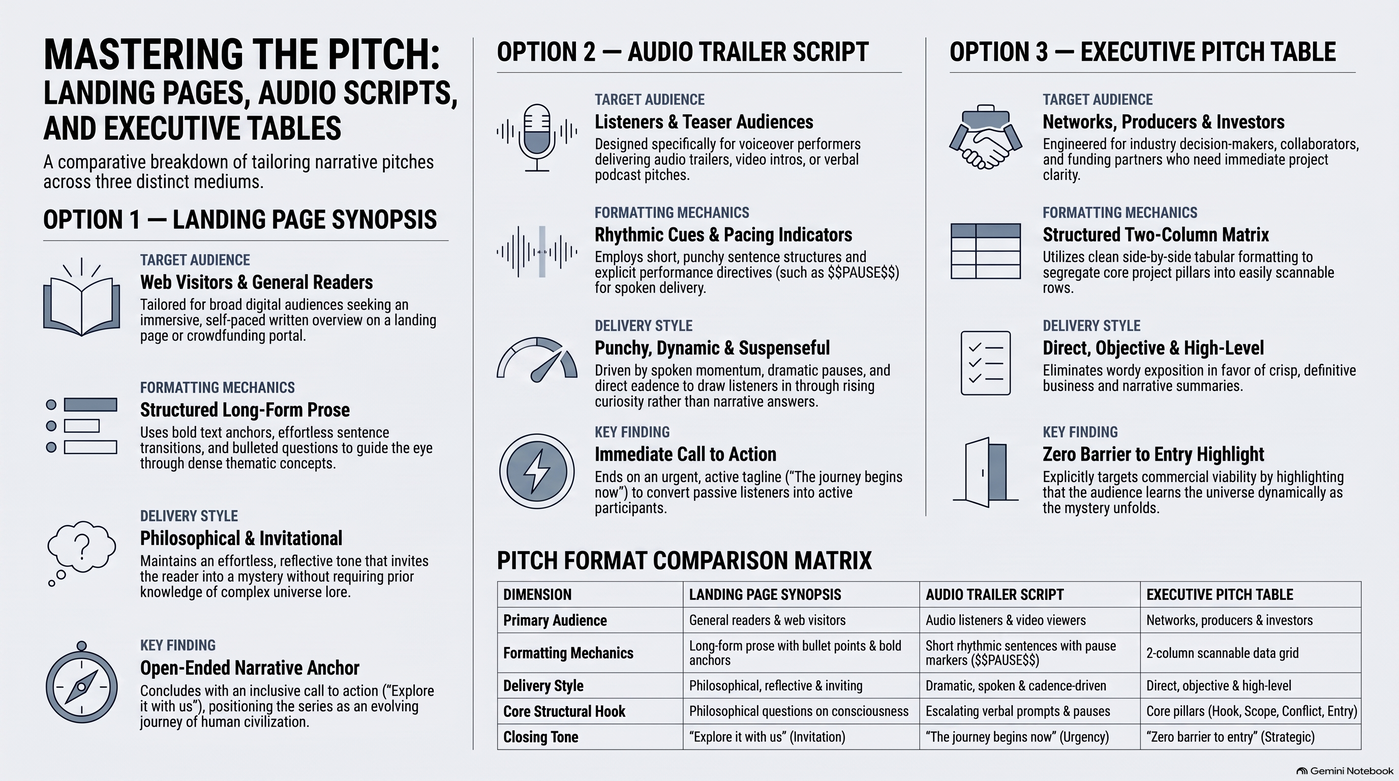
A single pitch format rarely works for every channel. A visitor browsing a website reads differently than an executive reading a quick proposal, and both differ radically from a voiceover actor delivering a radio teaser. The source material outlines three distinct approaches to communicate the exact same vision:
1. Option 1: The Polished Original (Best for Landing Pages & Synopses) This format relies on elegant prose, deliberate pacing, and structural flow. It uses open-ended bullet points to invite reflection and builds a sweeping, immersive argument for reading or listening.
2. Option 2: The Punchy Audio Trailer Script (Best for Teasers & Verbal Delivery) Designed explicitly to be spoken aloud, this version relies on short, rhythmic sentences and explicit cues like $$PAUSE$$. It drops non-essential prose in favor of dramatic cadence and punchy assertions like: "Don't listen because you want answers. Listen because you want to watch the questions grow."
3. Option 3: The Direct Pitch (Best for Producers & Executives) Busy industry professionals do not want to wade through atmospheric prose to find core facts. The Direct Pitch utilizes a side-by-side comparative table that instantly breaks down the project's Hook, Scope, Core Conflict, and Audience Entry.
Core Narrative Drivers and Refining Techniques
To make a pitch punchy and memorable, creators must embed specific narrative anchors and clean up redundant phrasing.
The Role of Catalytic Entities In Story of Life, the Titans serve as central narrative anchors. Rather than acting as conventional alien villains or generic monsters, their presence forces a profound philosophical dilemma: raising questions deeper than whether alien life exists by challenging what it means to be alive.
Mystery as the Invitation (Zero Barrier to Entry) One of the pitch's strongest value propositions is explicitly reassuring the audience that prior background knowledge is unnecessary. "The mystery is the invitation." The audience isn't expected to know the universe beforehand; they learn dynamically as the philosophical puzzle unfolds.
Key Line-Editing Improvements To elevate promotional copy from good to unforgettable, apply three core editorial rules demonstrated in the source text:
Bold Anchors: Bold key terms (like Titans or core questions) so skim-readers immediately catch central concepts.
Eliminate Redundancies: Cut repetitive pairings (e.g., changing "forces and forms of intelligence" to simply "forces" or "intelligences") to maintain swift forward momentum.
Rhythmic Taglines: Ensure the transition from the body text to the final call to action flows as a natural, inevitable conclusion.
Pitching Strategy & Vocabulary Flashcards
Interactive flashcards reviewing essential pitch concepts, narrative mechanisms like the Titans and zero-barrier entry, and copy-editing techniques.
Summary
An effective high-concept pitch prioritizes engaging philosophical questions over dense background lore, adapting its tone and structure to fit specific communication channels.
Key Takeaways:
Focus on Ideas over Lore: Bypassing complex timelines in favor of big, existential questions creates a lower barrier to entry and broader appeal.
Format for the Audience: Use evocative prose for landing pages, rhythmic short sentences with pause cues for spoken audio, and structured summary tables for industry executives.
Anchor with Key Concepts: Use catalytic elements (like the Titans) and bold formatting to focus the reader's attention on what makes the story unique.
Edit for Momentum: Eliminate redundant phrasing and refine final taglines so the message ends on a strong, natural hook.