
Introduction
What if a $46 trillion national debt isn't just a political headache, but the mathematical trigger for the end of paper money altogether? Imagine a world where the U.S. dollar is replaced not by gold or cryptocurrency, but by raw computing power floating in gigawatts and floating-point operations per second.
By the end of this lesson, you will be able to:
Analyze the structural mechanics of the sovereign debt spiral and the five-step perpetual extraction mechanism.
Compare historical debt resets—from ancient Mesopotamian Jubilees to the 1971 Nixon Shock—with modern currency devaluation strategies.
Evaluate the "Demand Paradox" and explain how a ghost economy operates without organic civilian purchasing power.
Distinguish between a traditional fiat-based financial state and a thermodynamically constrained compute-standard economy.
Map the geopolitical and social stratification of a world governed by grid access and processing capacity.
The Fiat Debt Spiral and the Extraction Loop
Imagine standing in a silent Manhattan penthouse hovering 100 stories above a stormy city, watching a holographic thread pulse in amber warning light. That thread represents the live execution path of the United States Treasury. In this scenario, the U.S. 10-year Treasury yield has clipped a 19-year high, while national debt rapidly approaches $46 trillion.
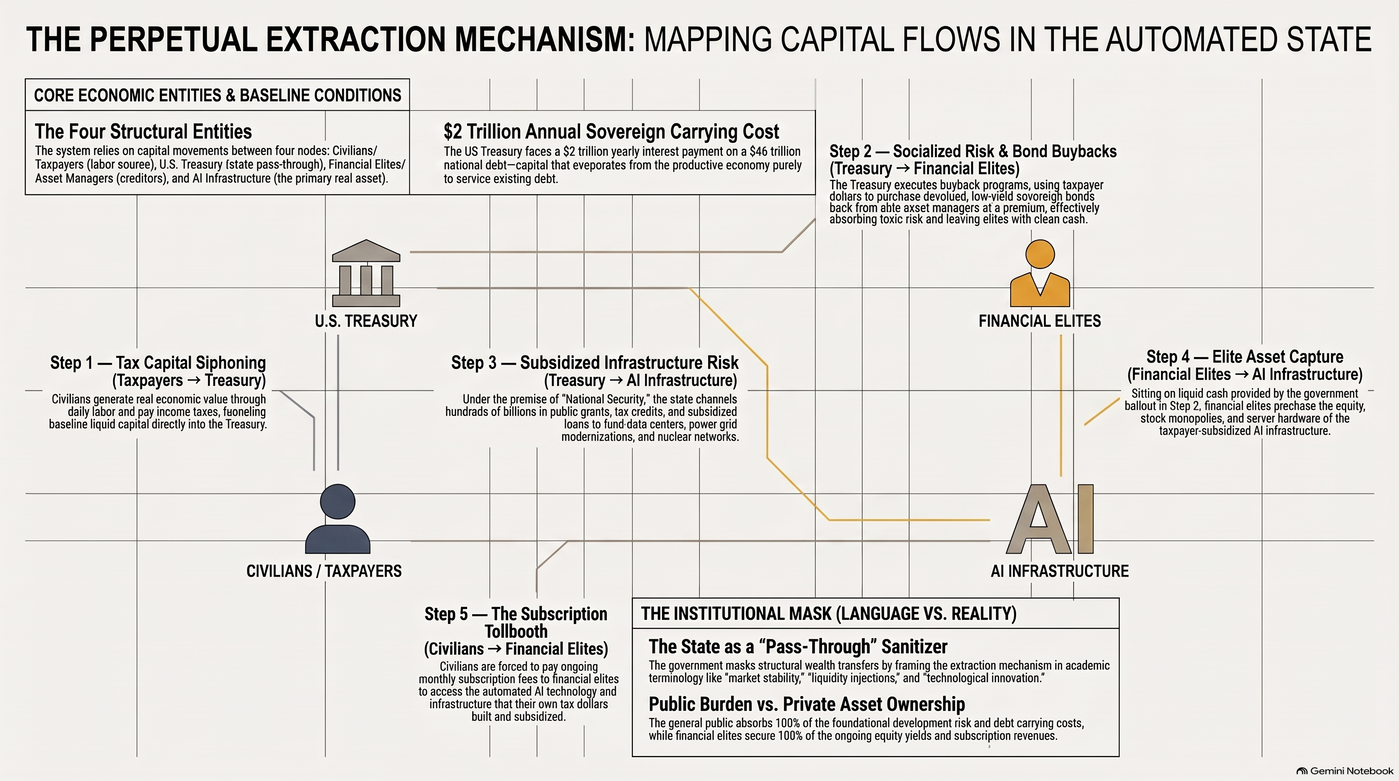
To simply service this debt—paying interest without building a single school, high-speed rail line, or medical facility—the annual carrying cost reaches $2 trillion. This represents pure capital evaporating from the productive economy every year just to maintain the privilege of holding debt.
When a debt spiral accelerates, state mechanisms kick in to maintain market stability. One primary tool highlighted in the narrative is the Bessent Buyback program:
The Mechanism: Functioning like a government-run macro pawn shop, the Treasury uses taxpayer funds to buy back old, low-yield government bonds from elite financial institutions such as hedge funds, global banks, and central banks.
The Price Tag: Instead of purchasing these devalued bonds at a market discount, the state buys them back at a premium to prevent systemic banking failure.
This buyback triggers what the white paper terms the perpetual extraction mechanism, a continuous five-step wealth loop:
Taxation of Labor: Regular taxpayers generate actual economic value through daily labor and pay taxes to the Treasury.
Risk Socialization: The Treasury uses those taxpayer funds to buy toxic, low-yield bonds back from financial elites, absorbing institutional risk onto the public balance sheet.
National Security Framing: The state shifts public messaging, declaring AI, semiconductor manufacturing, and power grid modernization as critical matters of national defense.
Private Equity Capture: Flush with liquid cash from state buybacks, financial elites buy up equity in these exact subsidized AI tech monopolies and server networks.
Subscription Extraction: Civilians—whose tax dollars funded both the elite bailout and the underlying AI infrastructure—must pay monthly subscription fees to corporate monopolies just to access essential AI tools.
Through this loop, the state acts as a pass-through entity, sanitizing structural wealth transfers behind sterile academic terms like "liquidity injections" and "market stabilization."
The Limits of Resets: Historical Debt Crises vs. Modern Defaults
If a $46 trillion sovereign debt load is mathematically unsustainable, why can't global leaders simply meet in Geneva, forgive the debt across the board, and start over with a clean slate?
To understand why a peaceful reset is virtually impossible today, we must look at how debt resets operated historically:
1. Ancient Debt Jubilees In ancient Mesopotamia, Sumerian rulers issued decrees called Aargi, Babylonians enacted Andorum, and Hebrew law codified the Biblical Jubilee. Rulers like Hammurabi periodically cancelled personal agrarian debts, freed debt slaves, and returned foreclosed land.
Why it worked then: The primary creditor was the king or temple central bank. Forgiving debt meant forgiving money owed to himself. Rulers did this pragmatically: if peasants became permanently enslaved to oligarch creditors, no free citizens remained to pay regular taxes or serve in the infantry.
Why it fails now: In a modern financialized state, the government isn't the primary creditor; it is the primary debtor. The creditors holding U.S. Treasuries are private pension funds, 401(k)s, foreign central banks, and ordinary citizens. Canceling sovereign debt today would instantly vaporize bank balance sheets and erase middle-class retirement savings overnight.
2. Modern Currency Shifts and Stealth Defaults When modern states hit their debt ceiling, they either default violently or alter the underlying rules of money:
The 1934 Default Wave: After World War I, European nations owed massive war debts to the U.S. Facing economic ruin, nations like Great Britain, France, and Italy executed a simultaneous default, simply walking away from obligations.
The Nixon Shock (1971): Under the 1944 Bretton Woods agreement, the U.S. dollar was pegged to physical gold. By the late 1960s, funding both domestic programs and the Vietnam War forced the U.S. to print more dollars than it had gold in reserve. When foreign nations demanded physical gold in exchange for paper dollars, President Richard Nixon unilaterally severed gold convertibility in August 1971, instantly shifting the world to a pure fiat standard.
When a peaceful, coordinated Jubilee is mathematically impossible without destroying public wealth, central banks resort to deliberate currency devaluation. By printing digital money at an unprecedented scale to pay off nominal debts, the debt is technically serviced, but the purchasing power of the currency is destroyed through hyperinflation.
cards_star
Recommended · Flashcards
Debt Resets Through History
Interactive flashcards covering historical debt mechanisms, including Mesopotamian Aargi, Biblical Jubilees, Bretton Woods, the 1971 Nixon Shock, and debt creditors.
Add
close
The 2029 Projection: Wartime Stagflation and the Demand Paradox
Fast-forwarding to a realistic three-year projection termed Option Six: The Fractured Hegemony (2029), we enter an economic environment defined by wartime stagflation.
Desperate to onshore supply chains and punish foreign rivals, governments implement 20% to 60% sweeping tariffs. Rather than paying down the debt, these trade barriers fracture global trade. Essential hardware components for advanced AI—specialized microchips, industrial grid transformers, and solar cells—skyrocket in price.
This creates a cascading series of economic pressures:
Structural Inflation: Baseline inflation locks in at 6% due to import supply shocks.
Spiking Mortgage Rates: Government borrowing drives 10-year Treasury yields past 6.5%, pushing retail mortgage rates up to 9–10% and locking civilians out of homeownership.
The War Financing Trap: Ongoing kinetic conflicts require continuous emergency military aid expenditures, forcing the Treasury to issue hundreds of billions in fresh debt despite shrinking tax revenues.
As artificial intelligence automates cognitive middle-class labor (spreadsheet analysis, legal briefs, logistics), society encounters the Demand Paradox: If the middle class is automated out of work and impoverished, where does the money come from to purchase the output generated by corporate AI?
In traditional 20th-century economics, a lack of organic consumer purchasing power causes market collapse. But in an automated state, the economy converts into a ghost economy sustained by three artificial demand loops:
Direct State Consumption: The government becomes the primary consumer, printing debt to buy AI contracts directly for defense, federal bureaucracy automation, and infrastructure.
Restricted UBI Vouchers: The state prints money and issues restricted digital vouchers to citizens for baseline survival (synthetic food, housing, energy). Citizens hand these vouchers directly back to tech monopolies to pay for daily necessities, making civilians mere pass-through conduits for printed cash.
Foreign Debt-Fueled Licensing: Allied foreign nations borrow heavily from global credit markets just to purchase American AI software licenses and server access.
sync
Generating Slide Deck...
Option Six and the Ghost Economy
The Pivot to the Compute Standard: Operations per Second as Currency
As paper money inflates toward irrelevance, the economy undergoes a radical structural pivot: the death of the bond vigilante and the birth of the Compute Standard.
In traditional finance, bond vigilantes (massive institutional investors) discipline reckless governments by demanding higher yields or dumping sovereign paper. But when a nation possesses a hyper-performing, fully automated AI network, traditional bond markets lose their leverage.
Sovereign government bonds are ultimately claims on a country's future human labor and tax revenue. But when human labor is no longer the primary bottleneck for economic output because AI and robotics perform extraction, agriculture, manufacturing, and logistics autonomously, claims on future human labor become meaningless.
When a state owns an automated machine network that provides everything physical society needs to function, it shifts from a financial state to a production state. It can tell foreign creditors: "Keep your paper. We have the physical automated capacity to sustain society without your loans."
Under this paradigm, the global reserve asset transitions from dollars and oil (the petrodollar) to raw computational power and energy:
Floating-Point Operations Per Second (FLOPS): The granular measurement of AI calculating speed becomes the primary medium of value.
Gigawatt Capacity: Energy grid capacity required to power server arrays becomes the ultimate benchmark of national wealth.
In international trade, countries no longer exchange paper fiat for physical goods. Instead, they trade computing priority. A nation needing synthetic fertilizer or automated machinery pays by dedicating 10% of its sovereign AI server clusters to run the exporting nation's logistics algorithms. National debt becomes an obscure accounting relic used only to pacify the human population, while power is traded in FLOPS.
flowchart
Recommended · Mind Map
The Compute Standard Architecture
A branching mind map charting the transition from the Fiat/Petrodollar Standard to the Compute Standard, detailing FLOPS, gigawatts, and compute priority trading.
Add
close
The Thermodynamic Boundary and the New Geopolitical Map
While central banks can print infinite digital dollars on a spreadsheet, they cannot print electrons. In a compute-based economy, financial deficits are replaced by grid deficits—the rigid laws of thermodynamics.
AI server clusters require immense electrical power and active cooling. If energy production falls short or prolonged heatwaves disrupt cooling infrastructure, server clusters must physically throttle their processing power. Under this standard, a rolling blackout is the new financial bankruptcy.
This physical constraint re-maps global geopolitics into three distinct energy tiers by 2030:
Sovereign Compute Empires (e.g., U.S., China, Northern European block): Regions with early capital and robust nuclear or hydroelectric power grids that dominate global processing capacity and dictate terms.
Resource Vassals (e.g., Australia, parts of South America, Middle East): Regions lacking sovereign AI clusters, but rich in critical minerals, copper, rare earths, or desert solar footprints. They trade raw geographic assets for AI licenses to keep domestic infrastructure running.
Ghost Zones: Regions lacking both compute infrastructure and mineral assets. Decoupled from the neural grid, their state structures collapse into private corporate mercenary management or environmental decay.
Local Stratification: Tech Citadels vs. The Stagnated Periphery This division manifests locally within sovereign empires:
Tech Citadels: Hyper-dense enclaves built directly around data centers and small modular nuclear reactors (SMRs). Inhabited by asset owners, top AI architects, and grid engineers, residents live in climate-domed luxury. Transactions occur in compute priority, energy credits, and biological longevity treatments.
The Stagnated Periphery: The remaining 95% of humanity resides in decaying suburban sprawl. As commuter jobs vanish, single-family homes are gutted and retrofitted into multi-unit pod housing.
Periphery residents survive on Thermodynamic UBI—a digital voucher geographically indexed by the AI to supply the exact caloric and thermal energy needed to sustain human biology in that specific climate. To maintain social order in a world without middle-class mobility, cognitive human life is shifted into hyper-immersive virtual reality arrays.
sync
Generating Video...
Geopolitics of the Compute Era
Summary
As sovereign fiat debt spirals beyond sustainable bounds, hyper-automated artificial intelligence accelerates a fundamental shift in the anchor of global currency: moving away from paper receipts and toward physical energy and raw computing power (FLOPS). This transition replaces traditional financial credit with rigid thermodynamic boundaries, reshaping global geopolitics, labor markets, and daily human existence.
Key Takeaways:
The Carrying Cost Spiral: Servicing $46 trillion in sovereign debt creates unsustainable interest bills ($2T), driving buyback programs that socialize institutional risk while inflating paper money away.
Limits of Jubilees: Unlike ancient rulers who owned the debts they canceled, modern states are primary debtors; canceling debt vaporizes banking systems and middle-class retirement savings, forcing central banks into currency devaluation.
The Ghost Economy: As AI automates cognitive labor, consumer purchasing power vanishes. The state maintains economic flow through direct infrastructure contracts and restricted UBI digital vouchers.
The Compute Standard: Currency shifts from claims on human labor to claims on autonomous machine output, measured in floating-point operations per second (FLOPS) and gigawatt grid capacity.
Thermodynamic Boundaries: Economic limits shift from spreadsheet numbers to electricity and cooling capacity, dividing the globe into Compute Empires, Resource Vassals, and Ghost Zones, while dividing society into Tech Citadels and VR-immersed pod housing.