
Introduction
What happens when the virtual cloud runs headfirst into the physical realities of power grids, drinking water, and local democracy? Across the United States and the Arctic, the astronomical resource demands of artificial intelligence are sparking an unexpected, bipartisan political revolt.
In this lesson, you will explore the real-world friction generated by hyperscale server yards and uncover how local communities, tribal nations, and state governments are responding. By the end of this lesson, you will be able to:
Analyze the local energy, water, and economic strains caused by AI data centers and the resulting municipal moratoriums.
Evaluate federal strategies and legal loopholes used to deploy server infrastructure on public lands and tribal fee lands.
Compare the unique infrastructural and ecological limits facing non-contiguous regions like Alaska, Hawaii, Greenland, and U.S. Territories.
Deconstruct the corporate extraction playbook and draw historical parallels between Big Tech incentives and Big Oil policy legacies.
The Local Limits of Big Tech: Power, Water, and Political Fracture
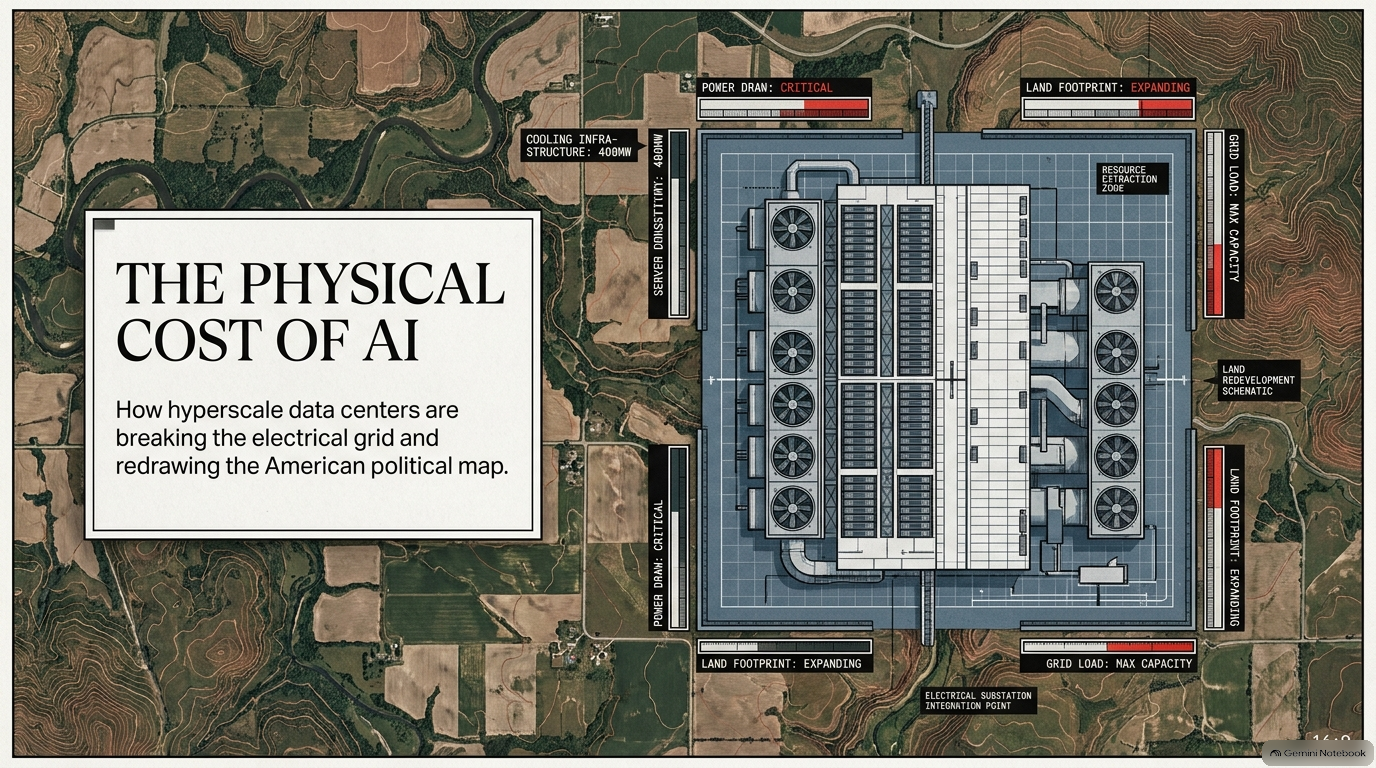
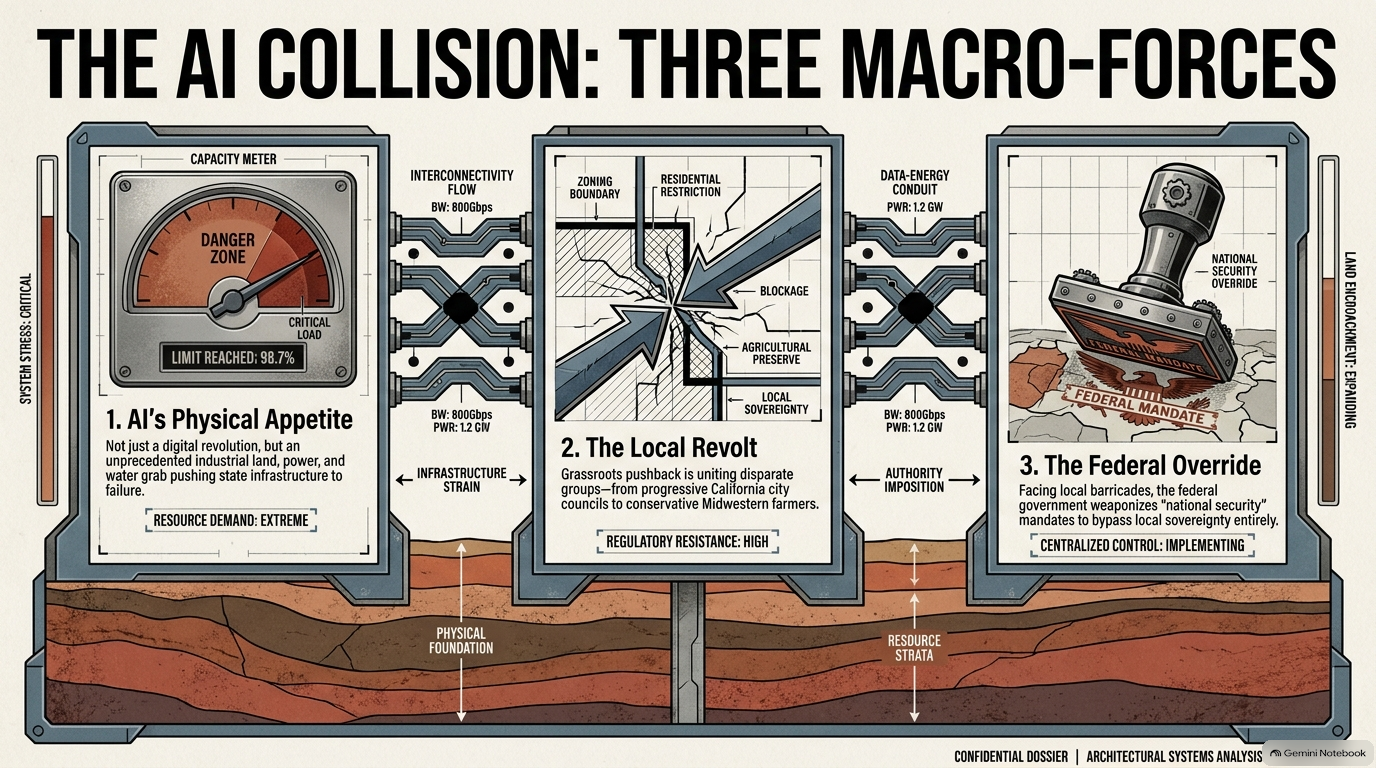
To understand why communities across the nation are suddenly pulling the plug on digital infrastructure, we must look at what happens on the ground when an artificial intelligence data center arrives in town. Unlike standard internet servers that route web traffic, hyperscale AI data centers require massive, continuous computational power to train complex algorithms. This creates three immediate local friction points:
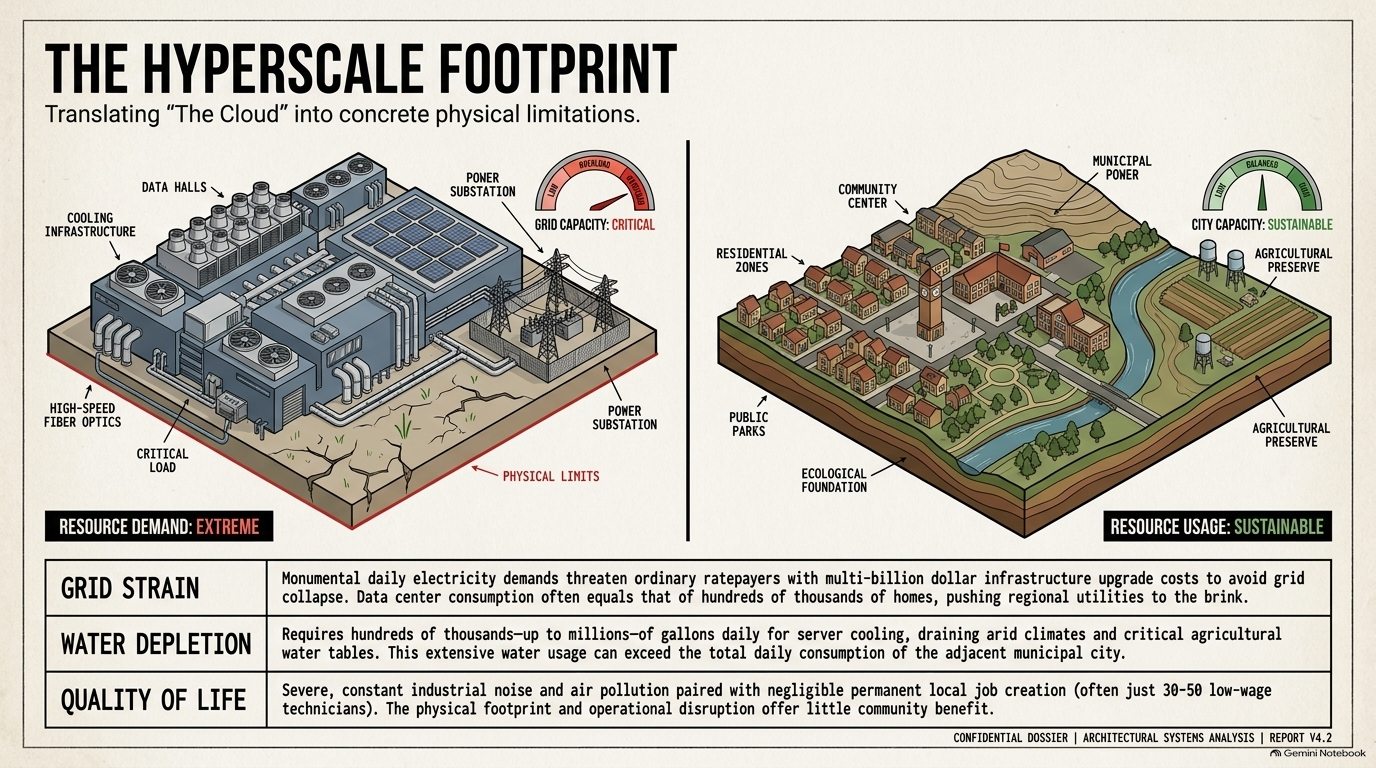
Power and Cost Strains: The astronomical electrical demand threatens to overload local utilities, forcing massive grid upgrades whose costs are passed directly onto everyday utility customers.
Water Depletion: To prevent overheating, server facilities can require hundreds of thousands to millions of gallons of cooling water daily, posing an existential risk to local freshwater supplies.
Quality of Life Issues: Surrounding neighborhoods face intense industrial noise, air pollution from diesel backup generators, and the frustrating reality that these multi-acre facilities yield very few permanent local jobs—typically only 30 to 50 low-wage security and maintenance roles once construction concludes.
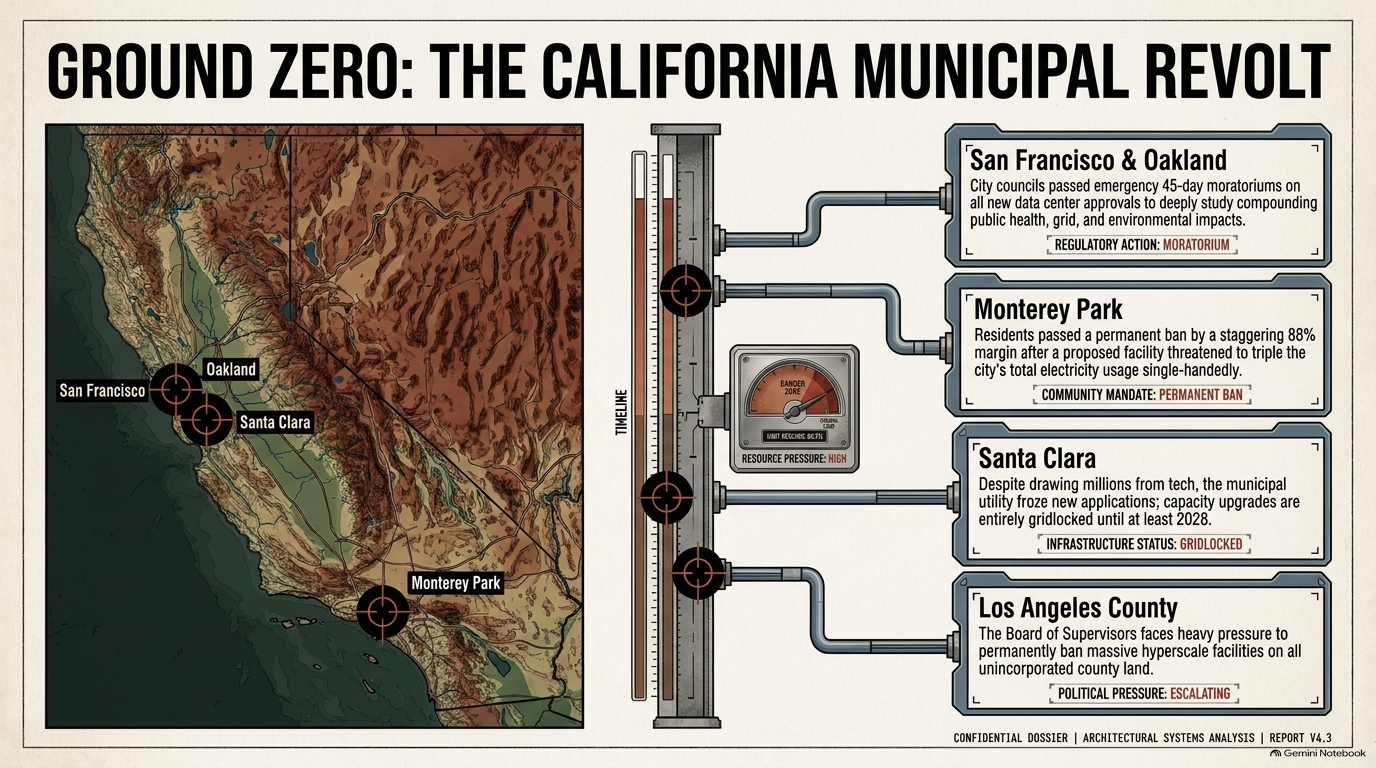
Frustrated by state regulations that fail to scale quickly enough, local jurisdictions are taking matters into their own hands. In California, despite Governor Gavin Newsom signing a comprehensive package of seven transparency and disclosure laws, major cities are enforcing outright freezes. City councils in Oakland and San Francisco enacted emergency 45-day moratoriums on new data center approvals. In Monterey Park, residents voted by a staggering 88% margin to permanently ban data centers after a developer proposed a hub that would have single-handedly tripled the city's electricity usage. Meanwhile, Santa Clara's municipal utility stopped accepting new applications altogether as capacity upgrades remain grid-locked until at least 2028.
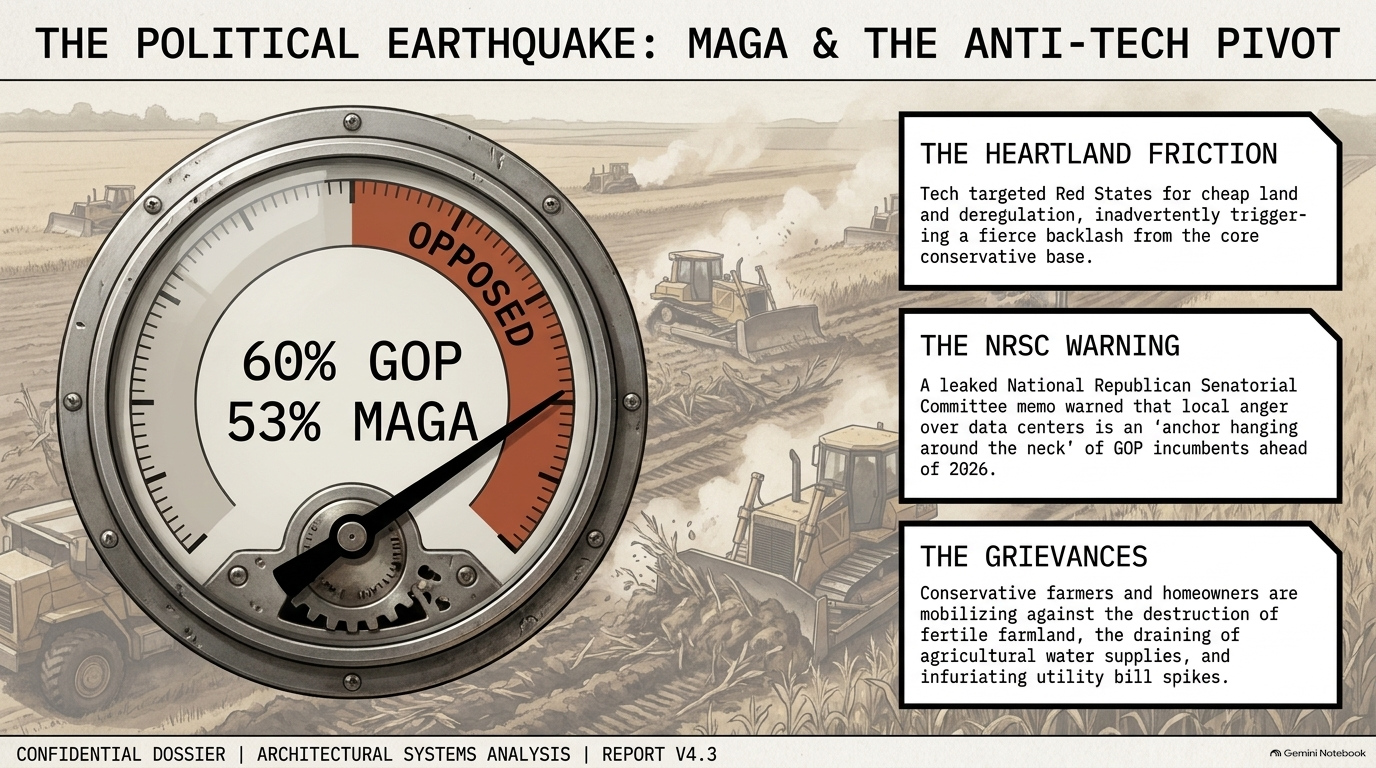
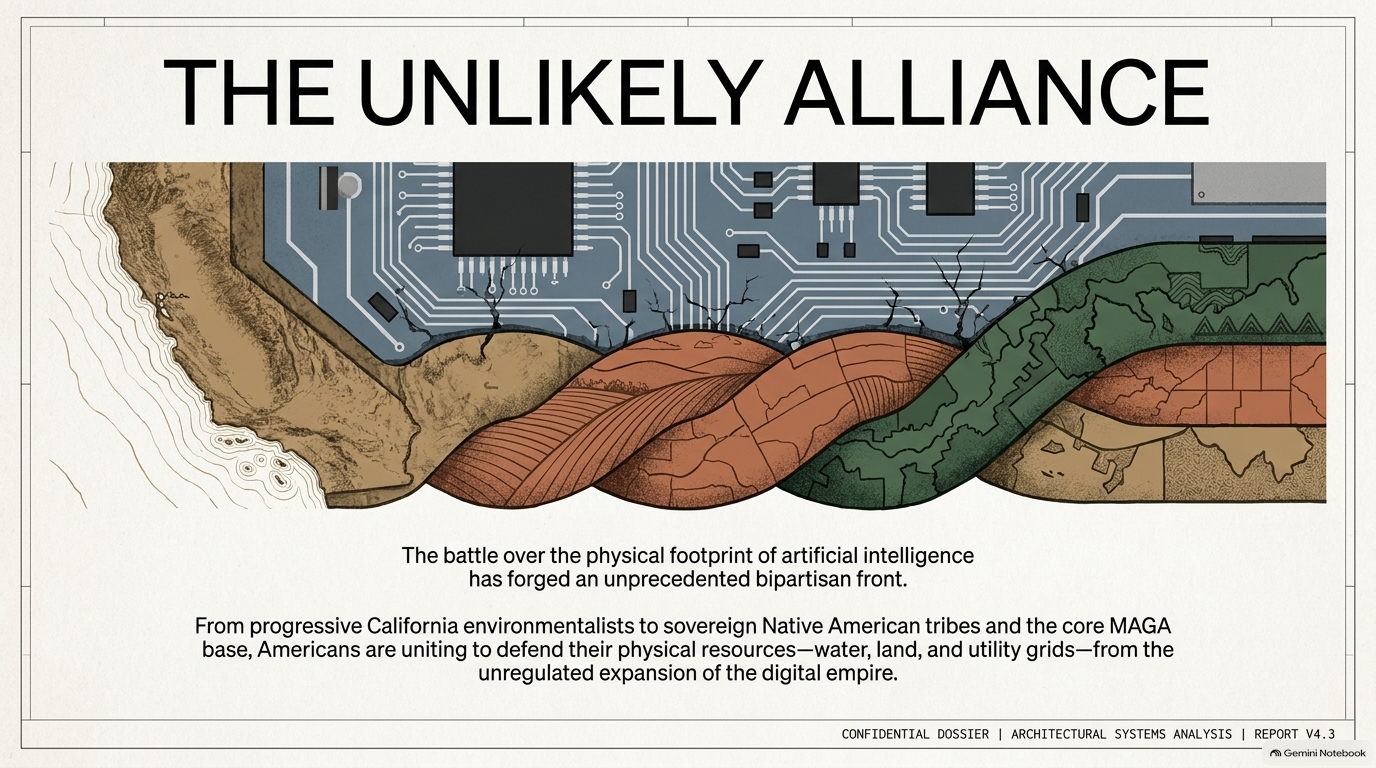
This localized anger has fractured traditional political lines. While tech firms previously enjoyed strong support in business-friendly regions, data center expansion has triggered a massive backlash among rural homeowners, farmers, and conservative taxpayers across Midwestern and Southern states. According to a July 2026 Fox News poll, 60% of Republicans and 53% of MAGA voters oppose building a data center in their local area, while a leaked memo from the National Republican Senatorial Committee (NRSC) explicitly warned that data center anger had become an "anchor hanging around the neck" of several GOP incumbents.
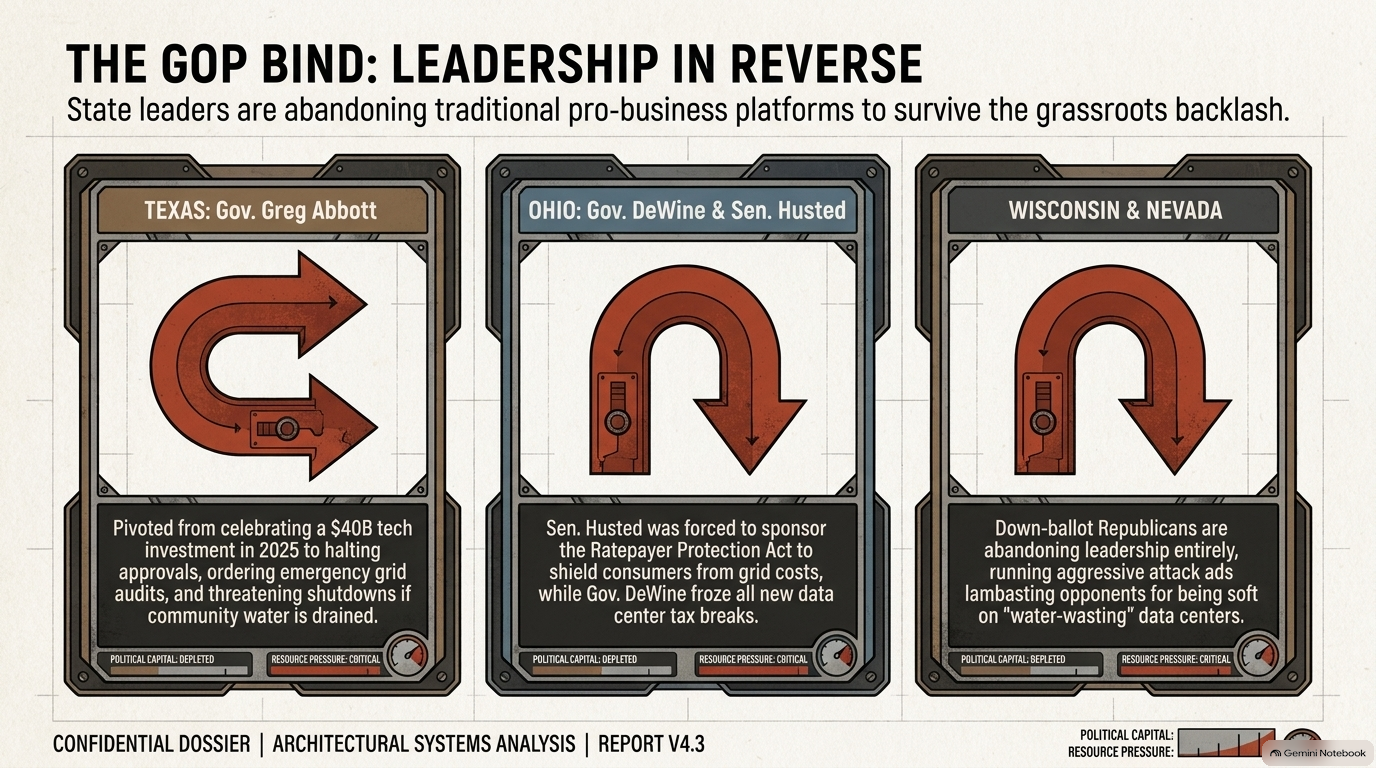
In response, prominent Republican leaders have executed sharp political pivots. In Texas, Governor Greg Abbott halted approvals for new facilities and ordered comprehensive grid audits. In Ohio, Senator Jon Husted sponsored the Ratepayer Protection Act to ensure tech giants—rather than residential consumers—pay for grid upgrades, while Governor Mike DeWine froze data center tax breaks. In Wisconsin, political candidates have taken to the airwaves with attack ads lambasting opponents for supporting "water-wasting" server yards.
The Data Center Backlash: Municipal Moratoriums and Political Shifts
Federal Encroachments and Tribal Sovereignty: The Fight for Public Lands and Water
As municipal bans close off city zoning options, Big Tech companies and federal administrators have turned toward expansive federal public lands and indigenous territories. However, this shift has ignited fierce constitutional, legal, and environmental battles.
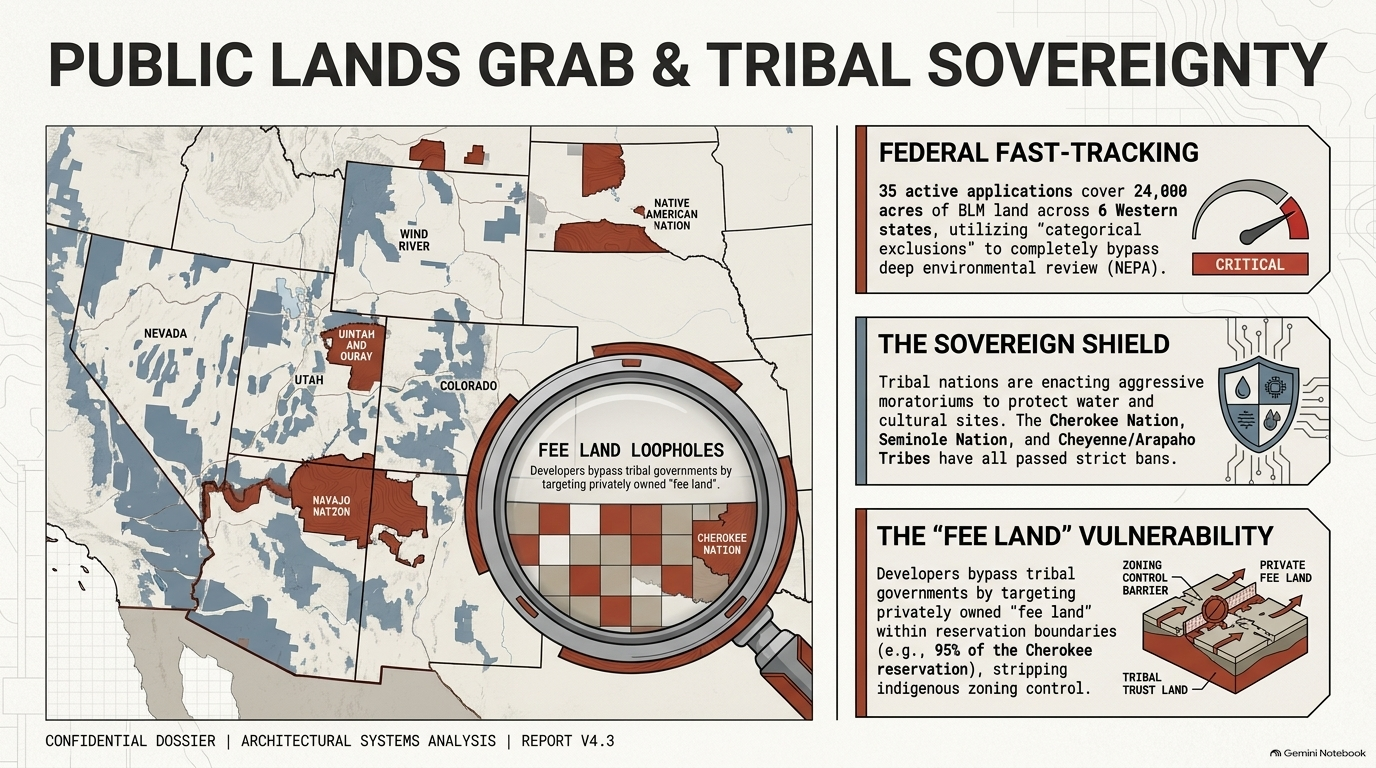
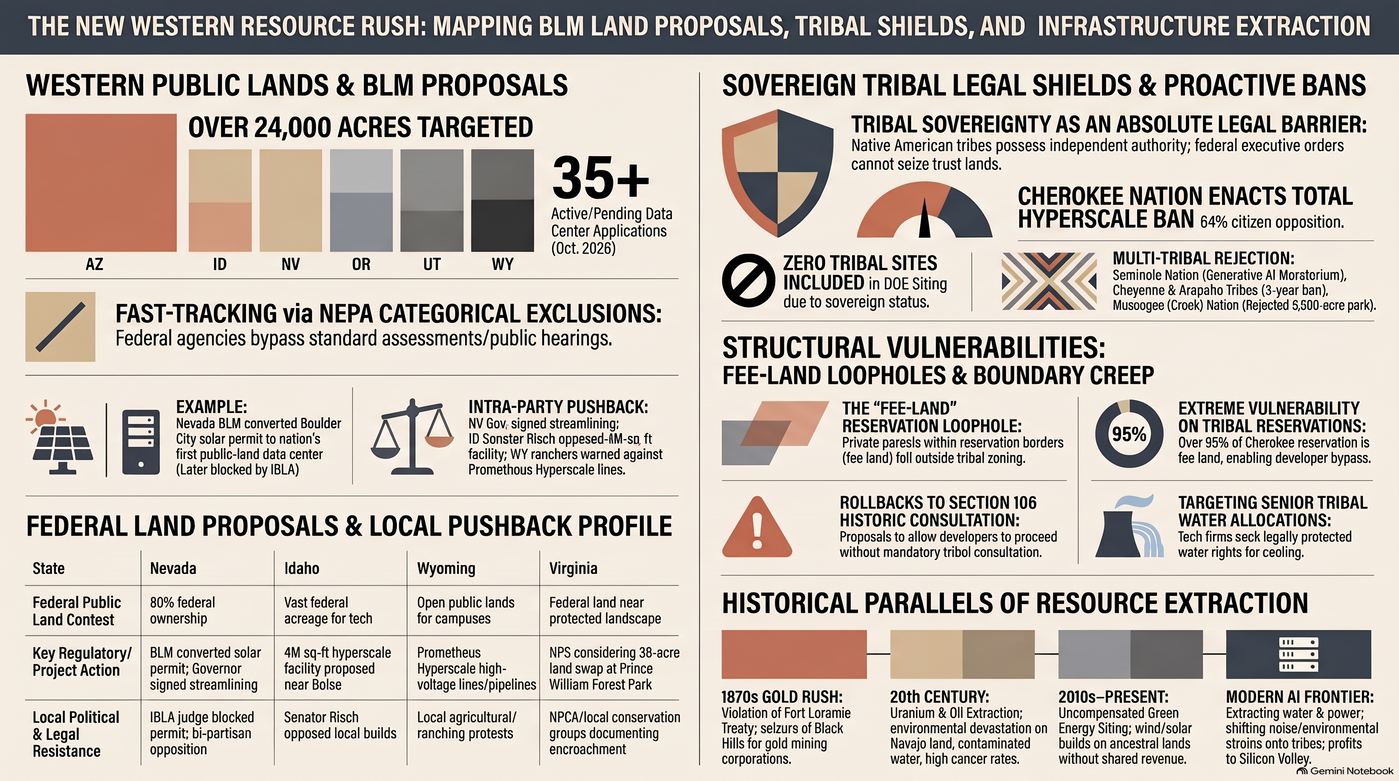
Under a July 2025 executive order directing federal land management agencies to prioritize identifying data center sites, the federal government began fast-tracking projects on public property. An October 2026 report by the Center for Western Priorities documented at least 35 active or pending data center applications covering over 24,000 acres across six Western states (Arizona, Idaho, Nevada, Oregon, Utah, and Wyoming). To bypass lengthy environmental reviews, federal agencies have utilized categorical exclusions under the National Environmental Policy Act (NEPA).
This fast-tracking strategy has repeatedly landed in regulatory and legal crosshairs:
Bypassing Input on BLM Land: In June 2026, the Bureau of Land Management (BLM) converted an existing solar farm permit near Boulder City, Nevada, into a data center approval without conducting a new environmental assessment—a decision subsequently blocked by an Interior Board of Land Appeals judge.
Encroachment on Park Borders: In Virginia, the National Park Service weighed a proposed land swap in Prince William Forest Park that would transfer 36 park-adjacent acres to accommodate 100-foot-tall hyperscale server blocks.
The dynamic shifts dramatically when developers eye Native American reservations. Under U.S. law, Native American tribes possess independent sovereign authority over their territory. Because tribes are recognized as domestic sovereign nations, federal executive orders streamlining public land builds do not apply to tribal trust lands. Department of Energy (DOE) assessments identified 16 initial federal land sites for potential data centers, none of which include tribal trust property.
Recognizing their legal power, tribal nations across the country are actively pulling the plug on tech proposals:
The Cherokee Nation enacted a sweeping ban on hyperscale data centers on tribally owned and trust lands following a survey showing 64% citizen opposition.
The Seminole Nation of Oklahoma voted unanimously in March 2026 to implement a strict moratorium on generative AI and hyperscale infrastructure.
The Cheyenne and Arapaho Tribes enacted a three-year prohibition to study long-term ecological impacts.
The Muscogee (Creek) Nation rejected a proposed 5,500-acre tech park following intense grassroots organizing.
However, a severe legal vulnerability remains: fee land. Many reservations are fractured by parcels within their borders that are privately owned by non-tribal members. In areas like the Cherokee reservation, where over 95% of the land within reservation boundaries is held as fee land, developers can buy private parcels and build server hubs directly adjacent to indigenous communities, bypassing tribal government zoning power.
Island Ecosystems and High-Risk Frontiers: Alaska, Hawaii, Greenland, and Territories
In search of cooler climates and alternative land sites, tech developers have expanded into remote, island, and Arctic territories. Yet, these non-contiguous regions present extreme physical, ecological, and infrastructural bottlenecks that showcase the limits of digital scaling.
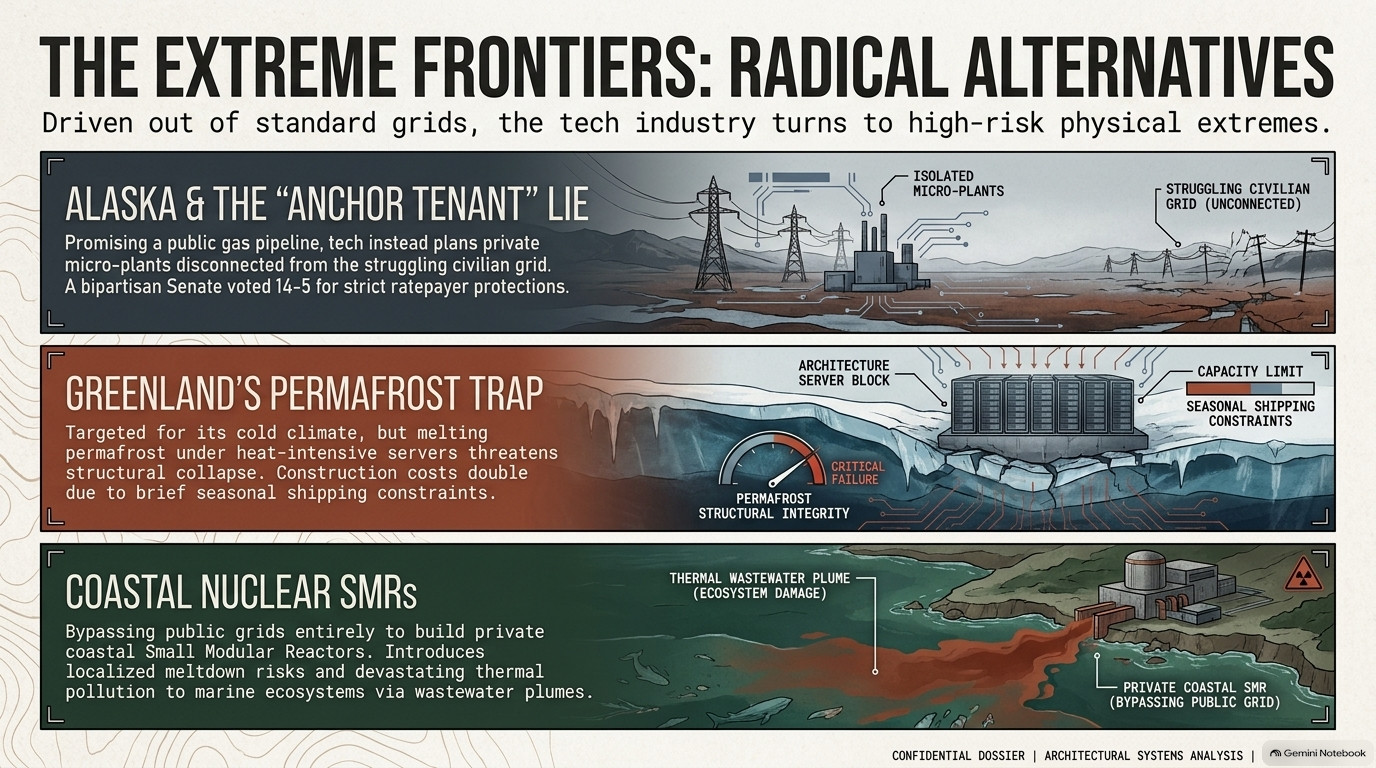
In Alaska, the core obstacle is energy infrastructure. The state's primary power grid—the isolated Railbelt grid spanning from Homer to Fairbanks—relies heavily on natural gas from the Cook Inlet, which faces a well-documented supply deficit. Despite federal attempts to lease 4,700 acres across Joint Base Elmendorf-Richardson, Eielson Air Force Base, and Clear Space Force Station to private tech firms, local communities have fought back. The Fairbanks North Star Borough adopted a resolution demanding a moratorium, Sitka fast-tracked zoning restrictions, and officials in Houston explicitly opposed state land transfers. Tech startups have responded with high-risk workarounds, including Stak Energy's proposed $500 million campus directly on the North Slope and proposals for underwater AI server hives in Cook Inlet utilizing 350 tidal turbines—a concept heavily criticized by local fishermen for threatening critical salmon runs.
In Hawaii, geography imposes absolute limits on resources:
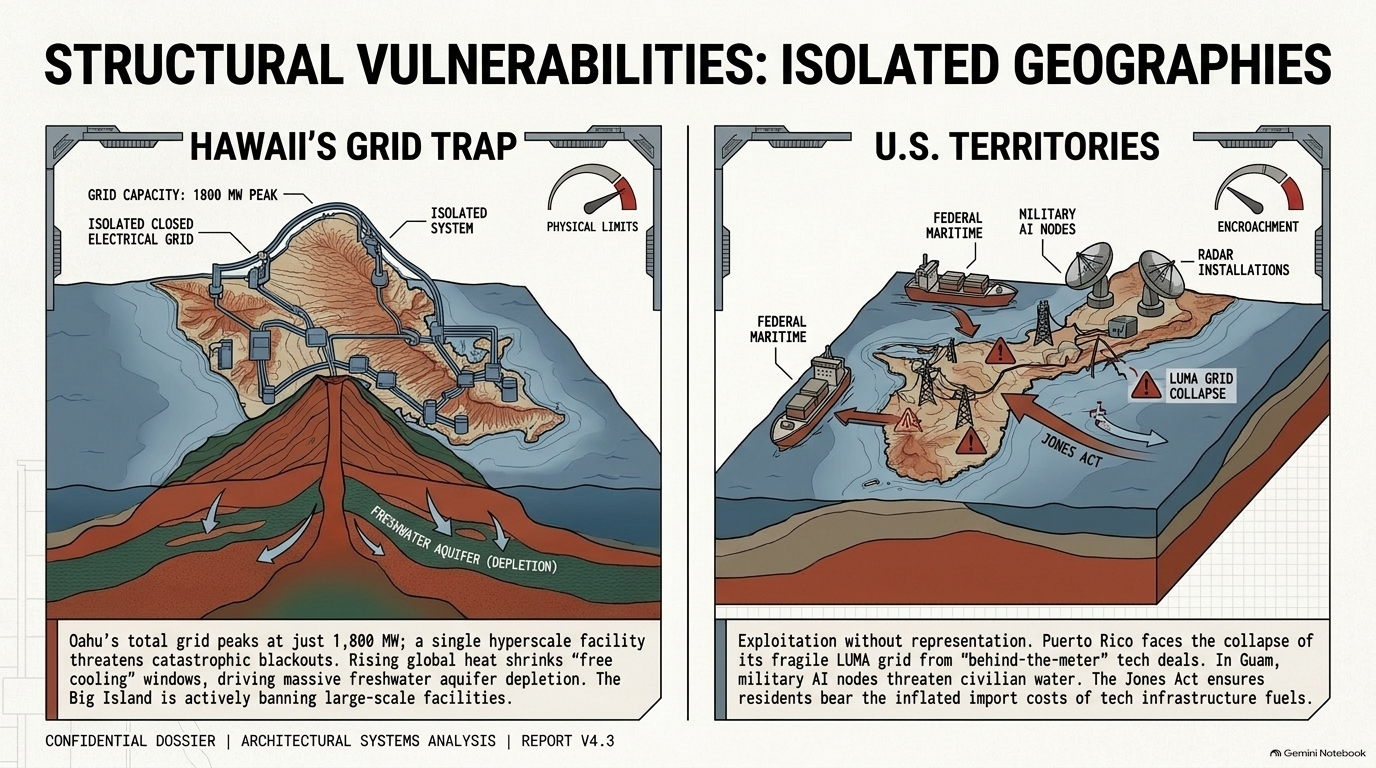
Isolated Grids: Each Hawaiian island operates an isolated electrical grid. Oahu's total grid capacity peaks at just 1,800 megawatts; injecting a single 100-megawatt AI training facility would consume a massive fraction of island power, threatening rolling blackouts.
Aquifer Threats: A hyperscale center can consume hundreds of millions of gallons of water annually, directly competing with island drinking water sources like Oahu's historic Wahiawa reservoir system.
Cooling Inefficiencies: A July 2026 study by University of Hawaii at Manoa scientists demonstrated that rising tropical ambient temperatures and humidity shrink the viability of direct air free cooling, forcing facilities to rely permanently on energy-intensive mechanical refrigeration.
Further north in Greenland, Big Tech has been drawn by sub-zero temperatures and abundant glacial meltwater hydropower. However, developers face the Permafrost Trap: data centers generate extreme thermal energy that can melt the frozen permafrost beneath them, causing heavy facility foundations to warp and structurally fail. Coupled with severe labor shortages, lack of connecting roads, and brief summer shipping windows, building a data center in Greenland costs $18 million to $25 million per megawatt, compared to $10 million to $12 million in mainland markets like Virginia.
Finally, U.S. Territories such as Puerto Rico, Guam, and the Commonwealth of the Northern Mariana Islands (CNMI) represent acute structural vulnerabilities. Because island residents lack voting representation in Congress, they face heightened exposure to federal overreach and military AI node expansion. Bound by maritime regulations like the Jones Act, which inflates fuel and shipping costs, residents in territories face skyrocketing utility bills whenever data center projects strain local infrastructure.
Ecological and Structural Bottlenecks in Remote and Island Frontiers
A branching diagram illustrating the unique logistical, infrastructural, and ecological constraints facing Alaska, Hawaii, Greenland, and U.S. Territories in the AI buildout.
The New Extraction Colony: The "Big Oil" Playbook and the Economic Paradox
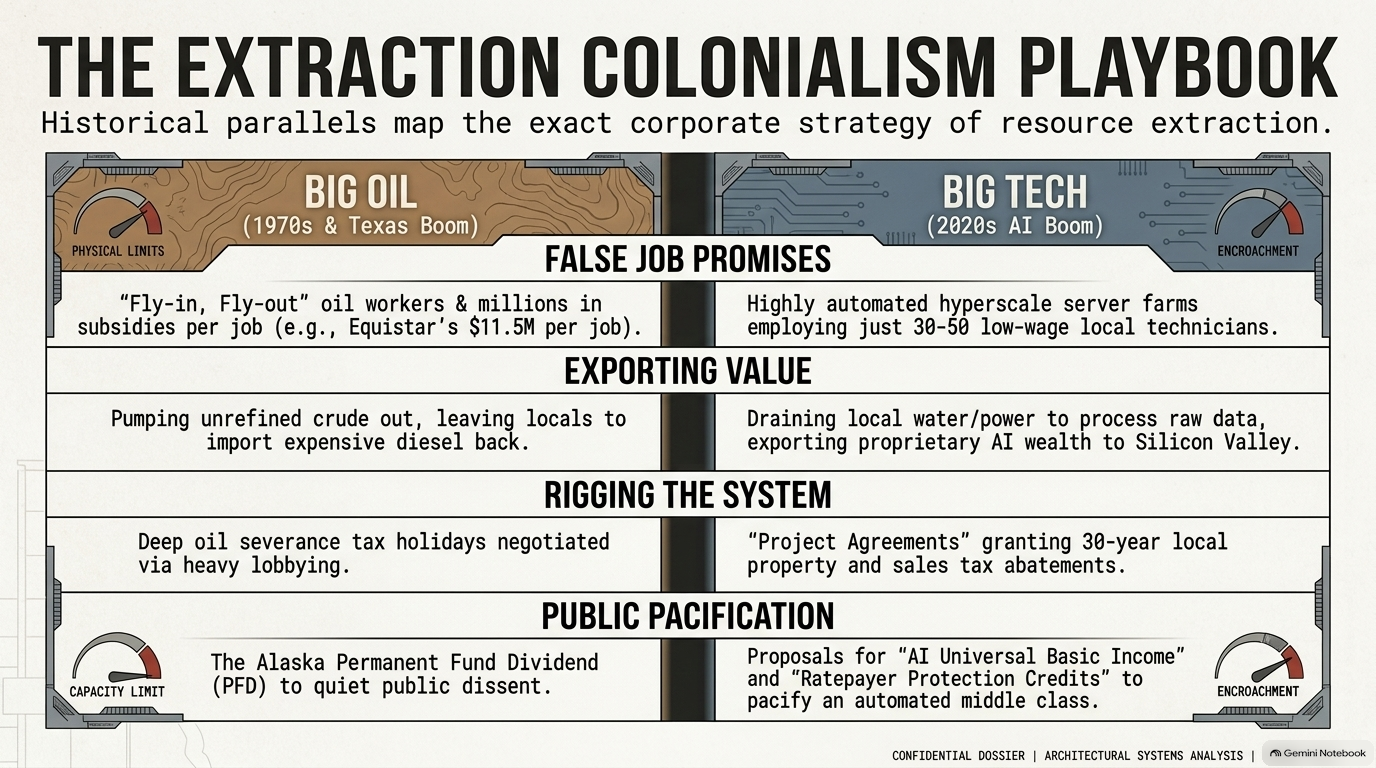
To fully grasp the economic mechanics of the data center expansion, economists and historians point to a familiar historical blueprint: the corporate resource extraction model pioneered by Big Oil in 20th-century Alaska and Texas. The strategy follows a distinct four-step cycle:
The Promise of Economic Prosperity: Developers enter a resource-rich region promising mass local employment and infrastructure investments. In reality, while initial construction creates temporary labor surges, operational hyperscale centers employ only 30 to 50 permanent staff, while high-value software engineering roles remain in major tech hubs.
Extracting Raw Value: Tech firms absorb local water allocations and electrical grid capacity to process digital data. The core value generated—proprietary AI models and corporate valuations—is exported, while the host community absorbs the ecological strain.
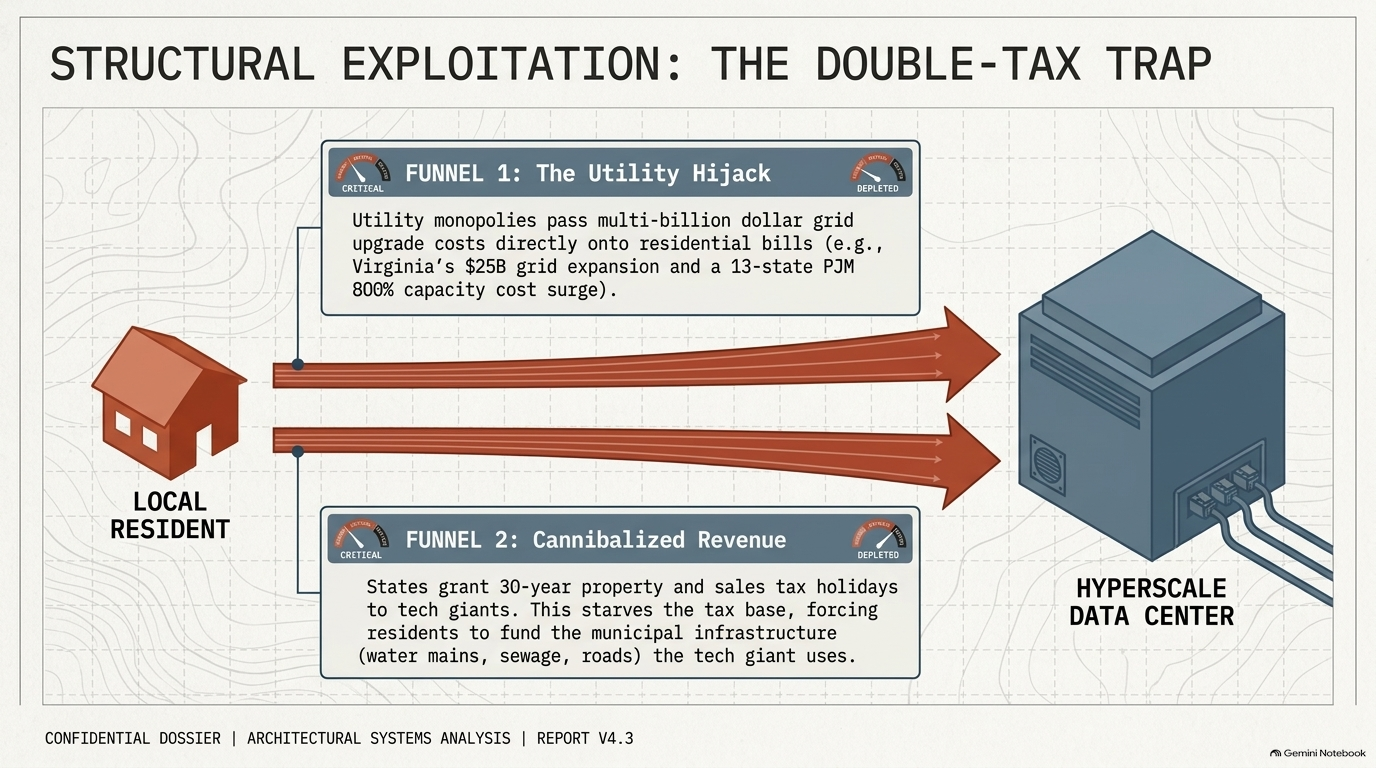
Rigging Tax Subsidies: Tech companies pit municipalities against one another to secure 10-to-30-year property and sales tax exemptions. This mirrors Texas's historical energy subsidies. In Brazoria County, Texas, local tax breaks to major energy projects averaged $1.93 million per job created; Equistar Chemicals received $34.5 million in subsidies for three jobs ($11.5 million per job), while Occidental Petroleum secured $77.4 million for just two jobs ($38.7 million per job).
Shifting Upgrade Costs to Residents: To support data center loads, utilities construct multi-billion-dollar power lines and substations. Under standard utility commission rules, these costs are passed directly to residential ratepayers. In Virginia's "Data Center Alley," residents face an estimated $25 billion grid expansion bill, while across the 13-state Midwestern PJM grid, backup power capacity costs surged by 800% in regional auctions.
When local municipalities block projects or ratepayer frustration boils over, the federal government and tech giants adapt their tactics:
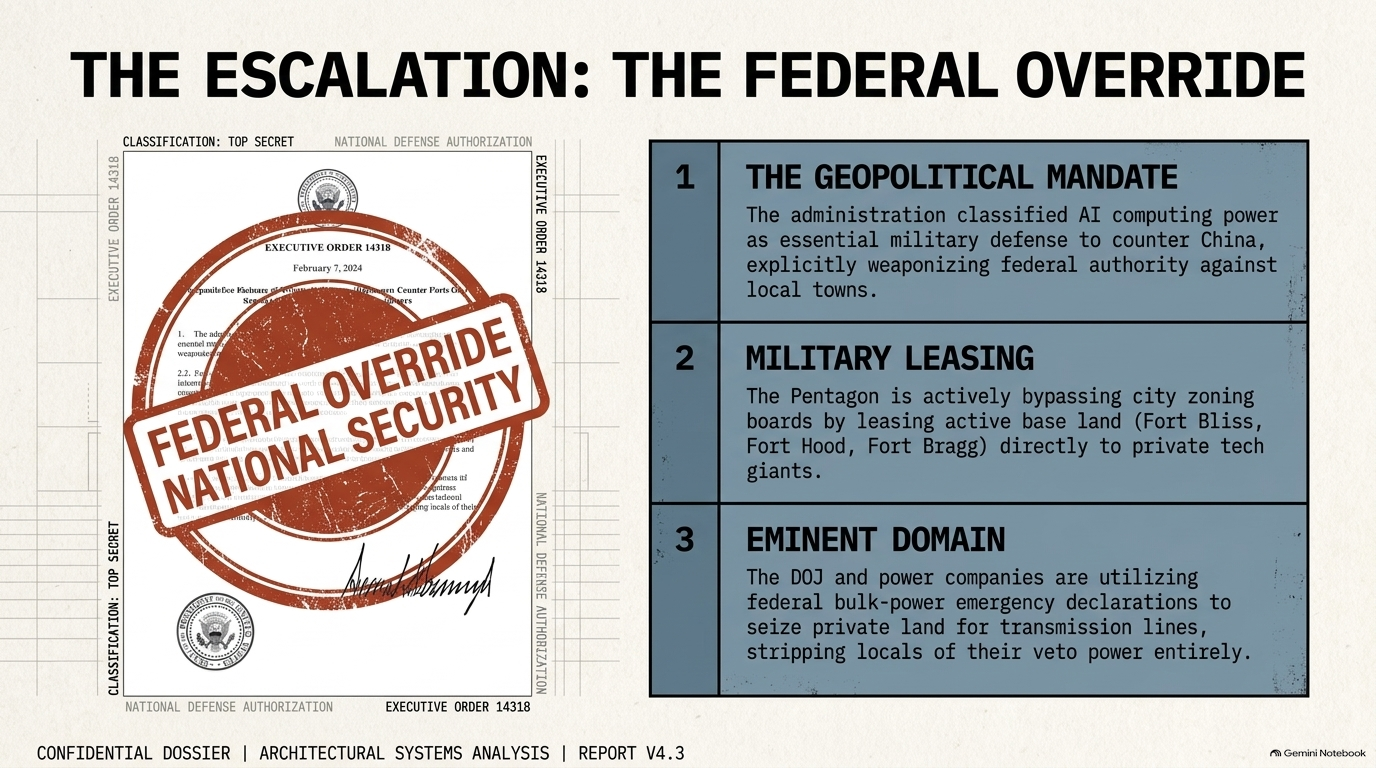
The National Security Mandate: Under Executive Order 14318 ("Accelerating Federal Permitting of Data Center Infrastructure"), computing power and AI infrastructure are classified as essential to military defense. This allows federal agencies to lease space on military bases (such as Fort Bliss, Fort Hood, and Fort Bragg) and utilize federal eminent domain to force transmission line construction across private property.
The Private Nuclear Pivot: To secure continuous power without relying on public grids, tech firms are building private Small Modular Reactors (SMRs) and co-locating data centers along coastlines to utilize direct ocean cooling.
New Environmental Dangers: Coastal nuclear-powered data centers introduce severe ecological risks. Discharging millions of gallons of superheated water back into the ocean creates thermal plumes that suffocate marine life and kelp forests. Furthermore, placing modular nuclear reactors in vulnerable coastal zones exposes critical digital infrastructure to severe storms, sea-level rise, and flooding risks.
Summary
The rapid expansion of AI data centers has transformed digital infrastructure from an invisible utility into a high-stakes arena of resource competition, legal conflict, and bipartisan political realignment.
Key Takeaways:
Local and Political Resistance: Cities across California and conservative voters across the Midwest and South are enacting moratoriums and bans to protect local electrical grids, municipal water supplies, and residential ratepayers.
Federal vs. Sovereign Authority: Federal efforts to deploy data centers on public lands face regulatory blocks, while sovereign tribal nations actively prohibit facilities on trust land despite ongoing vulnerabilities on private fee land.
Infrastructural Limits in Remote Regions: Severe grid deficits, water scarcity, thermal cooling barriers, and high construction costs make hyperscale developments in Alaska, Hawaii, Greenland, and U.S. Territories complex and risky.
The Resource Extraction Blueprint: Big Tech's economic strategy mirrors historical energy extraction models—leveraging tax abatements and shifting multi-billion-dollar grid expansion costs onto everyday ratepayers.
National Security Reclassification: Executive Order 14318 frames AI processing as a defense imperative, driving military base leasing and a pivot toward private nuclear power (SMRs) and coastal ocean cooling.