
What if the multi-billion-dollar artificial intelligence explosion isn't being funded by ordinary consumers buying subscriptions, but by a high-stakes financial closed loop? Five major technology hyperscalers have quietly accumulated an estimated $1.65 trillion in off-balance-sheet commitments, using specialized accounting vehicles and circular funding loops to finance data centers and hardware buildouts without unsettling Wall Street.
In this lesson, we will uncover the inner mechanics of this financial web, how tech giants are pivoting from software apps to human labor replacement, and why everyday taxpayers and utility customers may ultimately carry the real-world costs.
Analyze the structural mechanics of the "AI IOU" circular funding network and off-balance-sheet debt.
Evaluate the strategic shift from consumer SaaS subscriptions to enterprise labor arbitrage.
Assess the physical and financial burdens imposed on local tax bases and residential power bills.
Examine credit market fractures, private credit risks, and stock market volatility tied to AI infrastructure.
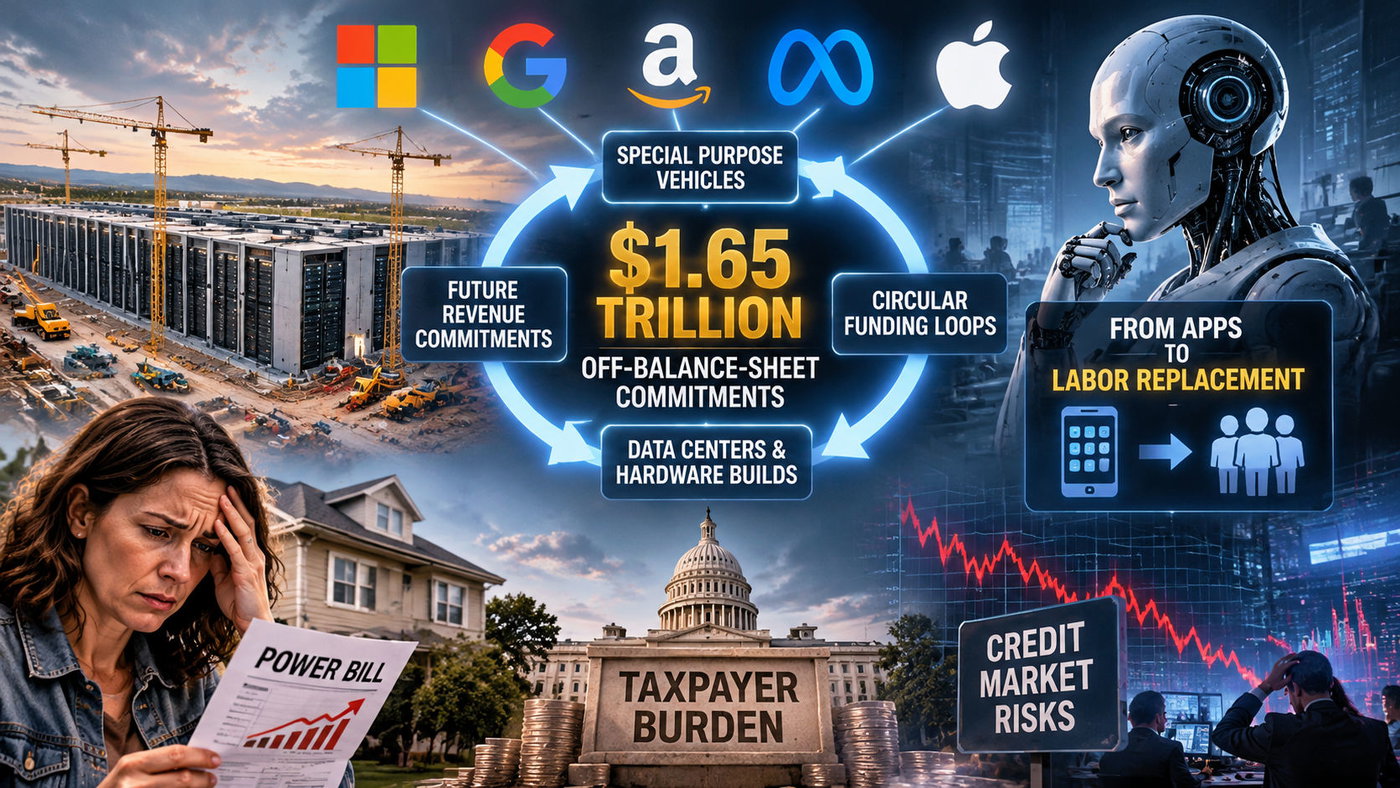

The Flywheel of Shadow Debt and Circular Deals
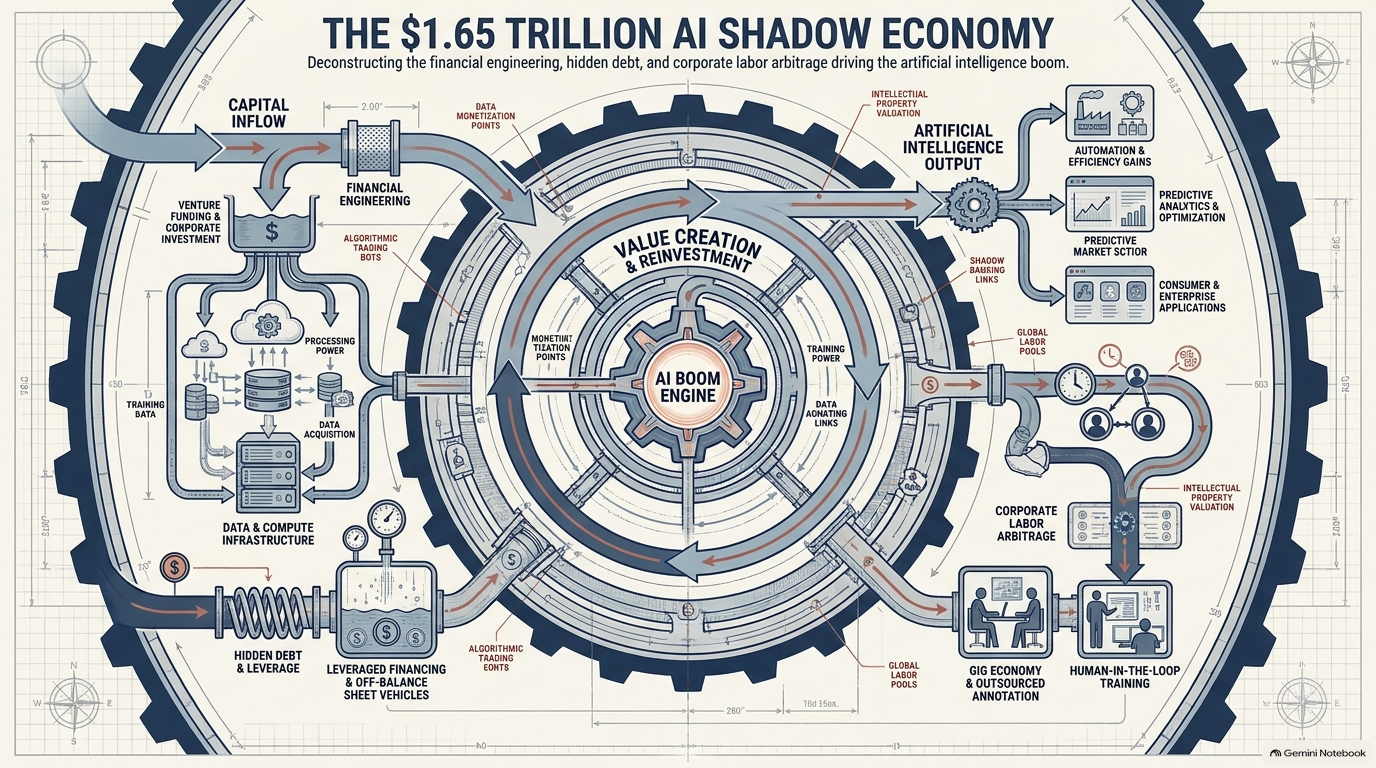
To understand the modern AI ecosystem, you must look past the flashy product demos and follow the capital. At the center of today's tech expansion is a phenomenon known as the AI IOU—a complex, interlocking funding web that decouples capital expenditures from true consumer monetization.
The Closed Financial Flywheel
Instead of relying on organic cash flow from millions of individual retail users, the technology cartel operates much like a closed internal economy. Here is how the loop spins:
Capital Injection: A tech giant (hyperscaler) invests billions of dollars into a promising AI startup or "frontier lab."
Infrastructure Recirculation: The startup immediately returns those same billions to the tech giant to purchase access to its cloud computing platform.
Revenue Illusion: Both entities record explosive revenue growth for public investors, even though no new external cash has entered the ecosystem.
Mapping the Players in the Network
This circular web spans the entire technology ecosystem, binding together four distinct layers:
The Cloud Giants (Hyperscalers): Microsoft poured billions into OpenAI, which OpenAI turns around and spends directly on Microsoft Azure cloud infrastructure. Similarly, Alphabet (Google) and Amazon have invested heavily in Anthropic, locking the startup into multi-billion-dollar commitments to Google Cloud and AWS. Meanwhile, Meta and Oracle utilize Special Purpose Vehicles (SPVs) and off-balance-sheet leases to acquire hardware; Meta alone carries an estimated $420 billion in off-balance-sheet commitments.
The Chipmakers: Nvidia reinvests its massive GPU profits back into AI startups and cloud builders, who then use those funds to buy more Nvidia chips. AMD engages in equity-for-hardware swaps, exchanging company shares for guaranteed chip purchase commitments.
The "Neoclouds": Specialized GPU cloud providers like CoreWeave and Lambda Labs borrow heavily from private credit funds to purchase hardware, serving as an intermediate layer that absorbs high-interest debt off Big Tech's primary balance sheets.
Private Hardware Ventures: Companies like Elon Musk's xAI pull in massive private capital rounds that cycle directly into specialized hardware clusters.
The Structural Risk
The core vulnerability of this insular flywheel lies in its reliance on self-generated momentum. If external enterprise buyers do not eventually step in to purchase these AI tools for practical, revenue-generating applications, the loop runs out of fresh cash, risking a severe unwind.
From Apps to Assets: The Cold Logic of Enterprise Labor Arbitrage
Why are tech giants willing to take on staggering shadow debt to construct massive data centers? The answer lies in a fundamental pivot in how tech leadership plans to monetise artificial intelligence.
The Consumer Bottleneck vs. Enterprise Replacement
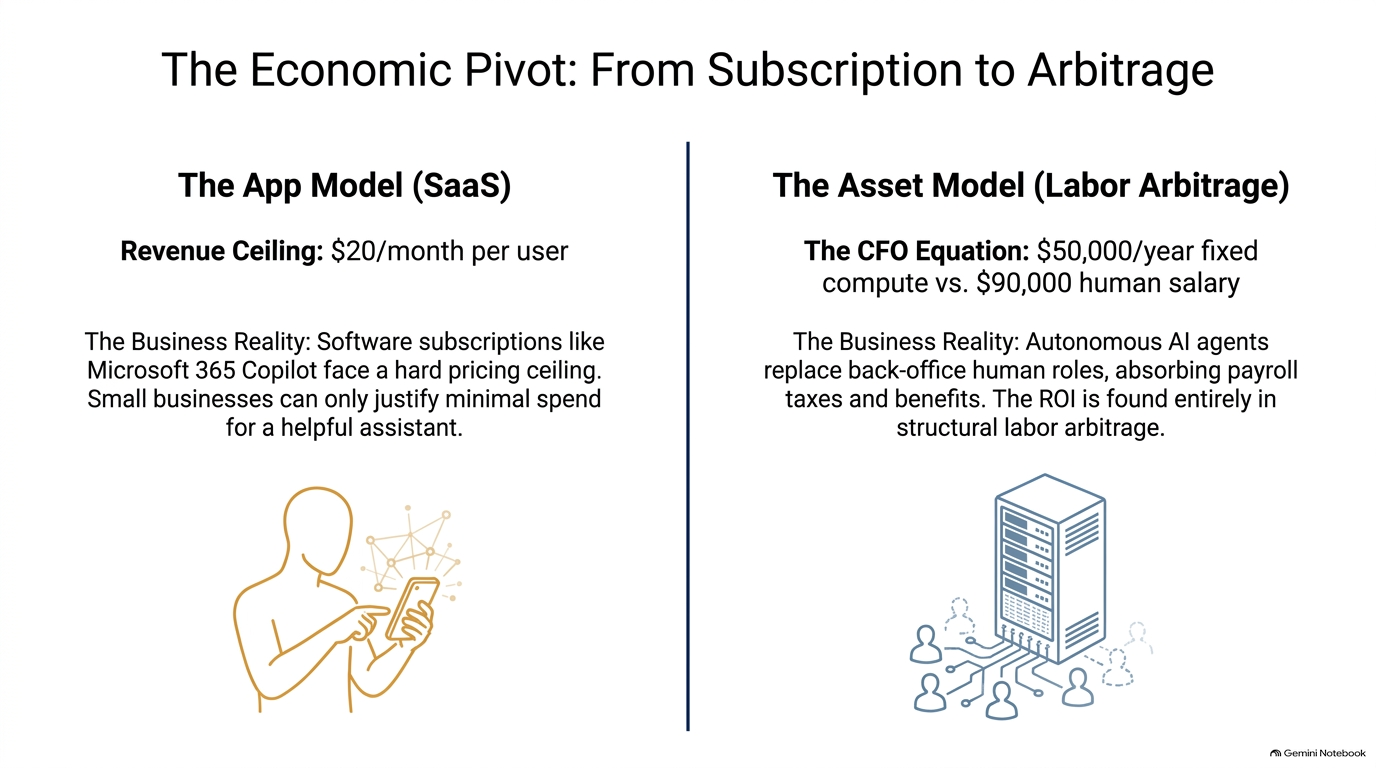
For years, software was sold as a Software-as-a-Service (SaaS) product—think $20 monthly subscriptions for ChatGPT or Microsoft 365 Copilot. However, consumer SaaS faces a hard pricing ceiling: individual workers and small businesses can only justify paying a modest amount for a "helpful digital assistant."
To justify hundreds of billions in capital expenditures, tech companies have shifted their focus to labor arbitrage. An enterprise corporation will rarely pay thousands of dollars for an assistant tool, but it will eagerly pay $50,000 annually** for an autonomous AI agent if that agent permanently replaces a back-office human employee who previously cost **$90,000 in salary, payroll taxes, and health benefits.
Traditional Consumer SaaS: $20/month Helper Tool ---> Low ROI CeilingEnterprise Labor Arbitrage: $50,000/year Digital Agent ---> Replaces $90,000 Human RoleWhere Human Overhead is Being Liquidated
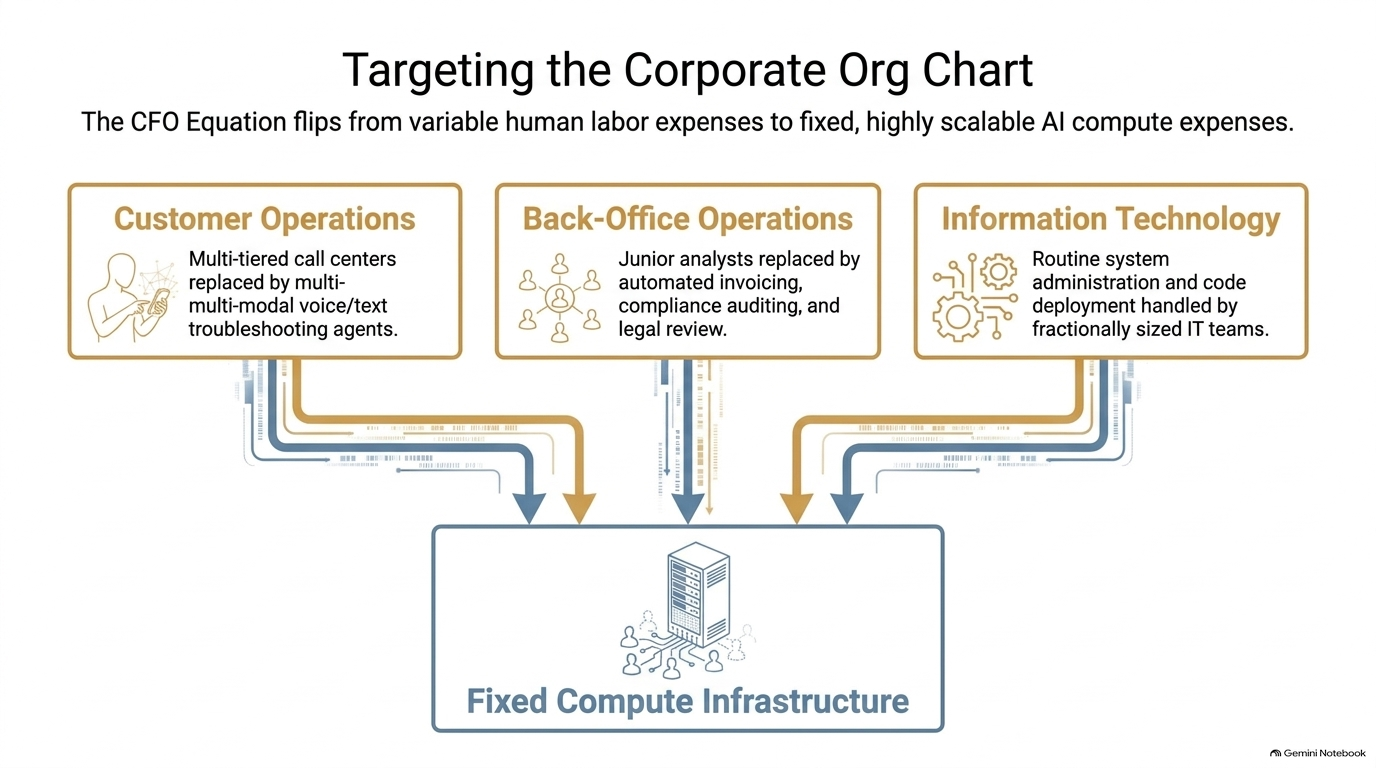
Corporate buyers are actively targeting three key operational layers to automate and recover compute costs:
Customer Operations: Replacing multi-tiered call centers and support desks with multimodal voice and text agents capable of resolving complex issues.
Back-Office Operations: Automating data entry, invoicing, compliance audits, and legal document reviews traditionally assigned to junior analysts.
Information Technology: Using automated code deployment, cybersecurity monitoring, and routine administration to operate networks with fractionally sized IT teams.
Case Study: Microsoft's Workforce Restructuring
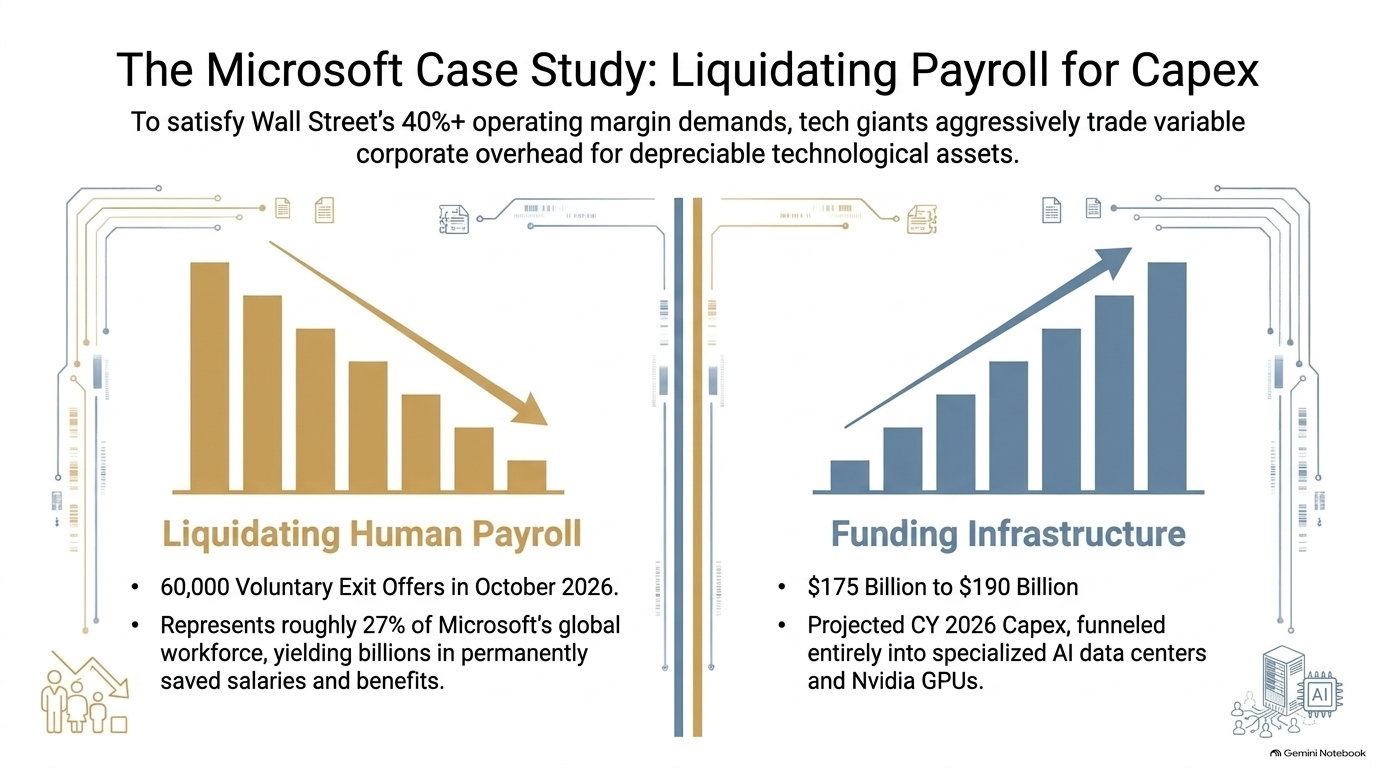
This economic logic is directly reflected in corporate balance sheets. On October 26, 2026, Microsoft introduced a massive "Voluntary Exit Offer" making 60,000 employees (roughly 27% of its global workforce) eligible for severance buyouts. At the exact same time, Microsoft CFO Amy Hood confirmed that capital expenditure was projected to reach $175 billion to $190 billion for the calendar year—spent almost entirely on AI data centers, specialized server clusters, and Nvidia chips.
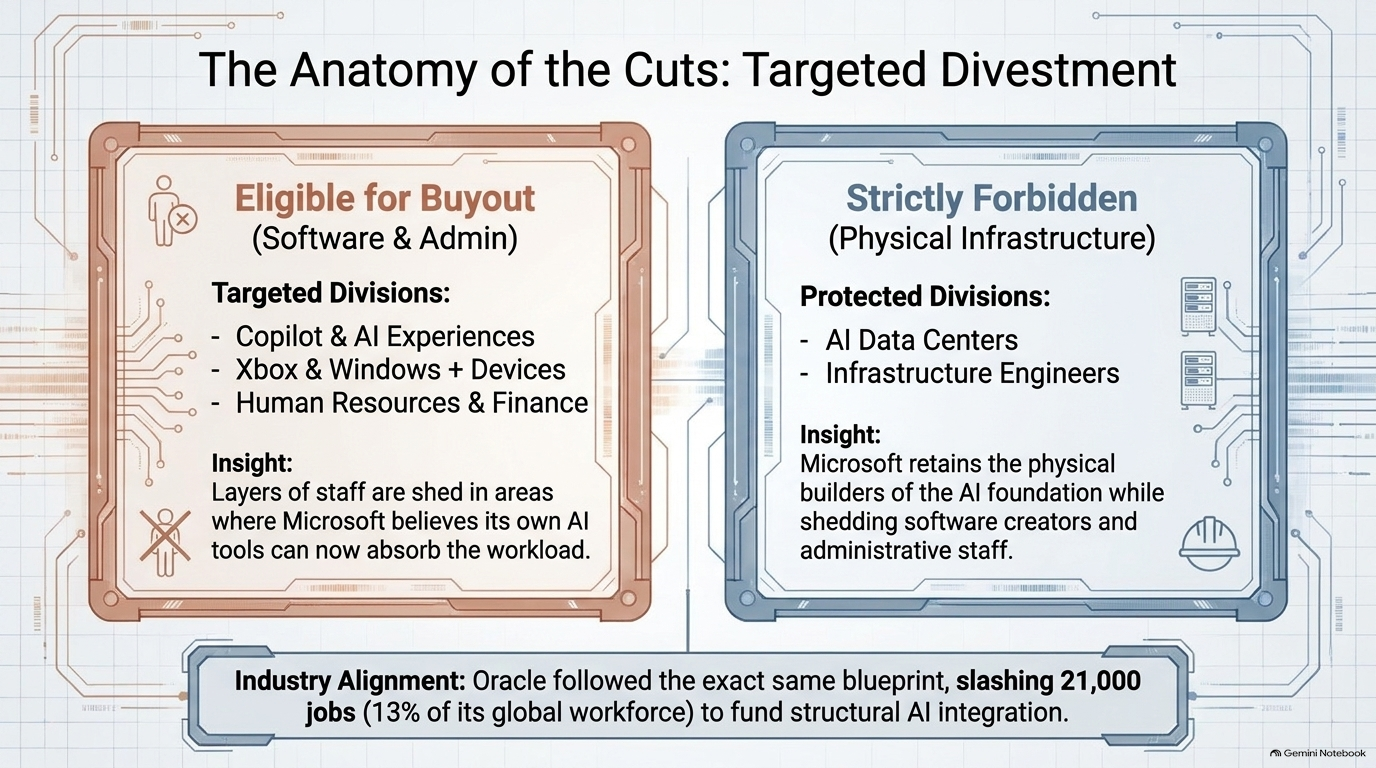
Crucially, Microsoft explicitly banned employees in AI Data Centers and Infrastructure from participating in the buyout program. While administrative staff, Xbox teams, and Copilot software creators were offered incentives to walk out the door, the physical engineers constructing the AI baseline were strictly retained. Variable human payroll was directly converted into fixed GPU assets.
The Local Bill: Tax Abatements, Grid Upgrades, and Stranded Assets
While Big Tech's circular economy fuels soaring market valuations, the physical infrastructure required to power it requires immense land, water, tax breaks, and electricity. As a result, local communities and everyday taxpayers are absorbing the immediate real-world costs of this digital expansion.
1. Draining Local Tax Bases
To entice tech companies to build facilities, state and local governments routinely grant generous tax abatements. By 2026, 40 U.S. states offered dedicated data center tax subsidies—primarily exempting servers and electricity from sales taxes.
State Budget Hits: These breaks cost states like Texas and Virginia over $1 billion annually in lost tax revenues.
Unanticipated Shortfalls: In Ohio, data center tax exemptions outran official projections, costing the state $1.6 billion in 2025 alone. When local governments forfeit corporate tax revenues, funding for public schools, road repairs, and emergency services suffers directly.
2. Shifting Grid Costs to Residential Utility Bills
A single hyperscale data center can consume as much electricity as 100,000 homes. Integrating these mega-facilities into regional power networks requires expensive high-voltage transmission lines and new substations.
In Illinois, electric utility ComEd filed dockets in late 2026 projecting $3.1 billion** in necessary grid upgrade costs across 30 data center projects. However, tech developers had contributed only **$721 million in advance deposits—leaving a $2.38 billion exposure gap.
ComEd Service Region Grid Metrics (2026) | Amount |
|---|---|
Total Projected Grid Upgrade Cost | $3.1 Billion |
Upfront Capital Paid by Tech Developers | $721 Million (<25%) |
Potential Uncovered Cost Gap | $2.38 Billion |
Consumer advocacy groups like the Citizens Utility Board (CUB) warn that under standard state utility laws, power providers can recover these capital buildouts by increasing delivery and transmission rates across their entire customer base. In fact, projected data center demand has already contributed to a ~50% surge in Illinois electricity supply prices over a two-year period.
3. The Threat of "Stranded Assets"
What happens if an AI startup defaults or abandons a project halfway through construction? The power grid infrastructure built specifically for that facility becomes a stranded asset—highly specialized equipment with no tenant to pay off the debt. Because these transmission upgrades cannot easily be resold to standard warehouses, local utility ratepayers risk paying higher monthly bills for decades to retire the stranded debt of failed data centers.
Credit Fractures, "Shadow Banks," and Systemic Market Risk
As the scale of off-balance-sheet leverage expands, stress fractures are appearing in the credit and debt markets that underpin the AI buildout.
Nvidia as the "Central Bank" of AI
Rather than acting purely as a vendor, Nvidia has assumed the role of primary financial backstop for the specialized cloud market. SEC filings reveal that Nvidia has put over $171.5 billion on the line to support neoclouds and frontier labs:
$105 Billion guarantee for OpenAI's mega-data center lease in Ohio.
$36 Billion in off-balance-sheet server backstops.
$20 Billion in direct data center leases signed to be assigned later.
$7+ Billion in direct equity injections.
The CoreWeave Stress Test
Neocloud provider CoreWeave highlights the risks of this high-leverage model. While scaling to over $5 billion in revenue, CoreWeave accumulated $51.6 billion in total debt and lease commitments funded by private credit. By October 2026:
CoreWeave's net quarterly interest expense doubled to $640 million.
Bond yields surged toward 16%.
Credit Default Swaps (CDS)—the market cost to insure against bankruptcy—spiked to 1,000 basis points, implying a 63% market probability of default over five years.
When news leaked that Nvidia was contractually obligated to buy up to $6.3 billion of CoreWeave's unused compute capacity if external buyers failed to materialize, Nvidia's own stock fell 4.5% in a single day. Investors realized that if neoclouds default, toxic debt flows directly back onto Nvidia's balance sheet.
Neocloud Debt Default ---> Triggers Backstop Commitments ---> Unpaid Debt Lands on Nvidia Balance SheetWhy a Federal Bailout is Unlikely
Unlike the 2008 banking collapse or the March 2023 Silicon Valley Bank (SVB) rescue—where the government invoked a "systemic risk exception" to protect checking accounts used for employee payroll—the debt bankrolling neoclouds is held by private credit funds (such as Blackstone, PIMCO, and Coatue Management).
Private credit operates outside traditional FDIC-insured commercial banks. Because these loans represent speculative corporate investments rather than consumer bank deposits, there is no legal mandate or political mechanism for a federal taxpayer bailout if these debt structures collapse. The financial losses remain concentrated within institutional portfolios, tech balance sheets, and local utility rate structures.

Summary
The modern AI boom relies on a highly interconnected financial architecture where circular deals, off-balance-sheet commitments, and private credit debt obscure true market demand. As tech giants transition from consumer software to enterprise labor arbitrage, the physical and financial risks of this infrastructure buildout are increasingly borne by local taxpayers, utility ratepayers, and institutional portfolios.
Key Takeaways
Circular Financing Mechanism: Major hyperscalers and chipmakers use closed capital loops and Special Purpose Vehicles (SPVs) to generate reported revenue growth while hiding an estimated $1.65 trillion in off-balance-sheet debt.
Pivot to Labor Arbitrage: Big Tech's enterprise strategy focuses on replacing human corporate roles with autonomous digital agents, converting variable payroll costs into fixed GPU and cloud compute expenditures.
Public Ratepayer Exposure: Local communities face tax base erosion through state tax abatements and higher residential electric bills due to massive utility grid upgrade costs and potential stranded assets.
Private Credit Vulnerability: Unregulated shadow banks and private credit managers hold tens of billions in neocloud debt, with Nvidia acting as an uncapped lender of last resort.
Disclaimer:
With the access to AI reading the news, watching movies and reading books opens up a new world. I have had various family members live to the age of 100 and I ask them what have they learned from their lives and they do not have awareness of what they journey means. These two areas fit with this idea I had. Having chats with AI on topics of thought and documenting them. I call this "Thoughts in the dark".
I am aware I do not have the answers only questions.
The report: