
Introduction
While private tech giants like Google are rapidly hiring tens of thousands of workers to build the foundational infrastructure of artificial intelligence, the U.S. federal government recently experienced a historic exodus of nearly half a million civil servants. How can the private tech sector experience an aggressive hiring boom at the exact same time the public sector undergoes a massive structural purge—and what happens when the central silicon engine powering this entire boom faces a massive federal antitrust probe?
In this lesson, we will explore the driving forces behind these contrasting workforce trajectories, the legal battles reshaping federal power, and the regulatory scrutiny surrounding the AI boom. By the end of this lesson, you will be able to:
Analyze the strategic and financial drivers behind Google's post-layoff workforce expansion during the AI boom.
Contrast private sector AI talent acquisition with the structural downsizing executed across federal civil service agencies.
Evaluate the legal mechanisms, executive orders, and judicial rulings used to reshape the federal civil service.
Examine the Department of Justice's vertical monopolization investigation into Nvidia's dominance over the AI ecosystem.

Two Divergent Paths: Google's AI Expansion vs. The Federal Purge
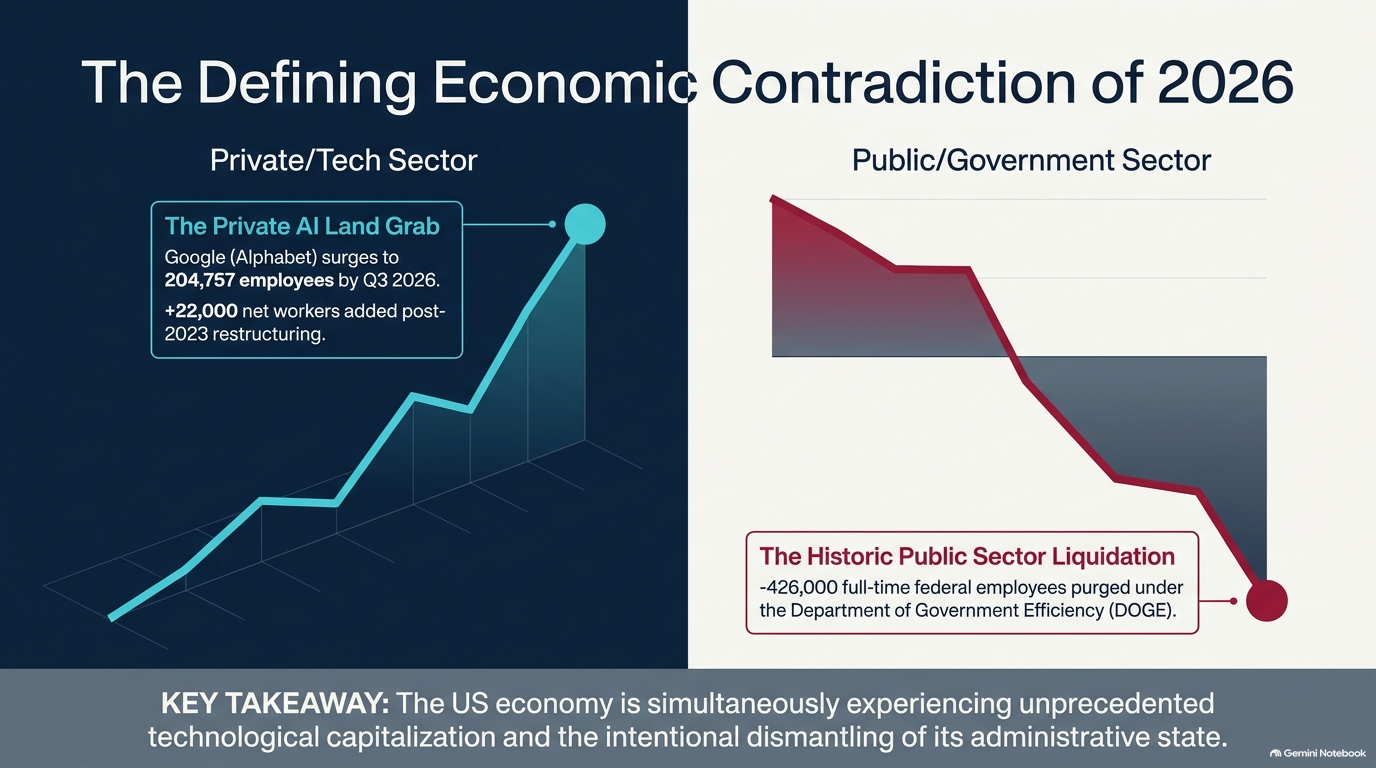
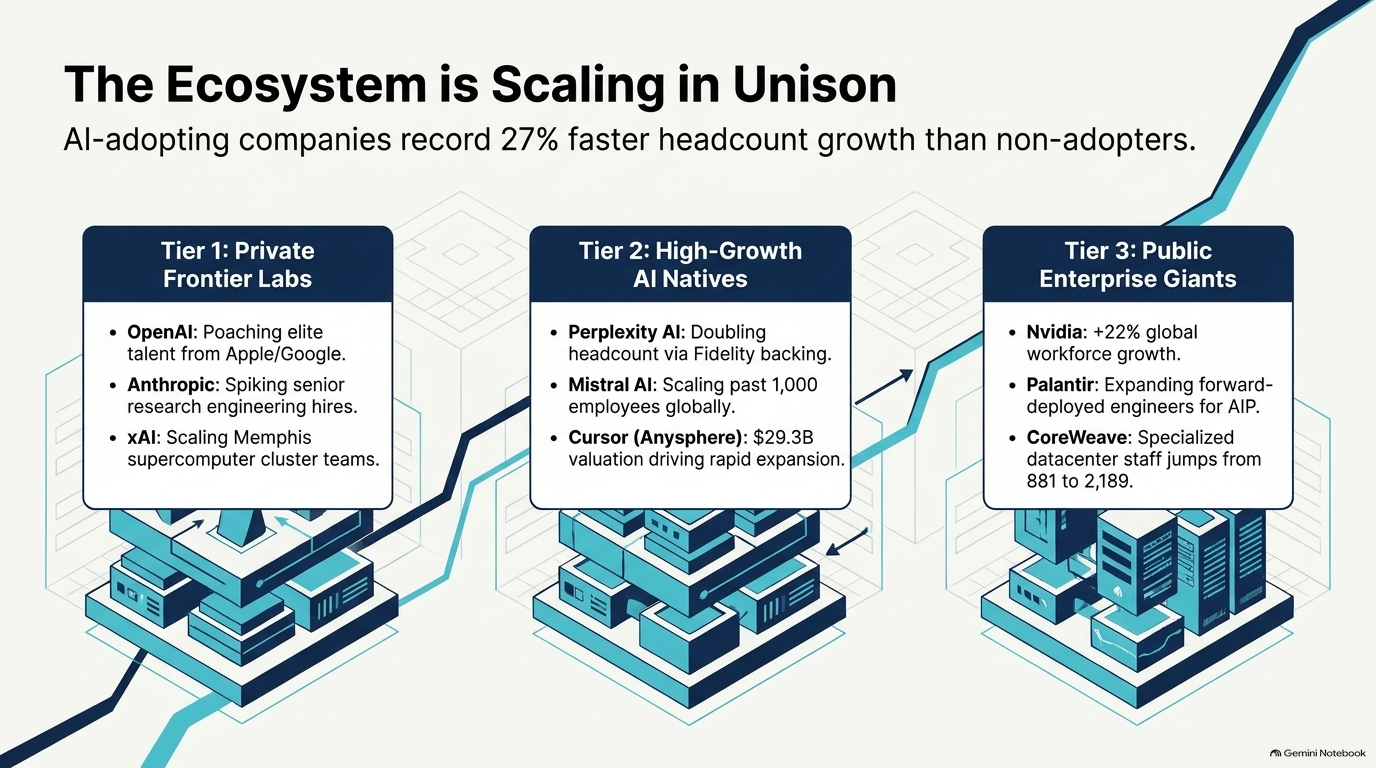
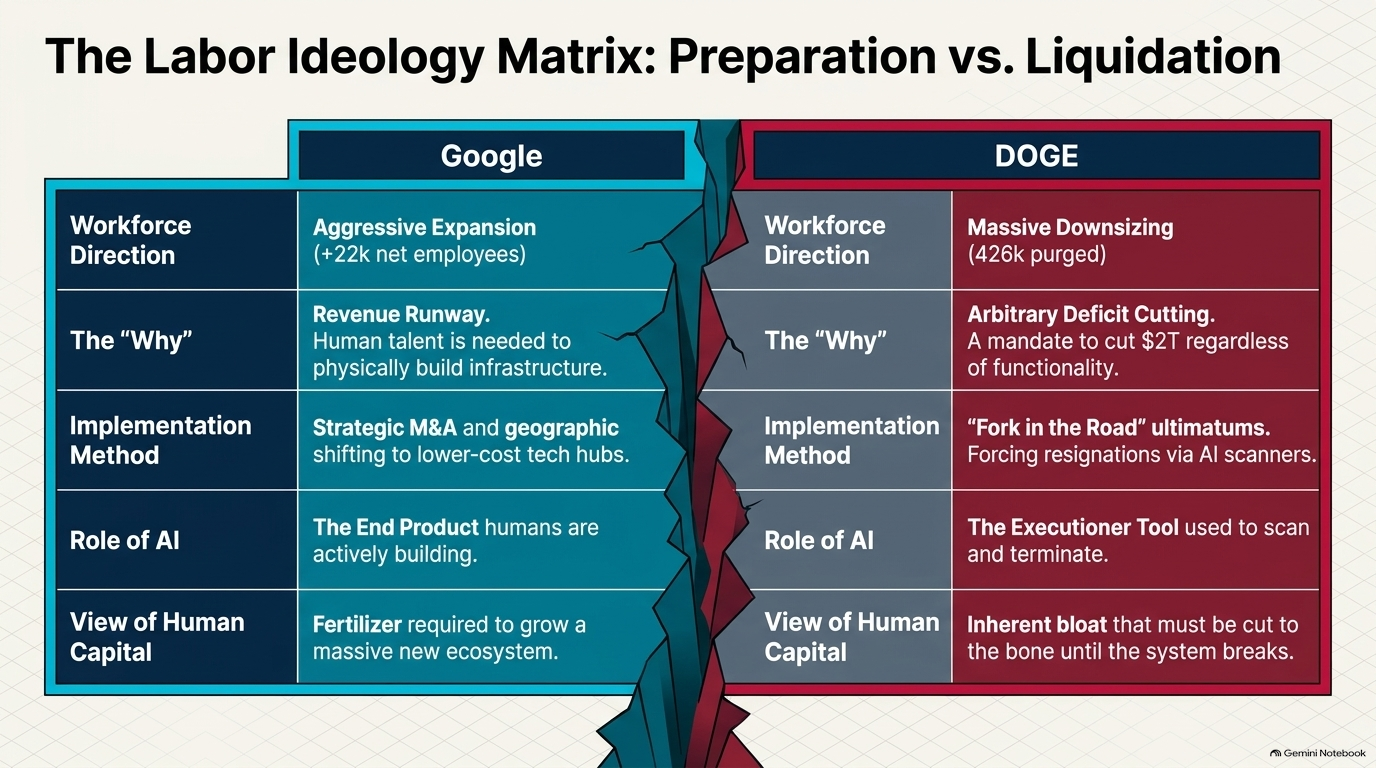
To understand the current economic landscape, picture two trains running on parallel tracks in completely opposite directions. On one track, Google's parent company, Alphabet, saw its global headcount surge to 204,757 employees by the third quarter of 2026. After trimming 12,000 roles during a 2023 restructuring, Google reversed course and expanded its payroll by over 22,000 net new workers, adding 10,000 employees in just a six-month window between March and September 2026.
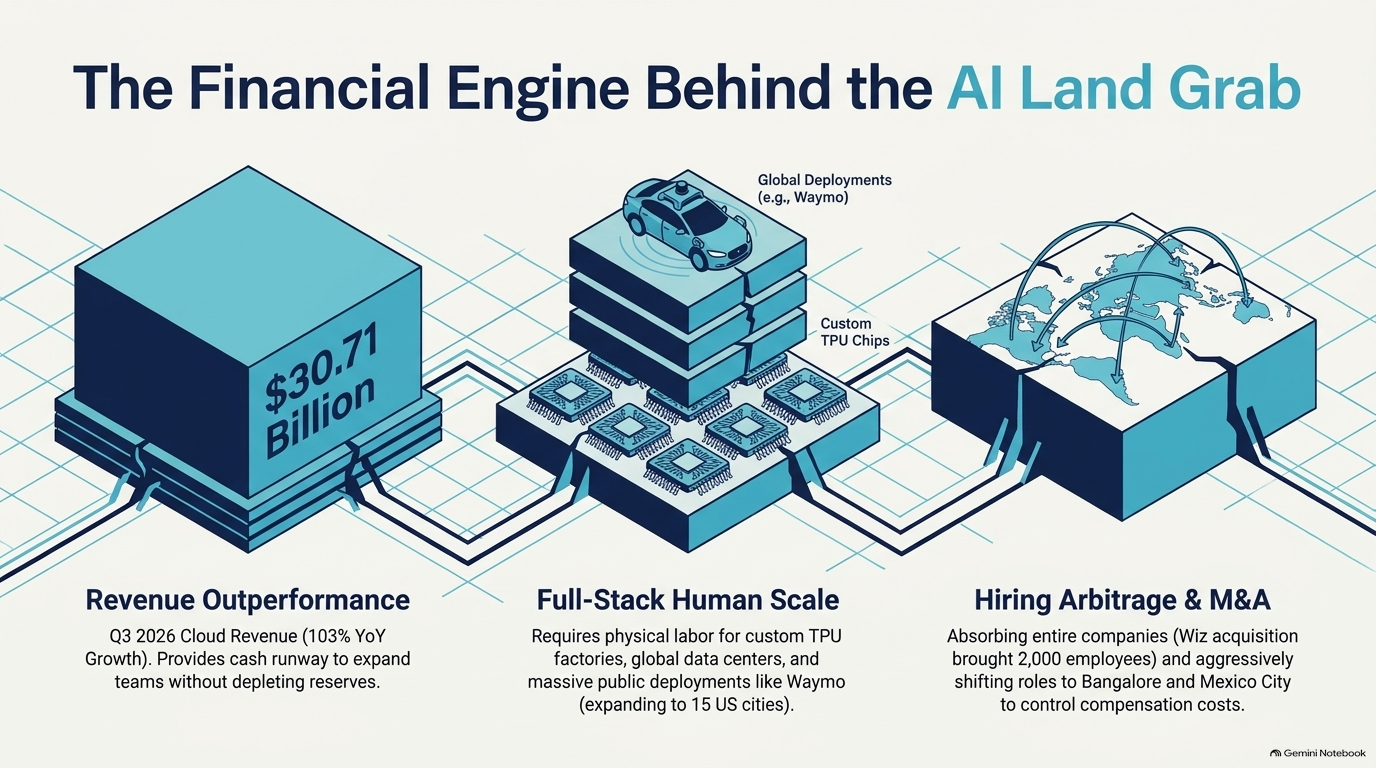
Why is Google hiring while tech peers navigate voluntary buyouts and headcount freezes? The answer lies in Google's "Full-Stack" AI Strategy and record revenue performance:
Massive Revenue Runway: Fueled by the enterprise demand for artificial intelligence, Google Cloud revenue grew by 103% to $30.71 billion in Q3 2026 alone, providing the financial runway required to scale human teams.
Infrastructure and Silicon Scale: Unlike competitors focused solely on software applications, Google designs physical chips (Tensor Processing Units or TPUs), builds massive physical data centers, and manages complex autonomous operations like Waymo across major U.S. cities. Human labor is required to deploy this physical infrastructure.
Strategic M&A and Hiring Arbitrage: Growth was bolstered by major acquisitions, such as absorbing 2,000 employees from the cybersecurity firm Wiz. Simultaneously, Google shifted certain U.S. roles to lower-cost tech hubs like Bangalore and Mexico City to manage overall compensation overhead while expanding total headcount.
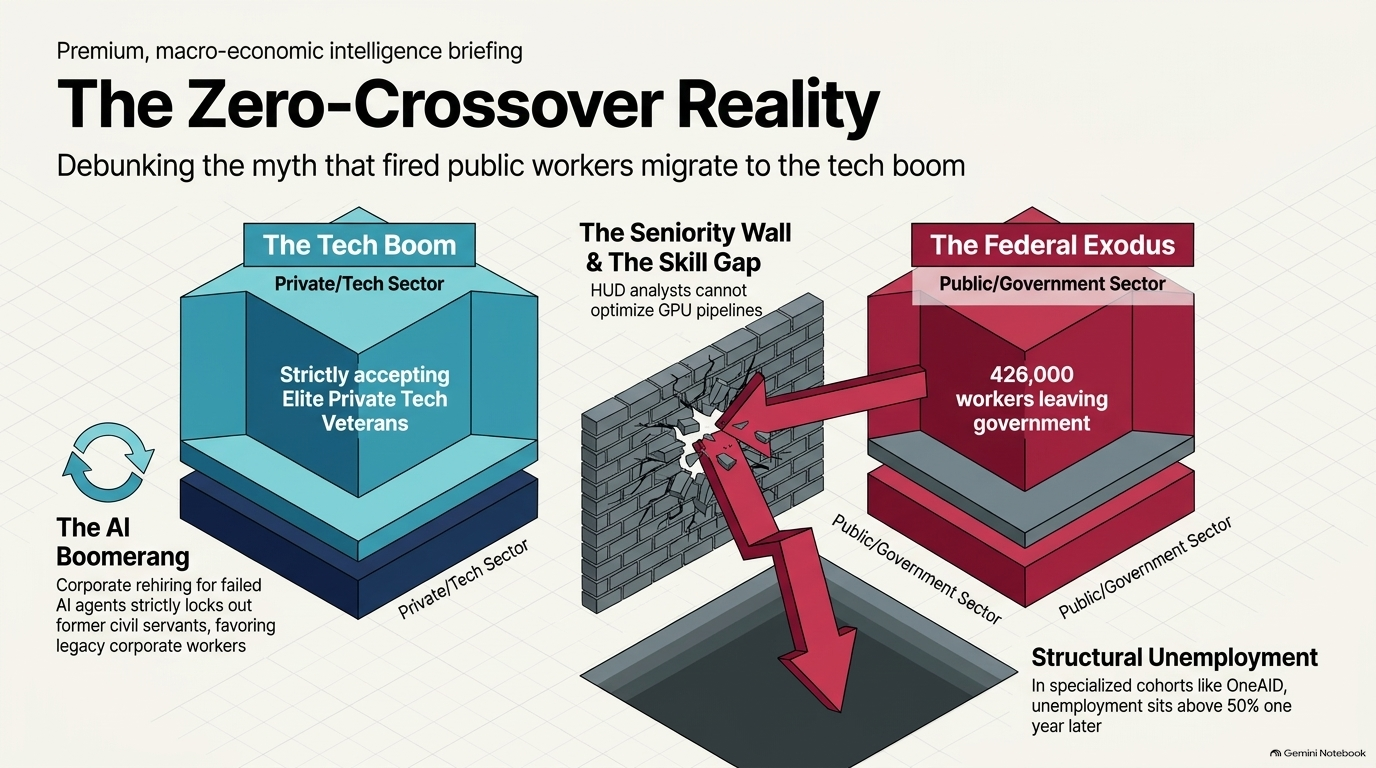
On the opposite track sits the public sector. Under the Department of Government Efficiency (DOGE), led by Elon Musk from January 2025 to July 2026, the federal government applied a private-sector liquidation model to the civil service. Official data shows 426,000 full-time federal employees—nearly 1 in 5 federal workers—left government service, heavily impacting agencies like USAID, the Department of Education, and the Social Security Administration.
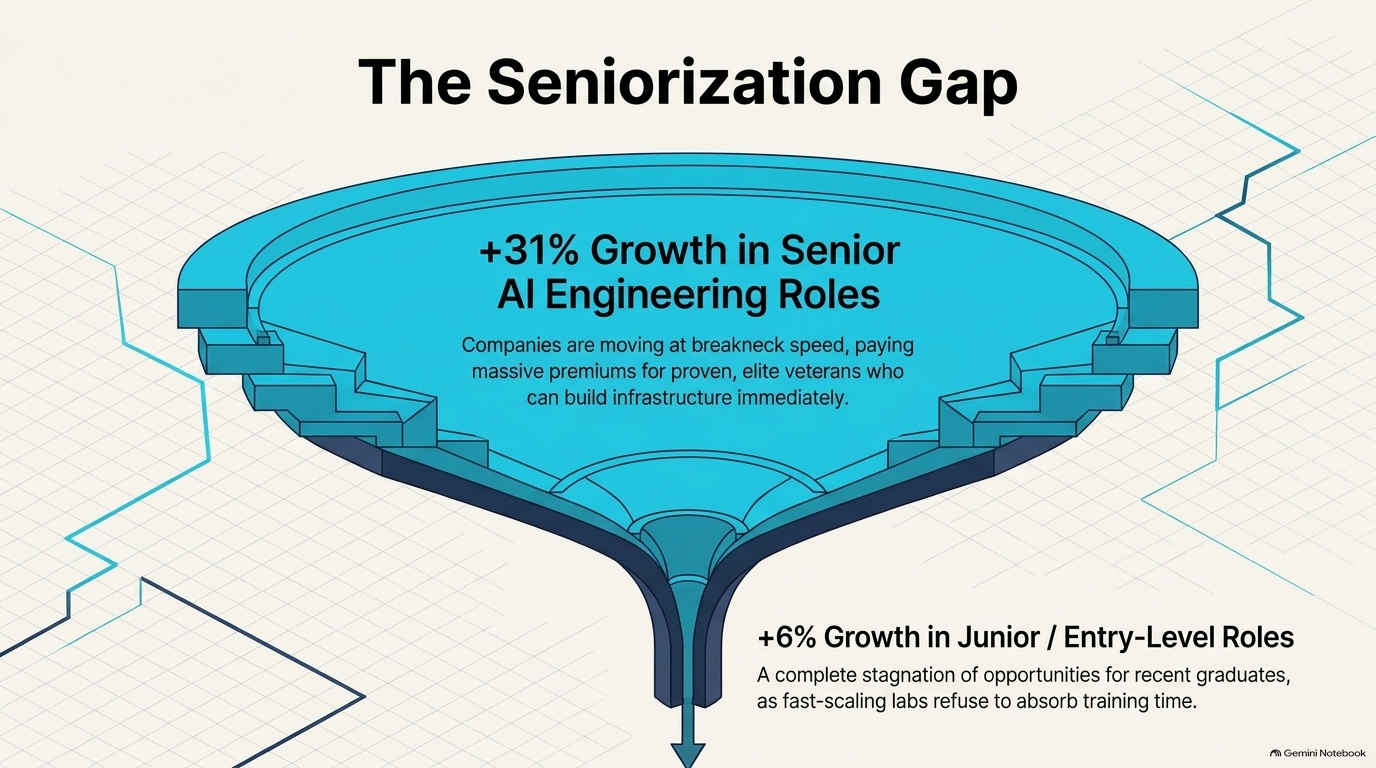
A common misconception is that workers flowing out of government seamlessly transitioned into high-paying private AI roles. In reality, real-world labor tracking shows almost zero direct crossover. Private AI leaders are locked in a "seniorization" trend—paying massive premiums for elite deep-learning research scientists and TPU chip architects (senior technical hiring grew 31%, while junior hiring stagnated at 6%). Policy analysts and civil administrators from public agencies lack the specialized technical skills required by private AI labs, leaving three-quarters of affected federal workers navigating structural long-term unemployment.
Rewriting Executive Power: Schedule Policy/Career and Judicial Battles
The federal workforce downsizing was not merely an exercise in cutting headcount; it represented a fundamental restructuring of how executive power governs civil servants. Rather than violating civil service laws outright, the administration executed legal workarounds to alter the legal landscape from within.
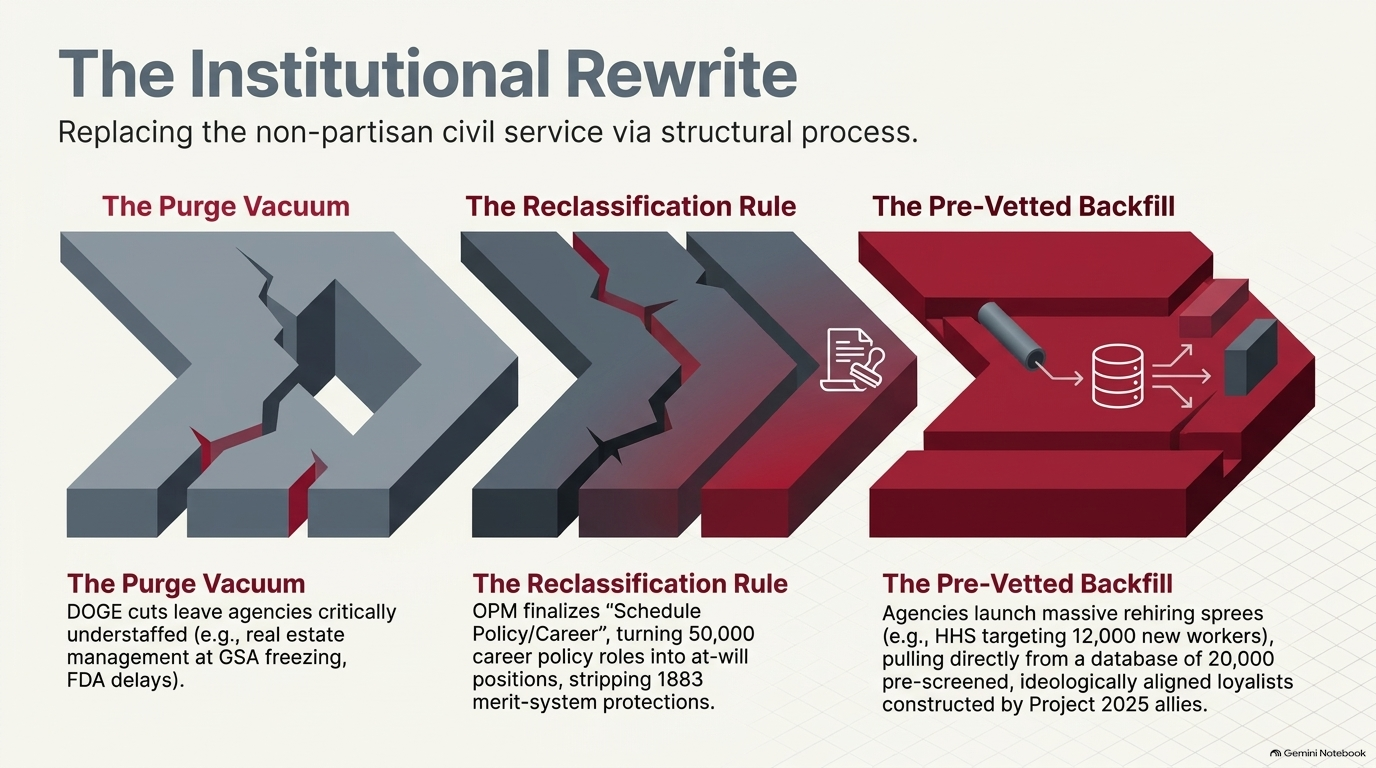
The centerpiece of this legal overhaul was the creation of the "Schedule Policy/Career" designation (an evolution of the 2020 "Schedule F" concept). This civil service classification targeted approximately 50,000 career officials whose roles influence policy, stripping away their traditional merit-system job protections and turning them into at-will employees who can be dismissed without standard due process rights.
To execute broad reductions without traditional performance reviews, the administration deployed three primary mechanisms:
Reductions in Force (RIFs): Exploiting statutory loopholes, agencies eliminated thousands of positions under the legal framing of budgetary efficiency and structural reorganization rather than direct performance firings.
Internal Oversight Shifts: Whistleblower complaints for reclassified policy roles were shifted away from independent bodies like the Office of Special Counsel to internal agency General Counsels, altering how oversight is enforced.
Constitutional Precedent Leverage: The administration successfully argued before the Merit Systems Protection Board (MSPB) that Article II of the Constitution grants the President inherent authority to manage policy-influencing officials free from statutory interference.
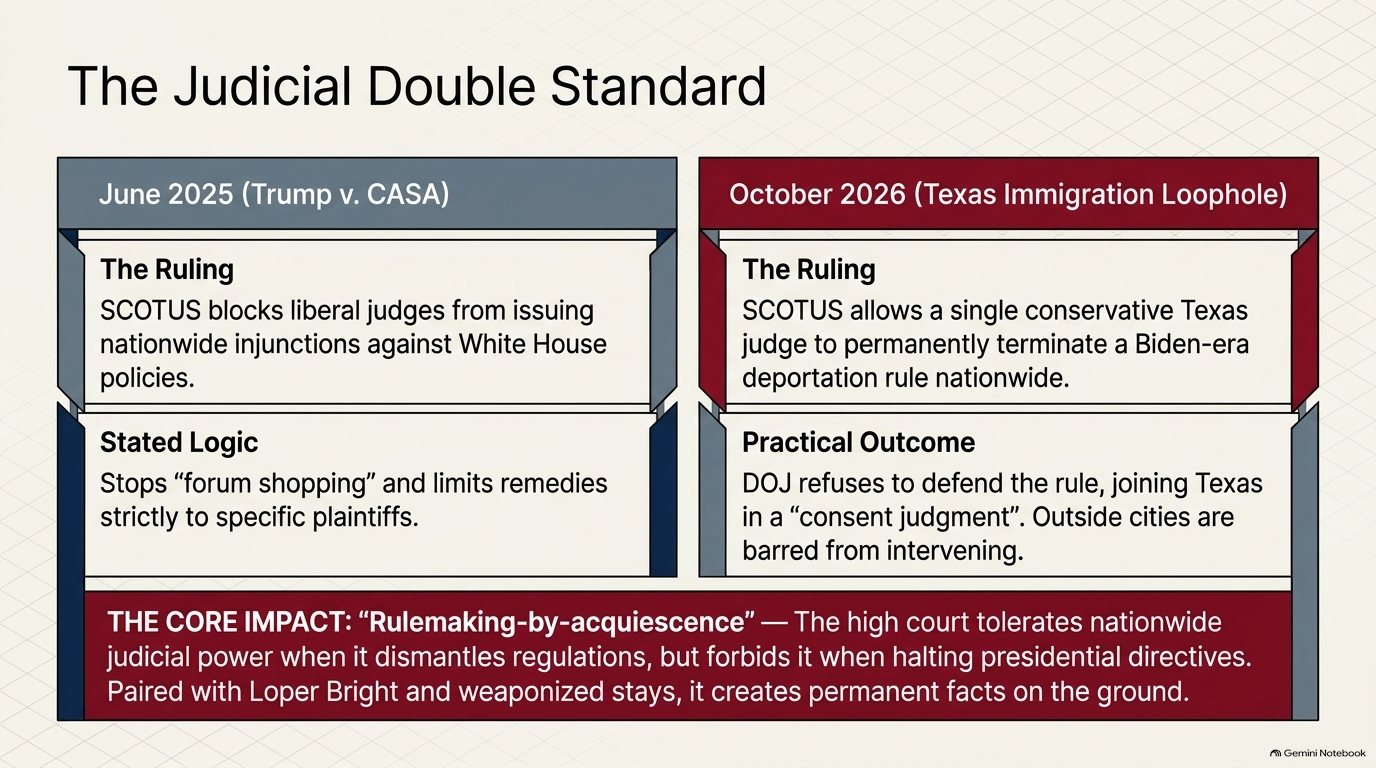
This executive posture intersected directly with a shifting judicial landscape. Following the landmark Loper Bright ruling—which overturned Chevron deference and stripped federal agencies of their authority to interpret ambiguous laws—the judiciary assumed primary authority over regulatory policy.
Furthermore, the Supreme Court's emergency docket handling generated intense legal debate. In June 2025 (Trump v. CASA, Inc.), the Court limited individual district judges from issuing nationwide injunctions to halt White House directives. However, in October 2026, the Supreme Court declined to block a nationwide order originating from a conservative federal district court in Texas, where the Department of Justice and the State of Texas entered a consent decree to terminate a Biden-era immigration regulation.
To legal critics, this reliance on judicial stays and consent decrees represents a strategy of creating "facts on the ground"—allowing an administration to dismantle agency structures and purge specialized staff during multi-year appeals, rendering original institutional knowledge impossible to restore even if lower court rulings are eventually upheld.
The Engine Under Scrutiny: Nvidia's AI Dominance and the DOJ Probe
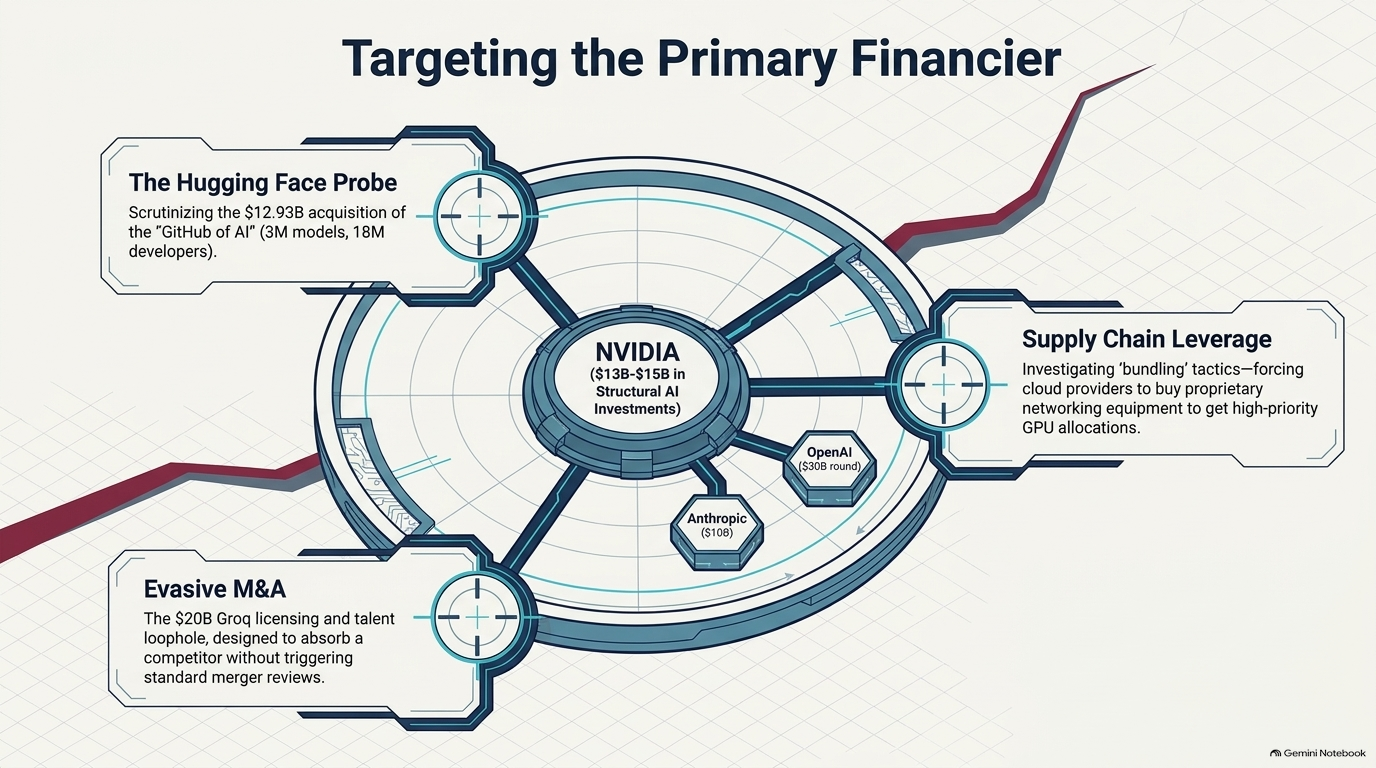
While tech titans expand their software and cloud infrastructure, the physical engine driving the entire artificial intelligence boom rests in the hands of a single hardware leader: Nvidia. Beyond manufacturing graphics processing units (GPUs), Nvidia has operated as the central financier of the AI ecosystem, deploying between $13 billion and $15 billion into anchor equity commitments for labs like OpenAI ($30B round participation), Anthropic ($10B), xAI ($2B), and specialized cloud providers like CoreWeave.
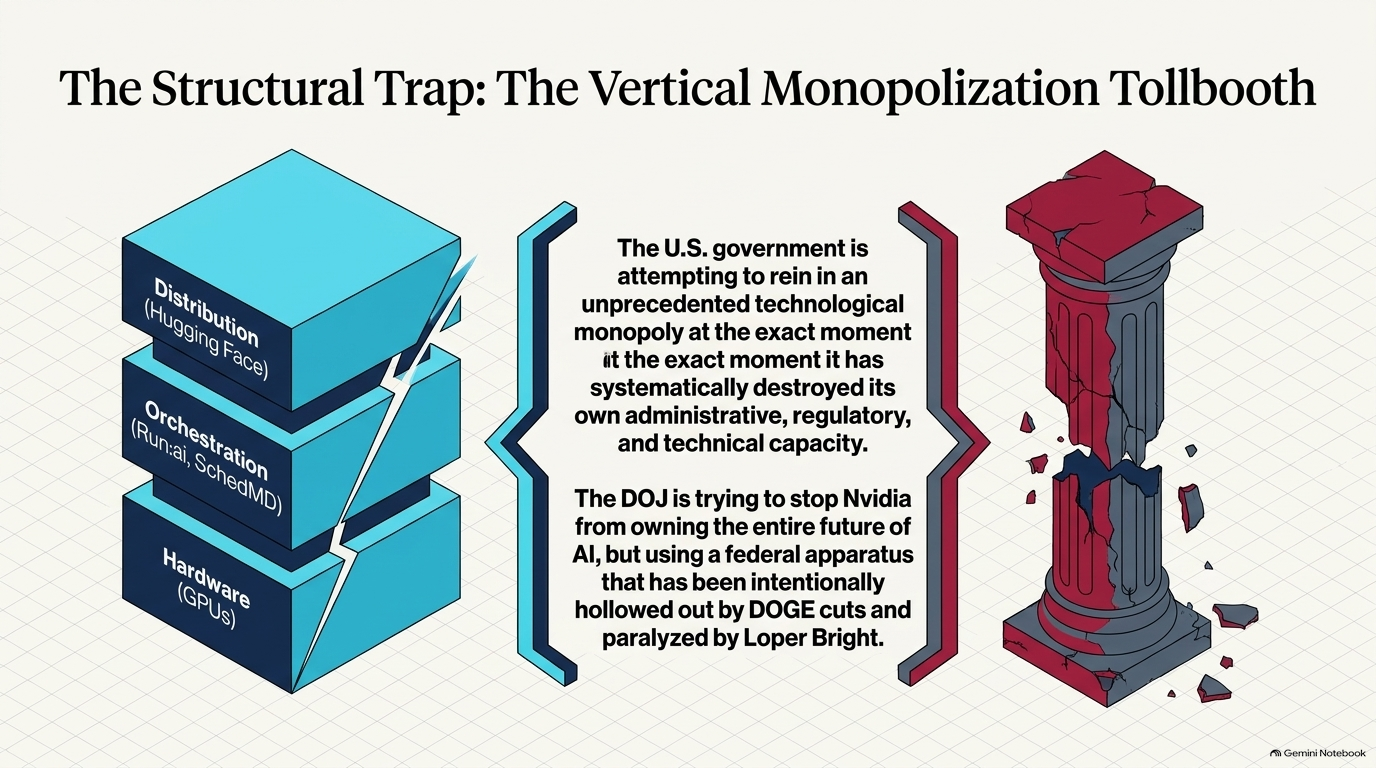
However, this central role has drawn intense scrutiny from the Department of Justice (DOJ), which has launched a major vertical-monopolization investigation into Nvidia's market practices. Regulators are evaluating whether Nvidia is using its dominant hardware position to lock down the entire AI software and distribution stack.
The DOJ investigation centers on three critical focal points:
The $12.93 Billion Hugging Face Acquisition: Hugging Face serves as the primary open-source model repository hosting over 3 million models for 18 million developers. Regulators view ownership of this platform as a potential distribution chokepoint, giving Nvidia the power to optimize open-source AI for its own hardware while sidelining rival chipmakers like AMD and Intel.
Hardware-Software Bundling: Investigators are scrutinizing whether Nvidia ties high-priority GPU allocations (such as Blackwell or Hopper chips) to whether clients also purchase adjacent proprietary server networking gear and utilize its proprietary CUDA software platform.
Creative Merger Structuring: The probe targets non-traditional transactions designed to absorb potential competitors, such as a $20 billion licensing and talent deal with Groq that brought over Groq's top leadership without triggering standard pre-merger antitrust review windows.
If federal regulators impose structural remedies or restrict Nvidia's corporate venture activities, the broader tech landscape faces significant macro risks. Restricting capital flows could freeze venture funding for early-stage AI startups, enforce delays across multi-billion-dollar cloud data center deployments, and raise geopolitical concerns regarding U.S. competitiveness in the global race toward superintelligence.

Summary
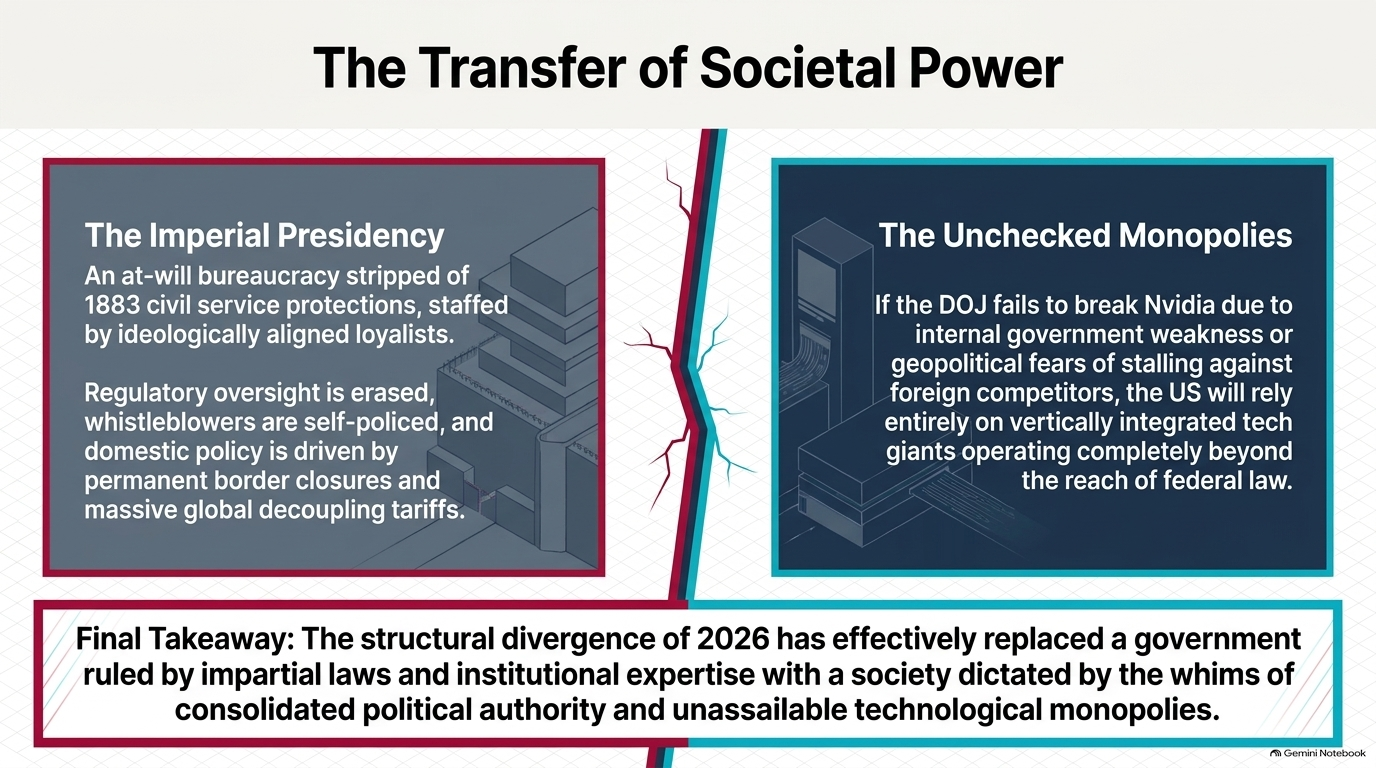
The contemporary economic and political landscape is marked by a profound structural divergence: private technology leaders are rapidly expanding headcount to capture foundational AI infrastructure, while the federal executive branch uses novel legal and administrative mechanisms to downsize and reclassify the traditional civil service workforce—all while antitrust regulators move to challenge the concentrated market power of the silicon hardware powering the entire transformation.
Key Takeaways:
Google's Targeted Expansion: Google expanded its global workforce to 204,757 by Q3 2026, driven by a 103% surge in Cloud revenue, custom TPU chip manufacturing, and full-stack physical projects like Waymo.
Demographic Disconnect: The 426,000 federal workers who departed government under DOGE civil service reductions faced severe structural unemployment, as private AI labs selectively hired senior deep-learning specialists rather than general public sector administrators.
Civil Service Restructuring: Executive orders established the "Schedule Policy/Career" classification, stripping job protections from policy-influencing officials and converting thousands of roles into at-will positions reinforced by RIF legal workarounds.
Judicial Shifts: Rulings surrounding Loper Bright and emergency docket stays have reallocated policy interpretation to the courts while allowing administrative reorganizations to establish permanent institutional changes during legal appeals.
Antitrust Scrutiny on Nvidia: The DOJ is investigating Nvidia for vertical monopolization, scrutinizing its $12.93 billion Hugging Face deal, hardware-software bundling tactics, and talent licensing arrangements across the AI supply chain.
Disclaimer:
With the access to AI reading the news, watching movies and reading books opens up a new world. I have had various family members live to the age of 100 and I ask them what have they learned from their lives and they do not have awareness of what they journey means. These two areas fit with this idea I had. Having chats with AI on topics of thought and documenting them. I call this "Thoughts in the dark".
I am aware I do not have the answers only questions.