
A story of what if, as dark as life.
Disclaimer:
With the access to AI reading the news, watching movies and reading books opens up a new world. I have had various family members live to the age of 100 and I ask them what have they learned from their lives and they do not have awareness of what they journey means. These two areas fit with this idea I had. Having chats with AI on topics of thought and documenting them. I call this "Thoughts in the dark".
I am aware I do not have the answers only questions.

Introduction
What if the key to surviving a hyper-automated, cutthroat corporate economy isn't climbing the ladder of modern capitalism—but resurrecting governance blueprints from the Incan Empire, the Golden Age of Islam, and ancient tribal confederacies?
In this lesson, we will explore how economic structural cruelty forces adaptive human survival, examining how two displaced workers transformed an abandoned roadside motel into a fortified, self-sustaining micro-society, and how those same historical principles can be scaled to reshape modern national policy.
Analyze the historical and legal origins of corporate power, corporate personhood, and safety-net frictions in the United States.
Synthesize ancient economic governance models—such as the Incan Mit'a, Islamic Zakat, and Nordic Solidarity Wage—into a functional micro-cooperative charter.
Evaluate practical solutions for resolving internal social friction, including multi-dimensional labor, Ostrom's commons ledgers, and restorative justice frameworks.
Translate micro-level cooperative strategies into actionable macro-political policy proposals for national universal basic services and job guarantees.
The Anvil of Structural Cruelty: Corporate Realities and Systemic Friction
To understand why human beings are forced to build alternative survival networks, we must first analyze the machinery of structural cruelty embedded within modern corporate capitalism. Consider the winter of 2026: two project professionals, Mark (Marcus) and Sarah, are terminated via an automated, pre-recorded Zoom call three weeks before Christmas. Their employer deliberately waited until the fiscal quarter wrapped so executive bonuses would clear before eliminating twenty percent of the workforce.
This maneuver is not an anomaly or a failure of manners; it is a feature of systemic design. In Charles Dickens's A Christmas Carol, Ebenezer Scrooge was not merely an unkind individual—he was the explicit personification of Gilded Age economic philosophy. When charity collectors asked for donations, Scrooge famously asserted that the poor should go to workhouses or prisons, and if they would rather die, they had better do it to "decrease the surplus population."
How did our legal and political system come to prioritize corporate balance sheets over human survival? The historical lineage reveals a calculated design:
The Constitutional Architecture (1787): The original U.S. Constitution was crafted primarily by wealthy northern merchants and southern plantation owners. To protect private property and elite capital from what they termed "the tyranny of the majority" or "mob rule," the Framers built massive structural bottlenecks—including the Electoral College, an unelected Senate, and strict property protections. Southern elites specifically leveraged mechanisms like the Three-Fifths Compromise to artificially boost their voting power in Congress.
The Hijacking of the 14th Amendment: Passed during Reconstruction to guarantee equal protection under the law for freed enslaved people, the 14th Amendment's "due process" clause was co-opted by Gilded Age corporate lawyers and conservative courts. The judiciary declared that corporations were legally "persons," granting corporate entities constitutional protections that blocked early government attempts to regulate child labor, establish safety standards, or enforce a minimum wage.
The Alignment of Corporate Capital and Culture: During the 1930s and 1940s, corporate executives funded a movement known as "Christian Libertarianism" to combat Franklin D. Roosevelt's New Deal and the rise of labor unions. By reframing free-market capitalism as a divine design and painting union solidarity or public safety nets as un-Christian coercion, pro-business strategists built a voting coalition that supported economic policies like "Right-to-Work" laws, directly weakening labor leverage and depressing wages for decades.
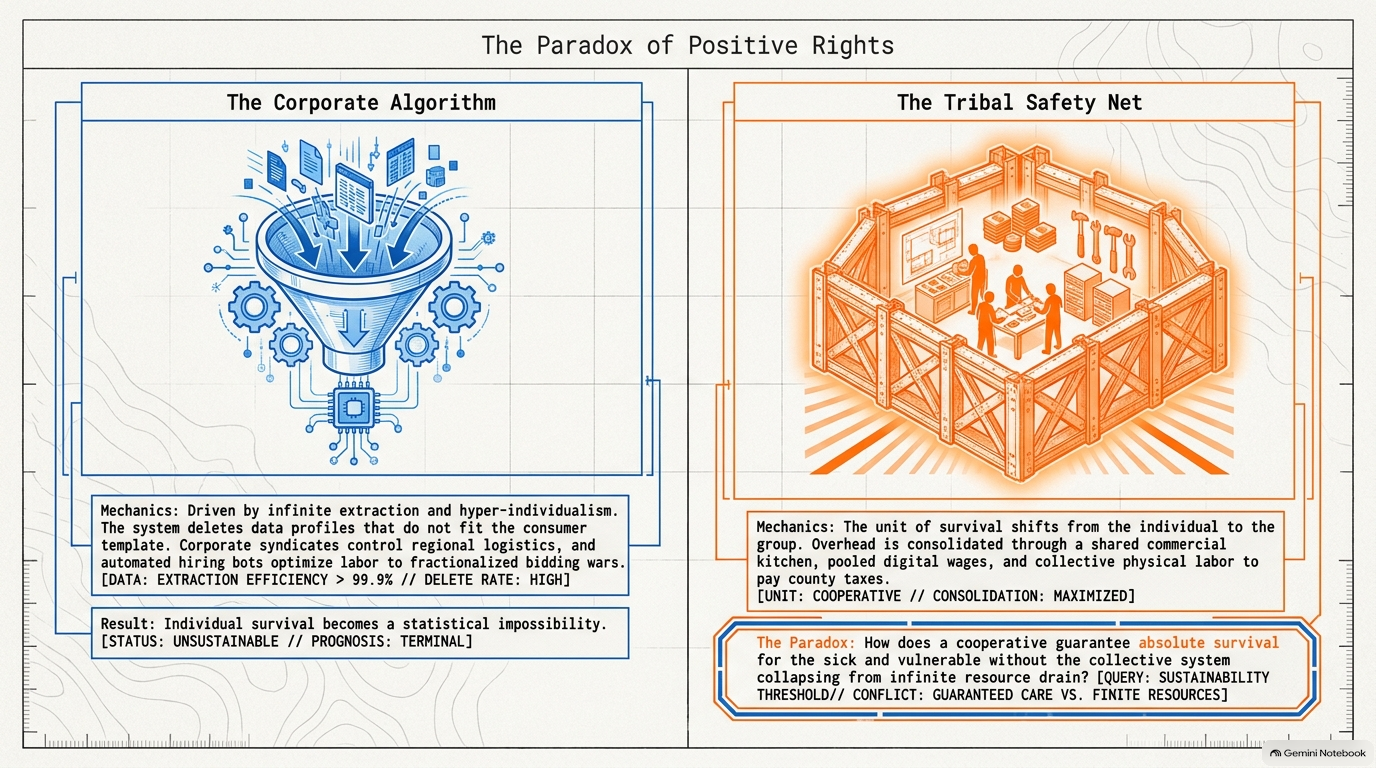
When algorithms and financial spreadsheets treat human labor as a disposable line item, isolated individuals are easily crushed. Realizing this, Marcus and Sarah were forced to pivot: if the system treats the individual worker as an economic unit to be deleted, the unit of survival must shift from the isolated individual to the cooperative group.

Building the Micro-Society: Historical Blueprints for Community Survival
By 2028, traditional employment has become a digital graveyard. Algorithmic hiring bots automatically reject applicants who lack traditional residential zip codes or commercial office profiles. Facing eviction from state campgrounds, Marcus, Sarah, and twelve displaced families take refuge in an abandoned roadside motel. To survive against predatory crime syndicates and unyielding corporate algorithms, they construct a micro-cooperative.
However, a fundamental paradox immediately emerges: How do you build a society that guarantees human survival without collapsing into financial starvation or internal resentment?
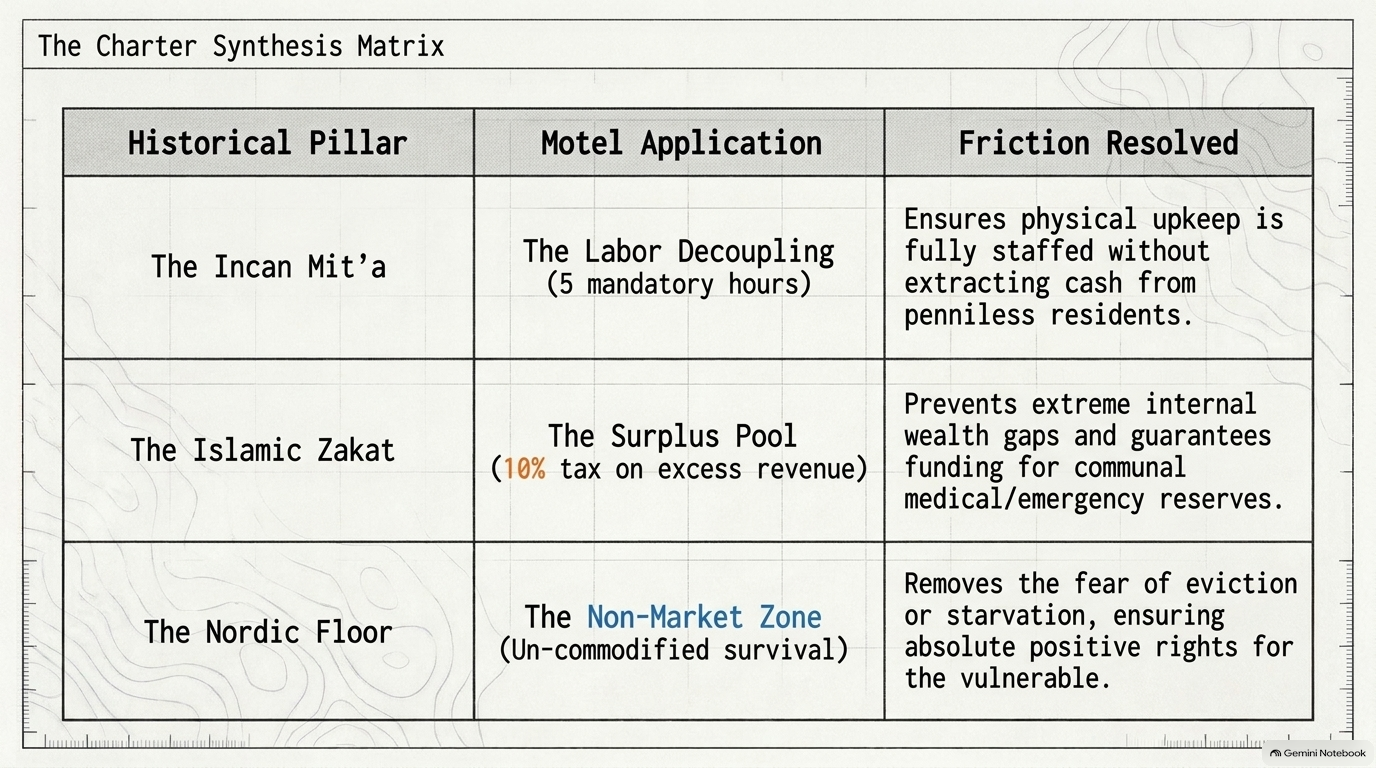
To solve this, Marcus and Sarah dig into historical governance frameworks, extracting three ancient economic blueprints to construct their "Motel Charter of 2028":
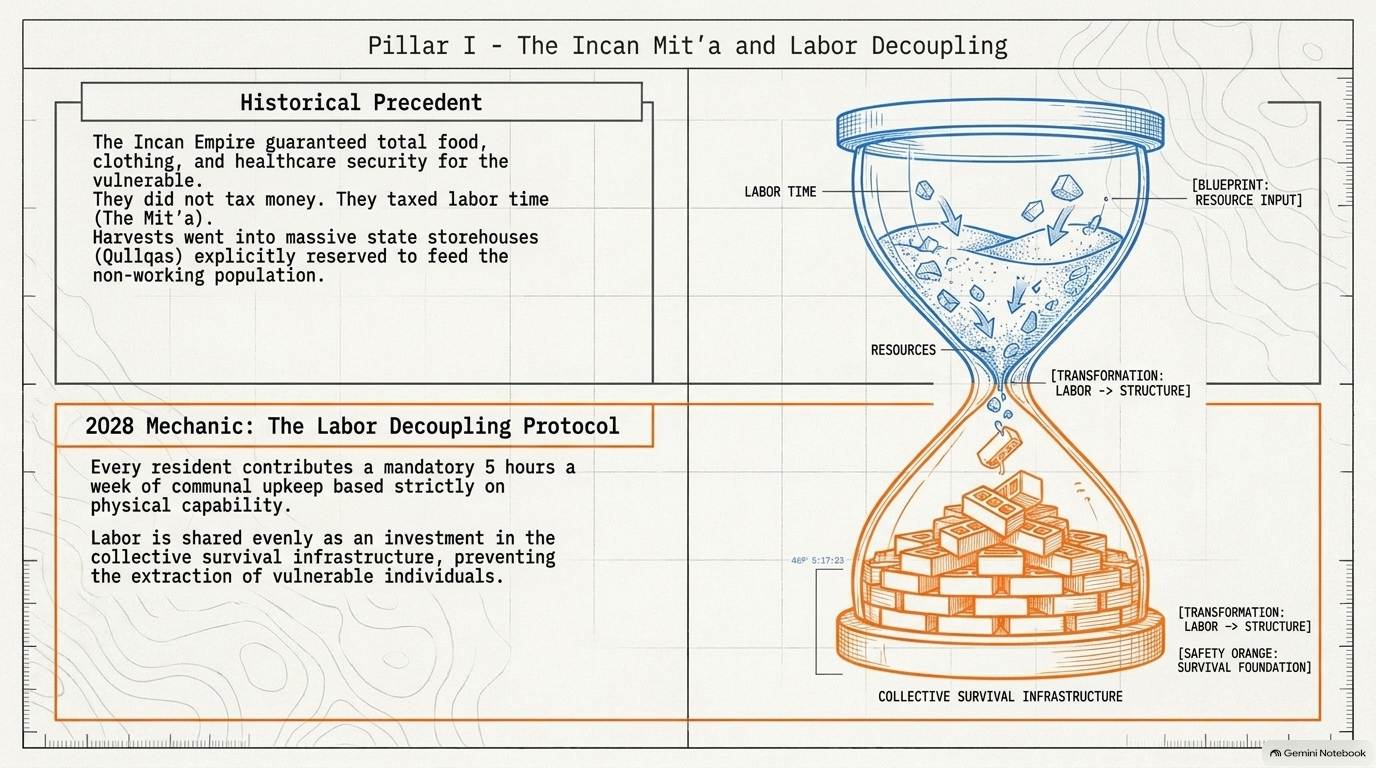
1. The Incan Mit'a System (The Time-Tax): Pre-Columbian Andean governance guaranteed complete food, clothing, and healthcare security to the sick, elderly, and widowed. Crucially, the Incas did not tax monetary currency; they taxed labor time. Every able-bodied citizen dedicated a specific number of days per year to farming state lands or building infrastructure. The harvest was stored in royal storehouses (Qullqas), explicitly earmarked for non-working vulnerable populations and famine relief.
Micro-Application: The motel establishes a mandatory 5-hour weekly labor contribution (Mit'a) for every resident. Physical capability determines the task, ensuring that upkeep, gardening, and security are shared equitably rather than extracted financially.
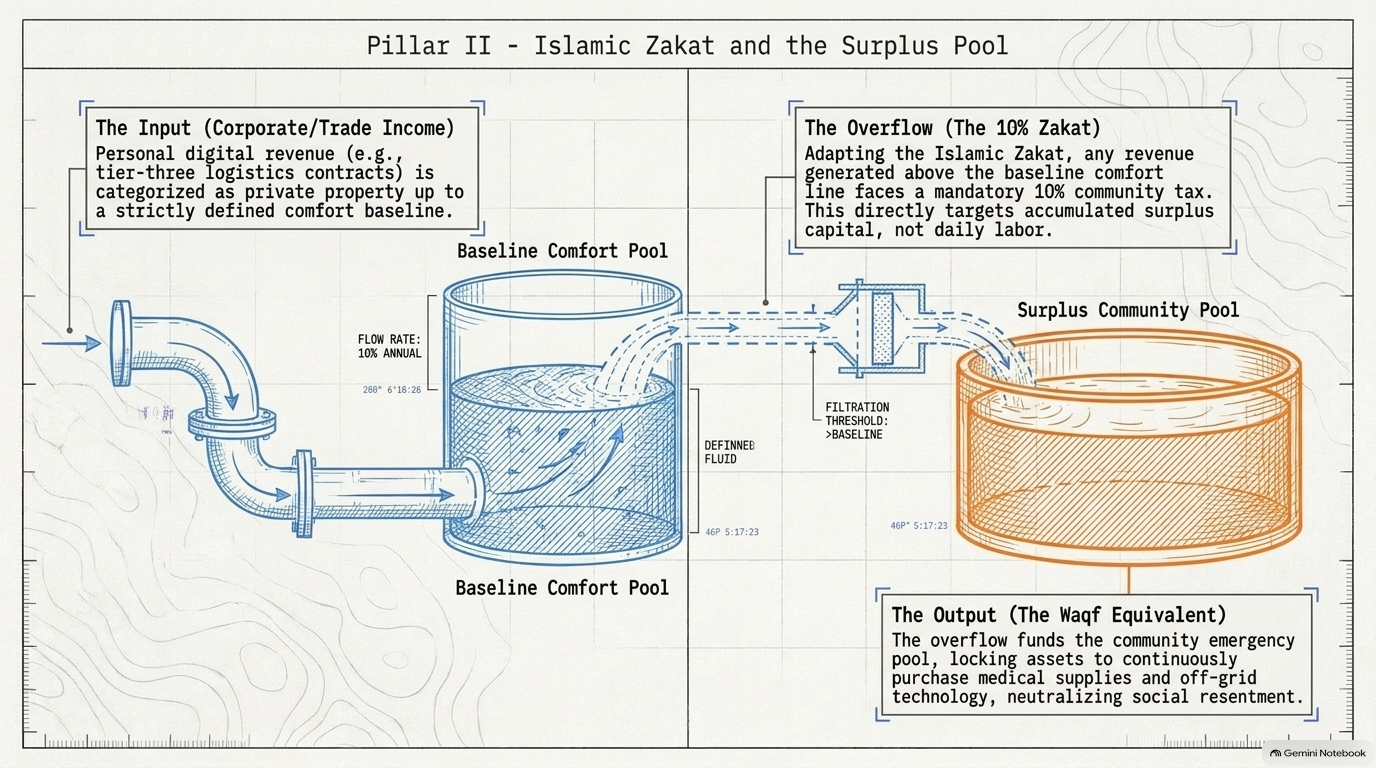
2. Islamic Zakat and Waqf (Surplus Insulation): During the Golden Age of Islam, wealth redistribution was institutionalized to prevent economic stagnation. The Zakat enforced a mandatory 2.5% annual tax on accumulated surplus capital—not daily labor income—specifically reserved for the poor and indebted. Concurrently, the Waqf system allowed individuals to lock assets into protected trusts dedicated to public goods like hospitals and schools.
Micro-Application: Personal income earned by residents from outside remote jobs (such as Sarah's logistics contract) remains private property up to a baseline comfort line. Any revenue generated above that line faces a 10% community surplus tax to fund emergency medical supplies and property upkeep.
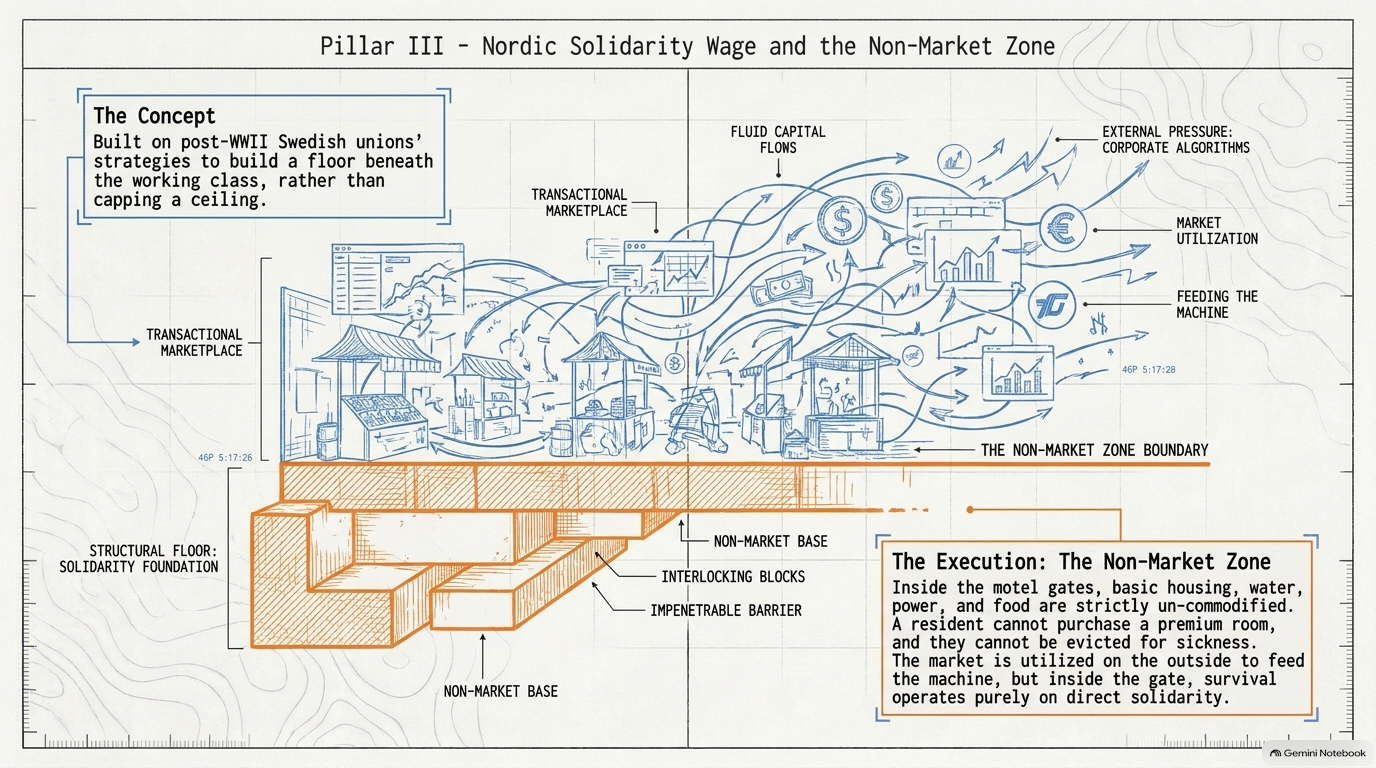
3. The Nordic Solidarity Wage Model (Non-Market Baseline): Post-WWII Sweden implemented the Rehn-Meidner model, compressing wage differentials across industries and taxing high-producing enterprises to heavily subsidize universal healthcare, parental leave, and worker retraining.
Micro-Application: Inside the motel gates, survival resources are completely un-commodified. Housing, water, power, and basic calories cannot be bought or sold, and no resident can be evicted for falling ill.
Navigating Human Friction: Wealth Gaps, Non-Workers, and Restorative Justice
Drafting broad economic principles is simple; managing the messy reality of human behavior in a closed space is remarkably difficult. A cooperative can quickly collapse under the weight of three classic social frictions: non-workers, wealth disparities, and crime.
To keep their twelve-room micro-society from tearing itself apart, Marcus and Sarah integrated tailored historical and legal mechanisms to address each point of friction:
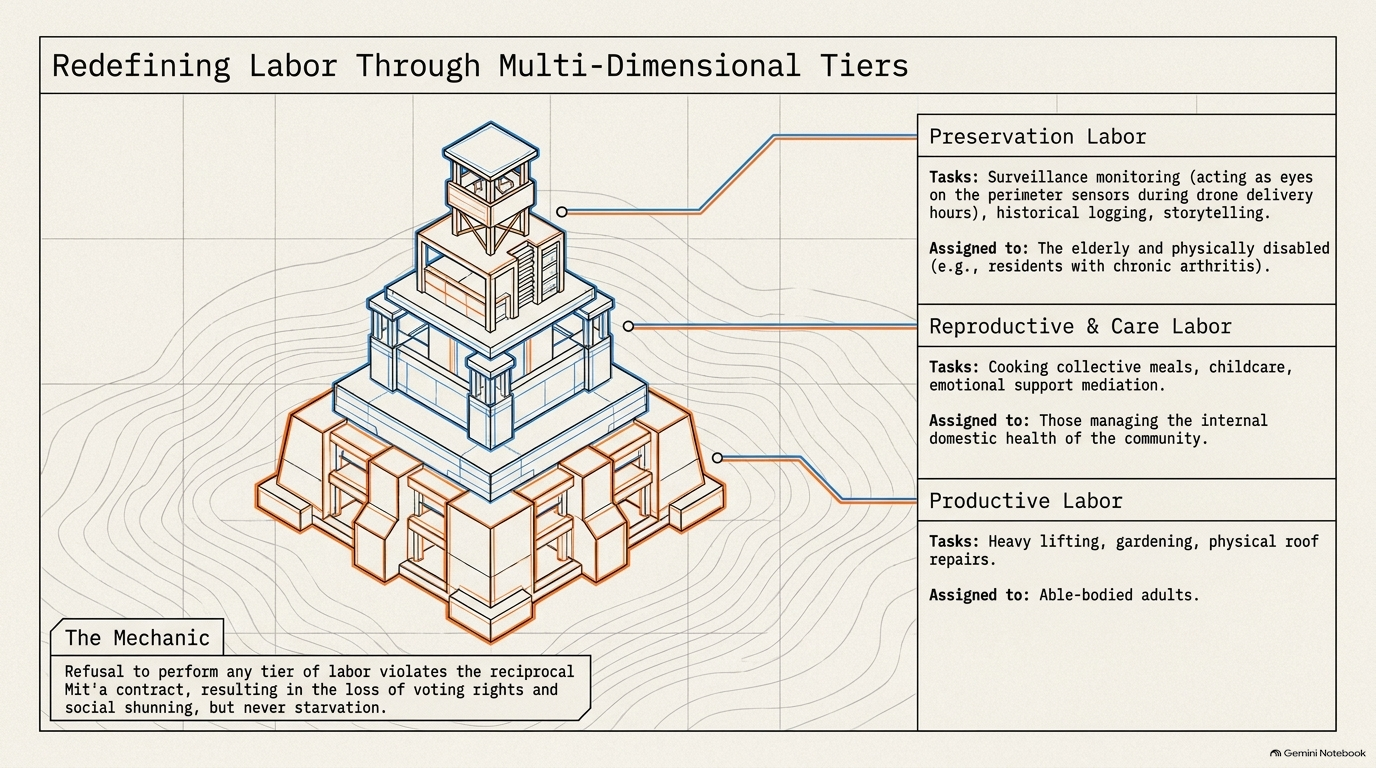
Friction 1: The "Non-Worker" Resentment & Multi-Dimensional Labor
The Problem: Producers feel intense toxic resentment toward individuals who do not contribute physical labor or outside income.
The Precedent: The Iroquois (Haudenosaunee) Confederacy and monastic economic models.
The Mechanism: Labor is formally redefined into three distinct, equal tiers: Productive (gardening, structural repairs), Reproductive/Care (cooking, childcare, eldercare), and Preservation (surveillance watch, history logging). An elderly resident with severe arthritis fulfills their 5-hour Mit'a obligation by monitoring surveillance screens during drone delivery hours. If an able-bodied resident flatly refuses to contribute any labor tier, their baseline survival floor remains intact, but they face social shunning and forfeit their voting rights in community governance.
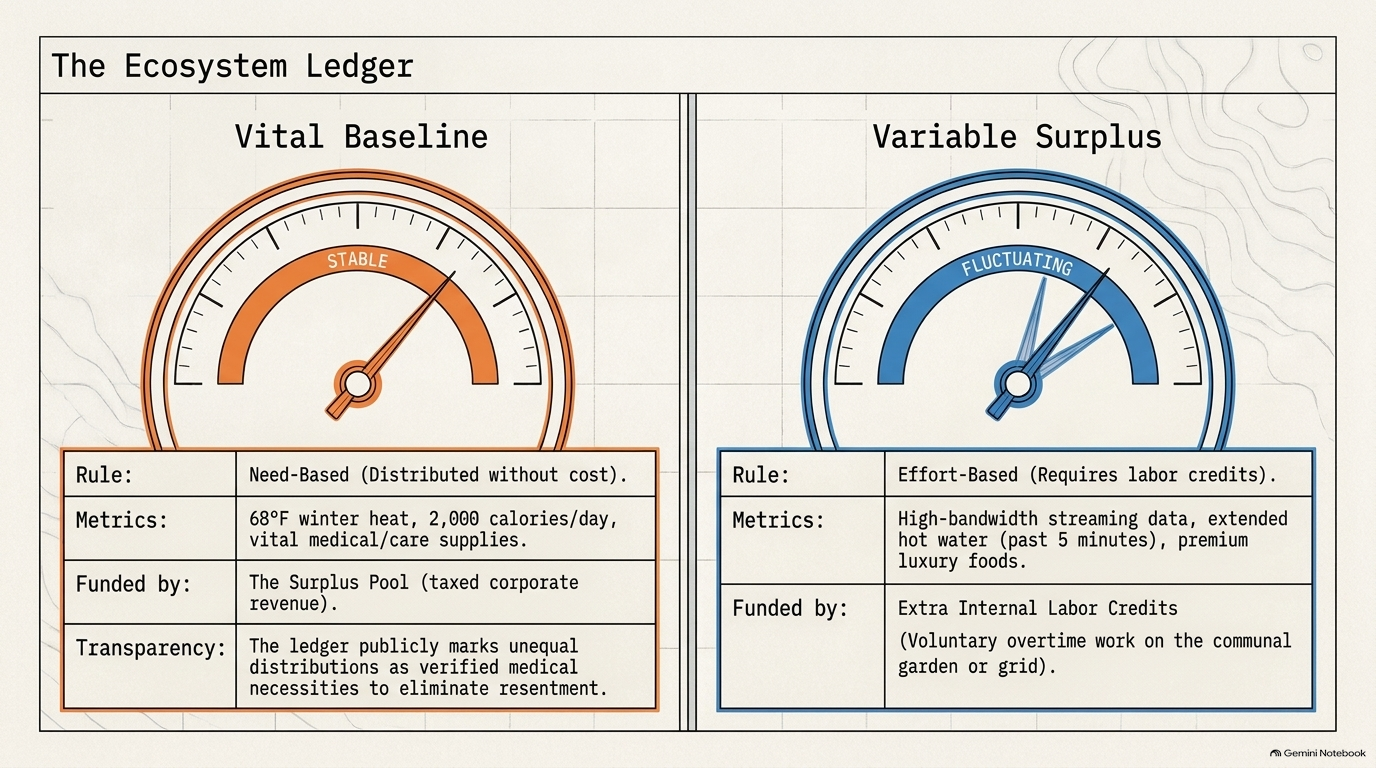
Friction 2: Wealth Gaps & Resource Depletion
The Problem: Income disparities trigger toxic social hierarchies, while unchecked resource use drains solar batteries.
The Precedent: Classical Athenian Liturgies and Elinor Ostrom's Nobel Prize-winning rules for Managing the Commons.
The Mechanism: Resources are divided into two clear categories on a public ledger:
Vital Baselines (Need-Based): Basic calories, medical care, and 68°F winter heating are absolute rights distributed strictly according to need (e.g., an ill resident receives triple heating allocation without penalty).
Variable Surpluses (Effort-Based): High-speed internet bandwidth, long hot showers, or luxury food items require internal labor credits earned through voluntary overtime work.
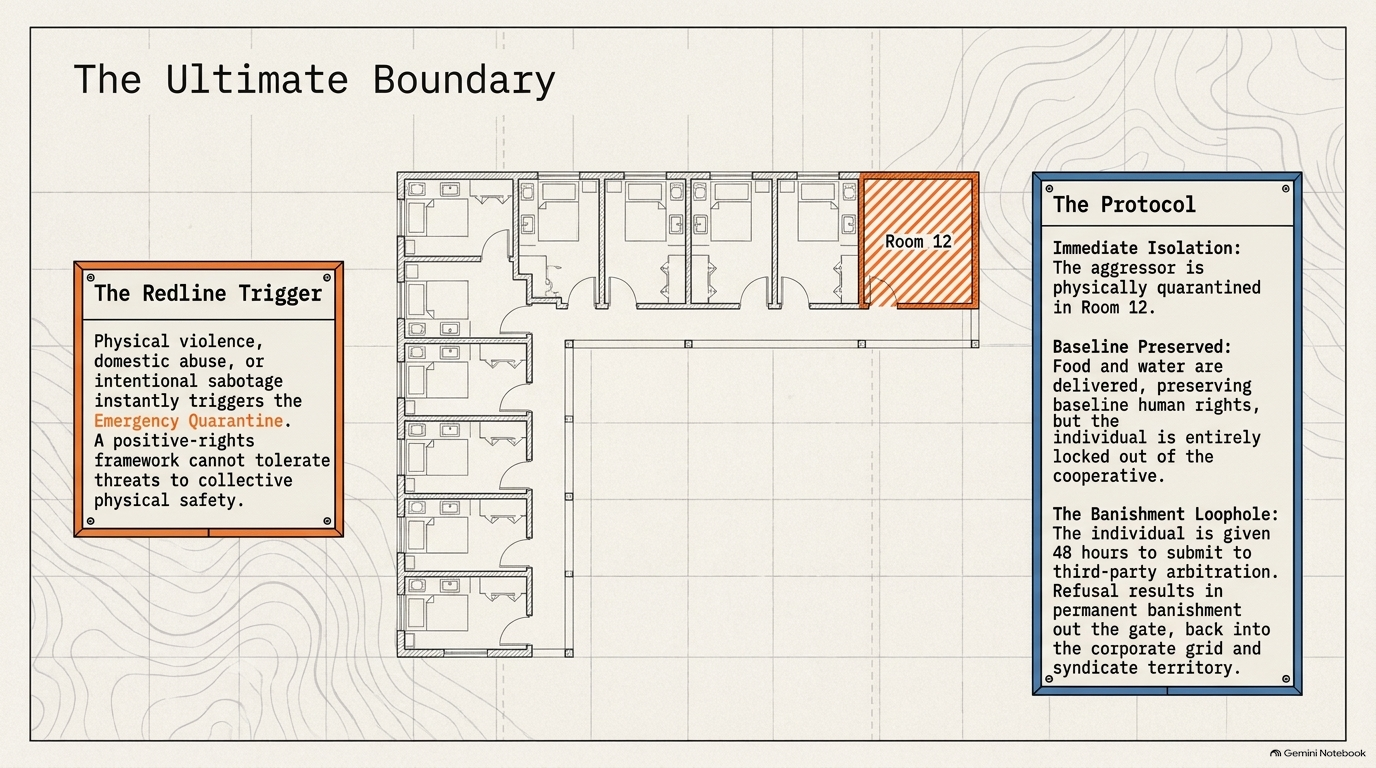
Friction 3: Crime, Violence, and Accountability
The Precedent: Anglo-Saxon Wergild (reparation matrix), Maori Whakawhitinga Kōrero (restorative circles), and medieval banishment laws.
The Mechanism:
Petty Theft: Handled via Wergild. Stealing food requires the offender to return threefold value back to the communal kitchen using voluntary labor credits while luxury resource privileges are frozen.
Rule-Breaking: Triggers a restorative circle where the non-worker must listen directly to how their inaction impacted vulnerable members, backed by public ledger transparency.
Violence or Abuse: Room 12 is designated as the Emergency Quarantine Node. Physical violence results in immediate physical isolation, forfeiture of community access, and a 48-hour ultimatum: submit to third-party arbitration or face Permanent Banishment outside the gates.
Friction 4: The Immigration & Intake Paradox
The Problem: A positive-rights system creates infinite demand on finite resources. Taking in too many refugees collapses the solar grid; turning everyone away destroys the moral charter.
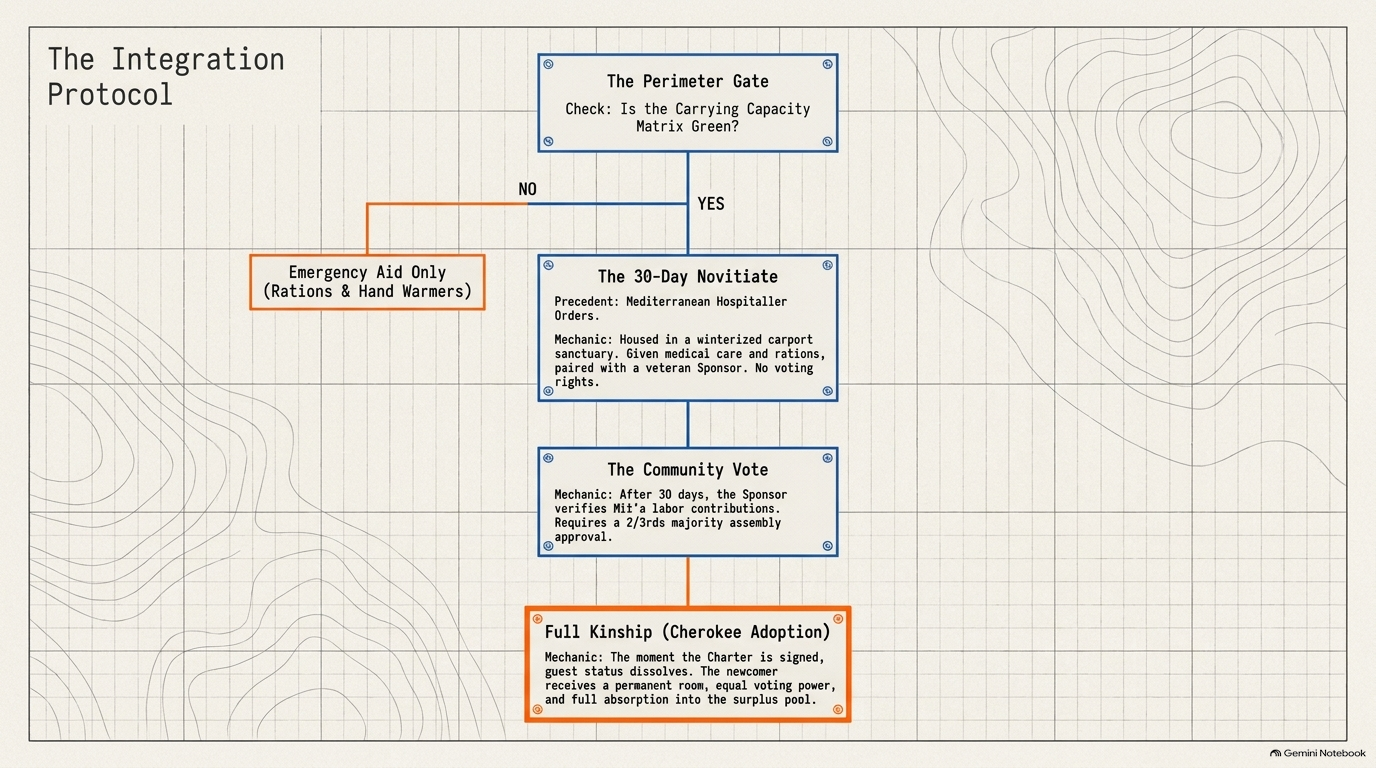
The Precedent: Polynesian Carrying Capacity mapping, Hospitaller Novitiates, and Cherokee Clan Adoption.
The Mechanism: The public Life-Support Ceiling ledger calculates total battery, caloric, and water capacity divided by a 20% safety margin. If the status is green, new arrivals enter a 30-Day Novitiate (sheltered in a winterized carport intake space paired with a mentor). Upon completion, a two-thirds community vote leads to Full Kinship Adoption, instantly granting equal voting rights and room placement.
Scaling Solidarity: Applying Micro-Cooperative Principles to Macro Policy
The structural trade-offs faced by Marcus and Sarah at the micro level mirror the national macroeconomic debates facing political strategists today. To move away from neoliberal policies that leave working-class citizens vulnerable to corporate restructuring, political economists suggest translating these micro-solidarity principles directly into national platform reforms:
1. Replacing Means-Testing with Universal Basic Services (UBS):
The Micro Principle: The non-market "Vital Baseline."
The Macro Application: Traditional welfare programs rely on complex income cutoffs (means-testing), creating administrative traps and intense resentment from blue-collar workers who pay taxes but receive no benefits. Transitioning to true Universal Basic Services—such as Medicare for All and public housing baselines—ensures that every citizen, rich or poor, utilizes the same non-market infrastructure. This eliminates social stigma and reframes public welfare as shared national power.
2. Resolving Working-Class Alienation via a Federal Job Guarantee:
The Micro Principle: The Incan Mit'a and Multi-Dimensional Labor.
The Macro Application: Unconditional cash transfers (such as UBI) often face political resistance from working-class voters who value labor reciprocity. A Federal Job Guarantee acts as an employer of last resort, offering $15–$25/hour jobs with full benefits to anyone seeking work. Citizens are deployed to rebuild public infrastructure, install green energy systems, and provide community care work. This establishes a baseline wage floor that forces private corporations to compete for labor while honoring the principle of civic contribution.
3. Insulating the Public Commons via Wealth Taxes:
The Micro Principle: Athenian Liturgies and Islamic Zakat.
The Macro Application: Instead of heavily taxing physical labor income, tax burdens shift toward unearned wealth accumulation, high-frequency financial speculation, and corporate capital gains. These revenues are sequestered into a permanent national infrastructure fund, protecting public grids, clean water systems, and healthcare reserves from market volatility.
4. Objective Carrying-Capacity Immigration:
The Micro Principle: The Life-Support Ceiling and Probationary Novitiate.
The Macro Application: Shifting immigration from hyper-ideological rhetoric to a data-driven National Carrying Capacity Ledger. Federal intake caps dynamically adjust based on regional housing availability, healthcare staff ratios, and localized labor needs, routing incoming migrants directly into federally funded naturalization and infrastructure training zones.






Summary
When corporate algorithms and market automation treat human beings as disposable economic units, survival depends on shifting from isolated competition to structured communal solidarity. By synthesizing ancient historical frameworks—from Incan labor taxes to Nordic wage floors—micro-communities and national economies alike can build resilient systems that honor basic human rights while enforcing reciprocal civic responsibility.
Historical Structural Roots: Modern economic vulnerability is anchored in legal precedents like Gilded Age corporate personhood and Constitutional protections designed to insulate capital from public control.
The Triad of Micro-Governance: Effective cooperatives survive by adapting the Incan Mit'a (labor-time tax), Islamic Zakat (surplus wealth insulation), and Nordic Solidarity Wage (un-commodified survival baselines).
Managing Internal Friction: Social cohesion requires broadening labor definitions beyond heavy lifting, managing resources via Ostrom commons ledgers, and enforcing restorative justice (Anglo-Saxon Wergild and Room 12 quarantine).
Macro Policy Translation: Scaling these lessons to national politics requires replacing bureaucratic means-tested welfare with Universal Basic Services, a Federal Job Guarantee, and dynamic carrying-capacity immigration planning.
The story
This 3 hour video covers great details about human society there is great difficulty to provide a shared structure. I ended the video with a repeat of the third part. This repeat is the meat of what we life with daily.
The things we are facing as humans:
A. Sharing within a family and working together to meet the needs of survival.
B. Working without the larger society to survive.
What I learned from creating this video is that our society within the USA has directed us to work for companies or run our own companies. The school systems and religions have been structured to support that.
Having the family focus on taking care of the family in a design of extended family was broken along the way. There are areas of the world that did not break this process. As AI takes over the jobs those that do not have extended support designs in their families will have a much more difficult process.