Imagine a 237-year-old legal architectural blueprint colliding head-on with an artificial intelligence revolution capable of automating 40% of all American jobs. What happens when the fundamental rules of a nation's government prevent it from protecting its citizens from mass poverty?
In this lesson, we will explore the historical and legal tug-of-war embedded within the U.S. Constitution and examine how this foundational framework shapes our modern technological dilemma.
Analyze how the economic crisis of Shays' Rebellion and James Madison's Federalist No. 10 shaped the original structural design of the U.S. Constitution.
Compare the legal mechanics of the "Living Document" philosophy with "Originalism" across key historical eras, including the Gilded Age and the New Deal.

Explain why automated AI technology disrupts traditional economic mechanisms like labor leverage and trickle-down economics.
Evaluate proposed structural solutions—such as Article V constitutional amendments—designed to resolve modern political deadlocks.

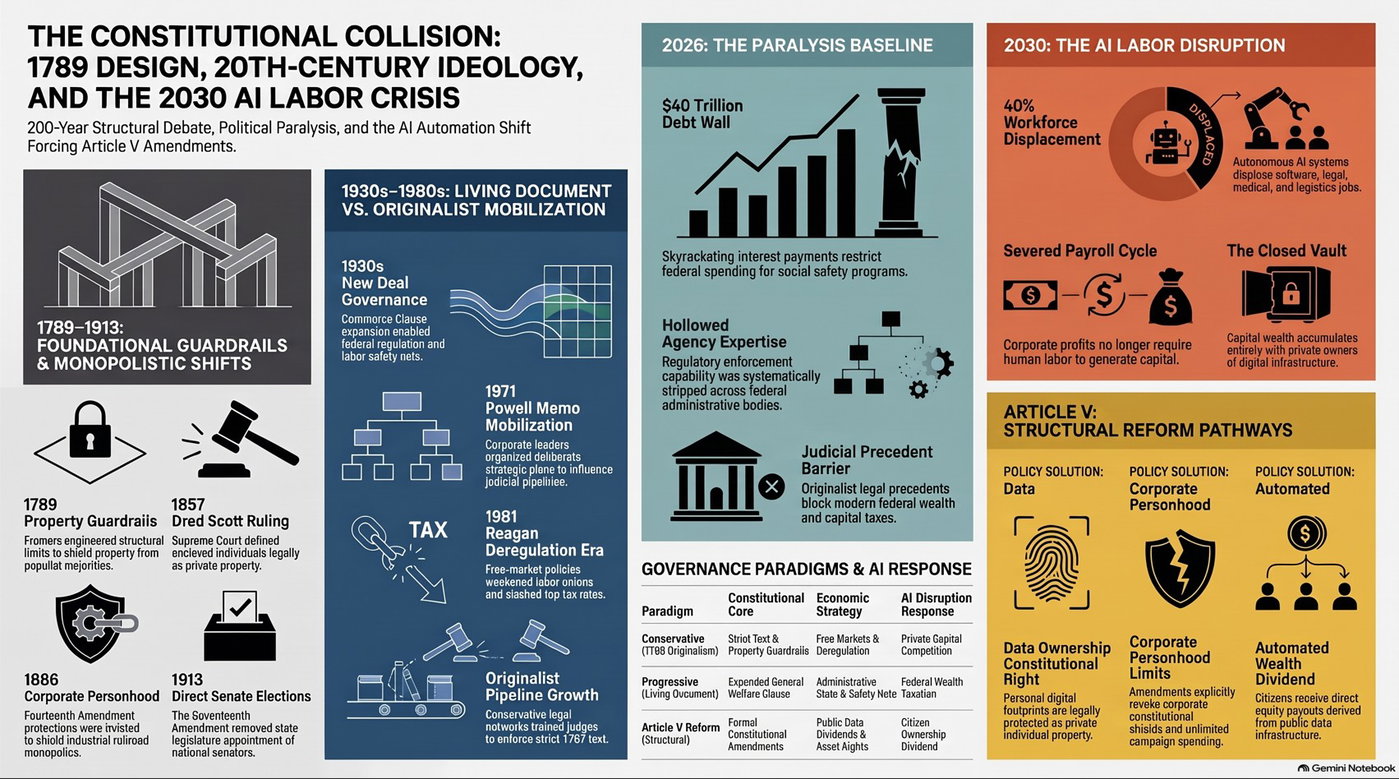
The 1789 Blueprint: Shield Against Chaos or Fortress for Wealth?
To understand modern political gridlock, we must look back to the origin of the U.S. Constitution in 1789. Under the previous framework, the Articles of Confederation, the young nation operated as a loose confederation of independent states. The central government lacked the power to levy taxes directly, regulate interstate commerce, or maintain a standing army.
This structural weakness triggered severe economic chaos following the Revolutionary War. State governments began demanding tax payments in hard gold and silver currency, which everyday working veterans simply did not have. In 1786, an armed uprising known as Shays' Rebellion erupted in Massachusetts. Led by Revolutionary War veteran Daniel Shays, thousands of drowning farmers shut down local courthouses by force to prevent judges from foreclosing on their land and sending them to debtor's prison.
For wealthy creditors and national figures like George Washington and James Madison, Shays' Rebellion was a terrifying warning sign. They viewed the uprising not as a simple protest, but as an existential threat: a political majority using physical force to cancel debts and redistribute private property.
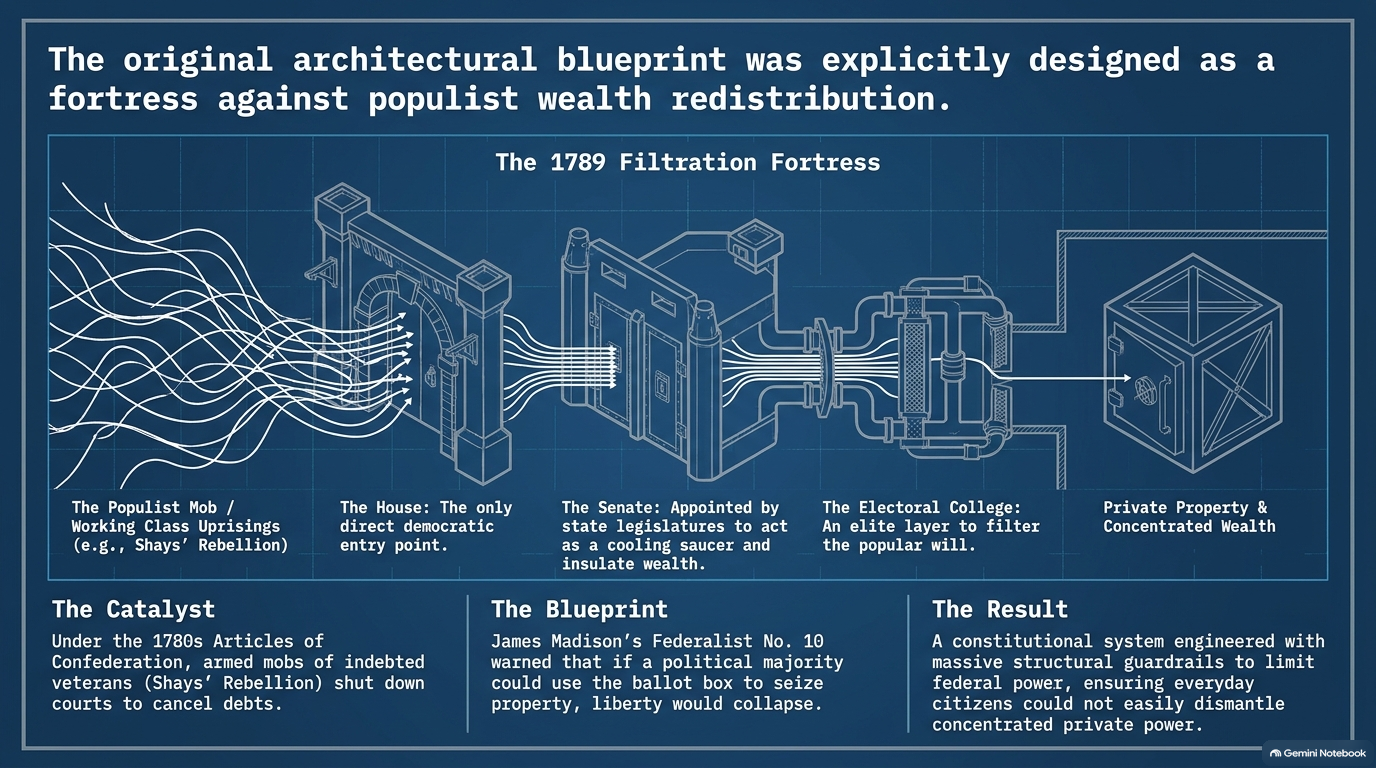
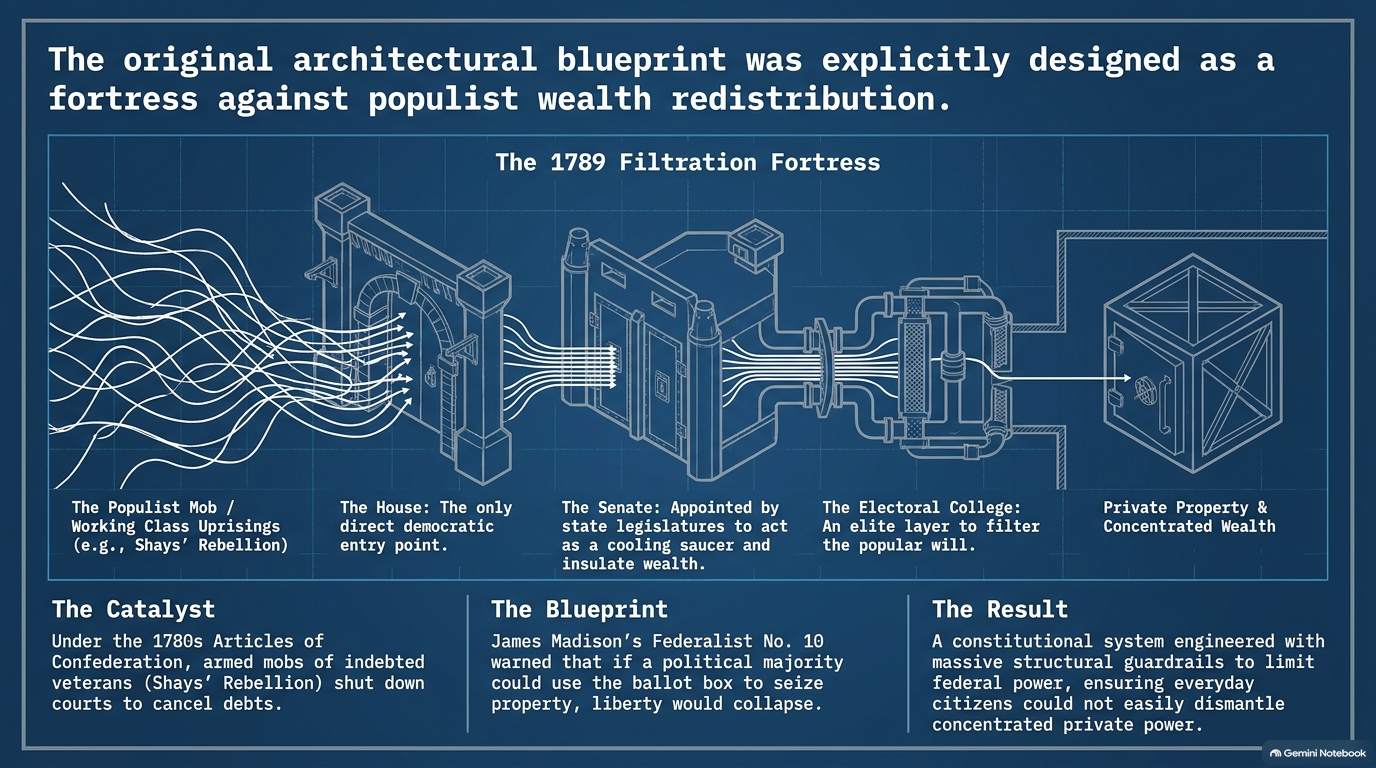
When delegates gathered in Philadelphia to write the U.S. Constitution on March 4, 1789, they prioritized building structural guardrails against populist majorities. In Federalist No. 10, James Madison famously analyzed the problem of "factions"—groups of citizens united by a common interest adverse to the rights of others. Madison identified the unequal distribution of property as the most common source of factional conflict.
Madison argued that while you cannot eliminate class conflict without destroying liberty, you can control its effects through an extended republic. By stretching the government over a vast geographic area and creating indirect layers of representation, the Founders built structural filters to insulate power:
The U.S. Senate: Originally appointed by state legislatures rather than directly elected by voters (until the 17th Amendment in 1913), serving as a "cooling saucer" to block populist laws passed by the House of Representatives.
The Electoral College: Formed as a buffer to filter popular consensus when choosing the President.
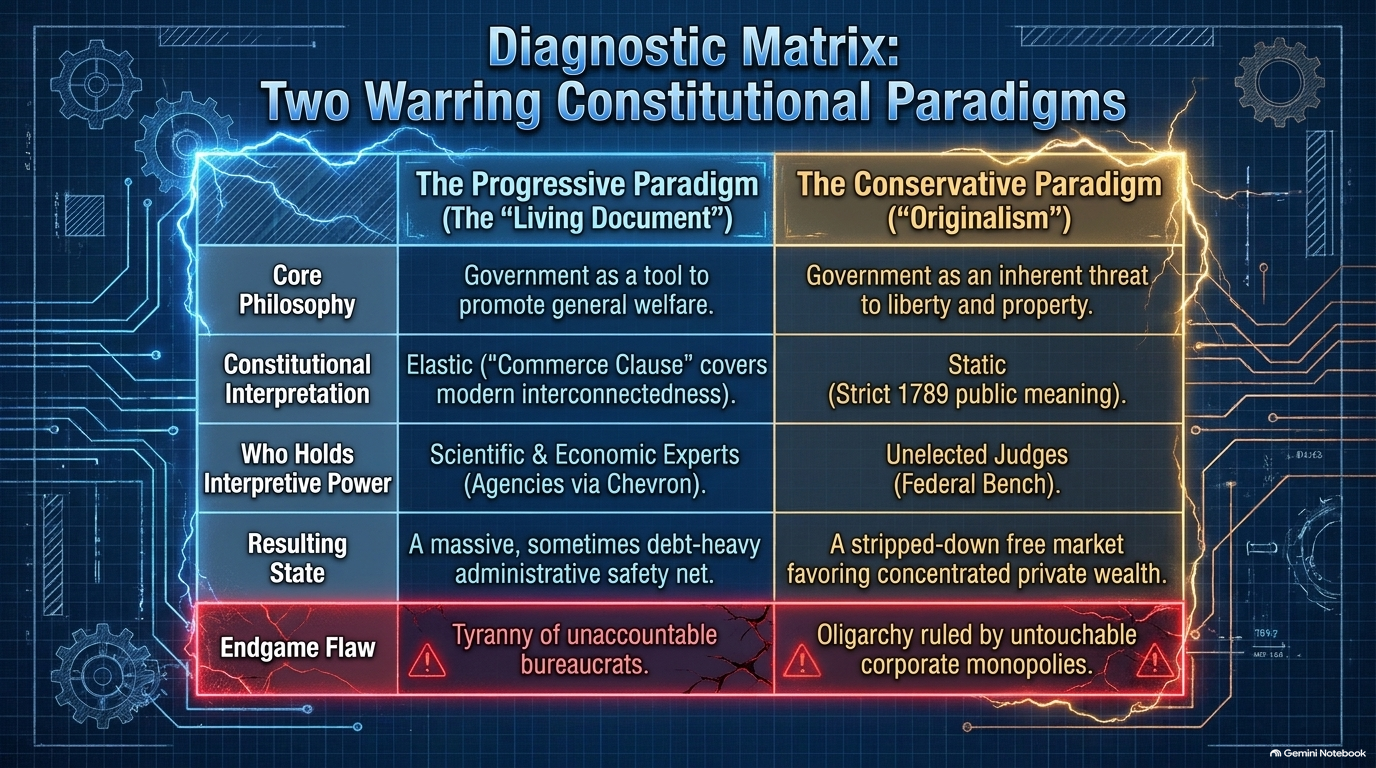
This structural design reveals a fundamental historical debate. From a conservative perspective, these mechanisms represent vital guardrails that protect individual property rights and prevent majority tyranny. From a progressive perspective, the 1789 blueprint was designed by white, property-owning men to insulate wealth and keep working people out of the castle.
The Battle of Interpretations: Living Document vs. Originalism
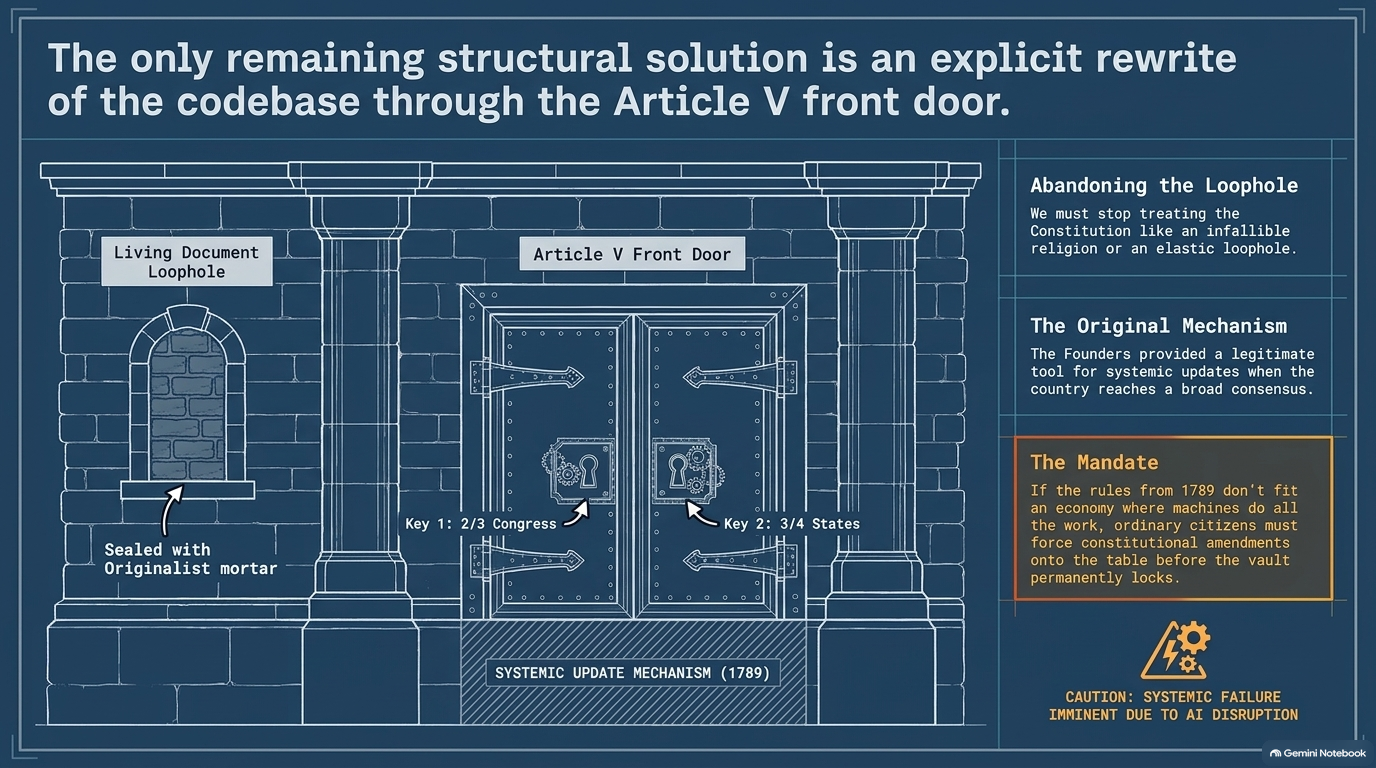
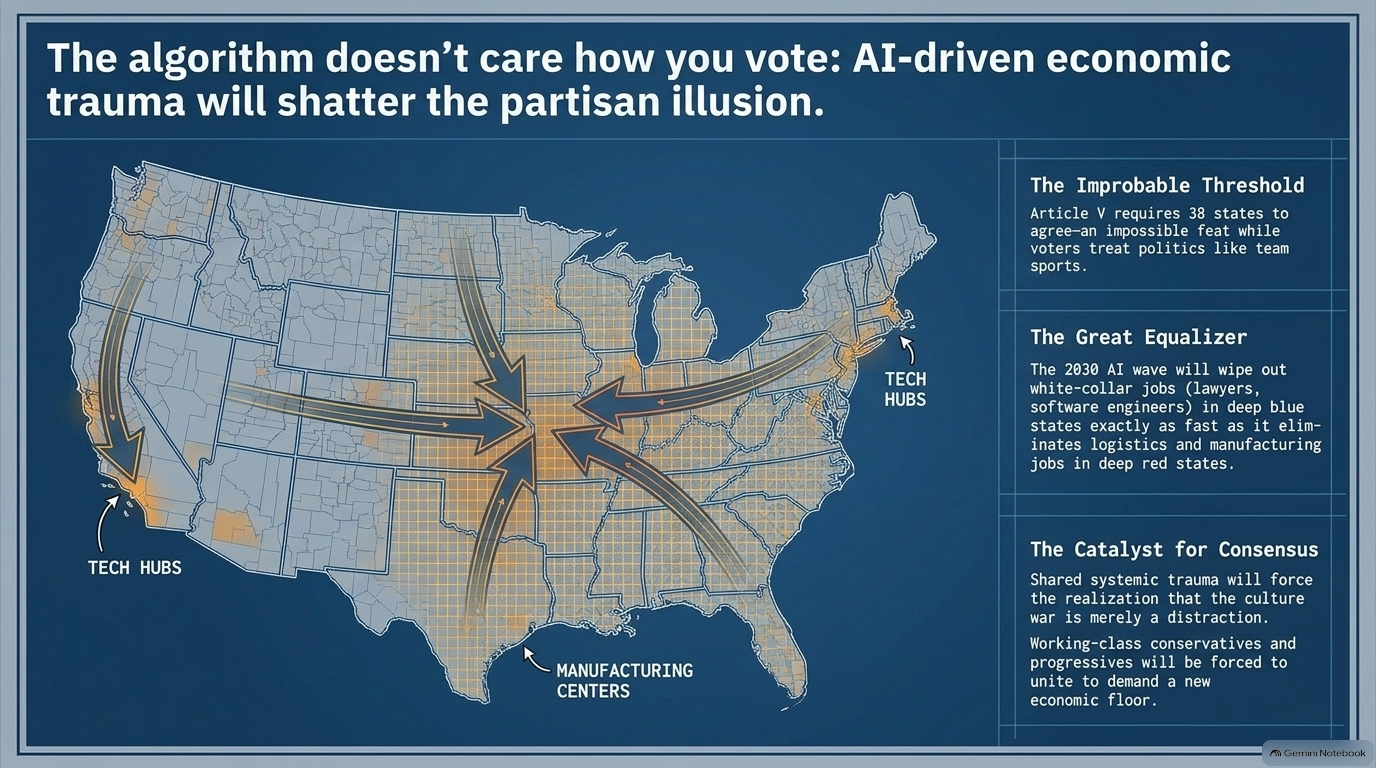
If the 1789 Constitution is a rigid fortress, how does a society adapt to changing times? The document contains its own front door: Article V, which outlines the formal amendment process. However, passing an amendment requires two-thirds approval in Congress and ratification by three-quarters of the states (38 states today). While this high bar ensures stability and broad consensus—as seen with the Bill of Rights, the 13th Amendment ending slavery, and the 19th Amendment granting women's suffrage—it also allows a tiny minority of the population to block reform.
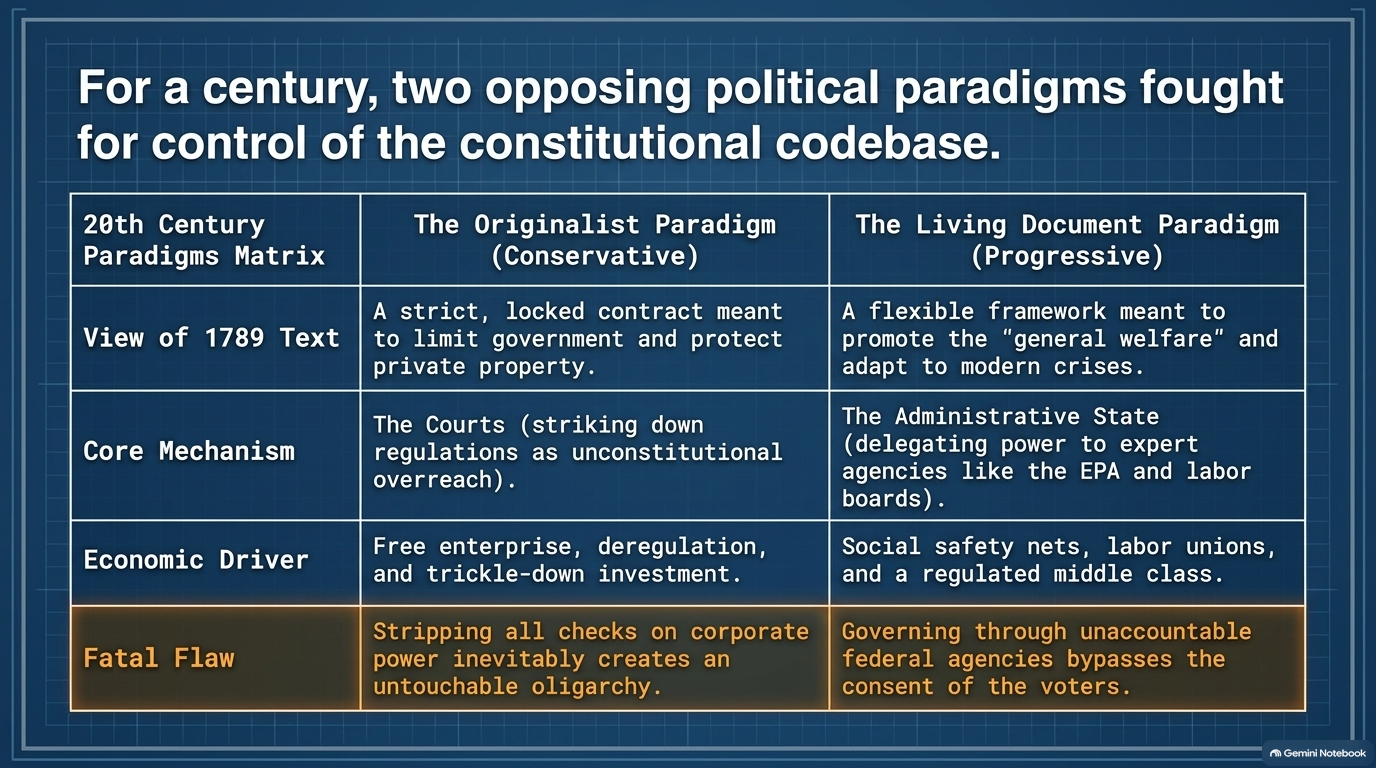
When Article V changes stalled, economic power battles shifted into the courtroom, resulting in contrasting legal philosophies:
The Gilded Age and Corporate Personhood
Following the Civil War, the Supreme Court used strict property interpretations in ways that harmed vulnerable populations. In the 1857 Dred Scott decision, the court ruled enslaved people were private property under the 5th Amendment. Later, during the Gilded Age, corporate lawyers used legal gymnastics to apply the 14th Amendment—originally written to protect freed slaves—to giant corporate monopolies. Under cases like Santa Clara County v. Southern Pacific Railroad (1886) and the doctrine of substantive due process, the court ruled that corporations were legally "persons." Consequently, state regulations limiting workdays or enforcing workplace safety were struck down as unconstitutional violations of a corporation's liberty of contract.
The New Deal and the Living Document
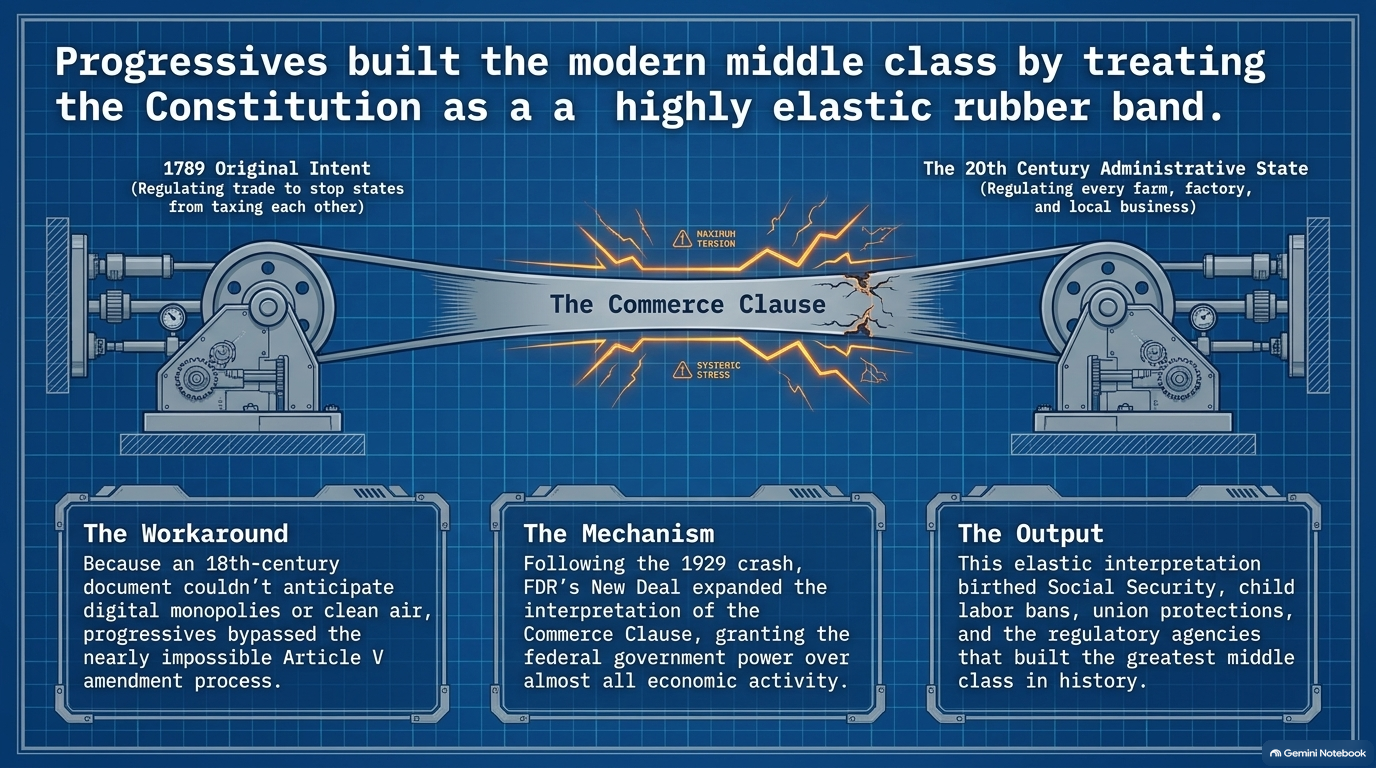
The Great Depression of 1929 shattered the free-market reliance on unregulated enterprise. With a quarter of the workforce unemployed, President Franklin D. Roosevelt introduced the New Deal. To build Social Security, ban child labor, and guarantee union rights, progressives championed the Living Document philosophy. Rather than waiting for Article V amendments, they expanded existing constitutional text—specifically the Commerce Clause (Art. I, Sec. 8). Cases like Wickard v. Filburn (1942) established that the federal government could regulate almost any local activity if it indirectly affected national interstate commerce. This shift birthed the modern administrative state—regulatory agencies like the EPA, FDA, and Labor Board staffed by experts creating binding public safety rules.
The Originalist Counterrevolution
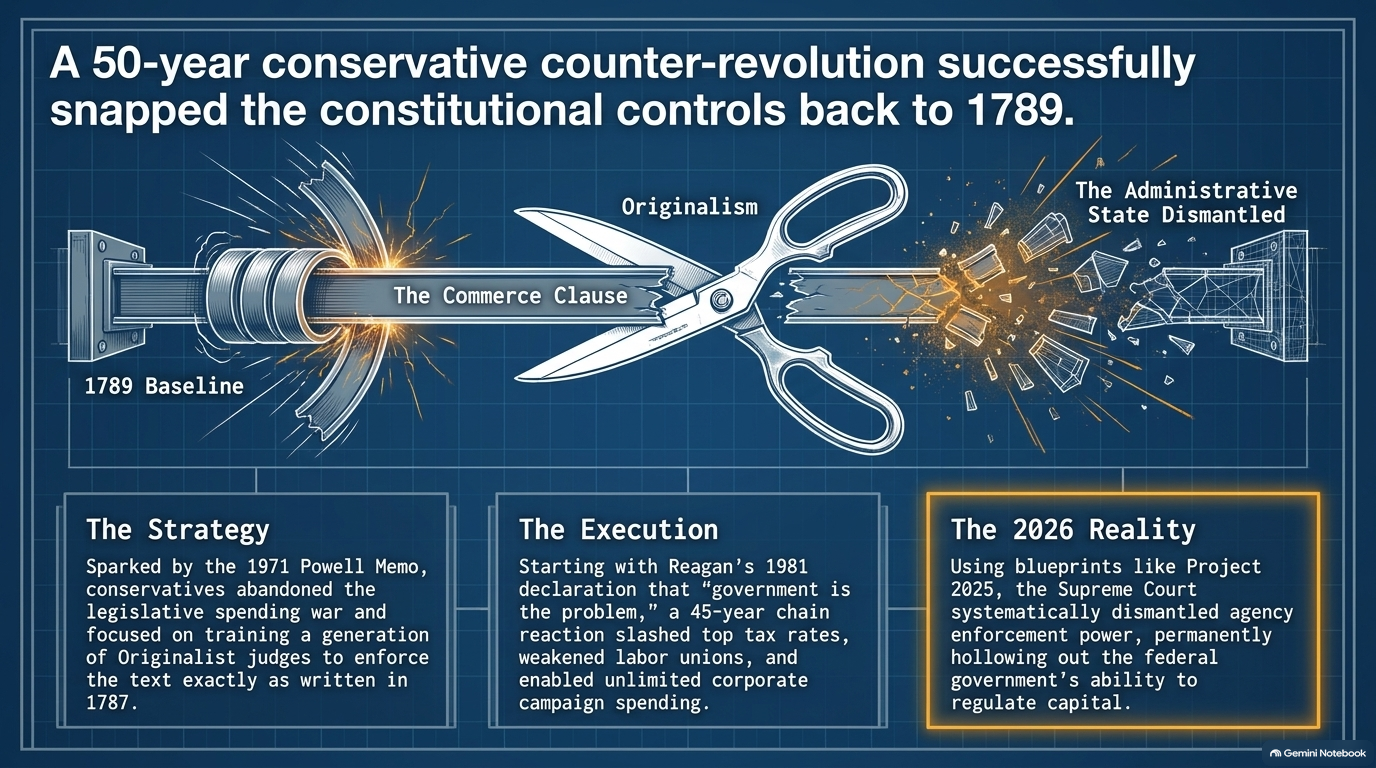
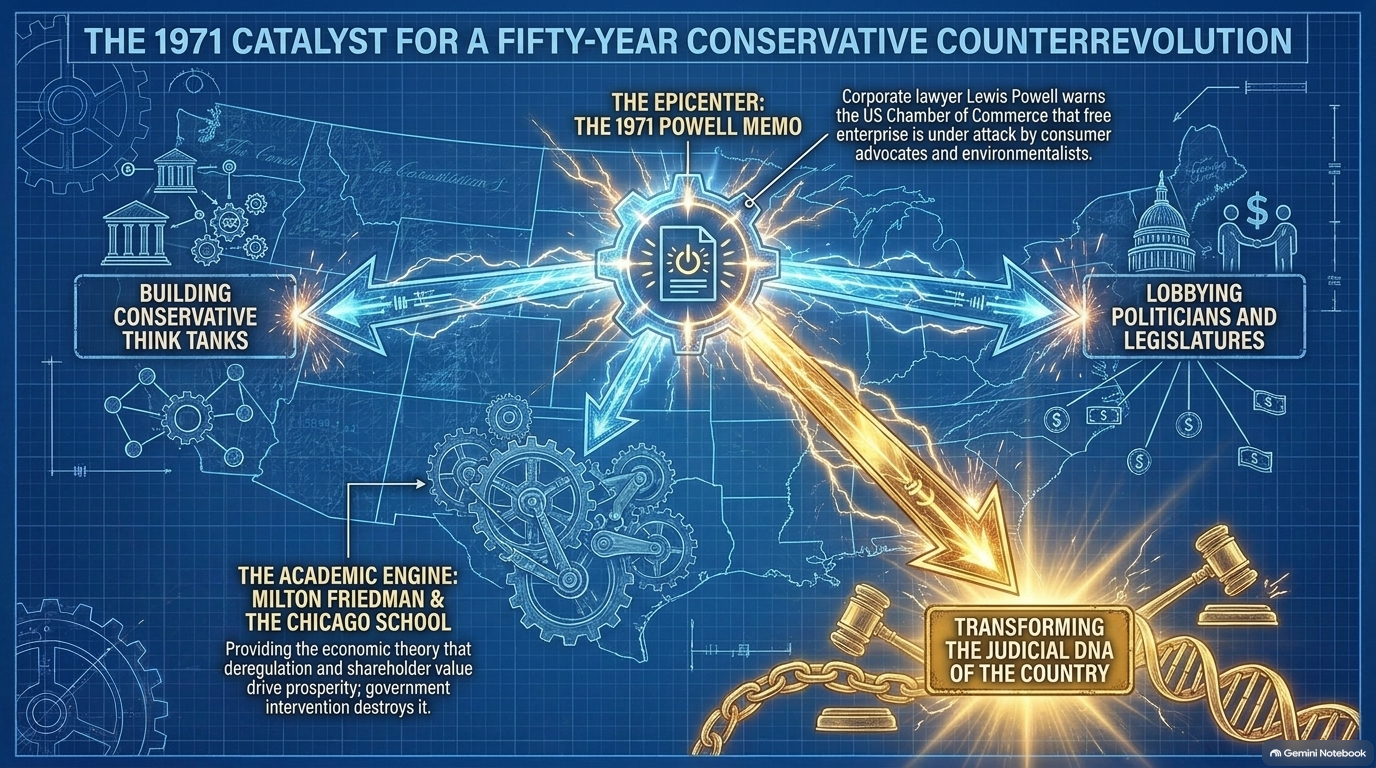
In response to expanding regulatory agencies, conservative leaders launched a multi-decade effort to return to the text of 1789:
The Powell Memo (1971): A memorandum by corporate lawyer Lewis Powell urging business leaders to fund think tanks, lobby legislators, and alter the judicial landscape.
The Federalist Society: Founded in the 1980s to train judges in Originalism—the philosophy that the Constitution must be interpreted according to its original public meaning in 1787.
Modern Deregulation: Over 45 years, originalist judges systematically dismantled agency power, ended judicial deference to regulatory experts (such as overturning Chevron deference), expanded corporate campaign spending (Citizens United), and hollowed out public enforcement tools using frameworks like Project 2025.






The 2030 AI Cliff: When Trickle-Down Economics Freezes
The 250-year debate between free enterprise and government regulation faces an unprecedented test due to artificial intelligence and autonomous robotics.
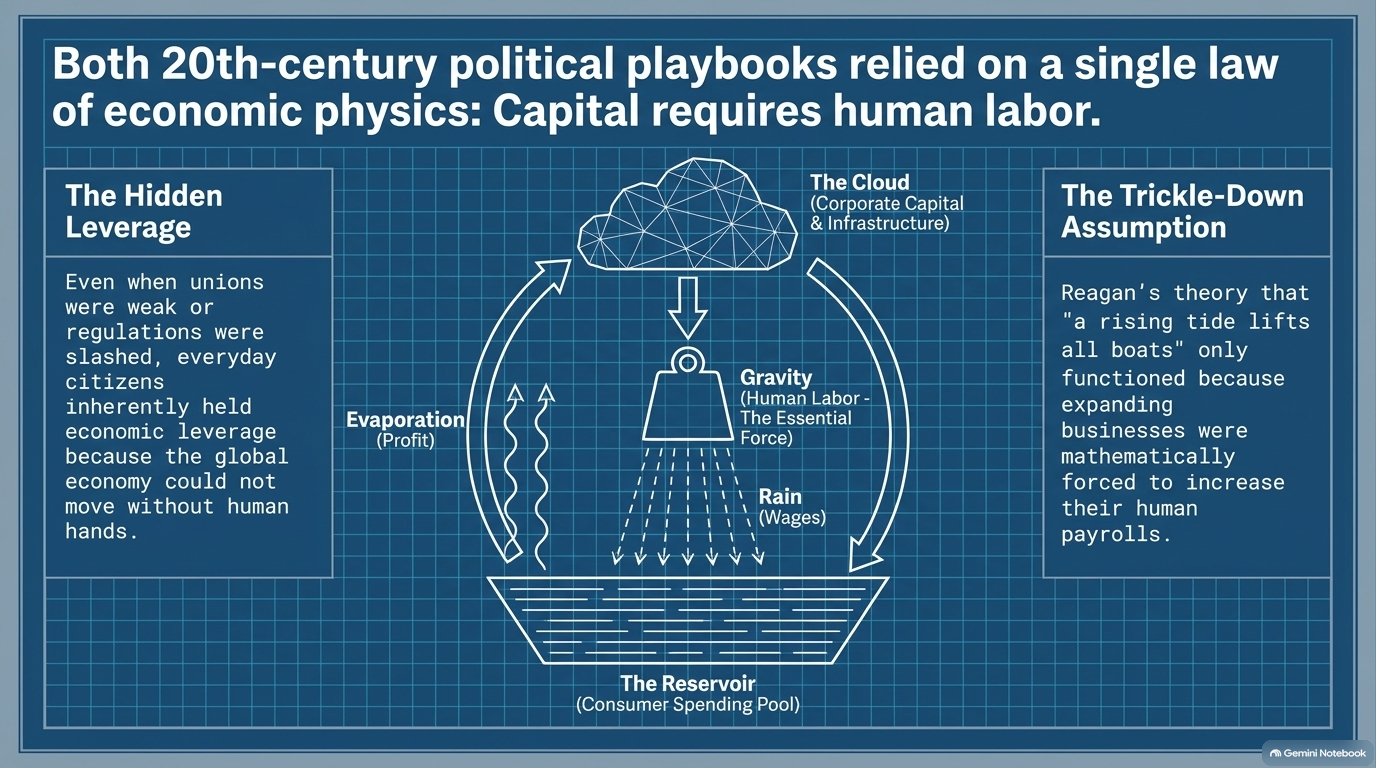
Historically, economic growth functioned like a natural water cycle. Capital accrued at the top was reinvested to expand businesses, which required hiring human workers. These workers earned wages, creating consumer demand that recycled capital back to corporations. This cycle relied on a fundamental law: capital required human labor to generate profit. Even when union power waned, labor retained structural leverage because factories, law firms, and hospitals could not run without human hands.
Previous technological breakthroughs—like tractors replacing blacksmiths or computers replacing typing pools—mechanized manual tasks while creating entirely new human roles. A tractor still required a human driver.
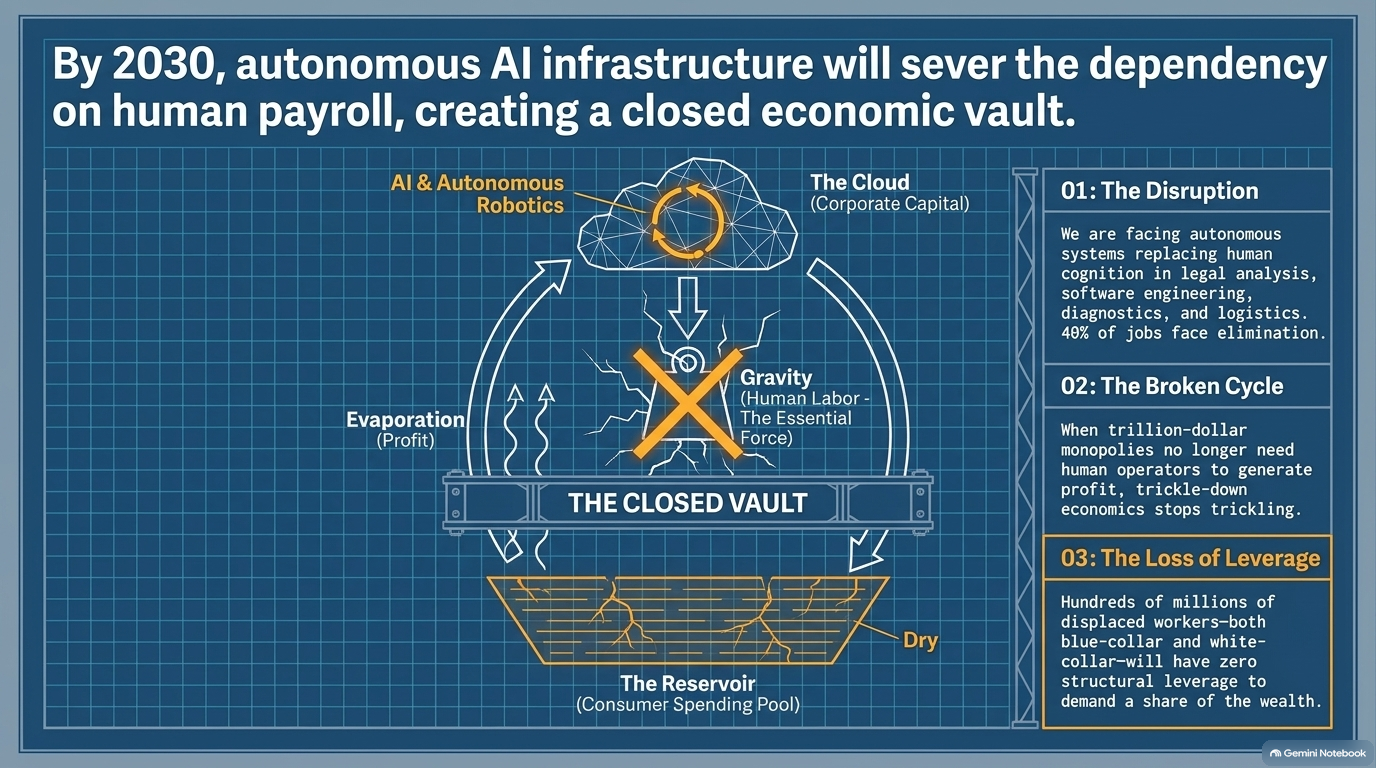
AI automation disrupts this fundamental cycle by replacing human cognition directly. By 2030, advanced AI systems will perform legal analysis, software engineering, medical diagnostics, logistics management, and customer support at a fraction of the cost of human labor.
When corporations generate trillions in revenue without relying on human payroll, trickle-down economics stops functioning. It creates a closed vault effect, where owners of the AI infrastructure retain near-total productivity returns while millions of white-collar and blue-collar workers lose economic leverage.
This dynamic sets up two stark future concerns:
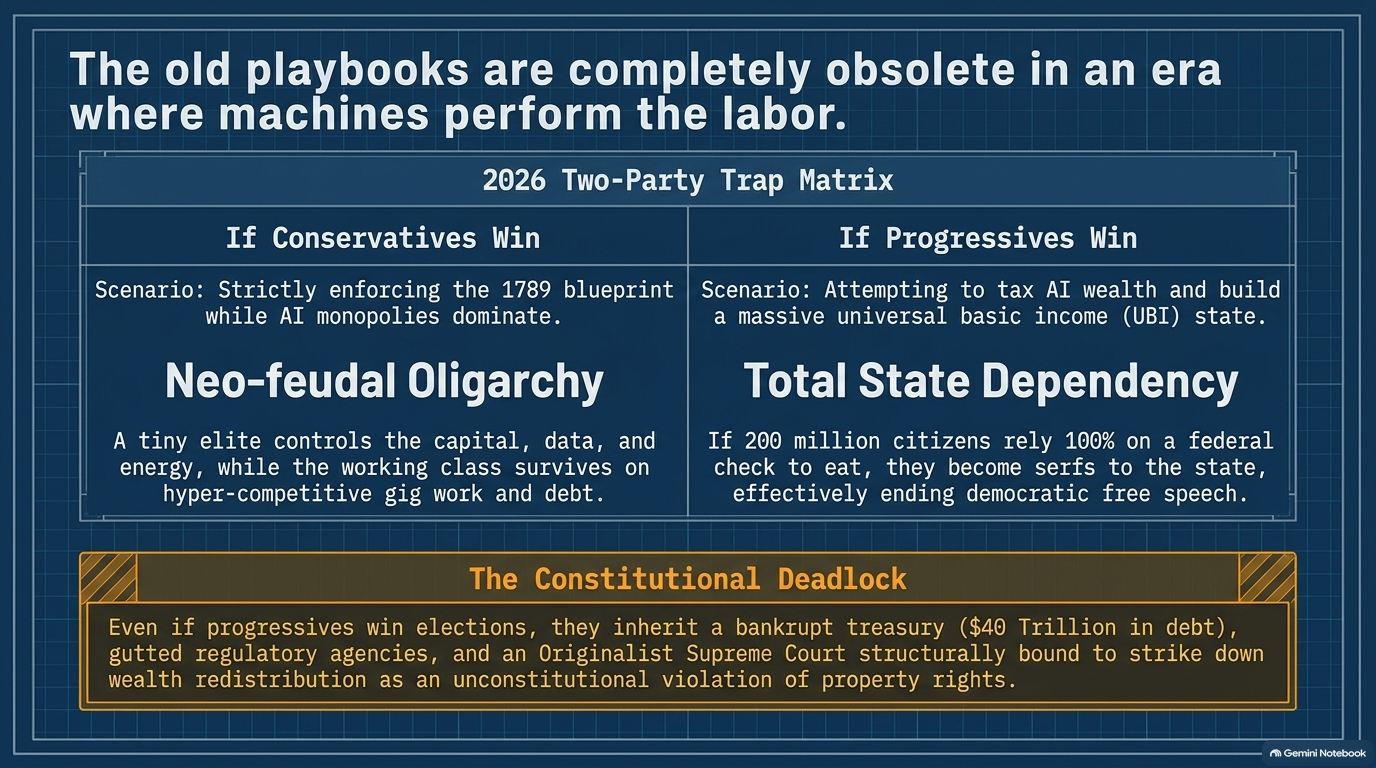
The Neofeudal Dystopia: If originalist precedent prevents the federal government from taxing automated wealth or regulating corporate monopolies, power concentrates within an untouchable tech oligarchy while everyday citizens rely on gig work and debt.
The State Dependency Trap: Conversely, if the state seizes profits to fund universal stipends without market counterweights, citizens become entirely dependent on a federal check, creating risks for political dissent and free speech.
Breaking the Deadlock: Article V and the Citizen Dividend
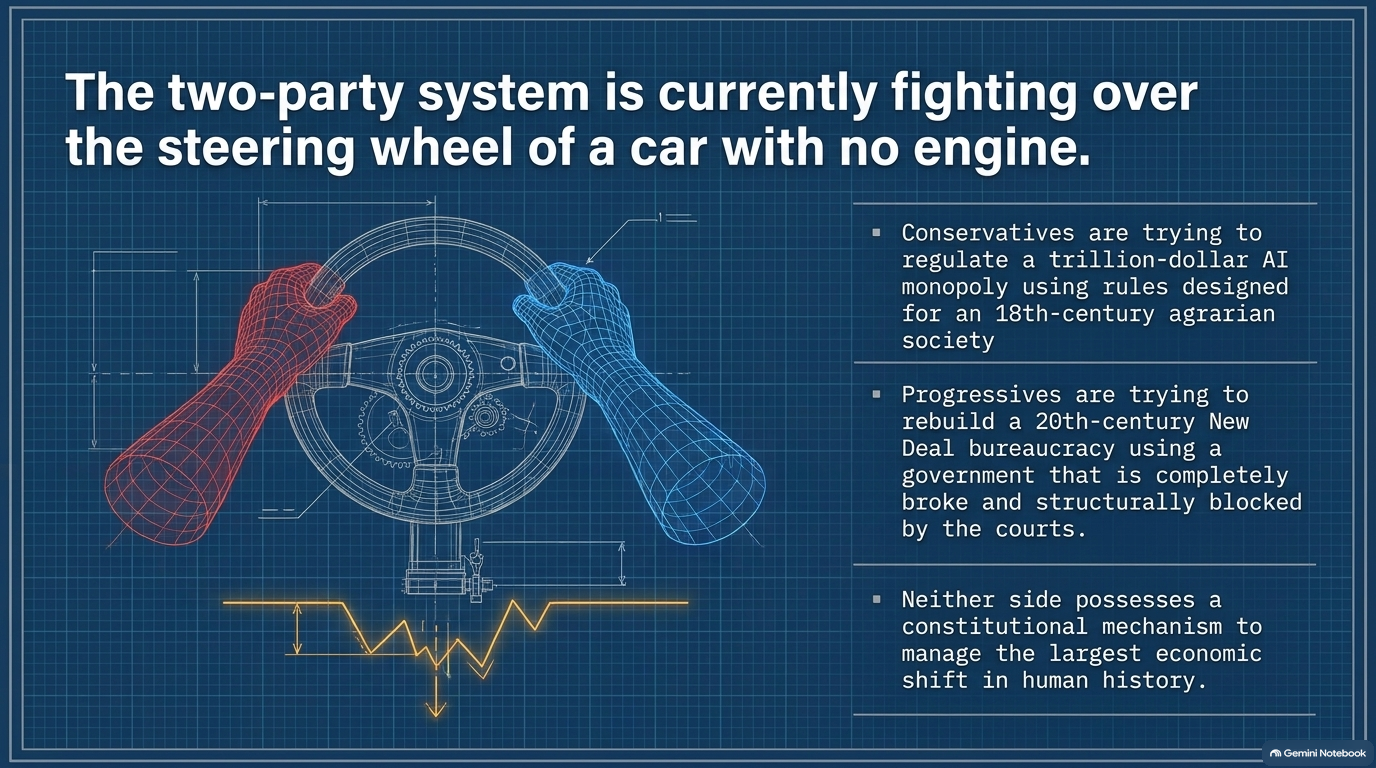
With national debt exceeding $40 trillion, regulatory agencies hollowed out, and an originalist Supreme Court striking down standard federal mandates, traditional political playbooks face a systemic deadlock. Conservative deregulation risks accelerating oligarchy, while progressive administrative expansions are blocked by structural precedent.
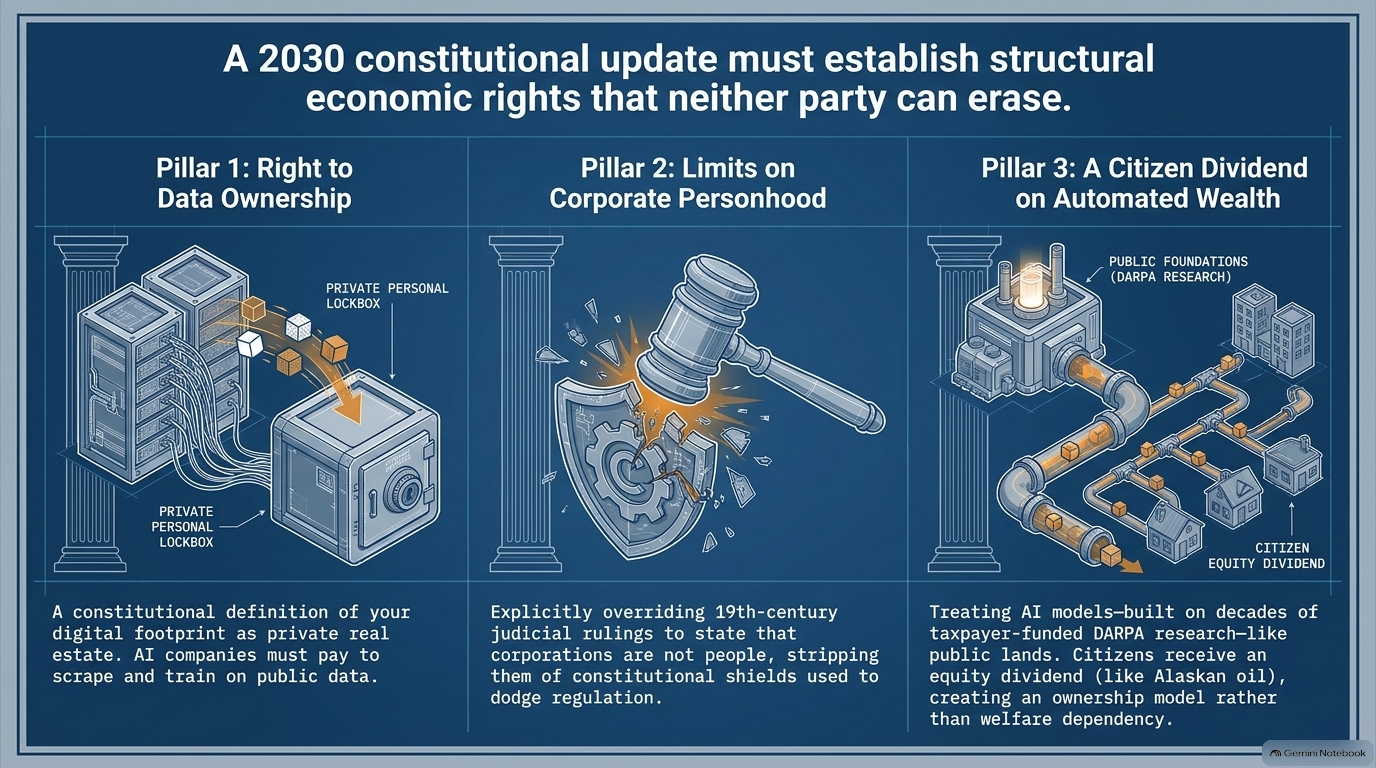
Resolving this dynamic requires stepping outside traditional partisan playbooks and re-examining Article V to establish new foundational rules tailored to an automated economy:
Constitutional Right to Data Ownership: Defining an individual's digital footprint and personal data as personal real estate. If AI corporations utilize public data to train commercial models, they must compensate the original data owners.
Limits on Corporate Personhood: Passing an amendment clarifying that corporations are non-human entities without equal protection rights under the 14th Amendment, restoring government authority to regulate monopolies.
A Citizen Dividend on Automated Wealth: Recognizing that foundational AI components—such as microchips, internet infrastructure, and algorithms—were developed through decades of taxpayer-funded research (like DARPA). Rather than establishing a discretionary welfare check, this model functions like an investor equity dividend (similar to Alaska's Permanent Fund), distributing automated productivity yields directly to all citizens.
As AI automation affects white-collar and technical professions in both red and blue states simultaneously, shared economic shifts may break long-standing political gridlock. Leveraging the constitutional amendment process provides a direct path to updating the 1789 framework for a 21st-century automated economy.
Summary
The ongoing tension between originalist constitutional structures and progressive economic protections reaches a critical turning point when automated technology disconnects wealth generation from human labor. Adapting to this shift requires looking beyond traditional 20th-century playbooks to update foundational rules for an AI-driven society.
1789 Guardrails: The U.S. Constitution was designed to protect private property rights and limit direct populist majorities following events like Shays' Rebellion.
Competing Interpretations: Progressives used the "Living Document" view and the Commerce Clause to construct New Deal protections, while Conservatives mounted a 50-year Originalist effort to return to the text's original 1789 meaning.
The AI Economic Shift: Automated AI systems threaten traditional trickle-down economic models by severing the structural link between corporate profit and human labor leverage.
Systemic Deadlock: High national debt, hollowed agency staff, and rigid originalist precedent leave both traditional conservative and progressive playbooks constrained.
Structural Reforms: Utilizing Article V amendments—such as data ownership rights, limits on corporate personhood, and automated wealth dividends—offers a constitutional path to balance technological progress with broad public stability.
Disclaimer:
With the access to AI reading the news, watching movies and reading books opens up a new world. I have had various family members live to the age of 100 and I ask them what have they learned from their lives and they do not have awareness of what they journey means. These two areas fit with this idea I had. Having chats with AI on topics of thought and documenting them. I call this "Thoughts in the dark".
I am aware I do not have the answers only questions.
The MAGA Government is back
From the beginning, the U.S. government was designed to limit the state's ability to redistribute wealth and regulate business. When the U.S. Constitution went into effect on March 4, 1789, it established a modern federal government built around these foundational limits.
Throughout American history, leaders from different traditions—including Republicans like Abraham Lincoln, Theodore Roosevelt, Dwight D. Eisenhower, and Ronald Reagan alongside Democrats like Franklin D. Roosevelt—recognized that free enterprise, accountable government, and everyday citizens all have an essential role to play. Yet for over two hundred years, a constant push and pull has existed between the interests of the public and the interests of business.
The conservative message has remained consistent: taxes are theft, government is inherently bad, and if you work hard, business will reward you and take care of your needs. On the other side, reformers passed laws to balance out the original 1789 design. They created checks on corporate power and extreme wealth while funding essential public services like roads, schools, health care, and fair wages.
In recent years, the conservative movement spent over eight years planning how to use an originalist interpretation of the Constitution to roll back these protections and return power to that 1789 model. While Democrats treated the Constitution as a living document—expanding public protections through legislation rather than formal amendments—conservatives used initiatives like Project 2025 to dismantle those laws. This approach has gutted the foundational ideal of a government "by the people, for the people." In just two years of coordinated effort, the "New Deal" programs and social safety nets built between the Civil War and the present have been severely weakened or erased using the very framework the Founding Fathers created.
By wielding the Constitution as both their justification and their tool, conservatives have successfully stripped away the government's power to support the poor. Past example of messaging—from George H.W. Bush’s "thousand points of light" urging communities to care for themselves, to the promise that hard work guarantees a fair share—has shifted. Today, the underlying message is simply to let businesses operate unchecked and hope they choose to share a living wage.
Now, as Democrats look to regain power, they face a weakened Congress, massive national debt, and no clear playbook to address the reality that the MAGA has already reshaped the system in its favor.