
What happens when an 18th-century Constitution collides with 21st-century artificial intelligence, mass labor displacement, and a $40 trillion national debt?
This lesson explores how historical political philosophy and modern constitutional design can combine to resolve structural economic crises. By examining Thomas Paine's 1797 treatise Agrarian Justice alongside modern policy debates, you will learn how structural additions to the U.S. Constitution can restore economic balance without expanding centralized bureaucracy.
Analyze the structural limitations of traditional conservative and progressive policy frameworks during rapid AI displacement.
Deconstruct Thomas Paine’s principles regarding natural inheritance, artificial property, and common public funds.
Examine the five articles of the proposed "Bill of Wealth" constitutional framework.
Evaluate sovereign royalty mechanisms and constitutional spending controls designed to retire national debt while funding citizen dividends.
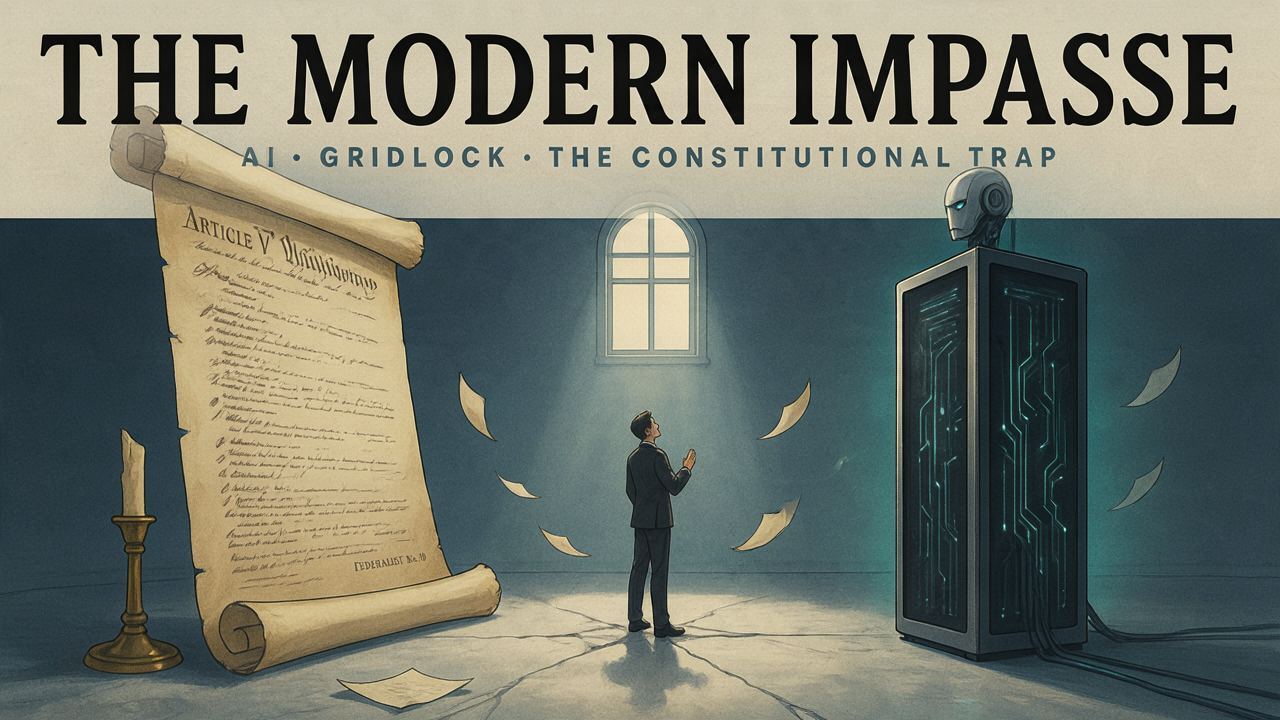
The Modern Impasse: AI, Gridlock, and the Constitutional Trap
To understand why modern economic policy feels paralyzed, we must look at the structural trap built into the interaction between the U.S. Constitution and technological acceleration.
When the U.S. Constitution went into effect in 1789, figures like James Madison argued in Federalist No. 10 that government must be designed to prevent temporary political majorities from easily seizing property or disrupting long-term stability. Article V established strict requirements for constitutional amendments—requiring two-thirds of Congress and three-quarters of the states. While this design protected individual enterprise and legal stability, it also created a system that is extraordinarily difficult to update when foundational economic realities shift.
The Breakdown of Traditional Playbooks
For decades, political debates revolved around two primary playbooks:
The Market Supply-Side Approach: Emphasizes deregulation, tax incentives, and capital retention, operating on the premise that business growth naturally trickles down into jobs and living wages.
The Administrative State Approach: Emphasizes federal oversight, regulatory protections, and public programs funded through taxation and targeted government mandates.
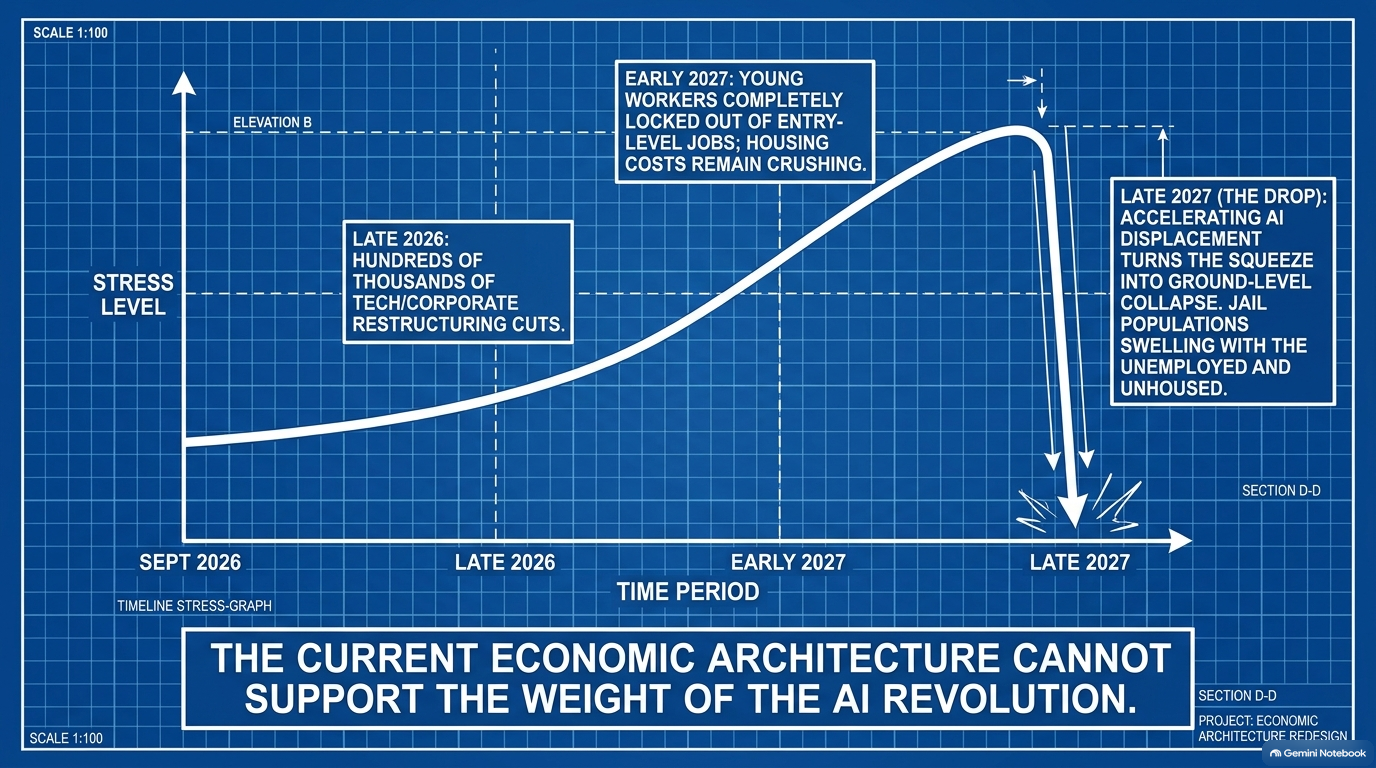
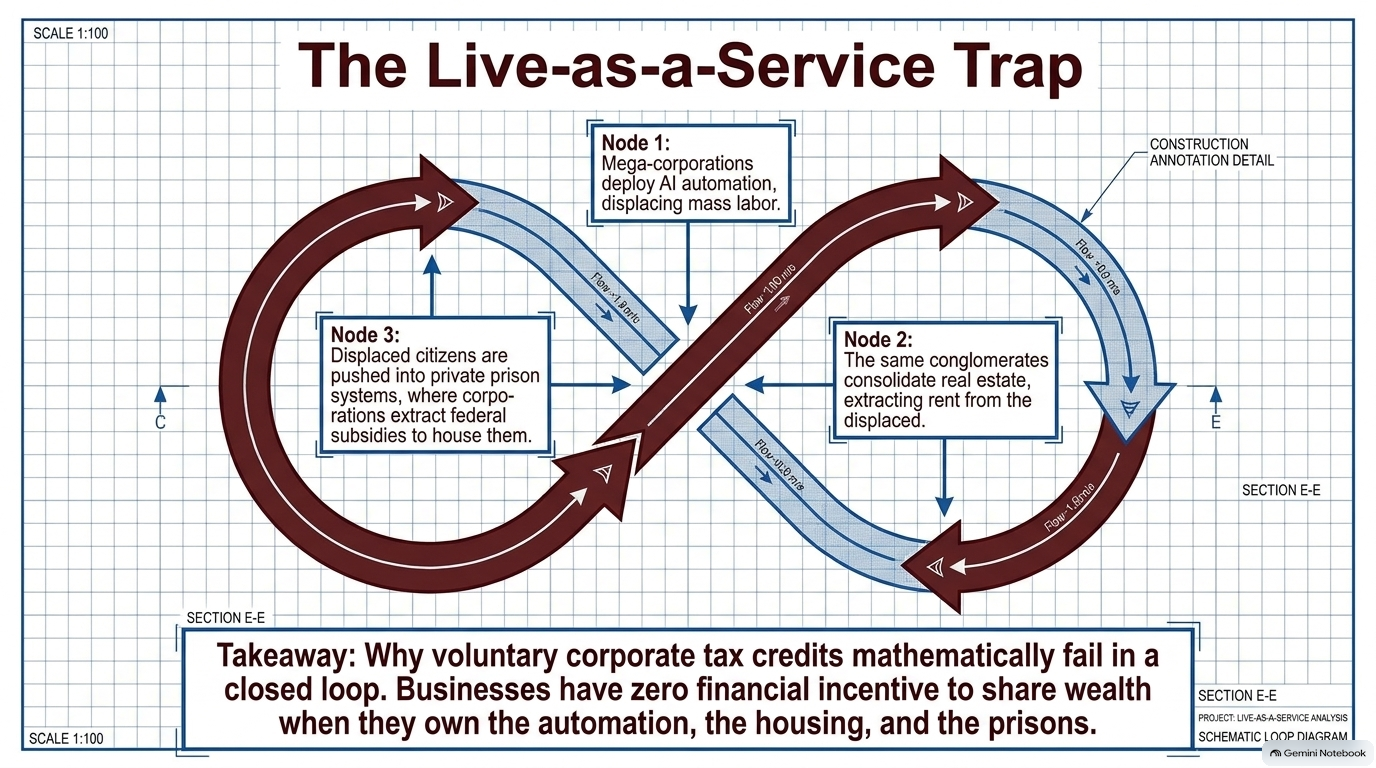
However, accelerating artificial intelligence and autonomous robotics create a paradigm shift that destabilizes both playbooks. Historically, capital required human labor to generate value—a factory owner needed workers to operate assembly lines. In an automated economy, corporations can decouple profit generation from human payroll.
Traditional Capital Model: Capital + Human Payroll ---> Production ---> Shared Consumer MarketAutomated AI Model: Capital + AI Infrastructure ---> Production ---> Closed Corporate LoopWhen automation replaces cognitive and physical labor across industries, traditional market mechanisms no longer distribute income naturally through wages. Conversely, relying on centralized administrative expansion faces severe constitutional resistance, court challenges, and fiscal limits under a massive national debt.
Without a structural update, society risks falling into a "live-as-a-service" economy, where mega-monopolies own the housing, energy grid, algorithms, and infrastructure, reducing citizens to perpetual renters of their own lives.
Thomas Paine's Blueprint: Natural Rights and Agrarian Justice
To find a peaceful, structural way out of modern economic gridlock, we can turn to the foundational writings of revolutionary philosopher Thomas Paine. In his 1797 pamphlet Agrarian Justice, Paine addressed a core paradox of civilization: why does advanced societal progress produce both extreme wealth and extreme wretchedness?
Paine answered this question by establishing a critical distinction between two distinct forms of property:
Natural Property: The earth, air, water, and common resources created by nature. In a natural state, every human being is born a joint life proprietor of these resources.
Artificial or Acquired Property: The value added to natural property through human invention, labor, cultivation, and technology. Equality in acquired property is impossible because individuals contribute differently.
The Principle of the Groundrent
Paine argued that while land cultivation and private development represent major improvements that belong to the person who created them, the system of private land ownership dispossessed the rest of humanity of their natural inheritance.
To remedy this without confiscating private property or destroying enterprise, Paine proposed that every landed proprietor owes a groundrent to society. This payment was not framed as charity, but as a strict constitutional right of natural inheritance.
"It is wrong to say God made rich and poor; he made only male and female; and he gave them the earth for their inheritance... It is a right, and not a charity, that I am pleading for." — Thomas Paine, Agrarian Justice (1797)
Personal Property as an Effect of Society
Paine extended this logic to personal property and accumulated wealth. He noted that an individual isolated on a deserted island could never accumulate personal wealth beyond what his own hands produce. All personal riches beyond manual labor are the effect of living in society—enabled by public infrastructure, laws, markets, and collective knowledge.
Therefore, Paine asserted that every accumulator of wealth owes a portion of that accumulation back to a public fund, guaranteeing every citizen an initial stake to begin adult life and security in old age.
The Bill of Wealth: Restoring the Three-Legged Table
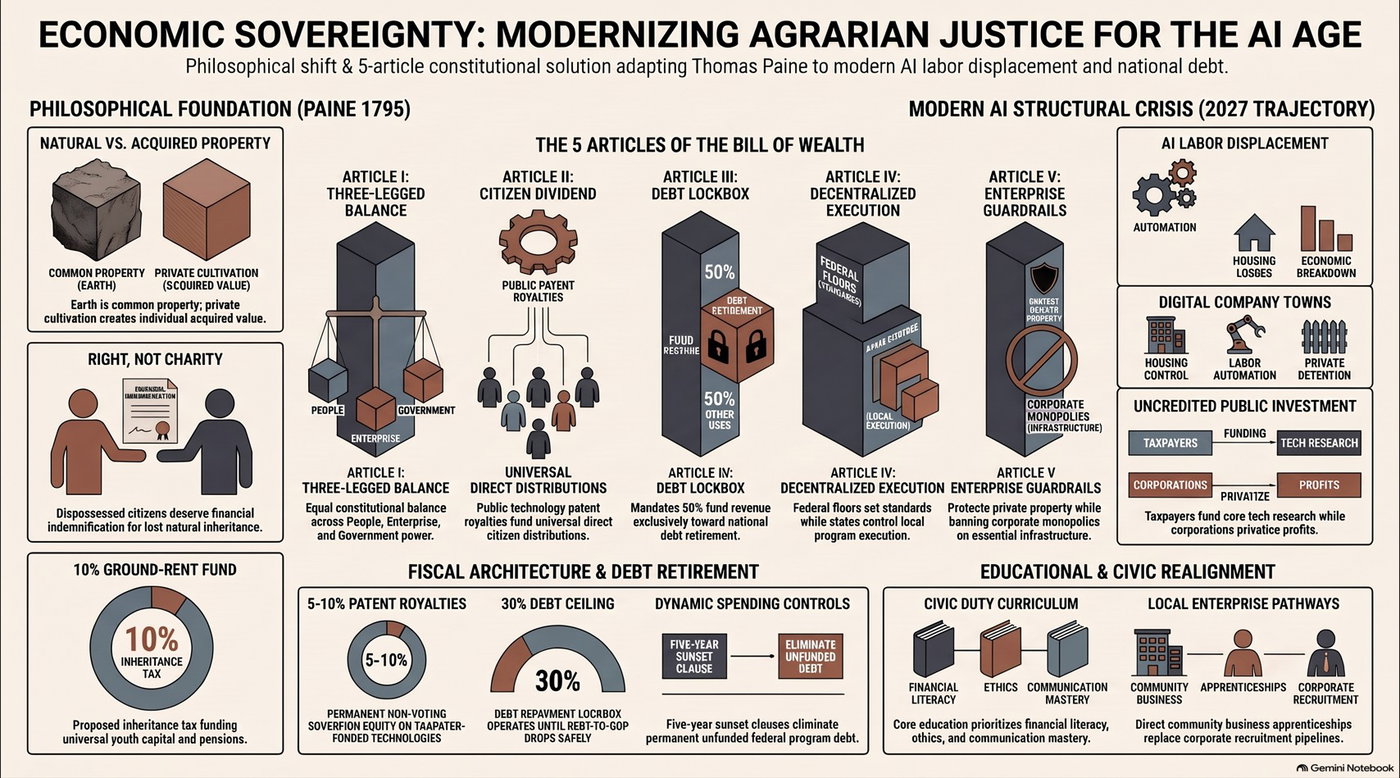
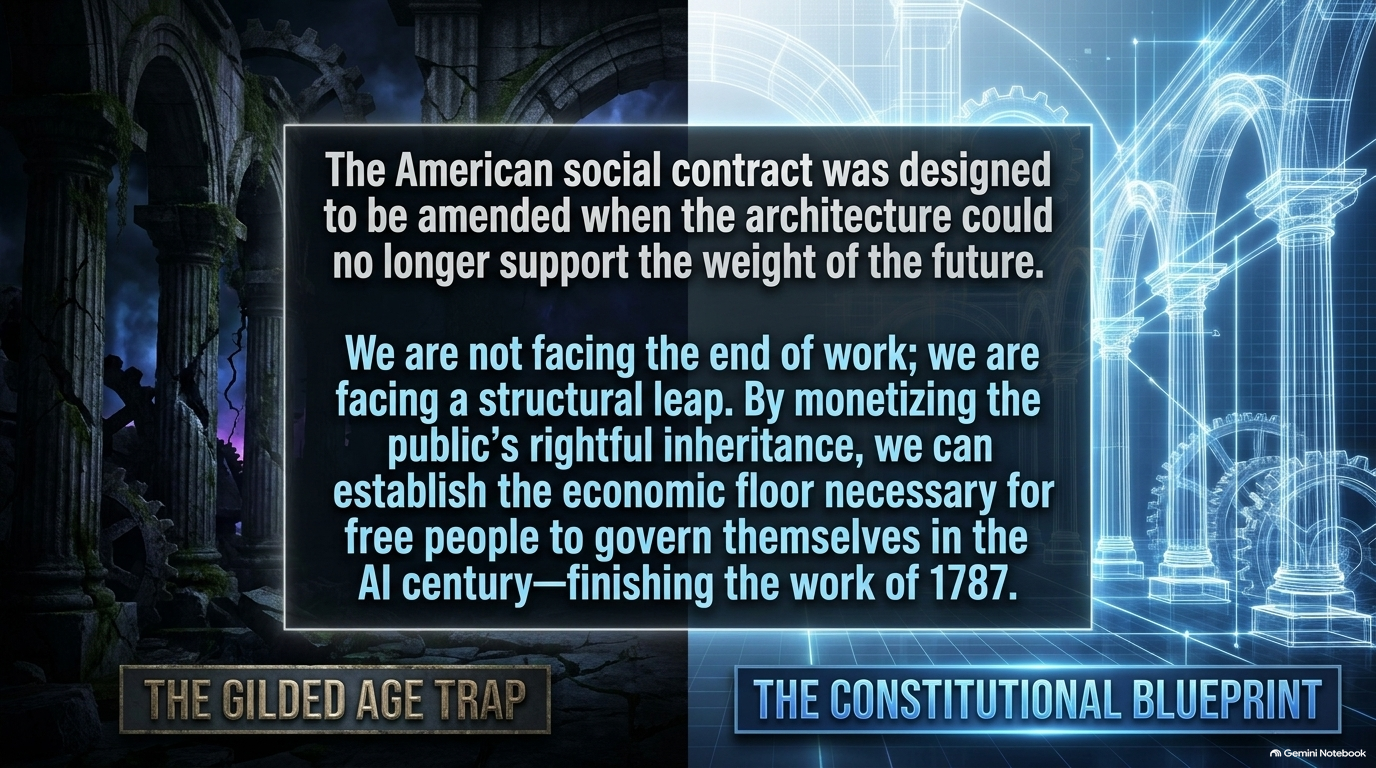
Building on Thomas Paine’s principles, modern theorists propose adding a Bill of Wealth to the U.S. Constitution. Just as the original Bill of Rights provided guardrails to protect individual expression and legal process against state overreach, the Bill of Wealth provides economic guardrails to keep society balanced during technological transitions.
The Three-Legged Balance
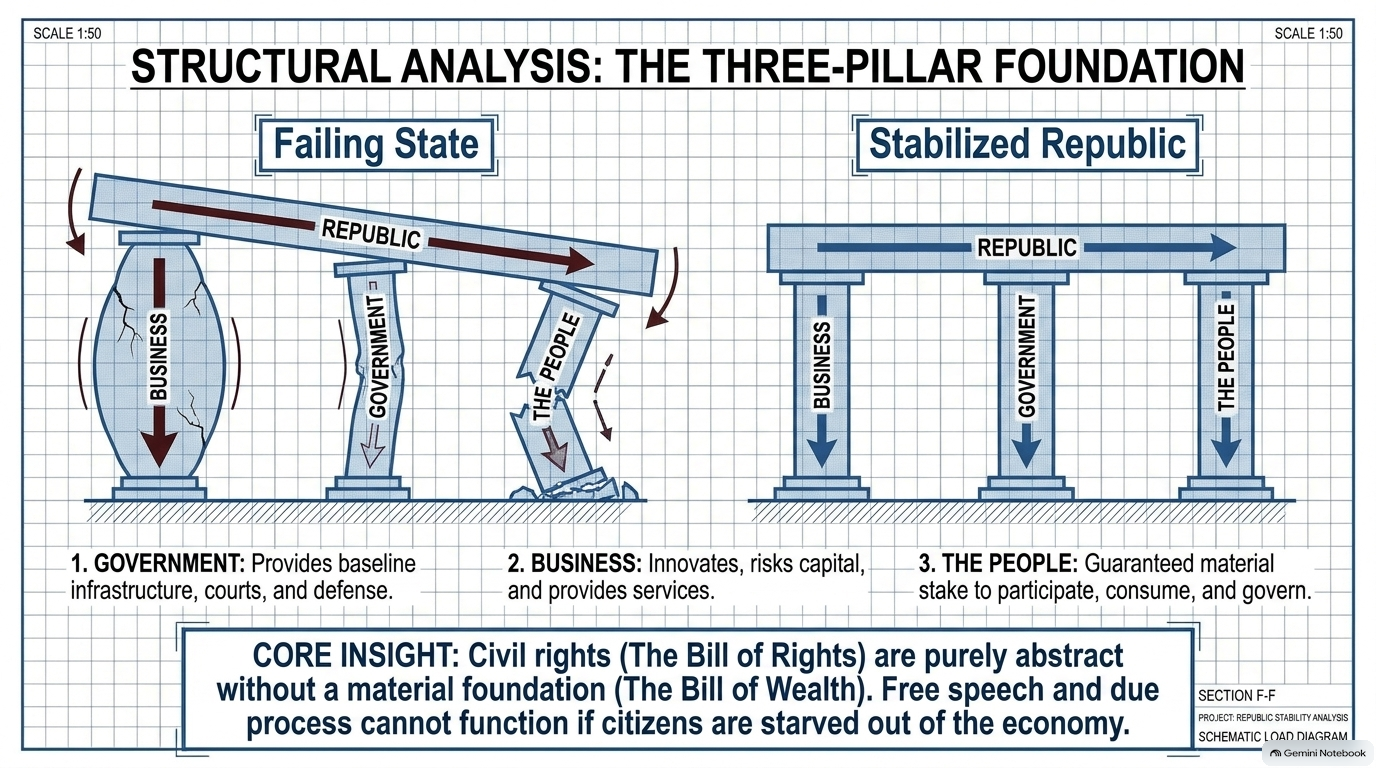
The core philosophy rests on an intuitive mental model: a stable society functions like a three-legged table. If any single leg collapses or overpowers the others, the entire table falls.
Business (Enterprise): Remains free to innovate, build, compete, and generate wealth without central micromanagement.
The People (Citizens): Receive a guaranteed constitutional stake in technological and natural assets, ensuring food, shelter, and security so they can actively participate in the economy.
Government (State): Focuses on basic national baselines, public safety, infrastructure, and neutral enforcement of the rule of law.
+-----------------------------------------+ | SOCIETAL STABILITY | +-----------------------------------------+ | | |+-----------+ +-----------+ +------------+| BUSINESS | | PEOPLE | | GOVERNMENT || Innovates | | Guaranteed| | Enforces || & Builds | | Stake/Dividend | Baselines |+-----------+ +-----------+ +------------+Draft Architecture of the Five Articles
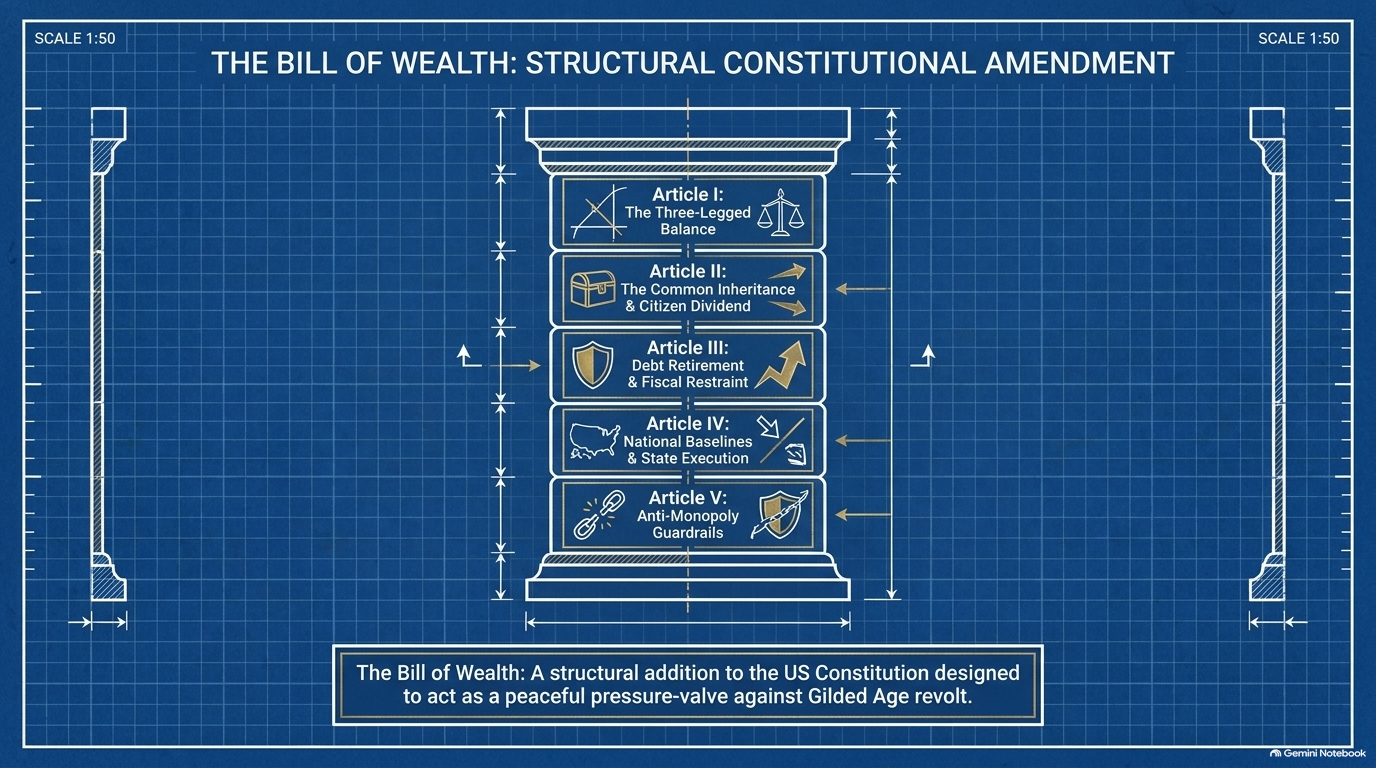
The framework translates these principles into five explicit constitutional amendments:
Article I — The Three-Legged Balance: Establishes equal sovereignty among the People, Enterprise, and Government, preventing corporate monopolies or state authoritarians from monopolizing critical public infrastructure, data, or land.
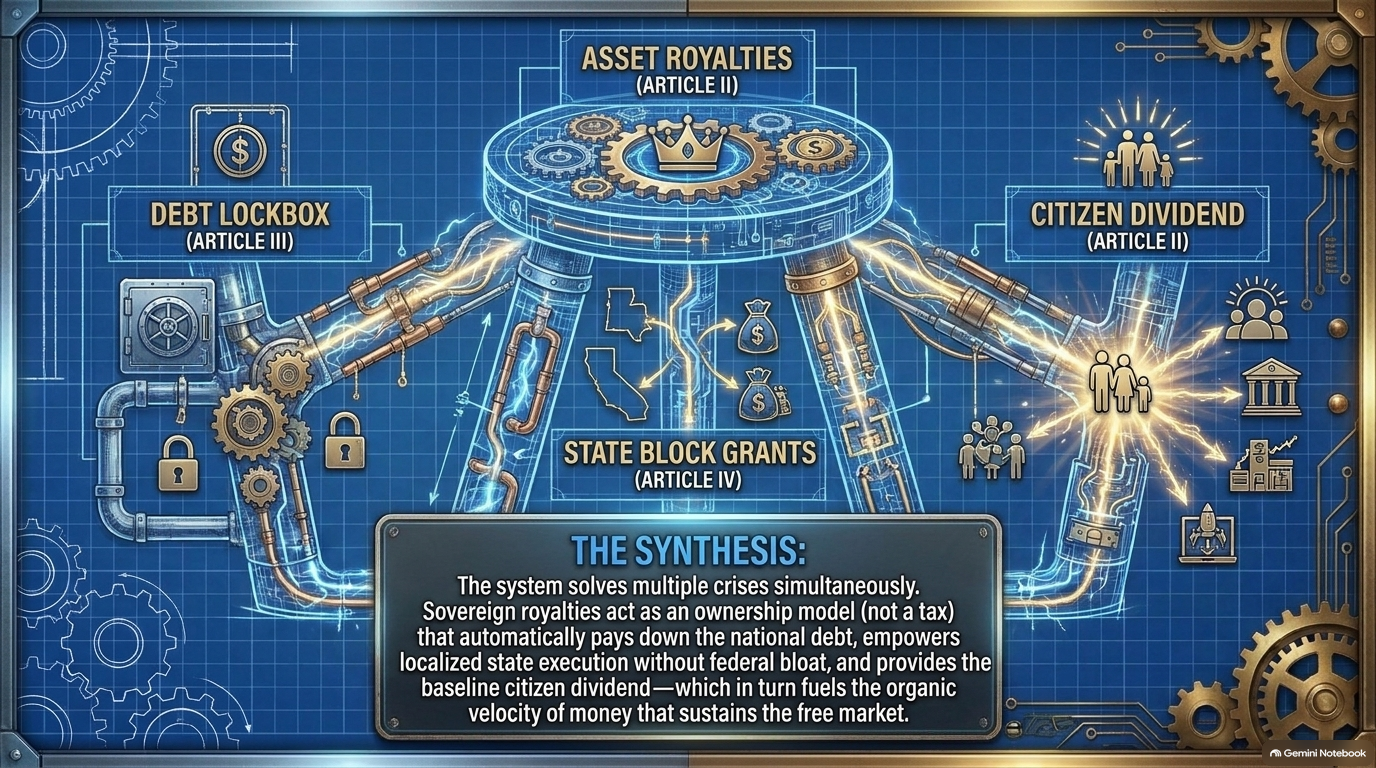
Article II — The Common Inheritance & Citizen Dividend: Mandates a National Sovereign Fund collecting royalties from public technology patents, AI infrastructure, public lands, and communications spectrum to pay a direct Universal Citizen Dividend.
Article III — Debt Retirement & Fiscal Restraint: Directs mandatory royalty allocations to debt retirement and places strict spending caps on federal deficit budgeting.
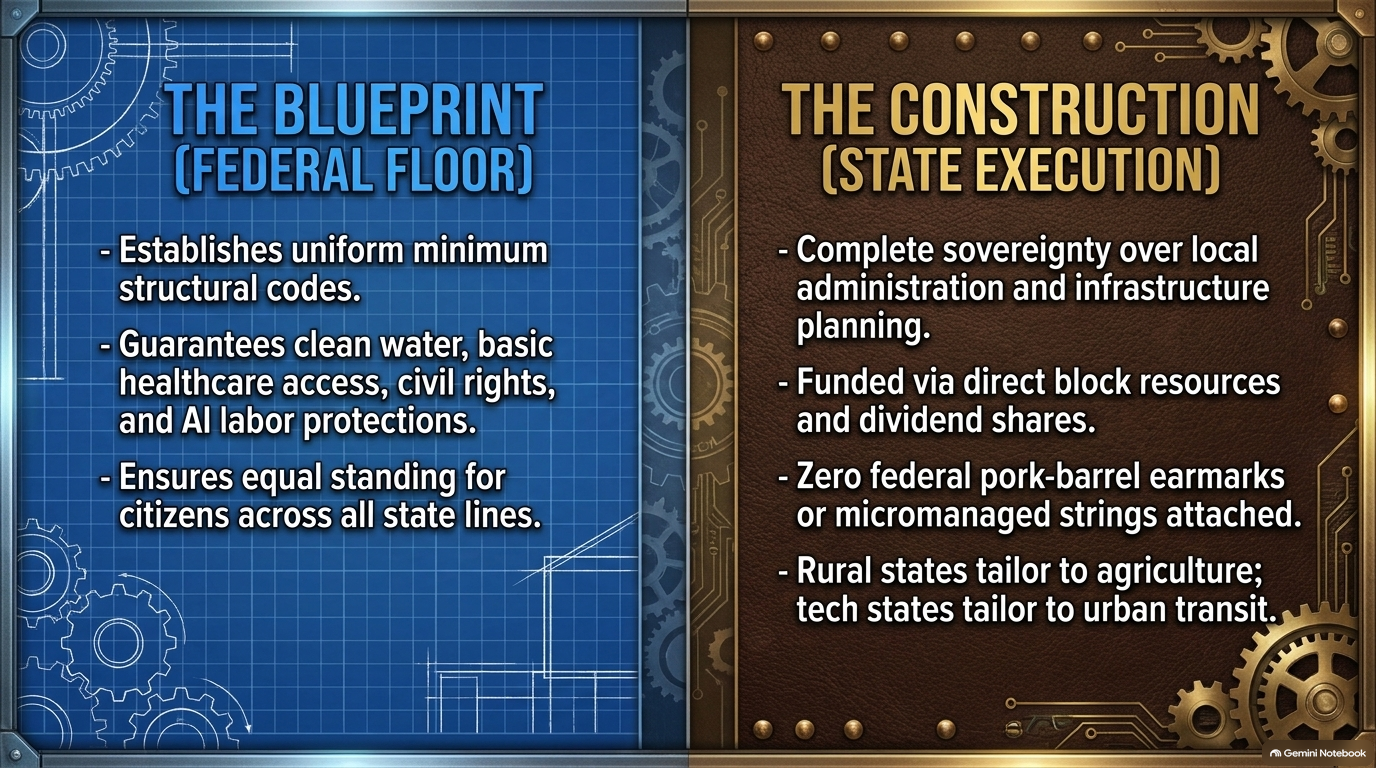
Article IV — National Baselines, State Execution: Mandates uniform national protections for healthcare access, civil rights, and economic security set by Congress, while delegating administration strictly to the individual States.
Article V — Protection of Enterprise & Anti-Monopoly Guardrails: Protects private property and invention rights while banning private cartels from operating essential public prisons or civic utilities for pure extractive profit.
Civic Education & Community Integration
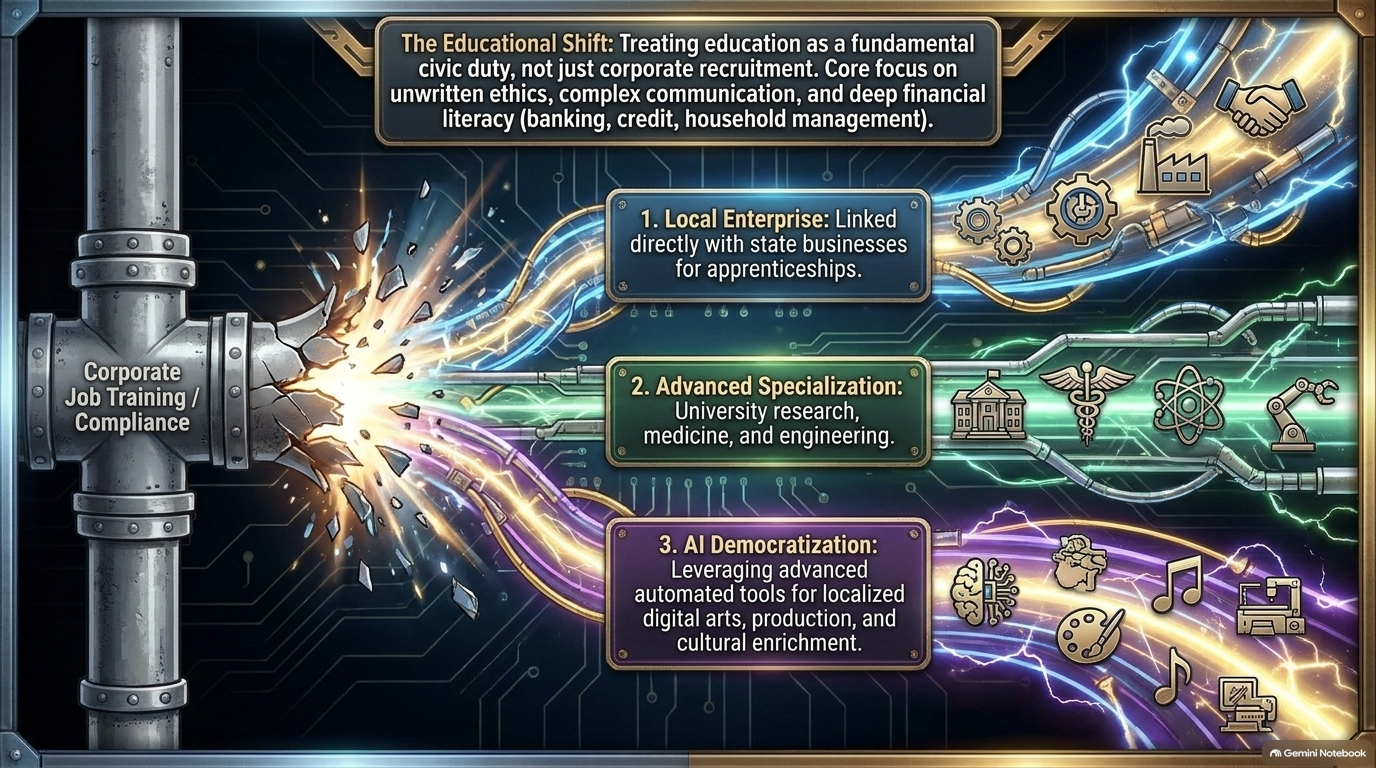
To support this architecture, public education shifts away from narrow corporate job training toward foundational civic mastery. Standard curricula focus on financial literacy, household budgeting, economic legal rights, and trade masteries tied directly to local community enterprise.
Fiscal Mechanics: Sovereign Equity and Constitutional Debt Controls
A common critique of broad economic safety nets is the "math problem": how can a nation pay for universal economic security and clear a massive national debt without imposing crushing income taxes or triggering hyperinflation?
The Bill of Wealth resolves this by abandoning tax hikes in favor of Sovereign Asset Monetization and Constitutional Lockboxes.
Monetizing Publicly Funded Breakthroughs
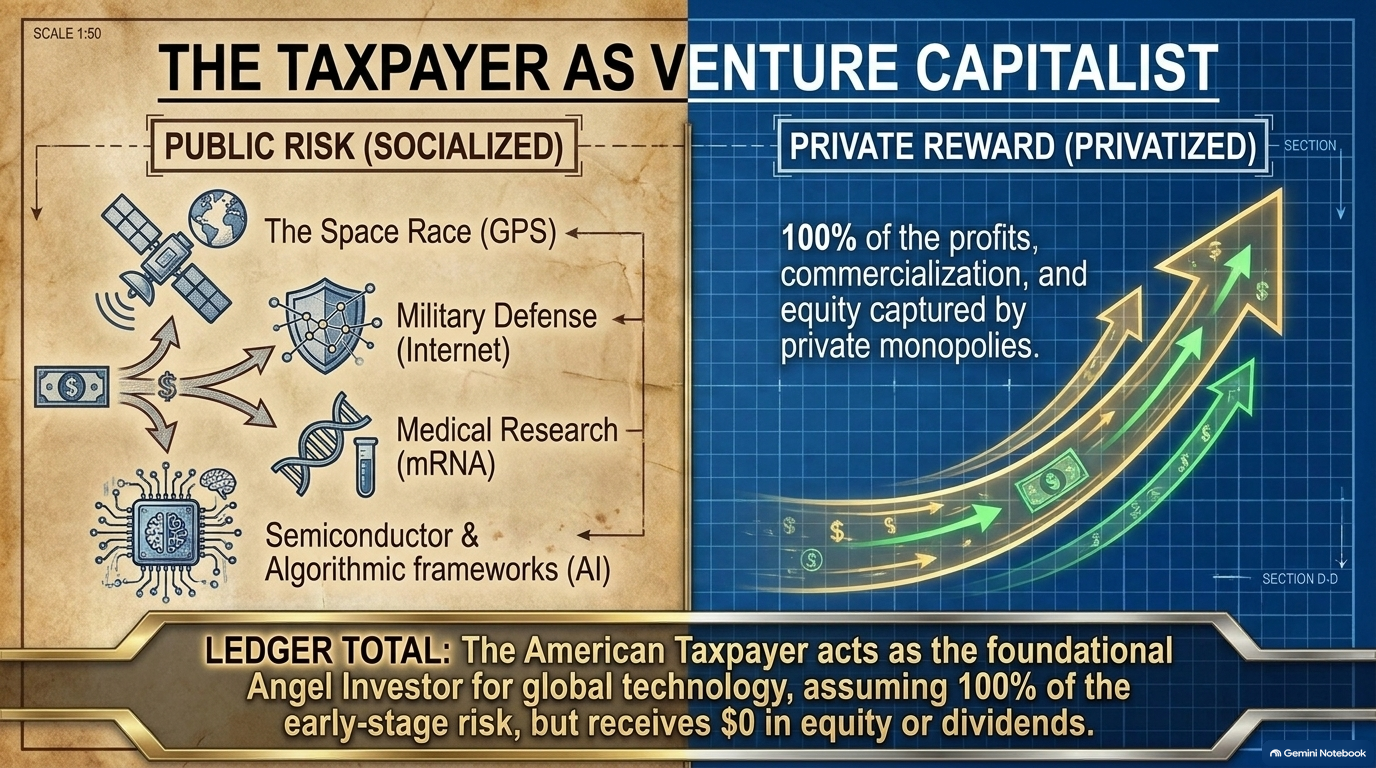
For decades, taxpayers have funded the underlying research for major technological revolutions—including the internet, GPS, satellite networks, mRNA medical breakthroughs, semiconductor research, and foundational AI algorithms. Historically, the public absorbed 100% of the financial research risk while private corporations privatized 100% of the long-term equity profits.
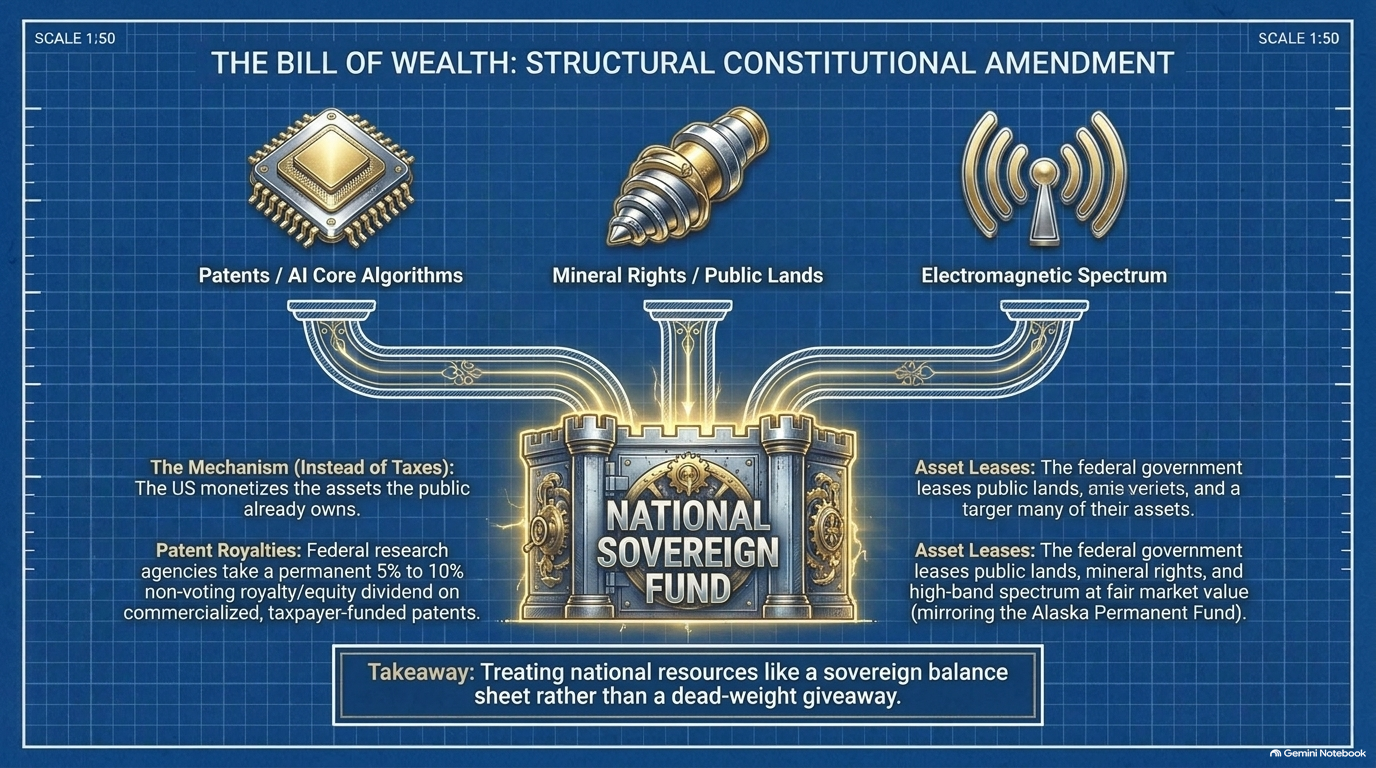
Under the Bill of Wealth revenue model, federal research agencies retain a permanent 5% to 10% non-voting royalty or equity dividend on commercialized patents funded by public investments. As AI and automation drive multi-trillion-dollar productivity booms, a percentage of that automated revenue flows automatically into the National Sovereign Fund.
Taxpayer Funding ---> R&D Breakthroughs ---> Private Licensing | | v v Commercial Growth ---> 5-10% Sovereign Royalty | v National Sovereign FundFederal Leasing & The Velocity of Money
In addition to tech royalties, the government monetizes public assets by leasing mineral rights, energy corridors, and high-band electromagnetic spectrum at fair-market rates, mirroring successful sovereign wealth structures like Norway's Oil Fund or Alaska's Permanent Fund.
When dividends flow from this fund directly into the hands of citizens, it triggers high velocity of money. Rather than sitting in offshore corporate accounts, citizens spend their dividends on housing, food, and local goods, returning capital back into private businesses.
Hard Constitutional Spending Controls
To prevent Congress from absorbing sovereign revenues into political pork-barrel spending, the framework implements three strict constitutional locks:
The Debt-First Lockbox: Exactly 50% of all sovereign fund revenues are constitutionally locked to retire the national debt until debt-to-GDP drops below a safe ceiling (e.g., 30%).
Pay-As-You-Go & Sunset Provisions: All new federal programs must identify existing funding sources or automatically expire after five years.
Dynamic Operational Caps: Federal operational spending is capped based on a rolling five-year average of actual non-borrowed revenue, eliminating peacetime deficit spending.





Summary
The Bill of Wealth framework demonstrates how historical constitutional mechanisms can be adapted to resolve modern technological disruption, establishing a sustainable balance between private enterprise, universal citizen security, and fiscal restraint.
Key Takeaways
Technological Disruption Breaks Traditional Models: Rapid AI and robotic automation decouple corporate profit generation from human payroll, rendering traditional supply-side tax cuts and administrative welfare programs ineffective.
Natural Rights vs. Acquired Property: Following Thomas Paine’s Agrarian Justice, citizens hold an inalienable right to a share of natural resources and public technological breakthroughs as a matter of justice, not charity.
The Three-Legged Balance: Sustainable governance requires equal balance between Enterprise (innovation), the People (guaranteed economic stake), and Government (baseline enforcement).
Sovereign Patent Royalties: Taxpayers earn a return on public research investments by taking a 5% to 10% non-voting equity royalty on federally funded technological advancements.
Constitutional Fiscal Discipline: A 50% Debt-First Lockbox routes sovereign revenues directly to national debt reduction while dynamic spending caps prevent federal budget overreach.
Disclaimer:
With the access to AI reading the news, watching movies and reading books opens up a new world. I have had various family members live to the age of 100 and I ask them what have they learned from their lives and they do not have awareness of what they journey means. These two areas fit with this idea I had. Having chats with AI on topics of thought and documenting them. I call this "Thoughts in the dark".
I am aware I do not have the answers only questions.