Introduction
What if poverty is not an inevitable law of nature or a divine design, but a structural flaw of human civilization? In 1795, revolutionary philosopher Thomas Paine proposed a radical yet pragmatic blueprint to eradicate poverty without abolishing private property: a universal national fund providing every young adult with starting capital and every senior with a pension, funded by a tax on inherited land and wealth.
In this lesson, you will explore the philosophical foundations, financial mechanics, and political strategy behind Paine's seminal treatise, Agrarian Justice.
Distinguish between natural property rights and artificial property rights.
Explain how cultivation created landed monopoly and why landholders owe a continuous groundrent to society.
Calculate the mechanics of Paine's National Fund, including inheritance subtractions and universal payouts.
Analyze how economic security safeguards democratic constitutions against violence and autocratic subversion.
The Origin of Inequality: Natural vs. Artificial Property
Thomas Paine wrote Agrarian Justice in response to a sermon preached by Richard Watson, the Bishop of Llandaff, titled "The Wisdom and Goodness of God, in having made both Rich and Poor." Paine strongly rejected the Bishop's premise, declaring: "It is wrong to say God made rich and poor; he made only male and female; and he gave them the earth for their inheritance."
To understand how society should operate, Paine urges us to examine humanity's primitive, natural state—such as that of the Native Americans in North America. In that natural state, there were no spectacles of wretched poverty, homeless begging, or urban starvation. However, that state also lacked the immense benefits of agriculture, science, arts, and manufactures.
Civilization has operated as a double-edged sword: it created dazzling affluence for some while plunging millions into a condition far worse than if they had been born in a wilderness. To resolve this paradox, Paine identifies two distinct species of property:
Natural Property: The earth, air, and water—created by the Creator as the common inheritance of all human beings.
Artificial or Acquired Property: Goods, buildings, and agricultural improvements created by human labor and invention.
While equality in artificial property is impossible because individuals contribute unequally, natural property belongs equally to every person born into the world. When civilization introduced land ownership, it dispossessed the majority of their natural inheritance without compensation, creating modern poverty.

Groundrent and the Philosophical Foundations of Social Debt
How did common land become private property in the first place? In early human history—among hunters and nomadic shepherds like Abraham or Job—landed property did not exist. People owned flocks and herds, moving freely across unowned terrain.
Landed property arose alongside agriculture. Because it is impossible to separate the physical improvement made by cultivation from the soil itself, the value of the improvement absorbed the natural earth underneath. Eventually, common rights were swallowed up by individual ownership.
Paine explicitly distinguishes his plan of Agrarian Justice from Agrarian Law. Agrarian Law sought to forcibly redistribute cultivated land, which Paine deemed unjust because cultivators owned the value added by their labor. Instead, Agrarian Justice insists that every landowner owes a groundrent to society for the raw, natural earth they monopolize.
Furthermore, Paine argues that personal property is also an effect of society. An individual isolated on a deserted island could never acquire personal wealth. Accumulation beyond what a person's own hands produce is made possible only through living in society—and often results from underpaying labor. Therefore, every wealthy individual owes a debt back to the collective community.
The Financial Plan: Creating the National Fund
To restore the lost natural inheritance of every citizen, Paine proposed establishing a self-sustaining National Fund. The plan provides two concrete economic guarantees:
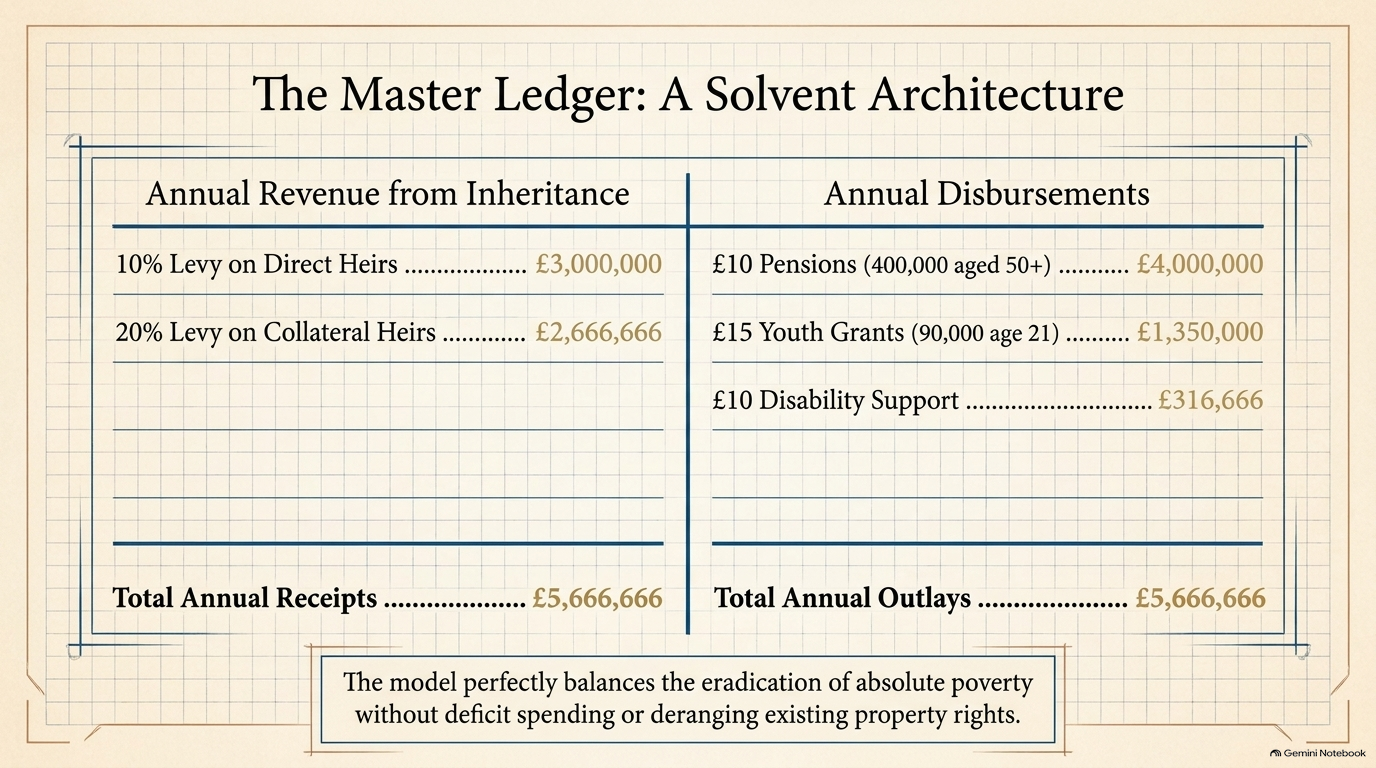
Capital Grant at 21: A one-time payment of 15 pounds sterling to every young person reaching age 21, providing capital to purchase livestock, tools, or land.
Old-Age Pension at 50: An annual payout of 10 pounds sterling for life to every person reaching age 50, alongside full provision for the blind and lame.
Crucially, Paine insists these payments be made to every person, rich or poor. Universal distribution prevents "invidious distinctions" and frames the payment as a sacred birthright rather than a humiliating charity. The wealthy could simply donate their share back to the common fund.
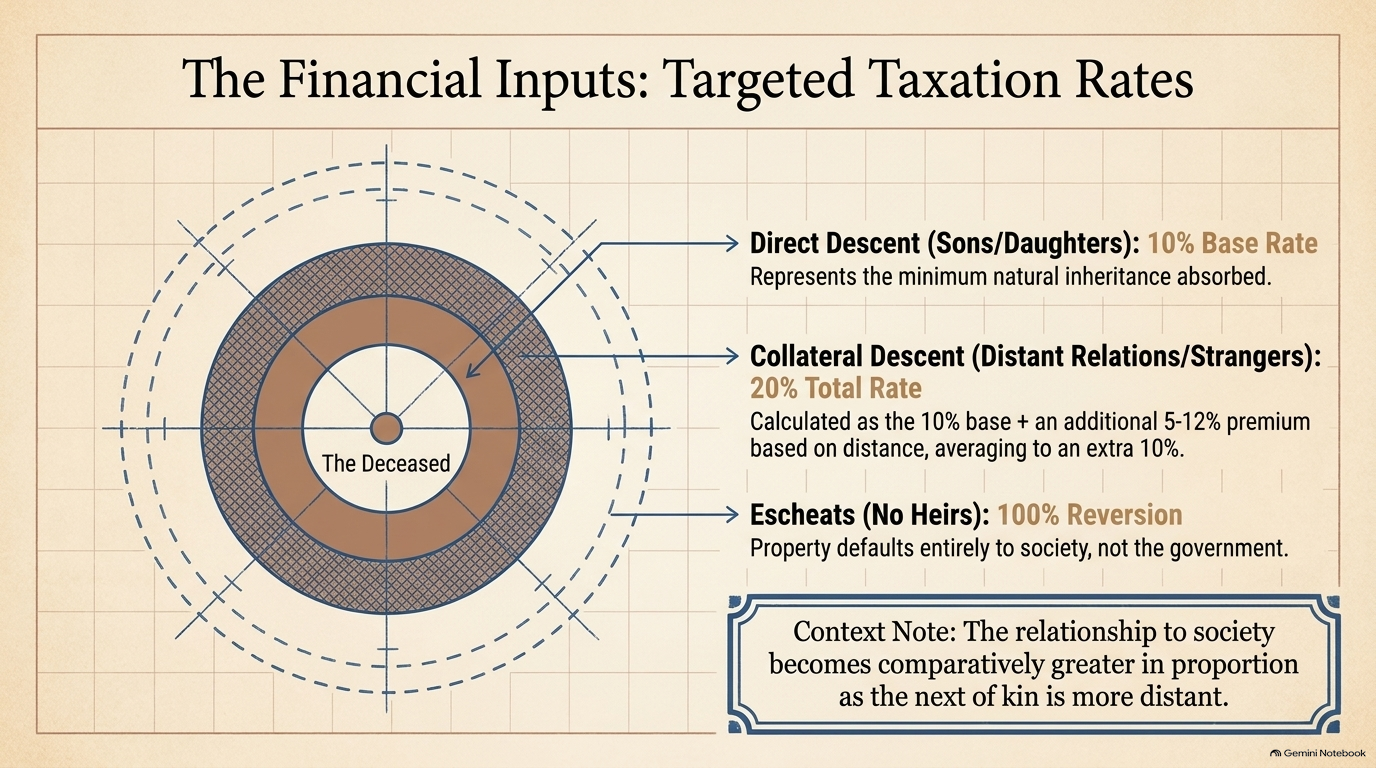
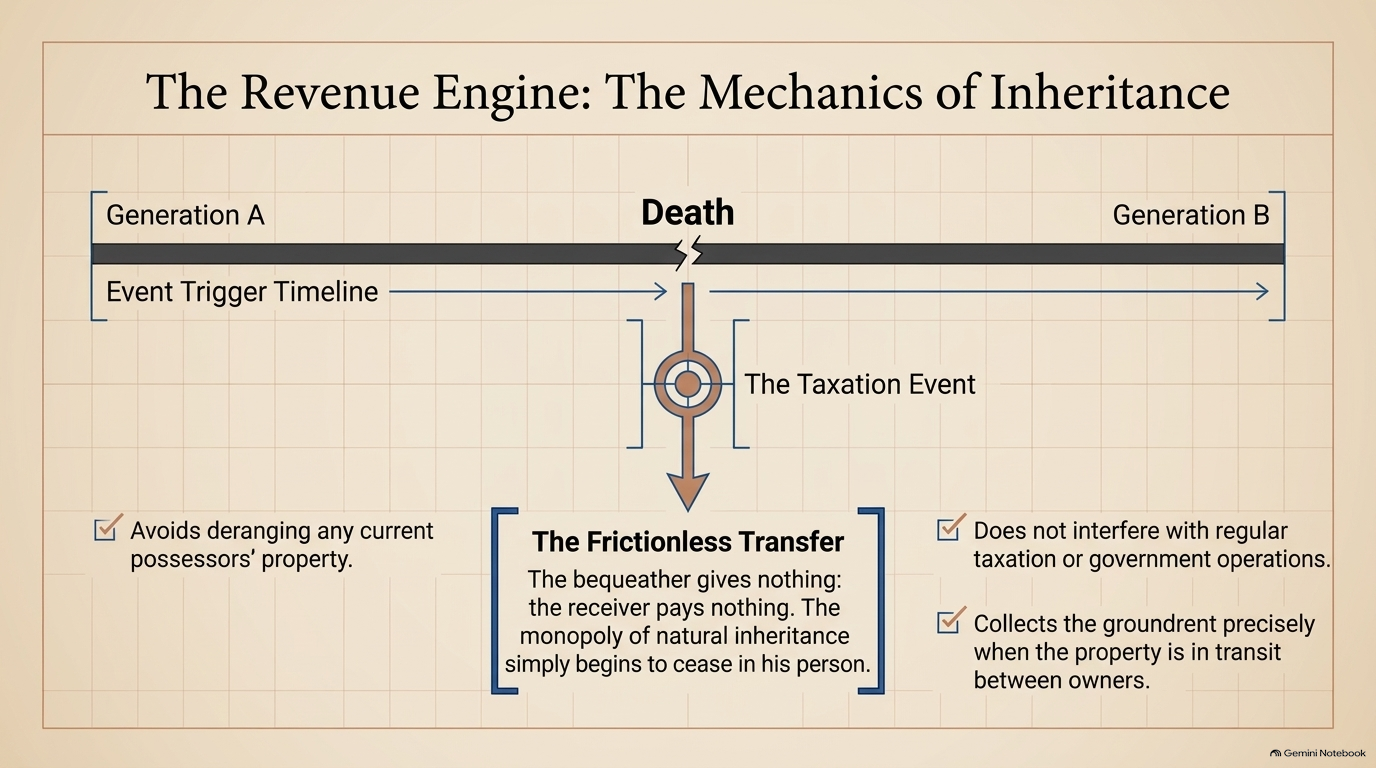
How is the fund created? Paine proposes subtracting a 10% inheritance tax whenever property passes upon death. For collateral inheritance (passing to distant relatives or non-family), the tax rate increases up to 20% or more.
Using British Chancellor William Pitt’s estimate of England's national capital (£1.3 billion sterling), Paine calculates that approximately 1/30th (£43.3 million) revolves annually through deaths. A 10% base tax yields £5.66 million per year—more than enough to pay pensions to 400,000 seniors (£4 million) and capital grants to 90,000 young adults (£1.35 million), leaving a surplus for disability assistance.
Implementation Mechanics and Safeguarding Democracy
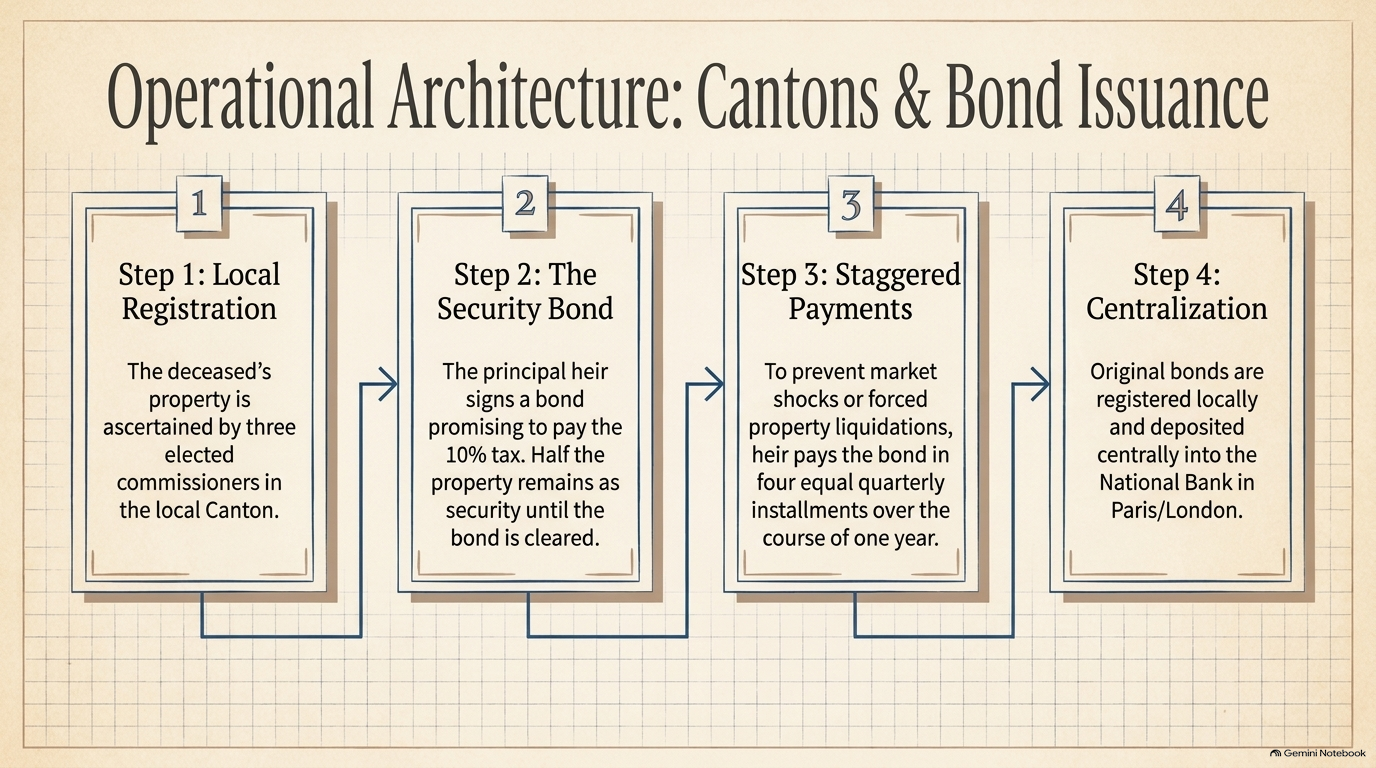
To make the proposal operational without disrupting existing markets or tax collections, Paine outlined an explicit administrative and financial architecture:
Cantonal Commissioners: Each canton primary assembly elects three commissioners to register all property deaths and track eligible recipients.
Property Bonds: Heirs must pay the 10% inheritance tax in four quarterly payments within one year, securing the debt by placing half the estate's value as collateral.
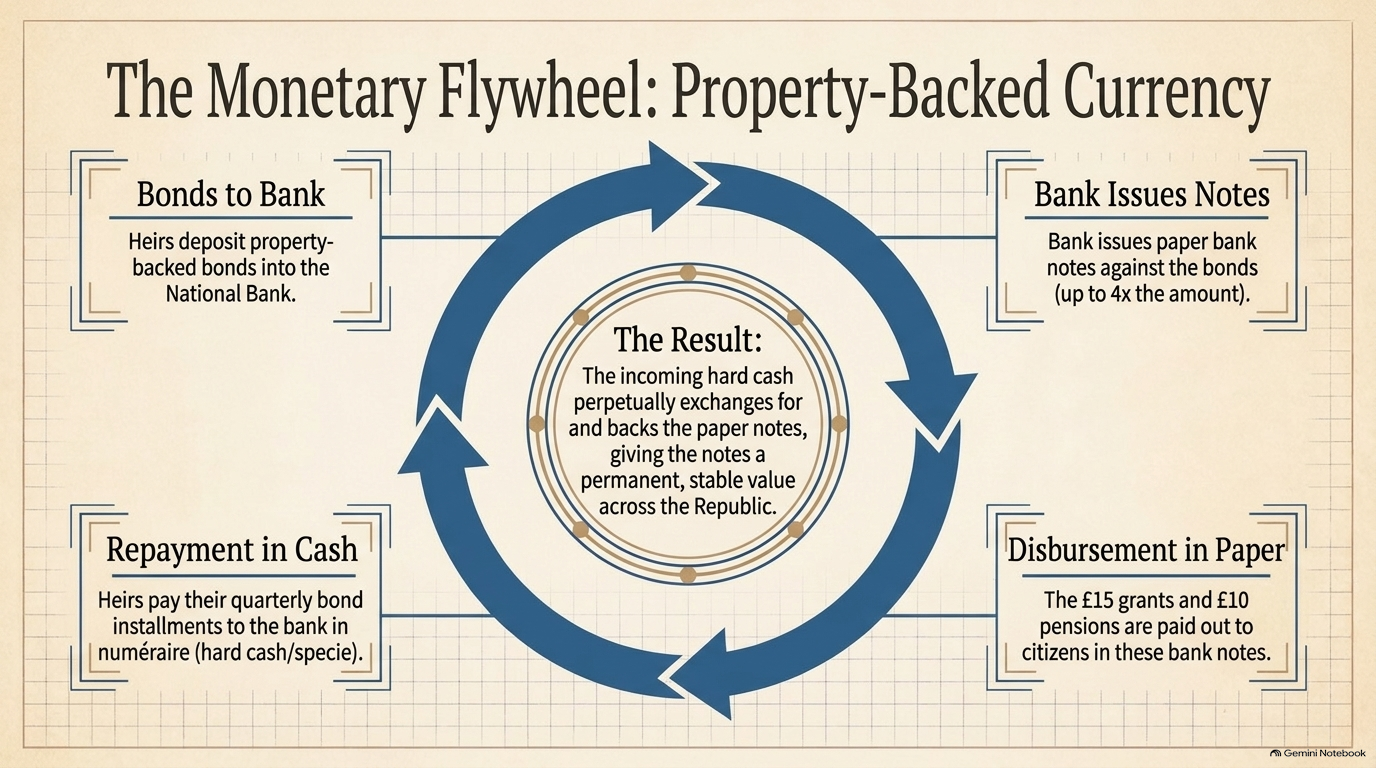
Bank Notes and Numéraire: The National Bank issues circulating bank notes backed by these registered property bonds. As heirs pay off their bonds in cash (numéraire), the bank maintains full liquidity to redeem notes.
Paine placed this economic framework directly into the political turmoil of the French Revolution. He warned the French National Assembly against restricting voting rights to those paying a direct tax—a flaw that sparked Babeuf's radical conspiracy and royalist counter-revolutions.
Paine argued that political rights without economic justice are fragile. By providing economic security to every citizen, republics eliminate the envy and disgust that lead the poor to attack wealth. An "army of principles" grounded in justice creates a permanent defense for liberty that no military force can stop.
Summary
Thomas Paine's Agrarian Justice demonstrates that poverty is an artificial creation of land monopoly and economic systems, and that true democratic stability requires pairing political equality with universal economic rights.
Natural vs. Artificial Property: Natural resources (land, air, water) are the common property of humanity, whereas artificial property is created through personal labor and invention.
The Concept of Groundrent: Landowners owe a continuous groundrent to society as compensation for monopolizing raw earth originally owned by all.
Universal Economic Rights: Poverty prevention requires universal cash infusions—a £15 capital grant at age 21 and a £10 annual pension at age 50—funded by a 10% inheritance tax.
Social Debt of Wealth: Personal wealth accumulation is possible only through societal structures, creating an obligation to return a portion of inherited wealth back to the public.
Safeguarding Republics: Systemic economic justice removes the class animosities that fuel violent political uprisings and autocratic threats.