
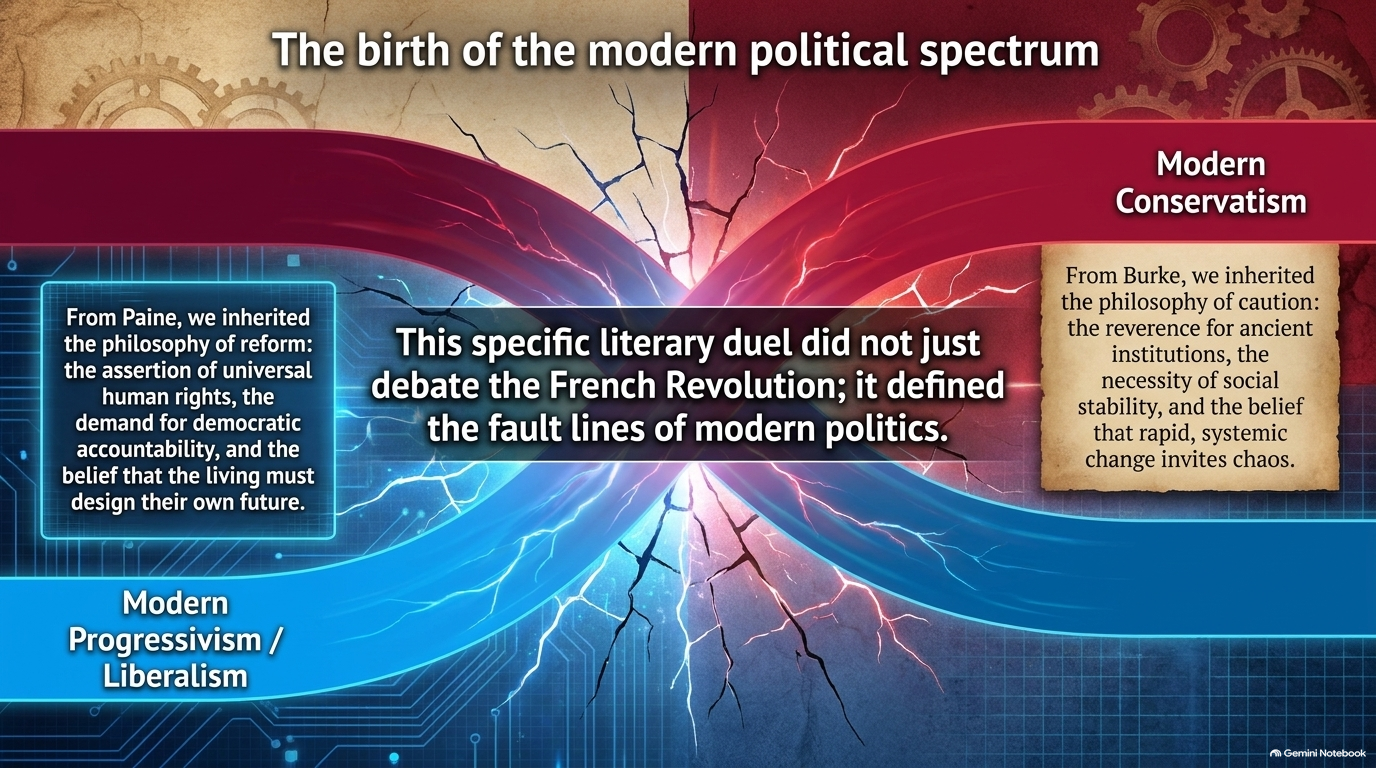
What right does a generation of people who lived over three hundred years ago have to mandate how you live your life today? In 1791, Thomas Paine posed this provocative question to the world, igniting one of the most transformative political debates in modern history. Written as a fiery response to Edmund Burke's defense of traditional monarchy, Rights of Man argued that liberty is not a gift granted by kings, but an inherent birthright of every living human being.
In this lesson, you will explore Paine's foundational political arguments, his critique of hereditary power, and his revolutionary vision for social reform.
Distinguish between natural rights and civil rights according to Thomas Paine.
Evaluate Paine's critique of Edmund Burke's defense of hereditary monarchy and parliamentary control over future generations.
Contrast written constitutions rooted in popular sovereignty with government by precedent and traditional power.
Analyze Paine's practical proposals for progressive taxation, social security, universal education, and international peace.
The Great Duel: Paine vs. Burke on the Living and the Dead
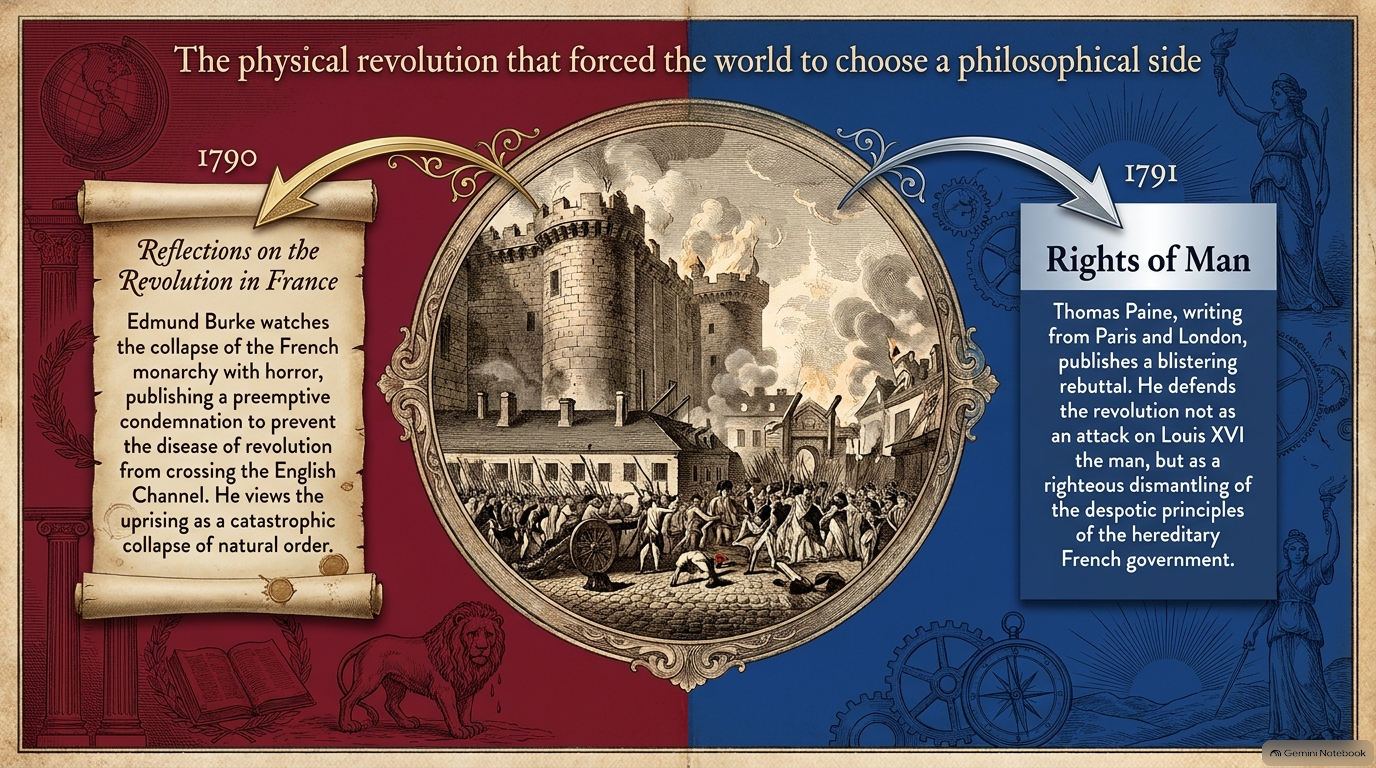
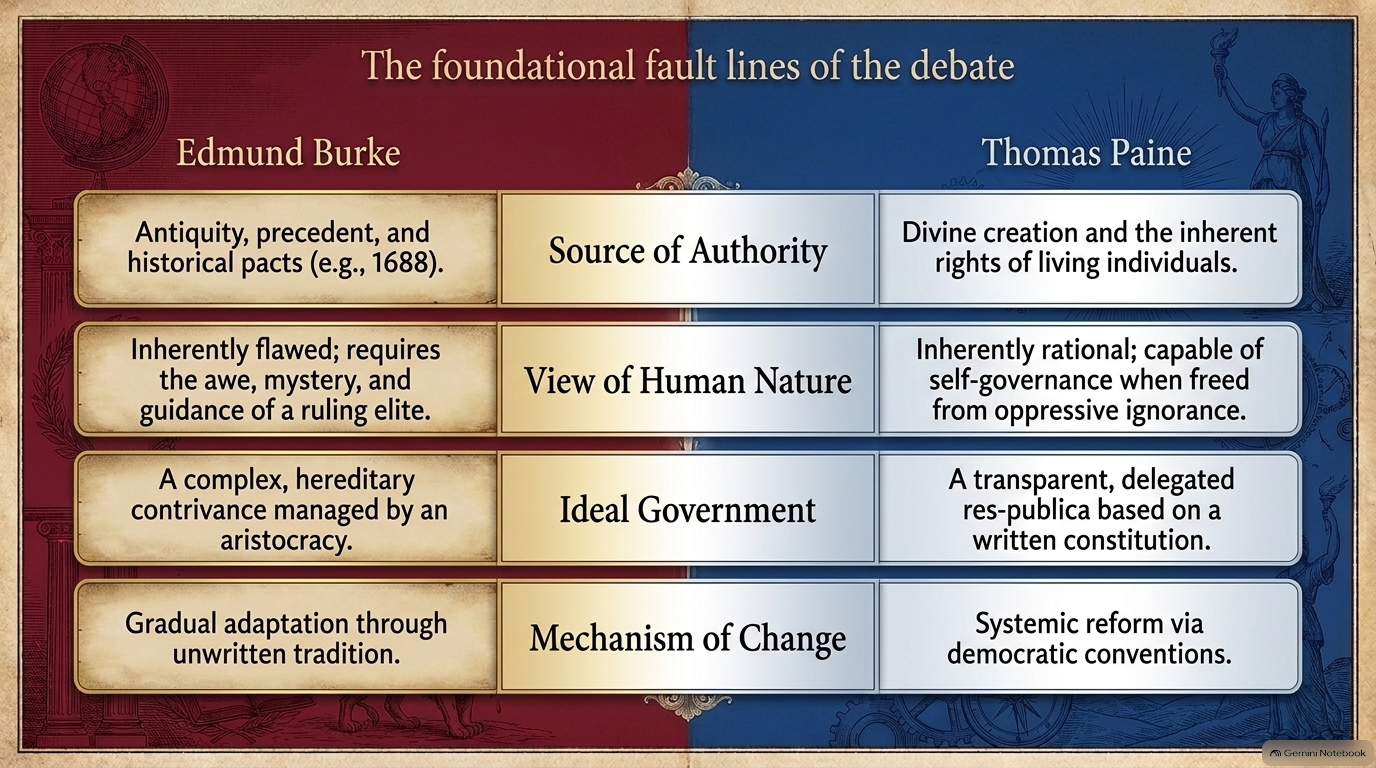
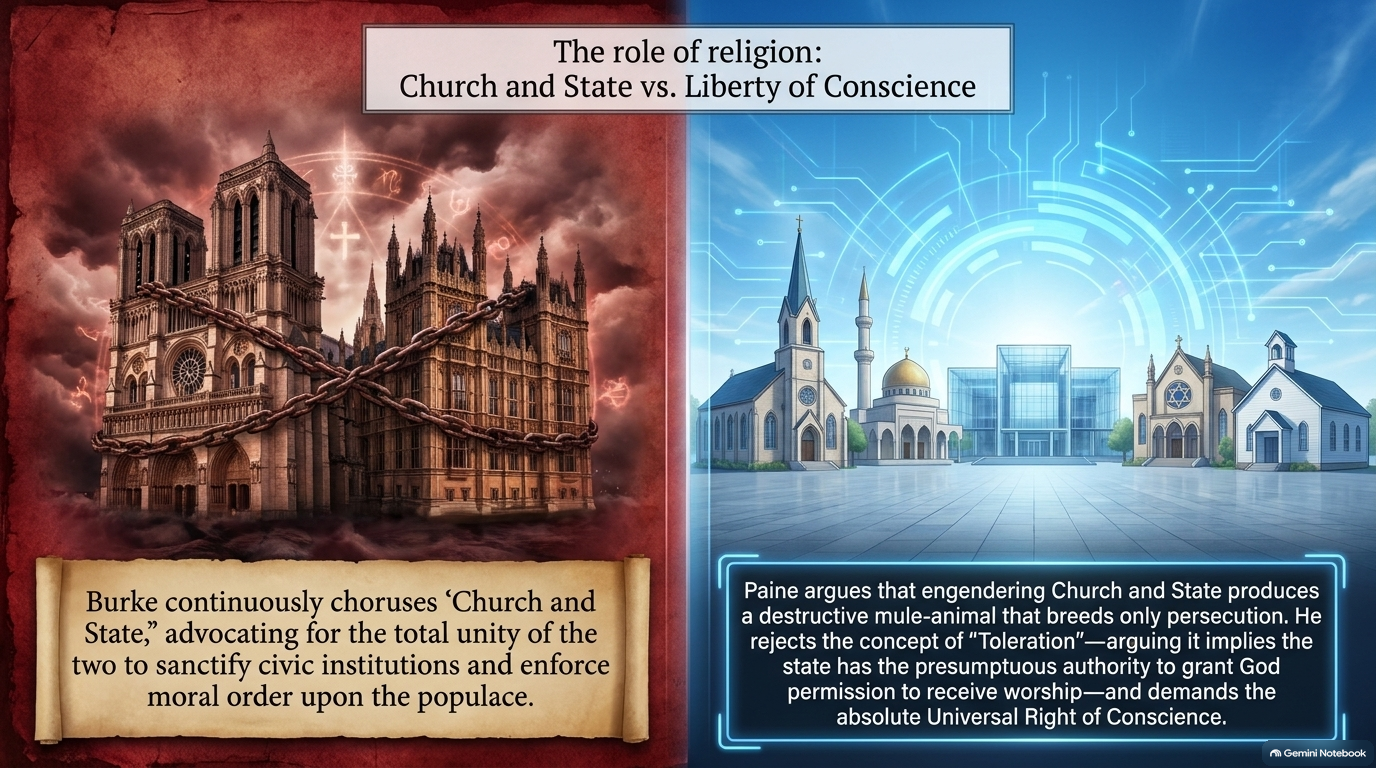
The controversy began when British statesman Edmund Burke published his Reflections on the Revolution in France (1790), scathingly attacking the French Revolution and defending traditional authority. Burke argued that the English Parliament of 1688 had solemnly bound the English people, "their heirs and posterities, forever" to submit to the Crown. To Burke, political wisdom lay in ancient tradition, hereditary succession, and established hierarchy.
Paine, writing from the Angel Inn in Islington, struck back with devastating force. He declared that no parliament, generation, or group of men has the right to bind posterity to the end of time:
> "The vanity and presumption of governing beyond the grave is the most ridiculous and insolent of all tyrannies. Man has no property in man; neither has any generation a property in the generations which are to follow."
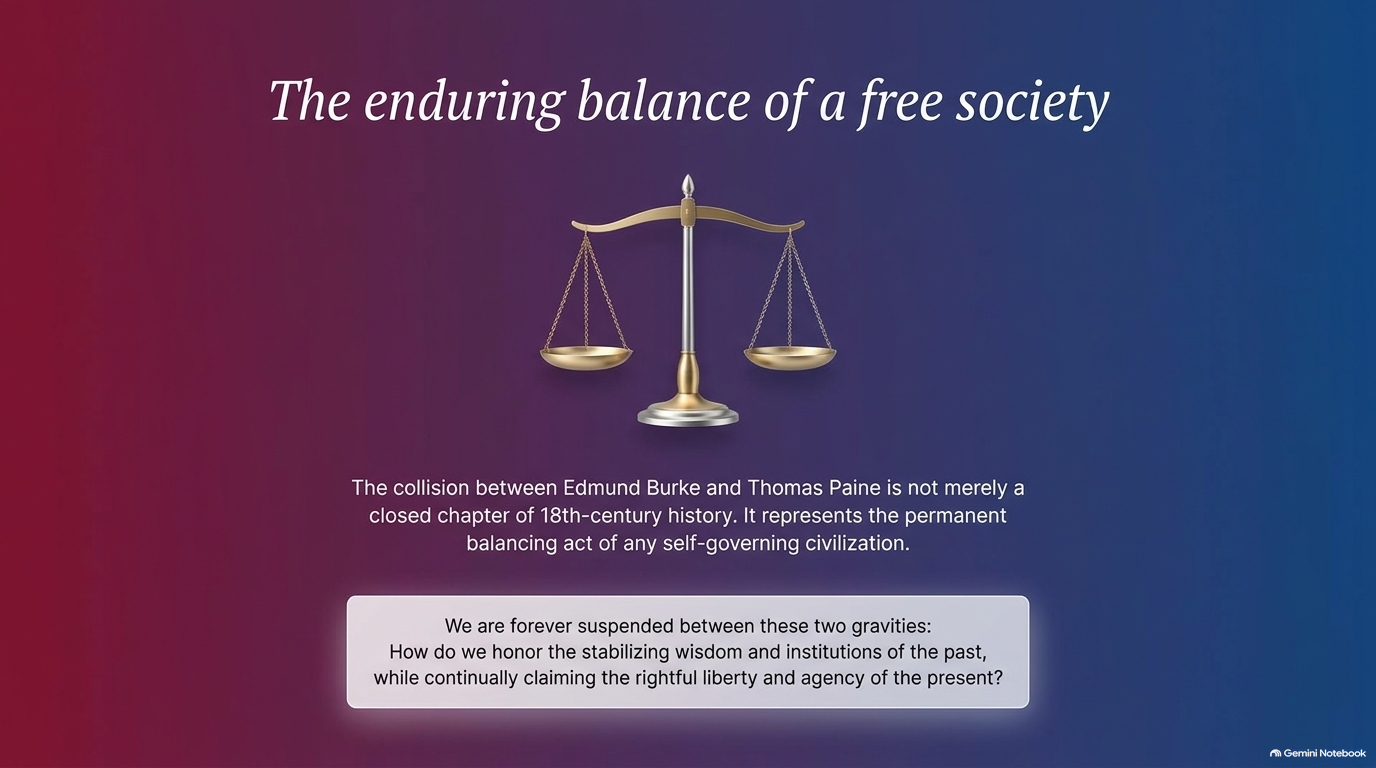
Paine insisted that every age must be free to act for itself according to its own needs. It is the living, not the dead, who must be accommodated.
Furthermore, Paine criticized Burke's dramatic grief over the fall of the French monarchy, famously observing that Burke "pities the plumage, but forgets the dying bird." While Burke wept over the lost elegance of courtly chivalry, he turned a blind eye to the millions of ordinary French citizens who had suffered under centuries of systemic despotism. Paine emphasized a crucial distinction: the French Revolution was not a riot against King Louis XVI as an individual (who was known to be a mild-mannered man), but a necessary revolt against the hereditary despotism of the monarchy itself.





Natural Rights, Civil Rights, and the True Nature of Constitutions
To understand where rights come from, Paine argues that we must look past recent centuries, past conquest, and travel all the way back to the origin of humanity itself. At creation, all human beings were brought into existence equal, deriving their baseline dignity directly from their Creator.
Paine divides human rights into two distinct categories:
Natural Rights: Rights inherent to man by virtue of his existence. These include all intellectual rights, rights of the mind, and freedom of conscience (such as religious belief). In these rights, the individual's power to execute the right is as perfect as the right itself.
Civil Rights: Rights that appertain to man by virtue of being a member of society. They grow out of natural rights where the individual's private power to enforce the right is defective. For example, a person has a natural right to judge in their own cause and seek justice, but lacks the personal strength to guarantee redress. They deposit this right into the common stock of society to gain the protective arm of the law.
What is a Constitution?
Paine demolishes the popular British notion that England possessed a true constitution. A constitution, Paine argues, is not an act of government, but of the people constituting a government. It has a real, visible existence—antecedent to government—that can be quoted article by article.
A constitution defines the limits of governmental power, election procedures, and fundamental principles.
A government operating without a written constitution created by the people is merely power without right, derived from historic usurpation or military conquest (such as the Norman Conquest of 1066).
Systems that claim Parliament is "omnipotent" or can alter its own tenure (like the English Parliament extending its term to seven years) lack a constitutional foundation, because a government cannot have the right to alter itself without becoming arbitrary.
The Absurdity of Hereditary Power and the Republican Solution
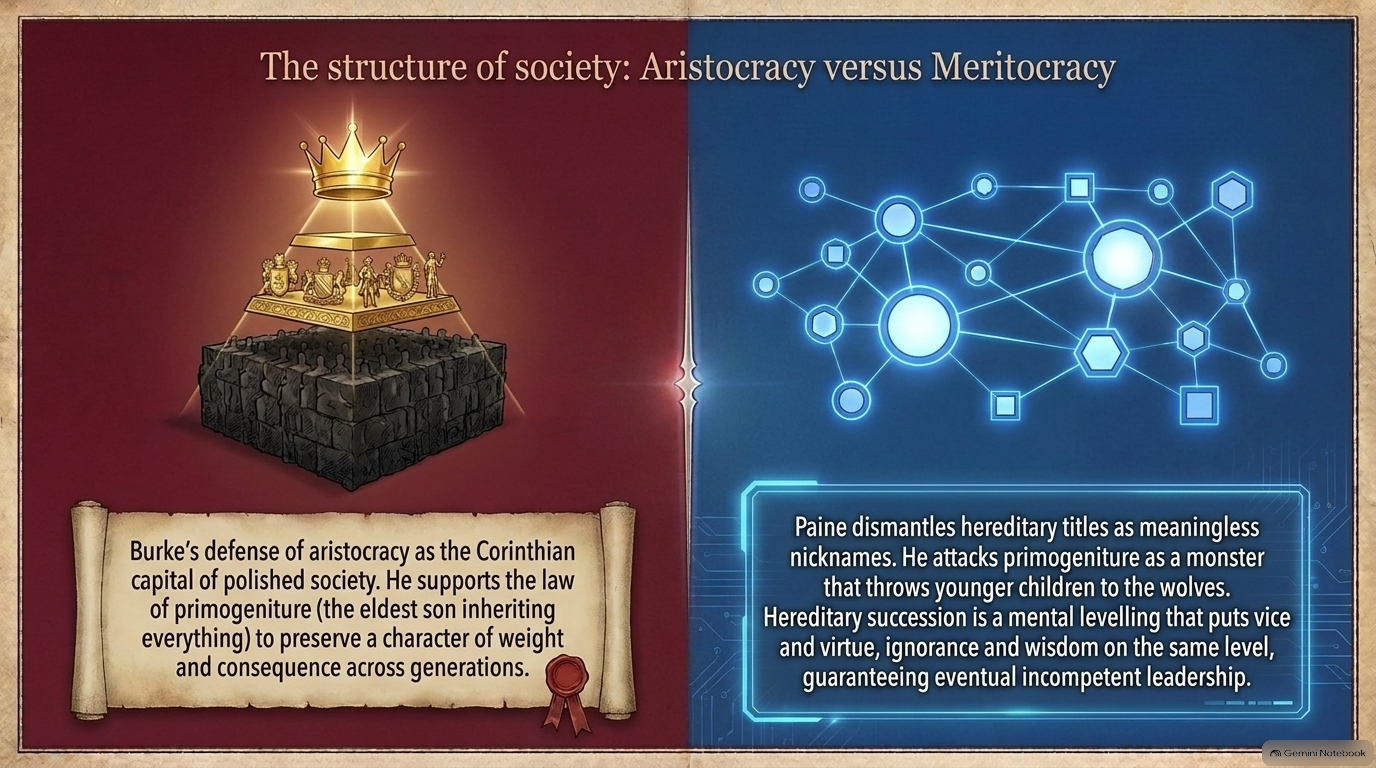
Paine unleashes his sharpest satire against the concept of hereditary monarchy and aristocracy. If government is a "contrivance of human wisdom," Paine points out a glaring paradox: wisdom cannot be made hereditary.
To drive this point home, Paine uses vivid mental models:
The Hereditary Author: Claiming a king's son is born with wisdom to govern is as absurd as claiming the son of a great poet or mathematician will automatically be an hereditary poet or mathematician.
Mental Levelling: Hereditary succession indiscriminately puts any character in power—placing infants over mature men, or idiots over wise citizens. It reduces government to an accident of birth.
The Law of Primogenitureship: Aristocracy relies on disinheriting younger children to keep vast landed estates intact for the eldest son. Paine calls this an unnatural cruelty that turns five out of six children into artificial orphans, forcing governments to create bloated administrative offices just to feed younger aristocrats at public expense.
The Representative Ideal
In place of monarchy and aristocracy, Paine advocates for representative democracy—what he calls the true Res-Publica (the public affairs/good).
While ancient Athens practiced simple democracy where all citizens gathered in one place, this model could not scale over large territories. By ingrafting representation onto democracy, society creates a center where the collective knowledge and interests of all regions meet. This representative structure remains in constant maturity—never an infant, never decrepit—and keeps government strictly accountable to the sovereign nation.
A Blueprint for Social Welfare, Progressive Taxation, and World Peace
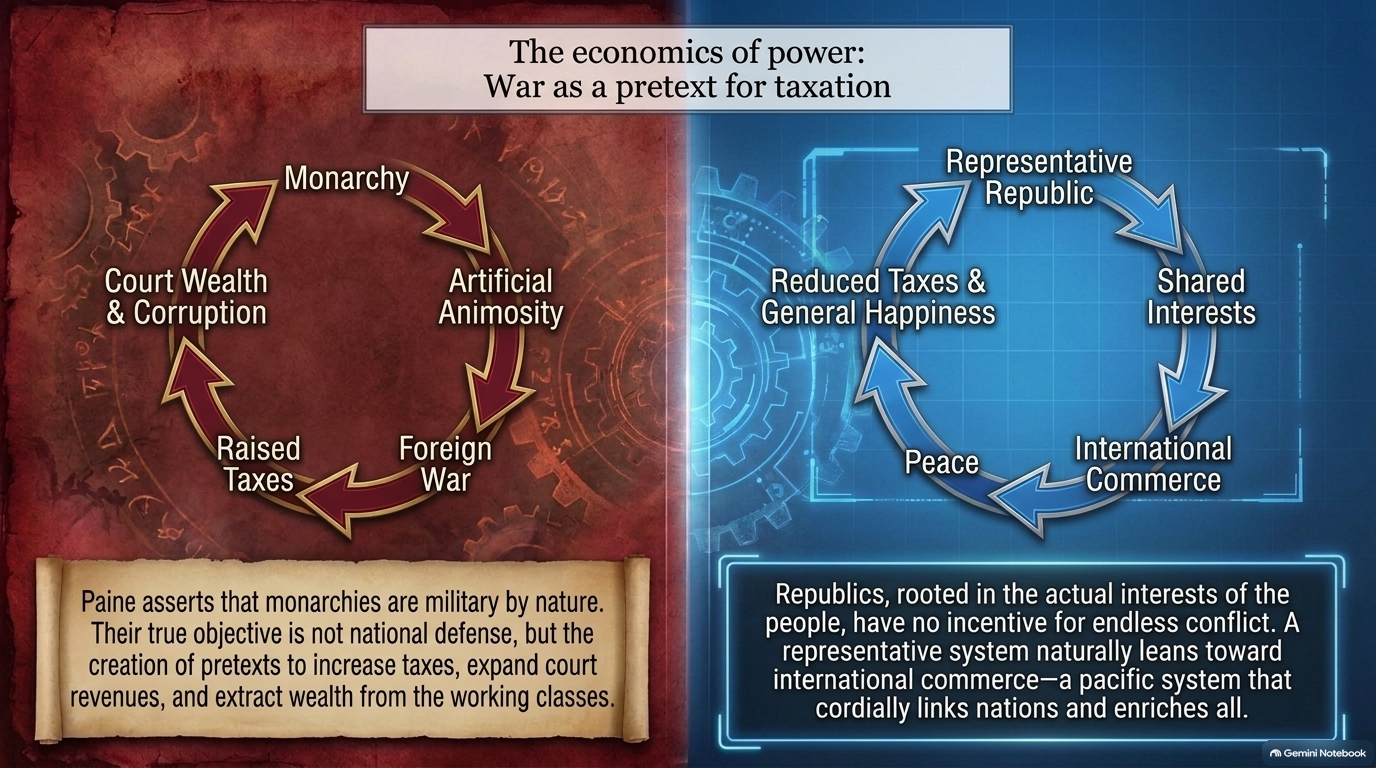
In Part Second of Rights of Man, Paine moves from abstract political theory to practical policy. He demonstrates how old governments waste vast sums of public money on foreign wars, courtly luxury, and strategic patronage, while leaving the majority of their populations in wretched poverty.
Paine argues that civil government is astonishingly inexpensive—executing local laws requires only a tiny fraction of national tax revenue. He lays out a detailed budgetary plan for England to redirect surplus tax revenue toward social welfare:
1. Universal Youth Education & Poverty Relief
Abolishing Poor-Rates: Replace county poor-rates with direct national grants out of tax surpluses.
Child Allowances: Pay £4 per year for every child under 14 to low-income families, on the strict condition that parents send their children to school to learn reading, writing, and arithmetic.
2. Old-Age Pensions
Pensions by Right: Provide an annual allowance of £6 per year to workers reaching age 50, and £10 per year after age 60. Paine emphasizes that this is not charity, but a civil right funded by the taxes workers paid throughout their working lives.
3. Progressive Estate Taxation
Ending Primogeniture: Implement a progressive tax on landed wealth. As estates grow larger, the tax rate rises step-by-step until it reaches 20 shillings in the pound (100%) on annual income above £23,000. This makes massive single-owner mega-estates unprofitable, forcing families to split land among all children and dismantling aristocratical influence.
4. International Peace & Disarmament
Ending War as Revenue: Monarchical governments profit from war because it provides pretexts for new taxes and appointments. Paine proposes an alliance between France, England, the United States, and Holland to enforce international arbitration, dismantle 90% of European naval forces, and unlock global commerce.

Summary
Thomas Paine's Rights of Man fundamentally redefined the purpose of human government, shifting it from a sacred inheritance of kings and noblemen to an accountable, representative social compact dedicated to securing individual rights and public happiness.
Posterity is Free: No generation has the right to bind future generations; each age must govern itself.
Origin of Rights: Natural rights belong to all individuals by birth, while civil rights represent natural rights deposited into society for security.
Constitutional Precedence: A real constitution is created by the people to limit and direct government, not granted by a government to control the people.
Anti-Hereditary System: Monarchy and primogeniture are irrational, unjust systems that produce political corruption and social inequality.
Humanitarian Governance: Public wealth should be redirected from foreign wars and royal luxury toward universal education, old-age security, and poverty relief.
Disclaimer:
With the access to AI reading the news, watching movies and reading books opens up a new world. I have had various family members live to the age of 100 and I ask them what have they learned from their lives and they do not have awareness of what they journey means. These two areas fit with this idea I had. Having chats with AI on topics of thought and documenting them. I call this "Thoughts in the dark".
I am aware I do not have the answers only questions.